
Continuous reports from the 2007 New Yorker Festival, by the Emdashes staff and special guest correspondents.
“Is there such a thing as insanity among penguins?†Werner Herzog poses this question to a taciturn biologist seated before an Antarctic field full of the flightless birds. Before the perplexed scientist can fully answer, Herzog cuts to a shot of a lone penguin who suddenly decides to make a dash for the distant mountains. As the shot widens to reveal a desolate, white world dotted by a mad penguin, Herzog, in his familiar solemn narration, asks “But why?†and then informs us that this penguin is certain to meet death.
The scene, from Herzog’s newest film, Encounters at the End of the World, invoked both wonder and laughter from the audience during Saturday night’s screening. Sitting in the row in front of the director, I turned to register the reaction of the German genius to the round of gasps and chuckles. I was curious to see if he would be put off by the reaction. Indeed, the edges of Werner’s lips crept ever so slightly up into a smile.
Billed as a documentary about Antarctica, Encounters is certainly unlike anything else I have ever seen about the frozen continent. Neither a homage to the wonders of the outdoors nor a call to arms to protect our endangered environment, it’s ultimately a dark and existential film. It’s vintage Herzog, who is ever interested in the people who choose to put themselves in the middle of the brutal, unpredictable chaos we call nature. In many ways it picks up where Grizzly Man left off, but instead of focusing on a bear-lover who answered the call of the wild, Herzog spends time with the scientists and lab techs, the fork lifters and mechanics who call Antarctica home.
All the characters, including Herzog, seem to share a Wanderlust. But Herzog is out to debunk the myth of Antarctica as an unspoiled, pristine frontier. Instead he proclaims “the end of adventure.†For an artist who has focused so much energy on studying explorers, the film exudes a deep sense of loss. While the film is something of an elegy, it’s not depressing. In fact, it’s mesmerizing, because Herzog is one of the few artists who can make a compelling film that, to me, is also a profound philosophical discourse.
What is perhaps most surprising is that Herzog’s newest masterpiece will be shown on the Discovery Channel. I am curious to know how it will translate to the small screen, possibly disrupted by commercial breaks. I only wish I could see people’s reactions when they turn on the tube to catch a rerun of Cash Cab or Dirty Jobs, but instead see an extended shot of a man crawling through an ice tunnel and hear an ominous, heavily accented voice state, without a trace of alarm, that “the end of human life is assured.â€
March of the Penguins this certainly is not.
More on the film and the post-screening discussion to come. —Toby Gardner
Author Archives: Toby
Deviant Matters: A. M. Homes and Miranda July
Continuous reports from the 2007 New Yorker Festival, by the Emdashes staff and special guest correspondents.
One of my favorite moments from Friday night’s conversation on deviants between Miranda July and A. M. Homes occurred at the very start. After Homes opened rather seriously by proclaiming that we are all deviants, July squirmed slightly in her chair, turned to Homes seated far across the stage and shyly said, “Um, yeah. I pictured us closer together.†The large audience, generally young and solidly hipster in style, exploded in laughter and, just like that, the tone for the evening was set. Perhaps the physical distance (see photo) partly accounted for the lack of sustained engagement between Homes and July. More likely, it had to do with the two artists’ approaches. While Homes the writer and July the performer never seemed to click entirely, the juxtaposition made for an entertaining evening accented by insights into the unique approaches of each artist.
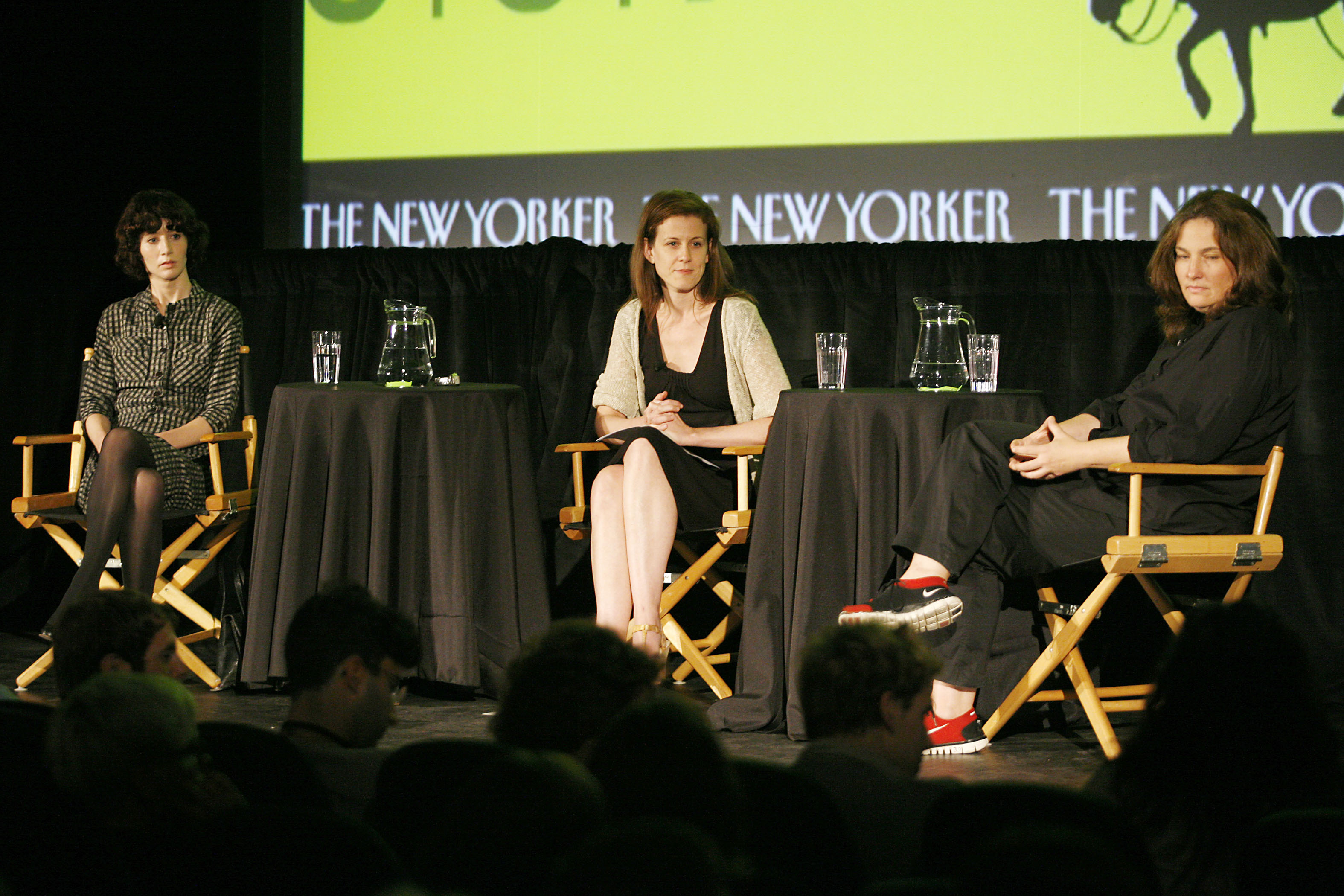
The fun was no more evident than when July attempted to engage the audience in a trivia contest about Homes’s work. What she thought would be a fun little activity quickly turned humorously awkward. Her first two questions on rather obscure details from Homes’s work were not only met by the audience’s collective silence but also seemed to stump Homes herself. A slightly flummoxed July lightened the mood, timidly saying that she now realized that “no one reads like this unless they’re writing trivia questions.†Homes, who seemed a bit uncomfortable with the whole situation, suggested that the questions should be about July’s more popular film. July asked one final question about a character’s nickname from Homes’s recent memoir, someone thankfully knew the answer was “Dragon Lady,†and order was restored. (The prize? Two well-earned Festival tickets to Saturday’s debate on the Ivy League. )
Oh wait, wasn’t this talk supposed to be about deviants? Despite moderator Carin Besser’s efforts, the conversation weaved in and out of the topic. It turned out to be more of a springboard into some of Homes and July’s fascinating insights into their motivations as artists. Homes spoke about the joy of inhabiting brains other than her own. Beyond sheer pleasure, this act of distancing is actually what enables her to write fiction. She indicated that occupying the mind of a pedophile, as she did in her book The End of Alice, in some sense was easier than simply drawing on personal experience. At the same time, she acknowledged the difficulties of fully stepping outside oneself and spoke of “the inescapability of the artist’s mark.†At one point, after some pauses and false starts, July summarized her artistic intention beautifully, saying she tries to get to the place where mystery is supposed to make sense. She added that, in her work, she is “going beyond getting to have it be correct.â€
The evening became even more intriguing when the subject turned to pen pals. Homes and July have each been correspondents with some rather interesting characters. While Homes had communicated with the likes of Pete Townshend and filmmaker John Sayles (who, in one letter, apparently advised the college-aged Homes to suffocate an annoying roommate with a pillow), July maintained a multi-year correspondence with a convicted murderer (July said he will be released in 2012). With her typical sensitivity and humor, she said, “I was lucky, he was a good guy.â€
Next year’s panel recommendation: John Sayles on deviants. —Toby Gardner
Joining the Coalition of the Willing: Greetings From Our Roving Correspondents
Martin and I will be reporting from the New Yorker Festival throughout the weekend, so look for our frequent reports! In the meantime, there are a few other people we’d like you to meet. —E.G.
Toby Gardner: With the New Yorker Festival upon us and so many events scattered across the city, the Emdashes Powers That Be (EPTB) saw the need for a new strategy: the Pepper Mill, whereby several correspondents are sprinkled throughout the proceedings like so many flavor-enhancing spices. And I am one of their new recruits. I hope I get called up for tonight’s chat between Miranda July and A.M. Homes on Deviants. There’s also a Town Hall meeting about the war in Iraq, but how relevant is that, really?
Although EPTB offered to pay off my student loans in exchange for my services, I said that really wouldn’t be necessary. [While we’re at it, we really should pay off ours, too. —Ed.] The honor to help cover this exciting festival is payment enough. So if you see a bald guy with a Mac G4 and a winning attitude, say hello. I’ll be working hard to make ensure that Operation Pepper Mill is a success.
Quin Browne will be covering a couple of events for Emdashes this weekend. She was born in New Orleans under one name, and writes in New York under this one. Blatherings about this and that can be found at www.fmdn.blogspot.com; actual shorts are located under her name at www.sixsentences.blogspot.com.
Tiffany De Vos‘s name and musical tastes owe much to the ’80s. She is a poet, pet chinchilla enthusiast, and teacher. Her stories and poems have appeared in Pedestal, The Saint Ann’s Review, Washington Square, Small Spiral Notebook, and the Global City Review. Her hair often falls over her right eye, but she is by no means a hipster.