
Friendly Nation intern (from my time there in the ’90s) Lizzy Ratner had a big story in the Observer earlier this week on the persistent racial imbalance at various magazines, including The New Yorker, the rest of Condé Nast, The Nation, and many others.
Category Archives: Headline Shooter
Pants on Frey-er
From Chris Lehmann’s Slate review of A Million Little Pieces (April 21, 2003):
Frey wants to offer a corrective to what he sees as the pieties (and possibility) of recovery—and to grant us an unvarnished glimpse of the gritty junky life. When a recovered rock star lectures his ward at Hazelden, Frey thinks to himself, “The life of the Addict is always the same…. There is no future and no escape. There is only an obsession…. To make light of it, brag about it, or revel in the mock glory of it is not in any way, shape or form related to its truth, and that is all that matters, the truth.”
This equation of “the truth” with the junky world’s degradations is the corollary of Frey’s view that all recovery theology is falsely comforting bullshit. It’s also what has already won the book praise from critics like John Homans, in New York, who marvels at Frey’s textbook-rebel penchant for “confronting the powers that be and winning every time.” But there’s nothing new or compelling (let alone heroic) about this pose: It is, in many ways, the classic arc of the genre Frey claims he’s boldly renovated—the conversion memoir. From St. Augustine to Rousseau to Dave Eggers and Elizabeth Wurtzel, readers of memoirs are invited to marvel at the incorrigible badness of a narrator as a sort of trust-exercise: Surely someone who conceals so little of their unpleasant behavior can’t be lying.
Assuming Chris stands behind his 2003 review (if he’s changed his mind, I’ll eat my laptop), I’m sure he’s delighted to be taking the side Oprah isn’t. Interestingly, in light of the current fur flying in Freyland, he ends his review:
[In A Fan’s Notes, Frederick] Exley also denied himself the cheap consolation of romanticizing his afflictions: He took everything about his life seriously and himself not seriously at all. Most of all, he knew a life’s story could never be squared with something as stark and unequivocal as “the truth”—whether or not the truth was all that mattered. That’s a saving wisdom all its own, even if it won’t fit onto a tattoo.
What about BoB?

Hooray! Emdashes is a finalist in the Best of Blogs awards this year, in the Best Book/Literary Blog category. I can’t think of a better one-year birthday present. Voting ends soon, so look for the form on BoB (I can’t seem to find it, but I’ll link when I do; here it is). Here are the rules:
On January 10 we will publish the finalists, and provide a form for voting online for the fan’s choice.
The fans will vote on a blogger and the resulting vote will count as a percentage of the overall vote to be put forth by the jury panel. Popular vote will only be a small portion of the overall decision making process, but it will allow some participation on behalf of the blog reading public.
All winners will be announced on January 30, 2006. (That’s when voting ends, too.)
I feel so Felicity Huffman right now. In every sense possible.
Later: The other blogs in my category rock. I’ll be happy when any one of them wins, for real. Don’t miss this second-by-second account of the Golden Globes by Sheila of The Sheila Variations; it’s sidesplittingly good. Anyone who puts a Gibson Girl at the top of her blog is OK in my…book.
Grant Residency To Yiyun Li: Hartford Courant
The frustrating case of the Chinese writer who can’t get a break:
The accomplishments of Yiyun Li, a Chinese national now living in California, are extraordinary. Enough to support her bid for permanent residency in the United States and then some. So far, however, Ms. Li’s greatest challenge seems to lie in persuading the federal bureaucracy.
A native of Beijing, Ms. Li, 33, came to this country in pursuit of a graduate degree in immunology. She enrolled at the University of Iowa, where she signed up for an adult-education class in writing.
Something happened. In English, Ms. Li discovered a medium for expressing ideas and emotions inaccessible to her native tongue. Chinese, she said, has become too riddled by habits of repression and secrecy to provide a clear voice.
Ms. Li set aside her goal of a doctorate in immunology. Instead, she enrolled in the prestigious Iowa Writers’ Workshop, where she earned master’s degrees in fiction and creative nonfiction.
Today she teaches at Mills College in Oakland, Calif., where she has accepted a tenure-track position. She has had stories published in The New Yorker and Paris Review. Her first book, “A Thousand Years of Good Prayers,” a collection of short stories, attracted strong critical acclaim. In September, “A Thousand Years of Good Prayers” won the Frank O’Connor International Short Story Award.
Ms. Li holds a temporary visa to live in the United States. She wants to become a permanent resident. Her application to the U.S. Citizenship and Immigration Services in August 2004 had to convince authorities that she was an artist of “extraordinary ability.” She submitted testimonials from some of the world’s most prominent literati, including novelist Salman Rushdie, New Yorker magazine editor David Remnick and novelist Elinor Lipman.
Somehow, immigration authorities weren’t impressed; they rejected Ms. Li’s application, dismissing it as “not persuasive.” She is appealing.
Clearly, she’s an extraordinary candidate.
(Links by me.)
Why can’t you behave?
Gawker tells us today that Bill O’Reilly has blacklisted The New Yorker for having “regularly helped distribute defamation and false information supplied by far left websites.” I’m sure this will make an awful dent in circulation. Also, websites? You know, Bill, fact-checking is a science. You might try it.
Guilty pleasures: Gladwell, Kunkel, Sittenfeld &c. tell you what to read
From the Journal News, where you can read the whole list. Here’s their introduction and my highlights, all of which have a New Yorker connection of one kind or another. Not in original order; links and boldfacings (?) are mine.
It’s the time of year when a great book recommendation can make the difference between spending hours at the packed Barnes & Noble, or coming home with the perfect gift. So for the third straight year, we went for the best recommendations of all, and queried the authors of more than 50 of our favorite books of 2005, asking them to write about something they loved this year. The consensus pick is both a best seller and a National Book Award-winner, Joan Didion’s “The Year of Magical Thinking.” But there are plenty of surprises, as well. Nick Hornby picked a terrific thriller for the genre-fiction lover on your list. Curtis Sittenfeld, whose debut “Prep” was carried around by the hipster set this year like “The Catcher in the Rye,” offers up a memoir, also largely set in private schools, for the college-aged. Another buzzed-about first novelist, meanwhile, Ben Kunkel, urges readers to check out the latest story collection by an aging American master. And the recommendations don’t stop there—we have picks from writers of fantasy, Iraq memoirs, presidential biographies, cultural histories of race relations, chick-lit [note: Let’s ban this term for 2006, shall we?], American history, and much more. Let this be the year of no gift certificates.
Curtis Sittenfeld [“Prep”]
I absolutely loved Sean Wilsey’s memoir “Oh the Glory of It All” (Penguin). It’s about his parents’ rich messy San Francisco divorce, his horrible stepmother, his misadventures at multiple boarding schools, and his wonderfully bizarre world travels as part of a coalition of children promoting peace. Alternately hilarious and heartbreaking, it contains pretty much everything you could possibly want in a book.Kaui Hart Hemmings, “House of Thieves†(Penguin)
My favorite book of 2005 was Sean Wilsey’s “Oh The Glory of it All” (Penguin). There were no reins on this thing and it absolutely soared. Money, sex, adolescence, familial cruelty, and skateboarding—he brilliantly shoved me into my favorite kind of territory. The entire book was a big shout to the people he loves so much despite it all. In a word: it ruled.TC Boyle, “Tooth and Claw†(Viking)
I read and loved a whole truckload of things this year, including Annie Proulx’s “Bad Dirt,” Bob Dylan’s “Chronicles,” and Tom Wolfe’s “I Am Charlotte Simmons,” but the one that really put a scare and a thrill into me was Alan Burdick’s “Out of Eden: An Odyssey of Ecological Invasion” (FSG). The chapters about the brown tree snake’s invasion of Guam are unparalleled. I also had fun with Elizabeth Royte’s “Garbage Land” (Little, Brown) (where does all that stuff go?) and Mary Roach’s “Stiff” (WW Norton), which tells in vomit-inducing detail what becomes of our corporeal selves after death. It so shook me that I’ve decided not to die.Bret Easton Ellis, “Lunar Park†(Knopf)
My favorite book of the year—no surprise—was Joan Didion’s “The Year of Magical Thinking” (Knopf). It’s her most accessible, direct and emotional writing and I read it in one sitting, shaking. On the other side: Dennis Cooper’s “The Sluts” (Carroll & Graf) was hugely satisfying and as addictive as anything he’s ever written. It’s not only a deeply compelling murder mystery but also a grand summation of all of Cooper’s great themes. Not for the faint-hearted, but genius. I also liked Jonathan Safran Foer’s 9/11 novel, “Extremely Loud and Incredibly Close” (Houghton Mifflin). He pulled off something incredibly difficult with a grace and ease that amazed and moved me.Malcolm Gladwell [the universe]
I have a guilty pleasure. I love Lee Child, and “One Shot” (Delacorte) was probably my favorite book of the year. There is something about Jack Reacher—hard-boiled, taciturn, repressed, man-of-quiet-violence Jack Reacher—that is utterly irresistible to me. Does it matter that every Lee Child book is basically the same? Not at all. It’s like complaining that ordering the same thing on the menu twice in a row at Le Cirque is a problem.Elizabeth Crane, “All This Heavenly Glory†(Little, Brown)
“Simplify” (University of Illinois Press) by Tod Goldberg is lovely and odd; “The Diviners” (Little, Brown) by Rick Moody is perfect; “Hairstyles of the Damned” (Akashic Books) by Joe Meno rocks; “Encyclopedia of an Ordinary Life” (Crown) by Amy Krouse Rosenthal is not ordinary at all; “The Brief and Frightening Reign of Phil” by George Saunders (Riverhead) is brief and hilarious and not at all frightening; and “Men and Cartoons” (Doubleday) by Jonathan Lethem features suicidal sheep. Why would you want more than that?Myla Goldberg, “Wickett’s Remedy†(Doubleday)
Tim Kreider’s “Why Do They Kill Me?” (Fantagraphics) is a fearless collection of dark, irreverent, and seriously funny political cartoons that acts a welcome salve for anyone who didn’t vote for the man currently inhabiting the White House.Nick Hornby, “A Long Way Down†(Riverhead)
One of the novels I’ve most enjoyed this year was Jess Walter’s “Citizen Vince” (HarperCollins), which is in part a thriller about voting—it’s 1980, and Vince is a petty crook who’s been placed in a witness protection program in Spokane. He is about to exercise his democratic right for the first time. Carter or Reagan? Vince hardly has the time to decide, because someone wants to kill him. This terrific book, a small-town “Mean Streets,” is smart, funny, dark and moving, and Walter is clearly a writer to watch.Nicole Krauss, “The History of Love†(WW Norton)
“The Old Child & Other Stories” (New Directions) by Jenny Erpenbeck. Erpenbeck was born in East Berlin in 1967, and she arrives here translated flawlessly by Susan Bernofsky. The title novella, “The Old Child,” describes the stark economy and mystical landscape of a homeless girl’s interior life as she tries to survive in a children’s home where she’s been placed by the police. In this and Erpenbeck’s stories, the brutality of her subjects combined with the fierce intelligence and tenderness at work behind her restrained, unvarnished prose is overwhelming. I haven’t read anything this good—this bracing, unflinching, and alive—for a long time.Ben Kunkel, “Indecision†(Random House)
I’m always grateful whenever there’s something new by James Salter. This year he published “Last Night” (Knopf), a story collection. I especially like Salter’s slightly curdled romanticism, and his style that’s so casual and lapidary at once. In his stories, he creates an effect of the tremendous offhandedness of fate.Elizabeth McKensie, “Stop That Girl†(Random House)
Everything by Haruki Murakami fills me with awe and excitement and “Kafka on the Shore” (Knopf) was no exception. Maybe all the more so because he keeps getting better, even when that seems impossible. His stuff seems to spring from somewhere betwe
en the deepest mysteries of the collective unconscious and breakfast. I love him as a writer—and maybe as a man.Rick Moody, “The Diviners†(Little, Brown)
A first novel I really loved recently was “Misfortune” (Little, Brown) by Wesley Stace. It’s a sort of a grand 19th-century yarn in which the narrator is first a boy and later a girl and then a boy again, and there are evil relatives who appropriate a castle that doesn’t belong to them, and there is much singing of ballads, etc. I read it with great excitement, astonished by its verve and sense of literary history, and this is all made even more impressive because the author is also a singer-songwriter of considerable note, who performs under the name John Wesley Harding. Apparently this is what he’s able to do on the side.Scott Turow, “Ordinary Heroes†(FSG)
I loved Benjamin Kunkel’s “Indecision” (Random House) about a 28-year-old who truly needs to get a life. It is touching but very funny, even zany at moments, and is crafted with an original voice.Meg Wolitzer, “The Position†(Scribner)
The book I loved this year was Kazuo Ishiguro’s “Never Let Me Go” (Knopf). I was less interested in its dystopianism than in its vision of repression and its consequences on people’s lives. Ishiguro does repression better than anyone; he did it so memorably with his butler narrator in “The Remains of the Day,” and he does it equally affectingly here, with his cloned narrator, Kath. (I’m obviously not one of those people who feels the need to write “spoiler alert!” before giving away information about a book’s plot.) What this heartbreaking and original book gives us is an approximation of human life. Ishiguro is a writer whose characters are sometimes afraid, and sometimes not fully alive, and so Ishiguro needs to be unafraid and alive for them. This is a little masterpiece.
Irish guys, gals smiling
From the Times o’ London report on the U.K.’s first gay “civil partnership”:
BELFAST scored a first yesterday — but delivered it with the unmistakable imprimatur of Northern Ireland — when a lesbian couple became the United Kingdom’s first participants in a civil partnership ceremony as the native Old Testament tendency howled its dismay.
…
Northern Ireland was first because the registration period is shorter. Henry Kane and Christopher Flanagan, who arrived at City Hall in a pink stretch limousine shortly after Ms Sickels and Ms Close departed, became the first male gay couple to form a civil partnership.But Northern Ireland’s fundamentalist streak ensured that the “Save Ulster from Sodomy†brigade — mostly members of the Rev Ian Paisley’s Free Presbyterian Church — were outside singing hymns and hurling abuse such as “sodomy is a sinâ€, “you’re going to Hell†and “filth, filth, filthâ€.
Happily for the couple on their big day a counter-demonstration soon formed, with humour as its main weapon. Two satirical interlopers infiltrated the anti-gay ranks wearing garish sports jackets and toothbrush moustaches but no trousers, carrying their own placards as an antidote to the religious tracts being paraded in Donegall Square.
These read “Bring back slavery†and “Earth is flatâ€. There was so much laughter that even the moral indignation of the Christian fundamentalists seemed on the verge of giggles. At times it seemed that the excitement generated by the first occasion on which a same-sex couple could legally commit themselves to one another would descend into a punch-up. That it did not perhaps speaks volumes about how much this once dourly Presbyterian city, where playground swings used to be chained up on Sundays, has changed.
…
But among the guests Brenda Murphy and partner Nuala Quiery decided they were not going to be intimidated and they proudly joined friends and family through the front entrance. “You need to repent, love,†cried James Dowson, of the Christian Reform Foundation, who mistook Ms Murphy and her friend as the happy couple. “You are marrying this other lady, and that’s a sin.â€â€œYou’d be so lucky to have this lady, mate,†she replied.
Brokeback Mountain of Sith
This has been around a while now, but I just saw it resurface on Technorati via Digital Theatre—someone’s re-edit of the Revenge of the Sith trailer. Hey presto! Romance of the Jedi, a thwarted Brokeback world kind of romance.
Risking Outside Scoop-iness
Yes, everyone’s talking about the Ken Auletta piece.
Original “Brokeback Mountain” Online
Recently posted to the magazine’s website: Annie Proulx’s October 13, 1997, short story, which inspired the film. (Update: The magazine’s taken down the link. Copyright conflicts? Profits to be generated from sales of the story-to-screenplay mini-book? But a commenter saved the day—the link above is now to Outspoken Clothing, which is bravely hosting the story itself. Thanks, commenter and host!) Proulx talks about writing it in the L.A. Times:
Proulx, 70, in town recently for the premiere of Ang Lee’s film adaptation of “Brokeback Mountain,” says that while she was “blown away” by the movie, she doesn’t welcome the return of Ennis and Jack to the forefront of her consciousness.
“Put yourself in my place,” the author says. “An elderly, white, straight female, trying to write about two 19-year-old gay kids in 1963. What kind of imaginative leap do you think was necessary? Profound, extreme, large. To get into those guys’ heads and actions took a lot of 16-hour days, and never thinking about anything else and living a zombie life. That’s what I had to do. I really needed an exorcist to get rid of those characters. And they roared back when I saw the film.”
The story bubbled forth from “years and years of observation and subliminal taking in of rural homophobia,” says Proulx, whose Pulitzer Prize-winning novel, “The Shipping News,” was also adapted for the screen. She remembers the moment when those years of observed hatred began taking form. It was 1995 and Proulx, who lives in Wyoming, visited a crowded bar near the Montana border. The place was rowdy and packed with attractive women, everyone was drinking, and the energy was high.
“There was the smell of sex in the air,” Proulx remembers. “But here was this old shabby-looking guy…. watching the guys playing pool. He had a raw hunger in his eyes that made me wonder if he were country gay. I wondered, ‘What would’ve he been like when he was younger?’ Then he disappeared, and in his place appeared Ennis. And then Jack. You can’t have Ennis without Jack.”
Proulx didn’t think her story would ever be published. The material felt too risky; Ennis and Jack express their love with as much physical gusto as any heterosexual couple, and it happens in full view of the reader, without any nervous obfuscation. The backdrop is that wide expansive West that bore forth John Wayne and the Marlboro Man — but here the edges of the mythos fray, and the world becomes chilly and oppressive.
The story was published in the New Yorker magazine in 1997, and screenwriter Diana Ossana read it one night when she couldn’t sleep.”It just floored me,” Ossana says, speaking after a screening of “Brokeback Mountain.” She ran downstairs to show it to her writing partner, who happens to be Larry McMurtry (“The Last Picture Show,” “Lonesome Dove”) and suggested they turn it into a screenplay.
…
The movie, like the story, does not pull any punches. The sex is just as graphic, the critique of rural homophobia just as angst-ridden and raw. Proulx doesn’t pretend to know how the movie will play with audiences, but she likes that her message will be broadcast through such a popular medium.“There are a lot of people who see movies who do not read,” Proulx says. “It used to be that writing and architecture were the main carriers, permanent carriers, of culture and civilization. Now you have to add film to that list, because film is the vehicle of cultural transmission of our time. It would be insane to say otherwise, to say that the book is still the thing. It isn’t.”
In the Southern Voice, more about the hard ride between story and screenplay:
“I recognized immediately that this was a story that was a work of genius,” says McMurtry…”And I wondered, why didn’t I write it? I’ve been there in the West my whole life.”
Before the end of the year, the two had optioned Proulx’s short story with their own money, but waited in vain as directors and stars came and went on the project. Gay filmmaker Gus Van Sant was attached for a while, as was fellow gay auteur Joel Schumacher.
Actors who saw the screenplay would tell Ossana it was the most beautiful script that they’d ever read but then, a few months later, would strangely distance themselves from the project…. Continued.
Update: There’s a good, concise history of gay material in movies in the SF Chronicle. If you still haven’t seen The Celluloid Closet, rent it–it’s so entertaining as well as true, right, informative, etc. One of the best bits is when Tom Hanks says something like, “I don’t exactly walk into a room and intimidate people. So when I’m cast as a gay man with AIDS, people are like, ‘Aw, look, it’s little Tommy Hanks! That’s not scary.’ ” It made me sorta like him again. Susan Sarandon is also, of course, great: “You wouldn’t have to get drunk to bed Catherine Deneuve, I don’t care what your sexual history to that point had been.”
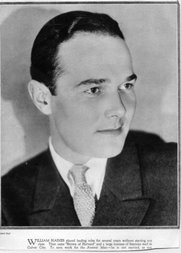
And I really hope someone’s working on a screenplay from William Mann’s riveting and galling Wisecracker: The Life and Times of William Haines, Hollywood’s First Openly Gay Star, a biography of the forgotten early-film headliner (pictured above). When the book was published, Film Forum showed a week’s worth of Haines’ movies (silent and talkies–he made the transition with panache), and I’m telling you, they were great. He used to get top billing over Joan Crawford! Maybe now’s the time to do this stylish, audacious, history-correcting story, especially with Tab Hunter coming out and all. ( I met a savvy, award-winning screenwriter named J. T. O’Neal at the movies recently; I bet he could do it.) Think of the hot actors who’ll run for the part, now that they see how it’s done.
Update update: Isn’t the wording interesting throughout this Catholic News Service review of Brokeback Mountain?
As the Catholic Church makes a distinction between homosexual orientation and activity, Ennis and Jack’s continuing physical relationship is morally problematic.
The adulterous nature of their affair is another hot-button issue. But the pain Jack and Ennis cause their families is not whitewashed. (The women are played with tremendous sympathy, not as shrill harridans.) It’s the emotional honesty of the story overall, and the portrayal of an unresolved relationship — which, by the way, ends in tragedy — that seems paramount.
Director Ang Lee tells the story with a sure sense of time and place, and presents the narrative in a way that is more palatable than would have been thought possible.
…
Looked at from the point of view of the need for love which everyone feels but few people can articulate, the plight of these guys is easy to understand while their way of dealing with it is likely to surprise and shock an audience.Except for the initial sex scene, and brief bedroom encounters between the men and their (bare breasted) wives, there’s no sexually related nudity. Some outdoor shots of the men washing themselves and skinny-dipping are side-view, long-shot or out-of-focus images.
While the actions taken by Ennis and Jack cannot be endorsed, the universal themes of love and loss ring true.
Update update update: More on Proulx, Lee, Ossana, McMurtry, and the story’s journey to the screen, in the Austin American-Statesman (originally in the Denver Post).
Update x 4 for you lovely googlers: Read the always brilliant James Wolcott on bloggers who protest too much and “the genteel homophobia hovering behind the he-man hand-fluttering about Brokeback Mountain’s mainstream prospects.”
And here’s the Out review.