
Martin Schneider writes:
The style issue of The New Yorker comes out tomorrow. A preview of its contents, adapted from the magazine’s press release:
In “Check Mate,” Lauren Collins profiles Christopher Bailey, the creative director of Burberry, the British fashion company. Founded in 1856 by Thomas Burberry, who “dedicated himself to devising superior ways of protecting his clientele from the elements,” the company outfitted famed explorers and outdoorsmen including Roald Amundsen and Robert Scott, and created the “trench coat” for British officers to wear in the First World War.
In “Happy Feet,” Alexandra Jacobs goes inside the headquarters of Zappos, the online shoe retailer. Zappos’s thirty-ï¬ve-year-old C.E.O., Tony Hsieh, “has earned a zealous following by imposing an ethos of live human connection on the chilly, anonymous bazaar of the Internet,” Jacobs writes. “He talks about being the architect of a movement to spread happiness, or ‘Zappiness,’ via three ‘C’s: clothing, customer service, and company culture.”
In “Lady of the House,” Dana Goodyear profiles Kelly Wearstler, the “presiding grande dame of West Coast interior design,” who is perhaps best known nationally for her turn as the eccentrically dressed judge on Bravo’s Top Design (“Most people, including her fellow-judge Jonathan Adler, say they watched just for Wearstler’s getups,” Goodyear notes).
In Comment, Lauren Collins compares local reactions to two recently completed New York City public spaces: the plaza in Times Square and the High Line.
In The Financial Page, James Surowiecki asks why some people are afraid that inflation is about to get out of control.
Patricia Marx shops Chicago.
In Shouts & Murmurs, Ian Frazier offers “Easy Cocktails from the Cursing Mommy.”
Photographs of the flamenco women of Spain, by Ruven Afanador.
Anthony Lane traces the journey behind the photographer Robert Frank’s The Americans.
Judith Thurman examines Amelia Earhart’s legend and legacy.
Nancy Franklin watches the CW’s new Melrose Place remake.
Sasha Frere-Jones writes about the Nine Inch Nails front man Trent Reznor’s latest album, farewell tour, and thoughts on the music business.
Anthony Lane reviews 9 and District 9.
There is a short story by Paul Theroux.
Category Archives: Headline Shooter
What’s in This Week’s New Yorker: 09.07.09
Martin Schneider writes:
A new issue of The New Yorker comes out tomorrow. A preview of its contents, adapted from the magazine’s press release:
In “Trial by Fire,” David Grann offers a pathbreaking report, presenting overwhelming evidence that an innocent man was executed by the modern American judicial system—something that has never been proven beyond doubt. Cameron Todd Willingham was put to death by lethal injection on February 17th, 2004, for the murder of his three children by arson, in 1991. But Grann, drawing on court records, government documents, interviews, and even Willingham’s own diaries, shows that the prosecution’s case was flawed in every respect, from the eyewitness testimony to the evidence presented for arson.
In Comment, Nicholas Lemann looks at Senator Ted Kennedy’s legacy of support for universal health care.
Adam Gopnik writes about Michael Ignatieff, the intellectual who may become Canada’s next Prime Minister.
In Shouts & Murmurs, Bruce McCall imagines a health-care newsletter from an unconcerned insurance company.
Jane Kramer looks at Michel de Montaigne’s legacy as the “first truly modern man.”
Hendrik Hertzberg remembers Senator Kennedy, accompanied by a photo of Kennedy from 1962 by John Loengard.
Caleb Crain asks what the pirates of yore can tell us about their modern counterparts.
Joyce Carol Oates reads E. L. Doctorow’s Homer and Langley.
Hilton Als watches the Public Theatre’s production of The Bacchae in Central Park.
David Denby reviews American Casino and The Most Dangerous Man in America.
There is a short story by Orhan Pamuk.
What’s in This Week’s New Yorker: 08.31.09
Martin Schneider writes:
A new issue of The New Yorker comes out tomorrow. A preview of its contents, adapted from the magazine’s press release:
In “The Rubber Room,” Steven Brill goes inside a facility where New York City teachers who have been accused of misconduct, or, in some cases, incompetence are required to spend each day—for which they receive full pay—while they await arbitration. Under the terms of the city’s contract with the teachers’ union, the United Federation of Teachers, teachers with more than three years’ seniority are guaranteed a job for life and cannot be fired unless they are “charged with an offense and lose in the arduous arbitration hearing,” Brill writes. Teachers can sit idle in these facilities, commonly referred to as “Rubber Rooms,” for as many as five years.
In “Perfect Match,” Burkhard Bilger profiles tennis’s Bob and Mike Bryan, “the best doubles team of their generation,” and examines the evolution of doubles tennis.
In “Useless Beauty,” Nick Paumgarten visits Governors Island in New York Harbor and explores the battle over how to develop it now that it is back under New York’s control.
In Comment, Laura Secor looks at the history of coerced confessions and show trials in Iran, and explains why such tactics are ineffectual today.
James Surowiecki asks if the public’s resistance to Obama’s health-care-reform plan is psychological.
Paul Simms sends a corporate memo about restructuring in one’s personal life.
Elif Batuman chronicles the rise of comedy traffic schools.
Elizabeth Kolbert explores extreme experiments in low-impact living.
James Wood examines attempts to defend God from the new atheists.
Alex Ross notes a recent return to improvisation in bel-canto opera.
Anthony Lane reviews Ang Lee’s Taking Woodstock and The Baader Meinhof Complex.
There is a short story by Ludmilla Petrushevskaya.
What’s in This Week’s New Yorker: 08.24.09
Martin Schneider writes:
A new issue of The New Yorker comes out tomorrow. A preview of its contents, adapted from the magazine’s press release:
In “The Untouchable,” Ben McGrath examines Michael Bloomberg’s campaign for a third term as Mayor of New York. “After seven and a half years in office, Bloomberg, who is now sixty-seven, has amassed so much power and respect that he seems more a Medici than a mayor,” McGrath writes.
In “Plugged In,” Tad Friend examines the state of the electric-car industry, by profiling Elon Musk, the colorful chairman, C.E.O., and product architect of Tesla Motors.
In Comment, Hendrik Hertzberg takes note of our foundering state governments, and asks if one of our largest states, California, has become ungovernable.
Alec Wilkinson explores the world of competitive free diving.
In Shouts & Murmurs, Amy Ozols offers a cure for hangovers.
David Sedaris reflects on his childhood and a trip to Australia.
Alex Ross examines depictions of fictional composers in literature.
Sasha Frere-Jones looks back at Leonard Cohen’s career in music.
Peter Schjeldahl visits the exhibit “Augustus Saint-Gaudens in the Metropolitan Museum of Art.”
David Denby reviews Inglourious Basterds and Julie & Julia.
There is also an excerpt from The Wild Things, Dave Eggers’s new adult novel based on the storybook by Maurice Sendak.
What’s in This Week’s New Yorker: 08.10.09
Martin Schneider writes:
A new issue of The New Yorker comes out tomorrow. It is a double issue. A preview of its contents, adapted from the magazine’s press release:
In “Travels in Siberia–II,” Ian Frazier’s trip by car across the vast expanse of Siberia continues, from the Continental Divide to the Pacific Ocean.
In “The Price of the Ticket,” John Seabrook looks at the changes in the live-music industry and the financial complications that have caused many insiders to agree that the business of live music is “dysfunctional.”
In “The Courthouse Ring,” Malcolm Gladwell looks at Harper Lee’s classic novel, To Kill a Mockingbird, and reëxamines its central character, Atticus Finch, and his attitude toward race.
In Comment, Kelefa Sanneh writes about reverse racism in the wake of the recent controversy over Henry Louis Gates, Jr.,’s arrest
In The Financial Page, James Surowiecki asks why government attempts to aid troubled borrowers have failed to turn the foreclosure crisis around.
In Shouts & Murmurs, Zev Borow offers a guide to summer sun protection.
Judith Thurman explores the collaboration between Laura Ingalls Wilder and her daughter in the “Little House on the Prairie” books.
Alex Ross discovers new innovations in digital sound.
Nancy Franklin watches VH1’s Lords of the Revolution and Woodstock: Now and Then.
Anthony Lane reviews Cold Souls and Not Quite Hollywood.
There is a story by Sherman Alexie.
Checking Facts, Links: Are You Completely Accurate? (Is Anyone?)
Martin Schneider writes:
Emily and I generally have little patience with the apparent hordes of pedants who seem just a tad too delighted when the come upon an occasional factual error in The New Yorker. (N.B.: As a copyeditor, my job description is basically “professional pedant,” so don’t take that slam too much to heart.)
Putting out a magazine is hard, as Emily knows all too well and I’ve also been able to figure out over the years, and the belief that The New Yorker might possibly (or ever did) achieve pristine perfection with regard to facts is kind of the adult version of believing in the tooth fairy. Magazines have deadlines; facts are elusive; brains get tired; it’s hard.
And yet, and yet—this position, in a sense, allows The New Yorker to benefit from its outsize reputation as the Magazine That Never Errs while shielding it from the responsibilities that that status brings with it.
So, you know, yeah—The New Yorker shouldn’t ever depart from its implied mission to Get It All Right, which mission (and a sizable budget) allows it to publish a great deal of material on a vast range of subjects with what everyone would agree is a dauntingly high degree of accuracy. That’s the story here, not that it got the identity of the 1953 Cy Young Award winner wrong that one time (or whatever).
We get a fair number of people writing in, alerting us to this or that inaccuracy, and we tend to ignore them (fair warning). But recently a fellow named Craig Fehrman contacted us, inquiring about a possible link to an article he had written about a recent error in The New Yorker.
I admit I indulged in a preemptive wince. And actually, I’m not entirely sure that the article doesn’t share just a bit of the same mindset as the “mere” error-flaggers out there in the magazine’s audience. But his article so transcends that big-brained delight in catching someone out, I thought it would be worth linking to it.
So here it is: “Just The Facts at The New Yorker?” by Craig Fehrman, at Splice Today. I particularly liked his closing point, about The New Yorker‘s subtle and precarious existence between print and the Internet.
While we’re at it, a couple of additional fact-checking links. Andrew Hearst at the indispensible Panopticon blog, posted a big chunk of “Are You Completely Bald?” a 1988 New Republic article by Ari Posner and Richard Blow a few years ago.
Fehrman links to John McPhee’s reminiscence from earlier this year about fact-checking as well as an amusing Wikipedia list (loooove those Wikipedia lists) called “Prominent former fact-checkers” which verifies that fact-checking can be the first step in a noteworthy career, but only in a narrow set of egghead-y endeavors. No NHL goaltender has ever started out as a fact-checker (apparently, anyway; I await the Wiki update).
The Lost Algonquin Round Table Book Release: An Emdashes Exclusive
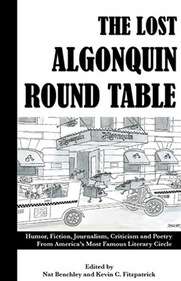
Martin Schneider writes:
A hidden treasure has been discovered.
Unearthed from forgotten bookcases, dark desk drawers, and public archives comes The Lost Algonquin Round Table, a compendium of 50 pieces written by the Algonquin Round Table, the legendary group of writers and critics that met at New York City’s Algonquin Hotel in the 1920s.
For the first time ever, the writers of the “Vicious Circle” are together in one collection, just in time to mark the 90th anniversary of their launch in 1919.
This new collection presents—for the first time—many pieces from family collections and long-lost periodicals.
Published by iUniverse and Donald Books, The Lost Algonquin Round Table is edited by Nat Benchley, grandson of Robert Benchley, and Kevin C. Fitzpatrick, friend of Emdashes, president of the Dorothy Parker Society, and author of A Journey into Dorothy Parker’s New York.
The book includes:
*Humor pieces by Robert Benchley, Franklin P. Adams, Heywood Broun, Frank Sullivan, and Donald Ogden Stewart.
*Criticism from Dorothy Parker, George S. Kaufman, and Robert E. Sherwood.
*Short fiction by Laurence Stallings and Pulitzer Prize-winners Edna Ferber and Margaret Leech.
*Journalism from Alexander Woollcott, Ruth Hale, and Deems Taylor.
*Poetry by Adams, Marc Connelly, Dorothy Parker, and John V. A. Weaver.
The editors spent years searching for material. Not focusing on the humor—but not eschewing it either—they have pulled together a remarkable collection of writings that will highlight the literary skills of the famous lunch partners.
The Lost Algonquin Round Table is available as a perfect bound softcover, hardcover, and e-book. Nat Benchley and Kevin Fitzpatrick will be making several bookstore appearances and talks at literary events this summer and fall. The book will be available on August 4, 2009.
Some book signing events:
*Saturday, August 16, 11 am, Long Branch Free Public Library, 328 Broadway, Long Branch, New Jersey.
As part of the annual Dorothy Parker Day, Kevin C. Fitzpatrick will give a talk, reading and book signing. Free. Open to the public. Telephone: (732) 222-3900. Online: www.lmxac.org/longbranch/.
*Wednesday, August 19, 6 pm, The Corner Bookstore, 1313 Madison Avenue, at East 93rd Street, New York.
Official book launch and reception party. Editors Nat Benchley and Kevin C. Fitzpatrick will be on hand with special guests. Books will be available for purchase and signing. Free. Open to the public. Telephone: (212) 831-3554.
*Thursday, August 20, 8 pm, Don’t Tell Mama, 343 W. 46th Street, New York.
Big Night Out presents the “1930s Idol” cabaret competition. Kevin C. Fitzpatrick will be signing/selling copies of the book plus is a judge in the show. Two drink minimum. Open to the public. Reservations encouraged. Telephone (212) 757-0788. Online: http://bnonyc.com/Big_Night_Out.html.
*Saturday, August 22, 12 pm, Algonquin Hotel, 59 West 44th Street, New York.
Algonquin Round Table Walking Tour. Editor Kevin C. Fitzpatrick has led this literary walking tour for ten years. Walk in the footsteps of the Vicious Circle and see the locations they visited, from speakeasies to old haunts. Twenty dollars per person. There will be a book signing in the lobby at 3 pm, to be followed by a small celebration to mark Dorothy Parker’s birthday. Reservations encouraged. Telephone: (212) 222-7239.
*Sunday, September 27, 12 pm, Governors Island (Colonel’s Row).
The Jazz Age Lawn Party and Roaring Twenties Party. Live music by Michael Arenella and the Dreamland Orchestra. Book signing 12-3 pm. Five dollars admission. Open to the public. Onilne: www.dreamlandorchestra.com.
For more book news and events, visit Donald Books.
What’s in This Week’s New Yorker: 08.03.09
Martin Schneider writes:
A new issue of The New Yorker comes out tomorrow. A preview of its contents, adapted from the magazine’s press release:
“Travels in Siberia–I,” by Ian Frazier, is the first part of a two-part article, and the culmination of a writing assignment ten years in the making. To paint a realistic portrait of Siberia, Frazier set off on an ambitious road trip to cross the vast Russian region during a five-week period in the summer of 2001.
In “A New Page,” Nicholson Baker tries out the Kindle 2, the new e-book reader released by Amazon.
In “Party of One,” Kelefa Sanneh profiles Michael Savage, the conservative host of “The Savage Nation,” “one of the most addictive programs on radio, and one of the least predictable.”
In Comment, Hendrik Hertzberg asks why the U.S. is so far behind other democratic nations in achieving universal health care and looks at Barack Obama’s proposals for reform.
Patricia Marx goes swimsuit shopping.
In Shouts & Murmurs, Bruce McCall imagines a dining-out guide written by Iran’s Guardian Council.
Joan Acocella examines the Gospel of Judas, a Gnostic text that exonerates Judas Iscariot as the betrayer of Jesus Christ.
Louis Menand reads Thomas Pynchon’s new detective novel, Inherent Vice.
Peter Schjeldahl attends “In & Out of Amsterdam: Travels in Conceptual Art, 1960-1976,” at the Museum of Modern Art.
David Denby reviews Judd Apatow’s latest film, Funny People.
There is a short story by Joshua Ferris.
Hawks, Doves, Loons: Catch Them All in Our Midsummer Grab-Bag
Martin Schneider writes:
Mediaite points out that frequent target of criticism Seymour Hersh had the CIA story right well before anyone else did. This article is fascinating primarily for David Remnick’s candid and inspiring remarks about editing a reporter of Hersh’s caliber.
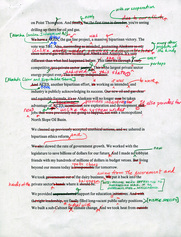
Vanity Fair redlines (actually red-, green-, and bluelines) Sarah Palin’s famously incoherent resignation address of July 3. I copyedit books for a living, so there’ll probably never be a moment of my waking life when this sort of image won’t stir my heartstrings to some extent:
It’s not too late to enter our big giveaway for Laura Jacobs’s new novel The Bird Catcher! Just email us a note, subject line “My favorite bird,” being sure to include your name, address, and … favorite bird, or retweet the relevant Jacobs-related Twitter message from @emdashes, and you’re entered! We’ve been loving the descriptions of the birds people like!
What’s in This Week’s New Yorker: 07.27.09
Martin Schneider writes:
A new issue of The New Yorker comes out tomorrow. A preview of its contents, adapted from the magazine’s press release:
In “The Kindest Cut,” Larissa MacFarquhar looks at the reasons that some people decide to donate organs to total strangers. “Does it seem crazy, giving something that precious to someone for whom you have no feeling, and whom, if you knew him, you might actually dislike?” she asks.
In “Cocksure,” Malcolm Gladwell looks at the concept of overconfidence and the role that it played in the recent economic crisis. “Wall Street is a conï¬dence game, in the strictest sense of that phrase,” he notes: a delicate balance must be maintained between inspiring others’ confidence in your firm and being delusionally self-assured.
In “Renaissance Man,” Rebecca Mead profiles the recently appointed director of the Metropolitan Museum of Art, Thomas Campbell. Although he is an expert in Renaissance tapestries and curated two successful and ambitious shows at the Met over the past ten years, “Campbell did not strike anyone as a director in the making” before his appointment last year, Mead writes.
In Comment, Jeffrey Toobin examines the significance of the questions posed and answers given at last week’s Supreme Court confirmation hearing for Sonia Sotomayor.
In the Financial Page, James Surowiecki explains how fiscal federalism stands in the way of reversing the economic downturn.
In Shouts & Murmurs, Andy Borowitz imagines Britney Spears’s diary entries during her conversion to Judaism.
Calvin Trillin recounts the story of the 2008 murder of three teenagers at an outdoor swimming hole in rural Michigan.
There is a late-night sketchbook by Barry Blitt.
Nicholas Lemann looks at the history of K.G.B. activity in America.
Joan Acocella traces Michael Jackson’s evolution as a dancer and recalls some of his most memorable moves.
Anthony Lane reviews Harry Potter and the Half-Blood Prince and In the Loop.
There is a short story by Kirstin Valdez Quade.