Category Archives: Jonathans are Illuminated

Jonathans are illuminated: Birdy

Chris Watson in the Santa Cruz Sentinel:

For such a little county, it’s amazing how often Santa Cruz wriggles its way into the media.

Just as Beth Lisick was cracking me up about UCSC co-eds, an August edition of The New Yorker magazine was slapped into my mailbox, falling open—sort of—to a nice long article by author JONATHAN FRANZEN, he of “The Corrections” fame and Oprah notoriety.

In his reflective article titled “My Bird Problem: love, grief and a change in the weather,” Franzen focused on his developing passion for bird-watching, proving in his complex essay that good nonfiction is at least as entertaining as fiction.

Gliding easily from one emotional subject to another—his feelings about the life and death of his marriage, the life and death of his mother, the life and death of species—Franzen dallied with issues big and small.

Most impressively, he considered the bipolar tendency in man to, in one moment, cling to “unsustainable” ideas and then, in the next moment, “bankrupt ourselves as rapidly as possible.”

Good stuff.

Now for the Santa Cruz bits.

In the middle of all his emotional turmoil, Franzen meets a vegetarian Californian writer who steals his heart and, incidentally, lives near some fine bird-watching habitats.

While in Santa Cruz, he goes looking for Eurasian wigeons, towhees, grosbeaks and scoters, which is when—binoculars in hand—he has an aha! moment:

“How different my marriage might have been if I’d been able to go birding!”

And later:

“Days passed like hours. I moved at the same pace as the sun in the sky; I could almost feel the earth turning.”

At one with the earth, Franzen became one with the birds: the threat of their extinction became, in the end, a threat to his extinction.

A long piece worth the read.

I have many fond memories of the Santa Cruz boardwalk from my middle-school days in California, although the undertow there nearly killed me once, and there were some unfortunate mixes of corn dogs, blue cotton candy, and mountainous car rides. Nevertheless, that waterslide was top-notch. And the corn dogs and cotton candy were worth it. There were also, sometimes, dolphins.

Categories:

Jonathans are illuminated: Naming names

From The Washington Post:

Next month, Stephen King, Amy Tan, Lemony Snicket, Nora Roberts, Michael Chabon and 11 other best-selling writers will auction the right to name characters in their new novels. The profits will go to the First Amendment Project, whose lawyers have repeatedly gone to court to protect the free speech rights of activists, writers and artists.

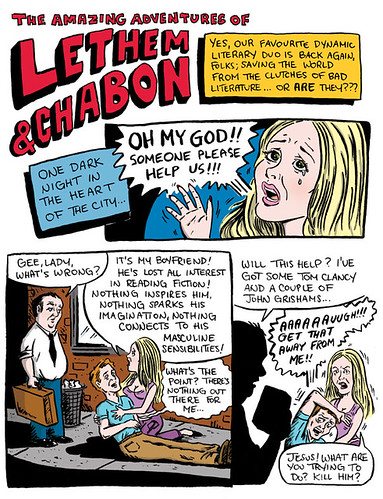
The benefit was the brainchild of [Neil] Gaiman, who approached Chabon with the idea when he heard the group was running out of money. It will now constitute the single-largest fund-raising event for the First Amendment Project, whose legal staff will gratefully leverage the goodwill of authors willing to help keep its doors open. Other writers include Dave Eggers, Dorothy Allison, Peter Straub, ZZ Packer, Jonathan Lethem, Rick Moody, Ayelet Waldman, Andrew Sean Greer and Karen Joy Fowler.

Greene said that money raised by the auction will go to support the organization’s pro bono work representing clients being sued over free speech, free press and freedom of expression. One such case, over whether a high school student’s angry poetry constituted a “criminal threat,” recently went before the California Supreme Court.

Snicket, who will let the top bidder determine an utterance by Sunny Baudelaire in his upcoming 13th installment of his “Series of Unfortunate Events,” said he holds the First Amendment dear because “the only trouble I should get in for my writing is the trouble I make myself.”

His only caveat: The meaning of the utterance may be slightly “mutilated.”

Also, Lethem’s Motherless Brooklyn seems to have almost gotten Mia Amato onto the John Gotti, Jr. jury:

The questions seemed overly concerned with the media exposure surrounding the case. Did I believe there was such a thing as the Mafia? Did I watch The Sopranos? Did I read The New York Post?

I felt small when it was my turn to be questioned by the judge, who was fluttery and squinted, puzzled, at her copy of my filled-out questionnaire. “We just want to clear up a few things,” she said as she looked me up and down.

“You work in publishing?”

“Yes, your honor.”

“You state here you have read books about the Mafia, the Godfatherseries and Motherless Brooklyn by Jonathan Lethem?”

“Yes, your honor.”

“I read that,” she said sharply, nodding.

Great! I thought. I’m in!

But not quite. Keep reading.

The biggest Jonathan news this month, of course, is the ingenious www.jonathanlethem.com, which I’ll be posting about soon. By the way, today I’m in an OS 9/IE 5.1 environment and am reminded of a fact that I’d successfully blocked out, which is that emdashes looks pretty sucky in old versions of Explorer. For example, Jennifer Hadley’s lovely graphic up above there is supposed to be centered, and I bet if I were a more advanced web designer I’m sure I could ensure its centeredness, but I’ve tried mightily and it’s just not sitting still. And the typefaces don’t look very nice at all. Very sorry about that, get Safari, and hope your workplaces are upgrading soon.

Categories:

Jonathans are illuminated: Lethem to Heaven

Which is not to imply that this Jonathan is prone to murderous boat trips; it’s just an awful pun. Sorry about that! Actually, Lethem published a new book this spring, The Disappointment Artist, and the Guardian‘s Sean O’Hagan isn’t a bit disappointed:

In many ways, then, this is a book about how a person can come to define himself as much through the cultural artefacts he absorbs in his formative years as through the people he is bound to, or bonds with, along the way. It celebrates a wide range of what some might consider ‘low-brow’ artefacts: the wilfully offensive cartoon art of Robert Crumb, the art-pop doodles of Brian Eno and David Byrne, the very different kinds of emphatically American films made by John Ford and John Cassavetes.

In Lethem’s world, it all adds up. These are the things that made him into not just a writer, but a functioning human being, no longer nerdish or obsessive, but alert—and honest—enough to reclaim and make sense of his younger, stranger self.

I’m really looking forward to reading it, especially the essay about Crumb. What does that word “lowbrow” mean, I wonder? I was born in the seventies; we have no concept of this.

Categories: ,

Jonathans and agua

Edward Champion reports from the front lines of the merry Jonathan Ames reading last night in SF, at which acupuncture, crabs and audiobooks were discussed alongside Ames’ devilish Wake Up, Sir!:

Shortly after suggesting that he was “the gayest straight writer in America,” Ames then let loose three hairy calls. These sounds permeated the depths of the Booksmith. Ames had had some practice with these, having resorted to hairy calls as a child when threatened by normal children.

Unrelated but important: Happy birthday to the Man From Watershed, who, if you didn’t know, is chronicling the changing nature and uncertain fate of H20, which is as vital to human life as the internet. No, more! He wrote recently:

As I’ve been developing a feel for what kind of stories would fit well on Watershed, I keep thinking I should narrow my focus even more. I should just research and post science and policy informaiton exclusively. But when I take that to the natural conclusion, I would end up only posting about dams, utilities, and drought. Which, like any narrow focus, would ignore all the joy and purpose people take out of water, or any other topic. If I’m writing about water, and I can’t write about, say, fishing or diving or beaches, then where’s the fun?

It wld mean I wouldn’t post pointers to excellent pieces of trivia like this AP story about Hungary’s long-standing fascination with the sport of water polo…. Glub.

Categories: , ,

Jonathans are illuminated: July, July

Domino Sugar factory, Williamsburg

When you’re making your list of Jonathans, seriously consider Jonathan Ames, who’s reading all over the place this month after his recent musicalish appearance at the Bowery Ballroom:

Tuesday, July 19, 7 PM: Booksmith, 1644 Haight Street, San Francisco, CA

Friday, July 22, 7:30 PM: Skylight Books, 1818 North Vermont Ave, Los Angeles, CA (Los Feliz)

Friday, July 29, 7 PM: Barnes & Noble, Astor Place, New York City, NY

And there’s a Jonathan Lethem interview about Brooklyn writers, emotional ghosts, and a “stab at chick-lit” set in L.A. in the début issue of The Brooklynite, an unusually nicely designed local magazine:

The aim of The Brooklynite…is to trace the contours of this amorphous idea. Certainly, this is an exciting moment in the borough’s history, a time of great cultural ferment and tremendous demographic change. But it is also a critical moment: How will new development affect Brooklyn’s unique character? Will the borough’s most vulnerable share in the benefits of Brooklyn’s renaissance?

The magazine’s money is where its mouth is so far; there are interviews with and photos of four former Domino Sugar factory workers displaced by the continuing overhaul of the waterfront. And it’s free. Edited by Daniel Treiman, whom I met tonight at the Bowery Poetry Club at the last Karaoke + Poetry = Fun hosted by Daniel Nester for a while, since he’s moving upstate. As they say in His Girl Friday, “Nice little town, Albany. They’ve got a state capital there, you know.” Actually, I’m jealous—conceptually, it’s halfway to Scotland, and that’s something I can endorse.

Speaking of men and cartoons, I’m listening to a recording of Mayor Fiorella LaGuardia reading aloud Dick Tracy on the radio during a newspaper strike. I think Bloomberg should think about reviving this practice; it would do a lot for his numbers, I bet.

Categories: , , ,

Jonathans Are Illuminated: Something wild

Exclusive interview with Jonathan Coe on the music in his books, Louis Philippe, and his prog phase, on Untouched by Work or Duty, a.k.a. Marlow Riley. Who knows everything that’s going to happen on the L.A. music scene before it happens, and will as likely or not be involved in some way while it’s happening. Read Sasha Frere-Jones on the White Stripes, then turn the virtual page for more White lightning from Marlow. When they say all the kids today think about is what song is coming up next, they’re darn right.

Jonathans Are Illuminated: Have you met Miss Jones?

Mother Jones lets Jonathan Safran Foer do the talking. Here’s the interview.

And a lucky coincidence: Also new, a very nicely written Jonathan Lethem profile from the Bangor Daily News. (Why Bangor? Lethem has a significant Maine connection, explained in the piece.) Just a taste:

“I’ve always preferred dark horses and underrated things,” said Lethem, who will return to Bennington College in Vermont, his almost alma mater, in June for the ultimate drop-out vindication – he’s giving the commencement address. “I’ve been fascinated by lesser writers. It helps you know the writing world, not just the peaks. I thought I’d always be the dark horse. I thought I’d be reprinted out of neglect. When ‘Motherless Brooklyn’ found its place in the world, I couldn’t occupy that stance anymore. I wasn’t underrated or neglected. I was kind of in fashion and had an unexpected, pleasurable amount of operating room. I learned there wasn’t much to cherish about neglect and struggle. I wondered instead what kind of work lesser-known writers would have done had they been better cared for.”

Lethem has long been my personal hero for helping get The Queen’s Gambit, unquestionably my favorite novel, back into print. It’s by the late Walter Tevis, who also wrote The Hustler and The Color of Money—those were novels first, you know. Lethem wrote this for the new paperback of Gambit, which is the electrifying story of Beth Harmon, a (fictional) chess champion who’s an orphan with a penchant for pills: “Beth Harmon is an unforgettable creation—and The Queen’s Gambit is Walter Tevis’s most consummate and heartbreaking work.” Michael Ondaatje has written, “The Queen’s Gambit is sheer entertainment. It is a book I reread every few years—for the pure pleasure and skill of it.” There’s a short excerpt here. I’m jealous of anyone who hasn’t heard of it; I may have to spotless-mind myself someday so I can read it afresh again. There’s only one screenplay I’d want to write, and it’d be this one. Lethem, of course, would have to help.

Speaking of The Color of Money (the movie), check out these comments from an Easter Egg site. They’re responding to this juicy bit of trivia: “Just after Eddie (Paul Newman) wins his first round match at the climactic 9-ball tournament, he walks by the grandstand and shakes hands with a man who congratulates him. The man he shakes hands with is the real Fast Eddie Felson.”

magnumbadass writes:
I met the real Fast Eddie at a pool clinic about nine years ago. His last name is not Felson, and says that only about 30% of the movie the Hustler is actually true. He also said that he was on both of the sets as a technical director. He did the famous “everybody’s doin’ it” trick where Tom Cruise shoots in the eight ball without looking. A nice guy — and the clinic was free. Whether or not this is the same gentleman that took a polygraph, I do not know, the fast Eddie that I met said that he used many different names in different cities that he toured during his “hustling” days.

Retro Boy writes:
Bollocks.

Fast Eddie Parker writes:
This is a fraudulent “egg”. Whomever wrote this “egg” does not know what he or she is talking about! His or her “story” is completely fiction. The REAL Fast Eddie was not in either of the movies written by Walter Tevis: “The Hustler” and “The Color of Money”. The REAL, ORIGINAL, Fast Eddie has taken AND PASSED two polygraph (lie detector) tests to PROVE that he is the REAL AND ORIGINAL Fast Eddie. One of the two polygraph tests was published in the billiard publication “The American Cueist”. No other human being has ever been willing to take a polygraph test in that regard, because NO OTHER HUMAN BEING WOULD PASS THAT TEST! The REAL Fast Eddie is still alive and performing pool shooting exhibitions throughout the world.

Jon writes:
that’s great

I’ll say!

Categories:

Jonathans Are Illuminated: Miller’s Cross

In tomorrow’s Book Review, the always refreshingly frank Laura Miller looks carefully at Nicole Krauss’ The History of Love:

It would be unfair to liken Nicole Krauss’s second novel, The History of Love, to Extremely Loud and Incredibly Close, the recently published second novel by her better-known husband, Jonathan Safran Foer, except for two things. The first is the deliberate and liberal sprinkling of correspondences between the two books, a system of coy marital cross-referencing that amounts to an engraved invitation to compare and contrast. The second, and more significant, is that Krauss is one of fiction’s dutiful daughters. She has written almost entirely under the influence of powerful literary fathers, an assemblage of canonical figures including (to list only those explicitly cited in ”The History of Love”), Isaac Babel, Franz Kafka and Bruno Schulz. That the relatively young and untried Foer has joined them in her pantheon represents only a slight deviation from form. Keep a-reading.

‘The History of Love’: Under the Influence [NYT]

Categories: ,

Jonathans Are Illuminated: Smart Women, Various Choices

Rachel Aviv’s Voice essay about Nicole Krass’ History of Love—and the links between Krauss’ novel and her husband’s (one Jonathan Safran Foer)—also mentions the art-and-life relationship between Kathryn Chetkovich and Jonathan Franzen: Written With Invisible Ink: Is Nicole Krauss’s book-within-a-book ‘taut as a drum’?

Speaking of Franzen, I’m sure you’re following the writers’ revolt against Oprahlessness:

Oprah, save us, we can’t get by without you.

That’s the message from a group of published and award-winning novelists in an open letter to influential television talk-show host Oprah Winfrey, begging her to resume picking new novels for members of her popular book club.

“There’s a widely-held belief that the landscape of literary fiction is now a gloomy place,” Word of Mouth, a loose alliance of women’s authors, wrote. It said fiction sales began to plummet when the The Oprah Winfrey Book Club went off the air in 2002 and stopped featuring contemporary authors.

“Book Club members stopped buying new fiction, and this changed the face of American publishing,” said the letter, which was signed by 158 authors.

Among those signing the letter were Pulitzer Prize winner Jhumpa Lahiri and Amy Tan, author of The Joy Luck Club. Several male authors also signed.

The letter expressed thanks for Winfrey’s contribution to book sales and asked her to “consider focusing, once again, on contemporary writers in your book club.”

“The readers need you. And we, the writers, need you,” it said. “Oprah Winfrey, we wish you’d come back.”

The club became embroiled in controversy in 2001 when Jonathan Franzen publicly objected to the selection of his novel, The Corrections, and said he feared it might affect his reputation in literary circles. He later said he regretted voicing his reservations.

American novelists beg for Oprah’s Book Club help [Houston Chronicle]
Oprah’s Book Fatigue: How fiction’s best friend ran out of stuff to read [Chris Lehmann, Slate]

Categories: ,