
Martin Schneider writes:
Talk about fortuitous timing—no sooner does a big Malcolm Gladwell article hit the newsstands than we receive word about an appearance he will be making in New York City this month, at the Moth Members’ Show at Symphony Space on May 21. Since a recent appearance at the Moth raised a few eyebrows, we’re glad to see that he’s diving in again.
Andy Borowitz, who appeared last week at the 92nd Street Y to celebrate/mock Obama’s 100th day in office, will host.
Here’s the press release:
Our Annual Moth Members’ Show
Thursday, May 21 at Symphony Space
Crack up: Stories about Comedies and Calamities
Storytellers include:
Malcolm Gladwell
Author of The Tipping Point, Blink and Outliers: The Story of Success
Sarah Jones
Tony award-winning playwright, performer, author and poet
Steve Osborne
Former lieutenant in NYPD detective bureau, Manhattan Gang Squad
Peter Zilahy
Essayist, playwright, and author of dictionary-novel, The Last Window-Giraffe
Hosted by:
Andy Borowitz
Comedian, actor and writer, featured regularly in The New Yorker, The
New York Times, and at borowitzreport.com
Become a Moth Member and receive 2 FREE tickets
With a $100 donation you will receive two tickets to the Members’ Show
($70 value) as well as our brand new double CD, with stories by
Richard Price, Sam Shepard, Mike Birbiglia, A.J. Jacobs ($15 value,
available only with membership), among other benefits.
When you join at a higher level of membership you get even more
benefits and perks. For a complete list of member levels and benefits
and to join go to www.themoth.org/membership.
We Need Your Support
Moth members are hugely important in helping us present unique voices
at our Mainstage and StorySLAM series, as well as our community
outreach program, MothShop, which brings storytelling workshops free
of charge to underserved communities. Moth Members also help us
produce our free–and commercial-free–podcast each week. Take a moment
to read about the importance of the membership program and what our
members have helped us to accomplish this year.
In these turbulent times, everyone needs a place to tell their stories
and hear the tales of our time. The Moth is that place. Please help
us offer more storytelling opportunities by becoming a Moth member.
How to Join:
Join online.
Call The Moth office at 212-507-9833 with your credit card information.
Mail a check, payable to Storyville Center for the Spoken Word, and
mail it with your name, mailing and email addresses to:
The Moth
330 West 38th Street, Suite 1403
New York, NY 10018
Storyville Center for the Spoken Word, d/b/a The Moth, is a 501 (c)
(3) not-for-profit organization. All donations are 100% tax deductible
and all donors receive a receipt for tax purposes.
Thank you for your support!
The Moth Board & Staff
P.S. Don’t Forget to RSVP to The Members’ Show when you join!
(to David Mutton at 212-507-9833 or rsvp@themoth.org)
Don’t wait for your donor receipt, call or email to RSVP as soon as
you have processed your online membership or mailed your check.
Show Information:
Crack up: Stories about Comedies and Calamities
at Symphony Space
2537 Broadway (at 95th St)
6:30pm Doors open
7:30pm Stories begin
Member tickets need to be reserved by calling 212-507-9833 or emailing
rsvp@themoth.org, and can be collected on the evening of the show from
Symphony Space box office.
A limited number of tickets are on sale at $35 from Symphony Space.
Category Archives: New Yorker
What’s in This Week’s New Yorker: 05.11.09
Martin Schneider writes:
The “Innovators” issue of The New Yorker comes out tomorrow. A preview of its contents, adapted from the magazine’s press release:
Malcolm Gladwell looks at the ability of underdogs to triumph over their stronger adversaries. “David can beat Goliath by substituting effort for ability—and substituting effort for ability turns out to be a winning formula for underdogs in all walks of life,” Gladwell writes.
Adam Gopnik ruminates on what spurs invention: necessity, or superfluity? Observing the abundance of razors in his medicine cabinet, all of which are about equally useful, Gopnik notes “a strange but basic truth of life and marketing alike: that it is after a problem has already been solved that ever more varied and splendid solutions to it start to appear.”
Douglas McGray writes about Green Dot Public Schools, a charter-school group that is California’s largest, by enrollment, and one of its most successful, sending nearly eighty percent of their kids to college.
Rebecca Mead observes the work of Christian Scheidemann, who “is among just a handful of private conservators who specialize in contemporary art,” and who “has become particularly admired for his skill in working with organic substances.”
John Colapinto profiles the behavioral neurologist V.S. Ramachandran, “one of a dozen or so scientists and doctors who, in the past thirty years, have revolutionized the ï¬eld of neurology by overturning a paradigm that dates back more than a hundred years: that of the brain as an organ with discrete modules (for vision, touch, pain, language, memory, etc.) that are ï¬xed early in life and immutable.”
Evan Osnos explores the life and career of Jia Zhangke, the Chinese filmmaker behind the award-winning film Still Life, about the social and physical demolition wrought by China’s Three Gorges Dam, and, more recently, 24 City, about a factory closing.
In Comment, Philip Gourevitch asks who should be held accountable for the torture memos.
In the Talk of the Town, Alma Guillermoprieto reports from Mexico City, under siege by swine flu.
In the Talk of the Town, Lauren Collins looks at the linguistic implications of the disease’s porcine name
In the Financial Page, James Surowiecki explains why the financial industry needs to shrink.
In Shouts & Murmurs, Amy Ozols makes friends on an airplane.
There is a comic strip by Chris Ware.
Judith Thurman writes Helen Gurley Brown and the Cosmo Girl.
Adam Kirsch explores the poetry of Gerard Manley Hopkins.
Hilton Als reviews Desire Under the Elms.
Sasha Frere-Jones listens to Grizzly Bear’s new album.
David Denby reviews X-Men Origins: Wolverine, Fighting, and Tyson.
There is a story by the recently departed writer J. G. Ballard.
Happy Day! The New Yorker and Print Take Home Ellies!
Martin Schneider writes:
Last night, at the American Society of Magazine Editors awards ceremony (our coverage of the nomination announcement is here and here), The New Yorker took home awards for fiction by E. Annie Proulx and Aleksander Hemon, photography by Platon, and criticism by James Wood. Congratulations to all!
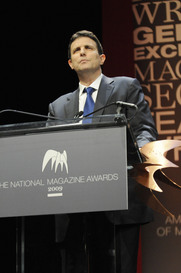
Judging from the reaction on Twitter, the victory of Field and Stream over The New Yorker and Vogue in the 1,000,000+ circulation category was a bit of a shocker.
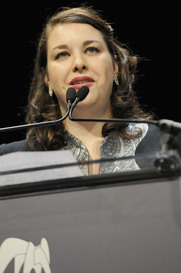
Meanwhile, Print won the award for general excellence, under 100,000 circulation. Congratulations to Emily and everyone at that outstanding publication for the well-deserved recognition!
President Obama Throws Googly, Is Reading Joseph O’Neill’s “Netherland”
Martin Schneider writes:
At least according to David Leonhardt in the New York Times. A few quick reactions.
1. I’m reading it too! I’m almost done (bet that overachiever Obama beats me to the end, though—I’m savoring). I’m fairly certain it’s the first time that the president and I are reading the same novel at the same time. Did Clinton read Kurt Andersen’s Turn of the Century? I didn’t read any Zane Grey during the Bush years….
2. I admire Obama’s taste. I’ve run into a few people on Twitter and elsewhere calling Netherland overrated, but surely it’s a quality piece of work, even if one feels that it’s been overpraised. I’m not entirely sure how I feel about it yet, but then again, I’m not done yet. Leaning towards thumbs-up, though. What did you make of it?
3. I wonder how much Obama knows about cricket. I know next to nothing.
New Yorker Blog Roundup: 04.30.09
(This content is taken directly from the left nav bar on the magazine’s website.)
Steve Coll wonders if the Times could really be nonprofit.
James Surowiecki loved Obama’s Georgetown speech, even if it wasn’t Churchillian.
Sasha Frere-Jones celebrates Graffiti Kings.
Hendrik Hertzberg on the electoral college and a Fox News stake out.
George Packer discusses George Orwell with the Book Club.
News Desk: What is it with the hundred-days business?
The Front Row: Who still thinks pornography is enlightening?
The Book Bench: Honoring E. L. Doctorow at the PEN Literary Gala.
Evan Osnos provides more details on China’s green-tech space race.
The Cartoon Lounge: Footage from the swing flu of 2006.
Goings On: A Jonas Brothers drug reference?
Spectral Appearances: An Arlen is Haunting The New Yorker
Martin Schneider writes:
In my best stentorian anchorman’s voice, I can honestly write that Senator Arlen Specter “rocked the political world today” when he announced that he would switch his party affiliation from Republican to Democrat, ensuring the Democrat’s a filibuster-proof majority in the Senate once Al Franken is seated sometime in June (it looks like). Specter is truly the man of the president’s 100th day.
When he was district attorney of Philadelphia, Arlen Specter was quoted in The New Yorker in opposition to the new Miranda rule. It was the December 14, 1968, issue. Since then he has appeared in the magazine’s pages many times—and there’ll be plenty more in the near future.
(Note that “Fight on the Right,” by Philip Gourevitch, and “Killing Habeas Corpus,” by Jeffrey Toobin, are actually about Specter, rather than merely mentioning him in passing.)
Here’s the full list:
“The Turning Point,” Richard Harris, December 14, 1968
Comment, Garrison Keillor, August 20, 1990
Comment, Adam Gopnik, October 28, 1991
Comment, Josselyn Simpson, August 3, 1992
“The Ogre’s Tale,” Peter J. Boyer, April 4, 1994
“Flat-Tax Follies,” Warren St. John, June 5, 1995
“The Western Front,” Sidney Blumenthal, June 5, 1995
“Ghost in the Machine,” Sidney Blumenthal, October 2, 1995
“Speaker of the Casino,” Sara Mosle, November 13, 1995
“The Stranger, Mary Anne Weaver, November 13, 1995
“Advice and Dissent,” Jeffrey Toobin, May 26, 2003
“Fight on the Right,” Philip Gourevitch, April 12, 2004
“The Candidate,” William Finnegan, May 31, 2004
“Hollywood Science,” Connie Bruck, October 18, 2004
“Blowing Up the Senate,” Jeffrey Toobin, March 7, 2005
“Ups and Downs,” Hendrik Hertzberg, November 14, 2005
“Unanswered Questions,” Jeffrey Toobin, January 23, 2006
“Hearts and Brains,” Hendrik Hertzberg, November 6, 2006
“The Art of Testifying,” Janet Malcolm, March 13, 2006
“Killing Habeas Corpus,” Jeffrey Toobin, December 4, 2006
“The Spymaster,” Lawrence Wright, January 21, 2008
“State Secrets,” Patrick Radden Keefe, April 28, 2008
“The Dirty Trickster,” Jeffrey Toobin, June 2, 2008
“The Gatekeeper,” Ryan Lizza, March 2, 2009
Tennis, Anyone? Budge, Cramm, Thurber, and the Nonexistent Mrs. Poos
Martin Schneider writes:
I noticed in Jay Jennings’s review of Marshall Jon Fisher’s A Terrible Splendor: Three Extraordinary Men, a World Poised for War, and the Greatest Tennis Match Ever Played, in the Wall Street Journal, that James Thurber is mentioned as “the tennis-besotted writer for The New Yorker magazine.” I didn’t know Thurber was such a tennis fan; does anyone know if the subject pops up much in the better-known Thurber collections?
The intersection of tennis and The New Yorker cannot but remind me of my father, who was a fan of both things for most of his life (Herbert Warren Wind was a particularly special byline). Furthermore, I remember him telling me about that particular match—Don Budge against Baron Gottfried von Cramm in 1937, a sort of tennis version of the second Joe Louis-Max Schmeling bout, which happened a year later (turns out, both Schmeling and von Cramm were good guys; the story of von Cramm’s life is especially interesting). The setting was Wimbledon, but the match was not a part of the well-known tournament; it was a Davis Cup semifinal.
Knowing a fair amount about the subject but not about the book, I feel confident in recommending it anyway. The book apparently omits an amusing story connected with the match that my dad used to tell. Here it is, quoted from Budge’s memoir (I found it here):
I know I was still in a daze in the locker room. It was as if everyone was trying to outdo each other in congratulating me. Tilden came in, and it was right then that he came over and told me it was the greatest tennis match ever played. Others had about the same thing to say as Tilden did—everyone, that is, except Jack Benny. He came in with Lukas an Sullivan, and while they were raving on at length, Benny just shook my hand and mumbled something like “nice match,” as if I had just won the second round of the mixed doubles at the club. I remember, Jack Benny was the only calm person in the whole locker room. The place was like a madhouse.
[snip]
After I won at First Hills, I went out to Los Angeles to play the Pacific Southwest Tournament. After my first-round match there, which was a rather normal, unexciting one, I looked up from my locker, and who should be coming at me but Jack Benny. He was positively beside himself, hardly pausing to say hello before he launched into a babbling, endless dissertation on how wonderful, how exciting, how fantastic the Cramm match had been. It was like one of those scenes from his show. I would keep trying to interrupt him, unsuccessfully. “But Jack”—I would try to start. And he would go right on.
“Magnificent, Don. It was just marvelous. Why when you—it was incredible. And then you—why, I’ve told everybody about it.” And on he went.
“But Jack,” I kept on, so that at last he stopped long enough to take that pose he is famous for, the palm cupped on his cheek, staring at me curiously. “Jack, I don’t understand,” I began. “At Wimbledon, after the Cramm match, you were the only person I met who was relaxed and calm. Now you carry on like this. The match was two months ago. Then you were unmoved. Now you’re jumping around all excited. What is it?”
“Don,” he said. “The truth is, that the Cramm match was the first tennis I ever saw. Now since then I’ve seen others, but at the time I thought all matches were more or less like that.”
I decided to search Thurber’s New Yorker contributions for tennis references, and found a silly and slight short story called “This Little Kitty Stayed Cool.” I can’t improve on the abstract:
Tells of girl who is an excellent tennis player. Her name is Kitty Carraway. A man by the name of Poos is proposing to her, but she doesn’t like the name Poos and refused. It just doesn’t sound as nice as Kitty Carraway. Argument.
Thursday: See Jonathan Safran Foer Interview Zadie Smith
A friend passes on information:
Acclaimed British writer Zadie Smith’s first book, White Teeth, won a number of awards, including the Guardian First Book Award and the Whitbread First Novel Award. Smith’s second novel, The Autograph Man, won the 2003 Jewish Quarterly Literary Prize for Fiction. On Beauty was published in 2005, and won the 2006 Orange Prize for Fiction.
Jonathan Safran Foer is the best-selling author of Everything Is Illuminated, which won numerous awards, including the Koret Award for best work of Jewish fiction of the decade, and, like White Teeth, the Guardian First Book Award. His second novel, Extremely Loud and Incredibly Close, was a finalist for the IMPAC Prize. Foer joined the NYU Creative Writing Program faculty in 2008, and lives in Brooklyn,
New York.
Date: Thursday, April 30th, 7:00 p.m.
Location: Tishman Auditorium, Vanderbilt Hall, 40 Washington Square South
New Yorker Covering “Swine Flu” Story since the Ford Administration
Martin Schneider writes:
Credit Twitter users supergork and echidnapi with the catch.
In the May 31, 1976, edition of The New Yorker, there appeared a “casual” (what today would be filed under “Shouts & Murmurs”) by Richard Leibmann-Smith satirizing the hullabaloo surrounding awards ceremonies. Leibmann-Smith spent page 31 (subscribers only) musing on the following scenario: what if the “Academy” in “Academy Awards” signified the American Academy of Medicine? What if there were a “Jonas” instead of an “Oscar,” with the categories Best Disease, Best Symptoms, Best Virus, and Best Potential Epidemic? Riffing on the most recent Oscar winner, One Flew Over the Cuckoo’s Nest, which had also effected a sweep of all the major categories just two months earlier, Leibmann-Smith chose as his awards juggernaut “Swine flu,” as in the piece’s title (prepare wince reflex), “Swine Flu Over the Cuckoo’s Nest.”
On the intersection of Twitter and swine flu, Randall Munroe expresses more amusingly something I had noticed as well.
What’s in This Week’s New Yorker: 05.04.09
Martin Schneider writes:
A new issue of The New Yorker comes out tomorrow. A preview of its contents, adapted from the magazine’s press release:
Philip Gourevitch, who covered the genocide in Rwanda for The New Yorker and in his book We Wish to Inform You That Tomorrow We Will Be Killed With Our Families, revisits Rwanda on the fifteenth anniversary of the genocide to meet with some of the people he previously profiled, and explores the unique reconciliation process that has been taking place there; today it is “one of the safest and the most orderly countries in Africa,” Gourevitch writes.
Ryan Lizza goes behind the scenes at the White House to chronicle how Peter Orszag, the new director of the Office of Management and Budget, put together the Obama Administration’s first budget.
Peter J. Boyer profiles Larry Jones, the racehorse trainer who trained Eight Belles, the horse that had to be euthanized at last year’s Kentucky Derby, and one of this year’s Derby hopefuls, Friesan Fire.
Jerome Groopman writes about new drugs, developed to treat cystic fibrosis, that may be able to correct the mutated gene responsible for the disorder.
Hendrik Hertzberg asks if it might be better to let Texas secede.
Lauren Collins talks to Dolly Parton about New York and her new musical, 9 to 5.
In Shouts & Murmurs, Noah Baumbach describes bees getting “buzzed.”
Nancy Franklin reviews Amy Poehler’s new comedy, Parks and Recreation.
Peter Conrad explores the work of the Portuguese writer António Lobo Antunes.
Peter Schjeldahl attends “The Pictures Generation” at the Metropolitan Museum of Art.
Joan Acocella watches dance works by Merce Cunningham and Karole Armitage.
Alex Ross covers Esa-Pekka Salonen’s farewell to the Los Angeles Philharmonic.
Anthony Lane reviews Il Divo and The Limits of Control.
There is a short story by Gail Hareven.