
Martin Schneider writes:
Mediaite points out that frequent target of criticism Seymour Hersh had the CIA story right well before anyone else did. This article is fascinating primarily for David Remnick’s candid and inspiring remarks about editing a reporter of Hersh’s caliber.
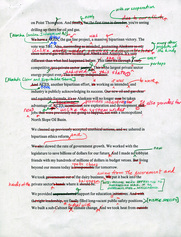
Vanity Fair redlines (actually red-, green-, and bluelines) Sarah Palin’s famously incoherent resignation address of July 3. I copyedit books for a living, so there’ll probably never be a moment of my waking life when this sort of image won’t stir my heartstrings to some extent:
It’s not too late to enter our big giveaway for Laura Jacobs’s new novel The Bird Catcher! Just email us a note, subject line “My favorite bird,” being sure to include your name, address, and … favorite bird, or retweet the relevant Jacobs-related Twitter message from @emdashes, and you’re entered! We’ve been loving the descriptions of the birds people like!
Category Archives: New Yorker
What’s in This Week’s New Yorker: 07.27.09
Martin Schneider writes:
A new issue of The New Yorker comes out tomorrow. A preview of its contents, adapted from the magazine’s press release:
In “The Kindest Cut,” Larissa MacFarquhar looks at the reasons that some people decide to donate organs to total strangers. “Does it seem crazy, giving something that precious to someone for whom you have no feeling, and whom, if you knew him, you might actually dislike?” she asks.
In “Cocksure,” Malcolm Gladwell looks at the concept of overconfidence and the role that it played in the recent economic crisis. “Wall Street is a conï¬dence game, in the strictest sense of that phrase,” he notes: a delicate balance must be maintained between inspiring others’ confidence in your firm and being delusionally self-assured.
In “Renaissance Man,” Rebecca Mead profiles the recently appointed director of the Metropolitan Museum of Art, Thomas Campbell. Although he is an expert in Renaissance tapestries and curated two successful and ambitious shows at the Met over the past ten years, “Campbell did not strike anyone as a director in the making” before his appointment last year, Mead writes.
In Comment, Jeffrey Toobin examines the significance of the questions posed and answers given at last week’s Supreme Court confirmation hearing for Sonia Sotomayor.
In the Financial Page, James Surowiecki explains how fiscal federalism stands in the way of reversing the economic downturn.
In Shouts & Murmurs, Andy Borowitz imagines Britney Spears’s diary entries during her conversion to Judaism.
Calvin Trillin recounts the story of the 2008 murder of three teenagers at an outdoor swimming hole in rural Michigan.
There is a late-night sketchbook by Barry Blitt.
Nicholas Lemann looks at the history of K.G.B. activity in America.
Joan Acocella traces Michael Jackson’s evolution as a dancer and recalls some of his most memorable moves.
Anthony Lane reviews Harry Potter and the Half-Blood Prince and In the Loop.
There is a short story by Kirstin Valdez Quade.
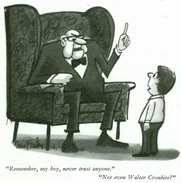
Walter Cronkite, 1916-2009
Martin Schneider writes:
I think the people who do Emdashes are uniformly too young to remember Cronkite in the role that made him such a ubiquitously admired figure. Speaking for myself, to watch Dan Rather chafe so uncomfortably in the role he inherited was to witness the most palpable sign of Cronkite’s distinction.
Every year, on January 1, the New Year’s Concert, consisting mostly of waltz masterpieces, is broadcast worldwide from Vienna. I watch it most years. For as long as I can remember, Cronkite was the host for the American telecast, and he did a really good job every year. For someone who was supposed to represent “everyman” in some way, he did “high culture” awfully well too. In a way, he embodied the best of America, a sentiment I’m sure we’ll be hearing plenty of in the days to come.
Judging from the archive, The New Yorker never really did a big Cronkite article. Perhaps I missed it. My guess is that he perhaps got very entrenched as a national icon a little too quickly, making a Profile almost irrelevant. As with Michael Jackson, The New Yorker generally approached Cronkite obliquely, in reviews, casuals, and cartoons.
Like this one:
Book Giveaway: Laura Jacobs’s “The Bird Catcher”
Martin Schneider writes:
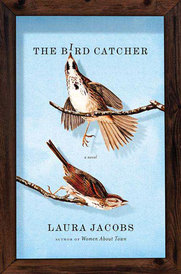
Emdashes is delighted to be giving away a copy of The Bird Catcher, the brand-new novel by Vanity Fair contributing editor Laura Jacobs, who’s also the author of the wonderful book Women About Town.
A true New York story, The Bird Catcher has received glowing notices in, among other publications, Booklist and Bookforum. That it’s about real birds as well as swooping and cawing city life and the nests and claws of love can only add to its appeal around these parts; as longtime readers know, both Emily and I have a lively interest in our enviably multicolored and befeathered counterparts. We salute them as vigorously as all of us Emdashers salute quality contemporary fiction.
In addition to the giveaway, we’re very pleased to present a lovely mini-essay from Jacobs herself on the subject of em dashes, below. My paying work is as a copy editor for academic publishers, so I’m fascinated by the interaction between authors and editors. I see one side of that dynamic, but always in a nonfiction context. I could never imagine intervening in a passionate, careful, heartfelt novel as boldly as I redline a study of Eastern European governance. So I understandably find Jacobs’s experiences with punctuation highly interesting. Let’s turn over the page before explaining how to enter our giveaway!
Em Dashes in The Bird Catcher
By Laura JacobsThe editing phase of a novel is quite different than the act of writing a novel, where you are daily pushing your plot forward even as you allow digressions to pull you into corners and shadows and glades. When you are writing, all energy is focused on driving to the finish line, even if the narrative is embedded with flashbacks (a good flashback will eventually rebound into the present). Em dashes, then, those linear bits of combustion, these cognitive bridges, work like spark plugs, synapses, in the story. The final manuscript of my second novel, The Bird Catcher (published in June by St. Martin’s Press), was loaded with em dashes.
But when it was time to go though and clean it up before showing it to prospective buyers, I found myself taking the em dashes out, rather ruthlessly. Much of the novel is thought—the memories and mental wanderings of my protagonist—and the em dashes suddenly looked too “writery” on the page. I told myself, people don’t think in em dashes. And yet I knew from experience that people do think in em dashes, or at least critics do. As a dance critic I rely greatly on the kinetic leap of the em dash—and the spotlight of white space it lands in. But in a novel, I asked myself, were the dashes too much of “telling” when I should be “showing”? In the spirit of postmodernism, even though The Bird Catcher is not postmodern, I removed the em dashes.
Imagine my surprise then, when months later I received the copy-edited manuscript from my publisher. Em dashes had been put back in almost every place I’d removed them, and they’d been introduced into places where commas had been before. I was, how shall I put it, freaked out. What should I do? Remove them a second time? Did the copy editor know something I didn’t know? I felt immobilized, unsure of how to proceed. I decided to consult the masters.
I pulled a recent translation of Leo Tolstoy’s Anna Karenina off the shelf, and also Edith Wharton’s The Age of Innocence. I saw that both books are full of em dashes. Tolstoy’s first em dash appears on the novel’s first page in the third paragraph, and many more follow in this chapter of marital agitation, in which Oblonsky is remembering the recent emotional moment when his wife confronted him with his adultery. Wharton’s first em dash comes on the third page of her novel, in a line of text from the opera Faust: “He loves me—he loves me not—he loves me!—” I’m not sure how the line is punctuated in Gounod’s libretto, but this is certainly how one would hear it, each exclamation floating in the air, a possibility. In fact, Wharton especially liked to end a line of conversation with an em dash, so attuned was she to the unspoken, the unspeakable, and the speechless. Well, if em dashes were good enough for these two writers, they were certainly good enough for me. I let them stand.
Here are the rules: There are two ways you can enter. One is to drop us an e-mail, with the subject line “My favorite bird”; include your favorite bird, your full name, and your mailing address in the body of the e-mail. The other way is to retweet our message about this contest on Twitter; our username is @emdashes, if you’re not already following us. Please mention your favorite bird in the tweet (ha), too. We’ll accept all entries until 8:00 p.m., Eastern Standard Time, on Friday, July 24, and then the Random Number Generator will deliver its negative verdict to every entrant save one. Good luck to all of you!
I Want to Read Pauline Kael’s Review of “Garp,” As It Happens
Martin Schneider writes:
I recently established contact with a cousin of mine on the West Coast I barely know—I’m not entirely sure we’ve met even a single time. How did we make contact? Why, he tapped me on Facebook, of course! It’s funny how family traits run kind of deep—he’s a theater critic with a strong interest in classic and foreign movies; judging from certain references he’s made just in the last couple of weeks (J. Hoberman, Proust, Jules et Jim), he’s probably has more in common with me than 90% of the people I’d count as volitional friends.
So I wasn’t entirely surprised when he recently linked to a friend of his, applauding his pilgrimage to 333 Central Park West, otherwise known as the former home of Pauline Kael. Kael doesn’t get enough mention on Emdashes, but I know Emily and I both love her. Is this address widely known? I had never heard it before but I wouldn’t be surprised if hard-core Kael fans are well aware of it. I may drop by myself!
Here’s a pic, taken by Michal Oleszczyk:

What’s in This Week’s New Yorker: 07.20.09
Martin Schneider writes:
Just yesterday I asked for new Senator Al Franken to appear at the New Yorker Festival. Instead, we get the next best thing, a long article about his path to the Senate. Plus Hertzberg on Palin! Joy, joy!
A new issue of The New Yorker comes out tomorrow. A preview of its contents, adapted from the magazine’s press release:
In “Enter Laughing,” John Colapinto visits Al Franken on his second day as the junior senator from Minnesota, and examines the long, disputed electoral process that finally ended in victory for him on June 30.
In “Sheriff Joe,” William Finnegan profiles Joe Arpaio, the controversial, publicity-loving sheriff of Maricopa County (which includes Phoenix, Arizona), who is known as “America’s Toughest Sheriff.” Arpaio, who worked as a federal narcotics agent before running for sheriff, in the early 1990s, won national notoriety and the support of conservative voters for his harsh treatment of prisoners.
In “The Forbidden Zone,” Evan Osnos writes about Hu Shuli, the founding editor of the Chinese magazine Caijing, who is often described as “the most dangerous woman in China.”
In Comment, Hendrik Hertzberg analyzes Sarah Palin’s resignation speech.
In Shouts & Murmurs, Ian Frazier describes a climate-change summit in Hell.
Paul Rudnick recalls working on the screenplay for the film Sister Act.
Anthony Lane reviews Brüno.
Elizabeth Kolbert examines the obesity epidemic.
John Lahr attends the National Theatre production of Racine’s Phèdre, starring Helen Mirren.
Nancy Franklin watches Michael Jackson’s memorial service on TV.
There is an excerpt from an unpublished work by William Styron.
A Decade of Good Gets: Garry Kasparov and Nick Nolte, Together Again!
Martin Schneider writes:
Question: What do the following people have in common?
Steve Albini
Woody Allen
Pedro Almodóvar
Christiane Amanpour
Fiona Apple
Mikhail Baryshnikov
Samantha Bee
Björk
Manolo Blahnik
Doyle Brunson
T. Bone Burnett
Rosanne Cash
Cat Power
Tracy Chapman
Joel and Ethan Coen
Stephen Colbert
Steve Coogan
Wes Craven
Chuck D
Guillermo del Toro
Ani DiFranco
Matt Dillon
Clint Eastwood
Elizabeth Edwards
Edie Falco
Douglas Feith
The Flying Karamazov Brothers
Jamie Foxx
Ricky Gervais
Matt Groening
P.J. Harvey
Ethan Hawke
Salma Hayek
Buck Henry
Werner Herzog
D.L. Hughley
Eddie Izzard
Peter Jennings
Tommy Lee Jones
Garry Kasparov
Stephen King
Jeff Koons
KRS-ONE
Robert Klein
John Landis
Eugene Levy
Laura Linney
Rich Lowry
Mike Lupica
Reinhold Messner
David Milch
Nick Nolte
Peggy Noonan
Krist Novoselic
Conan O’Brien
Ric Ocasek
Cheri Oteri
Nick Park
Graham Parker
Mary-Louise Parker
Trey Parker and Matt Stone
Harold Ramis
John C. Reilly
Seth Rogen
Henry Rollins
Sonny Rollins
The Roots
Paul Rudd
RZA
M. Night Shyamalan
Sigur Rós
Paul Simon
Sleater-Kinney
Kevin Smith
Patti Smith
Jon Stewart
Oliver Stone
Tom Stoppard
Stanley Tucci
Rufus Wainwright
David Foster Wallace
Chris Ware
Gillian Welch
Robin Williams
Answer: They have all been participants of the New Yorker Festival at least once since 2000.
To my eye, anyway, they’re all plausibly people you wouldn’t automatically assume have been involved with the Festival, although if you have been following the event over the years, you know that the offerings are quite diverse. Whoever has been responsible for booking this event over the years is very good (or has deep pockets) (or both). I was present at exactly three of those events (Colbert, Milch, Stone).
And now they’re all tags in our bloggy content management system (if they weren’t already).
The 2009 New Yorker Festival takes place October 14-16. The participants will be announced in September. Personally, I’m hoping for Mark Sanford Newt Gingrich Sarah Palin Al Franken!
Infinite Summer: Location 2009
Martin Schneider writes:
Note: I’m participating in Infinite Summer, the widespread Internet book project dedicated to reading David Foster Wallace’s Infinite Jest. For more information, consult my introduction. My strategy has been to avoid lengthy commentary but instead list quintessentially Wallacean vocabulary and note other oddities, including Kindle typos.
Not much to say. Proceeding nicely, if slowly. Elements still accruing. Very impressed with the confidence of Wallace’s authorial voice, it’s like he’s constantly idling in a Porsche, knowing he can rev up to any speed he needs, whenever he wants.
The Wardine section is difficult to follow and perhaps mildly offensive, but you really have to admire the guts of any white American author who would put such a section in his novel. It reminded me of “Authority and American Usage,” Wallace’s essay about the grammar wars, reprinted in Consider the Lobster, specifically the section in which he describes the process of emphasizing to an African-American student the pragmatic importance of adopting Standard Written English (which speech duly gets him into trouble, much as the Wardine section threatens to get him into trouble).
The other thing I wanted to say is that I didn’t think the Schtitt-Mario section was very good. Wallace wants to introduce a perverse idea about the infinitude of embracing boundaries (or something), and I thought it could have been done better.
Onward!
location 1124: howling fantods, thanks to a certain DFW-dedicated website, a phrase famously associated with Wallace. I was not familiar with the word fantods. You?
location 1136: twitter
location 1155: phylacteryish
location 1158: nubbin of neck
location 1257: fair-diametered
location 1279: grille’d
location 1289 (endnote): ‘drine-stimulation
location 1292 (endnote): injury-‘scrip
location 1299: paragraph on “giving yourself away,” major theme for the whole novel.
location 1318: quail, used as a verb, nice.
location 1379: chiffonnier
location 1393: apocopes
location 1417: so-calledly ‘Recon-figured,’ not sure I like this, so much
location 1432: bluely
location 1454: pertussives
location 1455: megaspansules
location 1463: nebulizer
location 1470: opioid, someday someone will write a paper about DFW’s fondness for words with too many vowels crammed together like this.
location 1488: bolections
location 1489: reglets
location 1494: [[V]], Kindle’s representation of \/. Hmmm.
location 1520: G. Ford-early G. Bush, no, not that one. Sigh.
location 1525: homolosine-cartography
location 1525: optative, since there is a perfectly appropriate word optional, this strikes me as practically a solecism.
location 1530 (endnote): UNRE-LEASED, Kindle typo
location 1530 (endnote): Iimura
location 1530 (endnote): incunabular
location 1530 (endnote): pertussive
location 1530 (endnote): Concupiscence
location 1543: technical feck, cannot overstate how much I enjoy that turn of phrase.
location 1547: Cornell University Press, I do work for them sometimes.
location 1580: muscimole
location 1704: Dretske
location 1789: synclinal
location 1794: duBois-gesture, anyone know?
location 1812: and meant it: these three words embody the DFW touch.
location 1882: Lebensgefährtins, the word, meaning “significant other,” is given in the feminine form, a possibility the definition DFW provides seems to rule out. The proper word is Lebensgefährtes. Puzzling.
location 1888: leptosomatic
location 1904: plosivity
location 1946: Cantorian, of course, DFW would write extensively about Cantor in Everything and More.
Sarah, Sarah, Quite Contrarah
Martin Schneider writes:
A few quick thoughts, in no particular order:
She’s seen her last presidential ticket.
I don’t think there’s a scandal brewing.
Assuming she does not seek political office, her decision and her statement reflects more poorly on John McCain than it does on Palin herself.
For all the talk of how much liberals despise her, let’s remember that her only triumph as a national political figure came when she boasted at length about her ability to attack those loathsome Democrats.
I have a hunch she’ll change her mind and serve out her term.
There’s been a lot of talk about Todd Purdum’s Vanity Fair profile of Palin, but it’s also an excellent moment to revisit Philip Gourevitch’s article about her from last autumn.
Happy Fourth, Everyone!
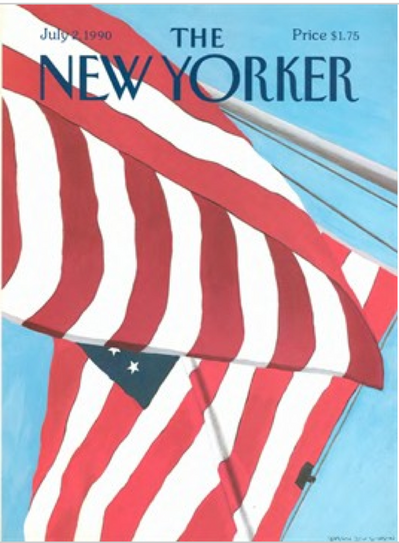
Credit: Gretchen Dow Simpson, The New Yorker, July 2, 1990. (We wrote about Simpson back in 2005 when she won a Pell grant.)