
I’m not ashamed to admit it’s been an emotional week. I covered the New Yorker Festival for the fourth year in a row (the first year, I reported on numerous events for Beatrice, whose editor, Ron Hogan, was one of the first believers in this site). As I sat in the audience for one excellent production after another–as you may have observed from my posts to our group Twitter feed experiment, I was particularly moved by the Town Hall on race and class and the beatific Lynda Barry–I also felt wrung out.
I’ve been an unshakeable admirer of The New Yorker since I first became aware of it on my parents’ coffee table, my grandparents’ bookshelves, and the walls around me. (I even published a poem about it once, when I was trying to combine journalism and poetry, a risky combination that my former Nation colleague Bruce Shapiro used to warn me about.) And I’ll always be dedicated to it: to promoting its contents, verbal and visual; to celebrating its staff and contributors, past and present; to reading it weekly, to providing it for others; to its standards, values, morals, traditions, and style. I’ve enjoyed writing about various aspects of the magazine and its contributors for other publications, including, of course, Print, of which I am now editor-in-chief and which deserves all my tender loving care. I’m also working on a book whose subjects include some vital and oft-overloked New Yorker players, so perhaps we’ll see that on our Kindles someday.
It’s hard not to be grandiose about something that has meant so much to me for nearly four years; after all, we’re just another blog in the hysterical hive that online reading has become. It surely means more to me than to anyone else that as of today, I am stepping down as the editor of the first publication I have ever created, art-directed, and overseen in its entirety from the first day of its existence.
Fortunately, I have some very good news, for me as well as for you. Martin Schneider has been writing for Emdashes, and doing double duty as part-time editor, for almost exactly two years. Especially considering that he has never seen a dime from his fine work for me (the site has never made a ha’penny), he’s been a consistent, sustaining, and invigorating presence both on Emdashes and, often from afar, in my life. He’s helped me bring in and shape the work of other writers and artists, and has long been a wonderful colllaborator in every way. He is a keen reader of The New Yorker as well, and has done many fascinating explorations into the Complete New Yorker archive; he’s a thorough and responsible reporter who’s worked at Brill’s Content, among other publications; he’s a serious reader of literature and history (and is now a university-press book editor for a living, so he gets to see some meaty stuff before we do); he’s a discerning consumer of pop culture, from music to comedy; he’s a bird-watcher; and he lives in a remote village in Austria, so he has an enviably healthy perspective on all things media and New York City.
So let’s welcome Martin as editor of Emdashes–which more than one wit has suggested we rename “M-Dashes,” or, in one case, “Mendashes”–and you’ll see me around. I’ll continue as publisher and tester of the remarkable patience of our brilliant site designers at House of Pretty in Chicago; I’ll enjoy the pleasure of editing Jon Michaud and Erin Overbey’s deliciously informative column “Ask the Librarians,” to which you should continue to submit your questions; and I’ll contribute occasionally when, as the Quakers say, I am moved to speak.
Till then, I remain yours, very truly. Thank you.
Category Archives: Personal
The Brothers Grimm and George Herbert Explain It All to You
(Love bade me welcome, yet my soul drew back,
Guilty of dust and sin.)
“You, Cinderella?” she said. “You, all covered with dust and dirt, and you want to go to the festival? You have neither clothes nor shoes, and yet you want to dance!”
(But quick-ey’d Love, observing me grow slack
From my first entrance in,
Drew nearer to me, sweetly questioning
If I lack’d anything.)
However, because Cinderella kept asking, the stepmother finally said, “I have scattered a bowl of lentils into the ashes for you. If you can pick them out again in two hours, then you may go with us.”
(“A guest,” I answer’d, “worthy to be here”;
Love said, “You shall be he.”)
The girl went through the back door into the garden, and called out, “You tame pigeons, you turtledoves, and all you birds beneath the sky, come and help me to gather:
The good ones go into the pot,
The bad ones go into your crop.”
Two white pigeons came in through the kitchen window, and then the turtledoves, and finally all the birds beneath the sky came whirring and swarming in, and lit around the ashes. The pigeons nodded their heads and began to pick, pick, pick, pick. And the others also began to pick, pick, pick, pick. They gathered all the good grains into the bowl. Hardly one hour had passed before they were finished, and they all flew out again.
The girl took the bowl to her stepmother, and was happy, thinking that now she would be allowed to go to the festival with them.
(“I, the unkind, the ungrateful? ah my dear,
I cannot look on thee.”
Love took my hand and smiling did reply,
“Who made the eyes but I?”
But the stepmother said, “No, Cinderella, you have no clothes, and you don’t know how to dance. Everyone would only laugh at you.”
Cinderella began to cry, and then the stepmother said, “You may go if you are able to pick two bowls of lentils out of the ashes for me in one hour,” thinking to herself, “She will never be able to do that.”
The girl went through the back door into the garden, and called out, “You tame pigeons, you turtledoves, and all you birds beneath the sky, come and help me to gather:
The good ones go into the pot,
The bad ones go into your crop.”
(“Truth, Lord, but I have marr’d them; let my shame
Go where it doth deserve.”
Two white pigeons came in through the kitchen window, and then the turtledoves, and finally all the birds beneath the sky came whirring and swarming in, and lit around the ashes. The pigeons nodded their heads and began to pick, pick, pick, pick. And the others also began to pick, pick, pick, pick. They gathered all the good grains into the bowls. Before a half hour had passed they were finished, and they all flew out again.
The girl took the bowls to her stepmother, and was happy, thinking that now she would be allowed to go to the festival with them.
But the stepmother said, “It’s no use. You are not coming with us, for you have no clothes, and you don’t know how to dance. We would be ashamed of you.” With this she turned her back on Cinderella, and hurried away with her two proud daughters.
(“And know you not,” says Love, “who bore the blame?”
“My dear, then I will serve.”)
Now that no one else was at home, Cinderella went to her mother’s grave beneath the hazel tree, and cried out:
Shake and quiver, little tree,
Throw gold and silver down to me.
Then the bird threw a gold and silver dress down to her, and slippers embroidered with silk and silver. She quickly put on the dress and went to the festival.
Her stepsisters and her stepmother did not recognize her. They thought she must be a foreign princess, for she looked so beautiful in the golden dress. They never once thought it was Cinderella, for they thought that she was sitting at home in the dirt, looking for lentils in the ashes.
“You must sit down,” says Love, “and taste my meat.”
So I did sit and eat.
–From “Cinderella,” by Jacob and Wilhelm Grimm, and “Love (III),” by George Herbert
So Many Changes Afoot I Think We Have to Call Them Changes Afeet
I have a new job, so you may see some changes around here, but don’t be scared. In the meantime, save the date: Emdashes’ fourth anniversary is this December, so we’re going to have a party. Yes, we are!
I’m Back
Report: Canada remains superb in all ways. I’m delighted to see all the swell posts created in my absence; sometimes it’s nice not to be needed!
The Wavy Rule, a Daily Comic by Paul Morris: Tilley Meets His Maker
As you might expect, since I just spent a number of months collecting material for a piece about Rea Irvin for PRINT, I am in love with all things Irvin. Paul–whom I thank in the piece because he’s shared numerous invaluable resources and insights with me about Irvin’s aesthetic–is as keen on the early years’ co-genius as I am. About this cartoon, he writes: “Inspired by the photograph of Irvin in Lee Lorenz’s wonderful The Art of The New Yorker. A must read.” I agree. Sweet Knopf: Please bring it back into print! Click to enlarge.
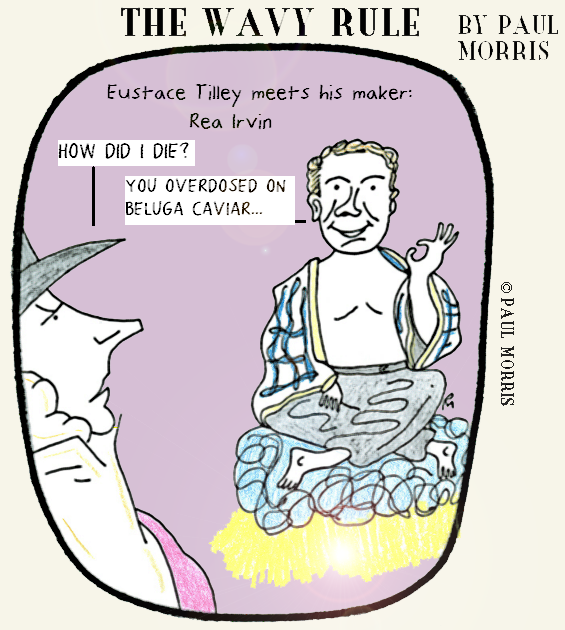
More Paul Morris: “The Wavy Rule” archive; his very funny webcomic, “Arnjuice,” a motley Flickr page, and beautifully off-kilter (and freely downloadable) cartoon collections at Lulu.
I Wish I Could Limn-y Like My Sister Kate
On The New Republic‘s site, there’s a good video co-starring my brainy sister Kate, a progressive energy policy analyst, who’s lately been working with Newark mayor Cory Booker (about whom Peter J. Boyer wrote an excellent Profile early this year) on labor and environmental projects:
As part of TNR TV’s series about the new environmental movement, TNR reporter Dayo Olopade sits down with environmental activist Kate Gordon and policy specialist Bracken Hendricks to discuss whether “green jobs” can actually help solve the current economic crisis.
Just in case you haven’t read Elizabeth Kolbert’s piece on the Danish carbon-footprint-reducers, by the way, it’s really something special. (Warning: It will make you feel weird about flying.) The New Yorker has been doing a swell job upholding its reputation as a leading voice on the environmental crisis, I think. Its coverage of China has also been increasing dramatically, if I’m not mistaken–I can think of half a dozen recent pieces that are gradually mapping China’s environmental, social, educational, athletic, architectural, financial, and musical life in intensely entertaining detail.
We’re Upgrading, and You May See Some Strangeness
Emdashes is upgrading to a new version of Movable Type–hurrah!–and that means that for the next day or so, you may witness some weirdness on the site, and commenting may be temporarily unavailable. Don’t worry! I suggest Sleepytime Tea, with a little brown sugar and milk. Yes, you can use soy milk. No, the bear is just dozing off naturally.

Emily Fox Gordon, I Have Your Fan Letter
I’ve never met the Texan author of the well-reviewed memoirs Are You Happy? and Mockingbird Years, but I do have an email for her that someone sent to me, hoping it might reach its destination via the Emily Gordon Underground. It’s a nice email, so E.F.G. (I like the way your initials contain that lilting second phrase from the alphabet song), get in touch if you’d like to see it!
Study: Listening to the Blues Actually Helps
If you are blue, says a leading study just released by a prominent researcher in this field, letting a gigantic boxed set of John Lee Hooker (a.k.a., on these discs, Texas Slim, Johnny Williams, and John Lee Booker) play through on your iTunes can in fact pick up your spirits to a remarkable degree. Although you very likely aren’t experiencing the very set of root causes that led the form’s originators to construct their melancholy melodies, you may still be surprised by the songs’ effectiveness on your sorry Weltschmertz or just plain old peevishness. The study cites one tune, entitled “Sally May,” that may be about a no-good woman, but could just as easily be about a knee-breaking student-loan collective.
Additional note: The study was conducted on myself, by myself. As everyone secretly knows, this is a rock-solid indication of applicability to all.
I Haven’t Slept a Wink! I Win!
I get Details because a friend of mine used to work there, and now it just keeps coming, no matter what I do. I always read Michael Chabon’s column; other than that, I marvel at the masculine anxieties that drip from it like expensive sweat. In the current issue, though, there’s a piece to shout hallelujah for: Greg Williams’ “Being Tired Is Not a Status Symbol.” Why not take the pledge to try not to say you’re exhausted when you’re really more like…well, let’s let the dictionary-and-thesaurus widget provide a few good suggestions (click, if you can, to enlarge):

Note that the Oxford American Dictionary, which kindly provides this widget (one of my favorites), suggests that one might be “exhausted by battling a terminal disease.” I remember the cover of a book I used to have called How to Tell When You’re Tired; it had a photo of, perhaps, a coal miner, covered in grime. He was probably pretty knackered by dinnertime. Delivering a baby can merit “exhausted.” A Details commenter adds:
This is a uniquely American behavior as far as I can tell. I live in Europe and I rarely hear this kind of “bragging†from Europeans, but as soon as I meet an American, all I hear are “I am exhausted, I am sooo busy,†as if this is something to be proud of. It is connected to the Blackberry mentale, and the final-exam-week mentale. All it means is that you are unable to prioritize your life and take care of yourself. To be truly cool, one would make it look effortless.
Next time you revive, try out the phrase, “I’m not sleepy, and there is no place I’m going to.” But I’ll stop wearing you out with this tirade, which may well tax the easily drained.
There’s one more story I’m planning to read in the current Details: something (I can’t find it on the website) by Mac Montandon of Silence in the City fame. It’s nice to see his alliterative byline; in case you were wondering, he is not one of Sean Wilsey’s stepbrothers, just a nice guy who writes.