
Each week, the staff of Emdashes (the unflagging Martin Schneider, faraway but beloved intern John Bucher, and me) put the blue ribbons on the outgoing issue’s buttermilkiest Wilburs.
Michael Crawford’s Chekhov cartoon made me laugh; why do people think you’re looking for a conversation if you’re reading in public? It is just the opposite, friend. As for the caption contest: Two of the three entries are quite decent, including David Wilkner’s “I’d like to get your arrow count down” (though Phyllis Mass’s “Have you tried sleeping on your side?” is clearly the funniest, and besides, she’s Phyllis from Philly! How can the judges resist?), and one (“Native American craftsmanship”—sorry, Norm Tabler of Indianapolis) is in surprisingly bad taste. And David Baker’s poem “Never-Ending Birds” is terrific: the best I’ve read in the magazine in recent memory.
In John Colapinto’s Paul McCartney profile, “When I’m Sixty-Four,” McCartney laughs to think of the classically trained musicians who were too snooty to clap on “Hey Jude”; in “How I Spent the War,” Günter Grass shivers to think of the German soldier “Wedontdothat,” who was too—what? we’ll never know—to hold a gun for the Reichsarbeitsdienst. I thought I sensed a note of ambiguous envy in Grass’s description of this perfectly Aryan pacifist.
By the way, ever since I started Emdashes on New Year’s Eve Day, 2004, I’ve been aiming for the perfect reading rhythm wherein I consume the magazine from cover to cover, with nothing omitted, before the new issue arrives. Yesterday, I reached my goal—that is, not only reading everything, but having that feel perfectly natural and reasonable. Now it’s hard to believe it once seemed like an uphill hike, and I read other things this week as well, in case you were wondering. It’s all about gradual conditioning, and you can do it, too! Anyway, that means I have a few more issue favorites to add, and I probably will, as is my wont. Also, if you were as keen on Paul Theroux’s Turkmenistan travel story as we were, you’ll also want to read Theroux’s interview on the subject with Radio Free Europe. —EG
All the best blogs in the left-wing blogosphere were discussing and debating Jeffrey Goldberg’s fine Letter from Washington about the Republican Party’s recent woes. As the caption for the expert Finn Graff illustration inquires, “Tom DeLay, Newt Gingrich, Karl Rove—who’s most to blame for the Republican Party’s disarray?” Really, the proper question is, Why stop at those three? Also worth a look is the centerpiece advertisement, for the 2007 Blue Planet Run, an around-the-world relay undertaken by twenty runners (!) in an effort to finance “safe water projects around the globe.” The first runner left New York City on Friday. Two MoMA-related items: Nestled in TOTT is an ad for the upcoming Richard Serra exhibition; the pic just looks cool. In GOAT, on pages 24 and 25, is a remarkable photograph by Israeli artist Barry Frydlender—he’s got a solo show at MoMA all summer long. I saw it last week; highly recommended. —MCS
This issue had three things I tasted, recoiled from, and then decided were pretty good: Adam Gopnik’s refusal to, like, edit the shibboleth of youth out of Lacy and Lily’s museum-trip musings; the seamless dramaturgy of David Sedaris’s Reflection on Jackie, the neighborhood child molester; and Paul McCartney’s marveling at the luck of being Paul McCartney (“And there was one guy who wrote ‘Yesterday,’ and I was him”), in an excellent article by John Colapinto. —JB
Category Archives: Pick of the Issue
Pick of the Issue That Wasn’t: My Favorite Story in the May 14 Issue
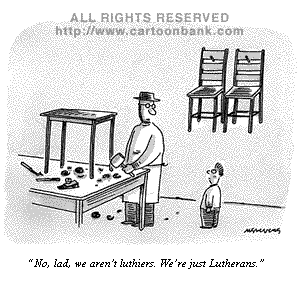
Apologies to Mick Stevens, and all religions. And kudos to Burkhard Bilger for writing such a kick-ass piece about visionary guitar builders. I was in Wolcott, Vermont, or thereabouts, yesterday and saw a sign for a custom guitar shop; I wonder if that guy knows Ken Parker, the subject of Bilger’s profile (not a Profile, I know, but it’s kind of a profile anyway)?
Here’s the original cartoon to which I refer in my Photoshop adulteration there. Wasn’t it in the magazine just a few months ago rather than in 1999, or am I confusing dates and times again? It does happen.
5.21.07 Issue: Very Linky, But Not Lactose-Free
In which some or all of the staff of Emdashes (me, the masterly Martin Schneider, and cherished intern John Bucher), put the blue ribbons on last week’s Wilburs.
I’ve got to give it to Larry Doyle’s Shouts, “Share Our Joy,” for signaling the magazine’s elegant long jump into true interactivity with a) a story that has ersatz links in it, 2) the actual links in the story online, and 3) additional web content now featured, subtly and tastefully, under selected print stories (the more the better, in my opinion). For instance, Peter Schjeldahl’s Edward Hopper review has an accompanying slide show, noted right after the print story, just where it’s needed. Jill Lepore’s “The Meaning of Life” was an intense pleasure to read: informative, bold, and dreamy, all at once. Anthony Gottlieb’s review of books about atheism was a highlight, too, and prompted a pleasant memory of Paul Bloom’s terrific Atlantic story “Is God an Accident?” I loved these Barsotti, Crawford, and Talk, to a deathless libretto from my own educational era: You know the one: “The macaroni’s soggy,/The peas are mushed,/And the chicken tastes like wood.” —EG
Best somewhat creepy lactic metaphor: no, not the milk of human kindness, but this one, by Anthony Lane in his Talk about the French elections. “Awaiting your hero for more than two hours is no hardship to the faithful; standing for two hours without earplugs, however, while the cream of soft Euro-rock is hosed into your consciousness, is another matter.” —JB
Nancy Franklin Is Back!
Because I’m so delighted to see that Franklin is back from her leave at long last, I’m awarding immediate Pick of the Isssue to her review this week of the Eddie Izzard show The Riches on FX. When the designer, the illustrator, and I were plotting this site’s redesign, we thought of the Pick of the Issue pig as Wilbur from Charlotte’s Web, just after his buttermilk bath, sweet-smelling, beautified, and ready for the fair. I think every appreciator of criticism that’s as painstakingly crafted and humanistic as it is achingly funny would agree that Franklin’s reviews are terrific and radiant, and I can attest to the humble part. This is really worth celebrating! N.F., welcome back from all your fans, and there are a lot of us.
Speaking of Wilbur, has anyone gotten to the new Charlotte’s Web movie yet? I was wary of the casting, but it’s getting fairly good reviews. I’ll be seeing it.
Be Careful!
The February 19 & 26 issue of the magazine is so good it’s in danger of exploding.
Unrelated, yet essentially the same:
Ellington was appalled by the very thought that jazz might “develop” to the point where people could no longer dance to it. When he said “jitterbugs are always above you,” he wasn’t really complaining. They might have kept him awake, but he wanted them to be there. He was recalling the sights and sounds of New York life that he got into “Harlem Airshaft,” one of his three-minute symphonies from the early 1940s. If he had put the sounds in literally, one of his most richly textured numbers would have been just a piece of Âliteral-Âminded program music like Strauss’ Sinfonia Domestica. But Ellington put them in creatively, as a concrete transference from his power of noticing to his power of imagining. Ellington was always a noticer, and in the early 1940s, he had already noticed what was happening to the Âart form that he had helped to invent. He put his doubts and fears into a single funny line. “It don’t mean a thing if it ain’t got that swing.” Characteristically, he set the line to music, and it swung superbly. But under the exultation, there is foreboding. Ellington could see the writing on the wall, in musical notation. His seemingly flippant remark goes to the heart of a long crisis in the arts in the 20th century, and whether or not the crisis was a birth pang is still in dispute.
—Clive James, “The Astonishing Duke Ellington,” Slate
Obvious caption for this week’s contest: “I don’t care if she is the recently sawed cross-section of a tree. I love her.”
Do Reporters at Large Have Personal Histories?
Easily checkable fact: Katherine Boo is a kick-ass reporter, as is demonstrated in her searing (search the blog and my clips; I defy you to find me using that word carelessly) story about teen mothers in Louisiana, published in February (here she talks to Matt Dellinger about reporting it); and, this week, in “Expectations,” Boo’s dispatch from an endangered public school in Denver. Her reportorial insight is astounding; her prose is a course in style and structure.
Menwhile, this issue (January 15) has the potential to be a C.G.I., or Completely Good Issue, which always thrills me, though it’s not easy to achieve. So far, I also love Shalom Auslander‘s “Playoffs,” which shouldn’t even be described, just read. It’s such good writing, it’s so funny and irreligious and perfect, it made me choke up and grin and want to give him caramels; this rabbi agrees.
Meanwhile, I’ve spent weeks in an aphasic cocoon, trying to find the words to praise another recent Personal History. You know the one, or you’d better: Tad Friend’s wistfully confrontational portrait of his mother, from (I think) this past December. It was so good it made me angry, and I couldn’t calm down for hours. I thought: Goddamn it, Tad Friend, why have you been writing nonchalantly jokey TV reviews when you could have been forging transcendent pieces like this? Get back to work on the book this is surely destined to become, and quit fooling around! I was furious with admiration as I read it. Why spend this sensibility on the toga-partiers of HBO? Popular-media criticism takes finesse and heart; it’s not for the casual visitor. Save your strength!
I also dug Julian Barnes’s memoir “The Past Conditional.” And a slew of others, almost all, if not all, by men. I’ve been reading The New Yorker especially closely for the past two years, and I can hardly remember any first-person stories by ladies besides Caitlin Flanagan. Am I wrong? I entreat you to correct me. I want to be corrected. I repeat, I’m an open-armed appreciator of Ian Frazier, Nick Paumgarten, Calvin Trillin (of course), Donald Antrim (double of course), John Lahr (ditto), Orhan Pamuk, David Owen (more David Owen!), John le Carré, David Sedaris, Roger Angell, Bill Buford, Sean Wilsey (who I trust will be appearing in the magazine again this year), Ben Bradlee, Adam Gopnik, and so on. It’s not a question. I look forward to them and I relish them.
I’m also wondering, don’t Nancy Franklin, Susan Orlean, Elizabeth Kolbert, Joan Acocella, Jane Kramer, Stacy Schiff, Rebecca Mead, Lauren Collins, Meghan O’Rourke, Larissa MacFarquhar, Jill Lepore, Jane Mayer, Margaret Talbot, Katha Pollitt (a friend who’s written excellent first-person essays for the magazine, but not recently), Connie Bruck, Judith Thurman, Susan Sheehan, Cynthia Zarin, Lillian Ross, Claudia Roth Pierpont, Elsa Walsh, etc., have funny, meditative, idiosyncratic reminiscences they’d like to develop into gleaming, tenderly calibrated personal essays? Because I’d really like to read them, please.
Not everyone can write memoirs, of course, or wants to, but it’s always pleasing to see nimble writers stretch. I know how many editors at the magazine are women, and how many writers (even if they don’t appear as often as I’d like), and protest horns have already been sounded in that arena. For now, I’m hoping that in 2007 we’ll witness more of these New Yorker writers wielding the capital letter “I.” No magazine is perfect, but there are ways for this one to inch ever closer.
The December 4 Issue Is Scaring Me
It is just so good. So good, in fact, that it threatens to be a CGI—a Completely Good Issue, from GOAT to reviews (I’ll leave out the Caption Contest since there’s an element of randomness and bafflement to that)—and there’s been more than one CGI in the past few months. What’s more, there’s a pleasing plethora of women contributors to this issue, and between Elizabeth Kolbert’s transcendent picture-book review (with a kicker that will squeeze your heart like a fistful of Play-Doh) and Margaret Talbot’s Bratz story, there appears to be some kind of writerly celebration going on. A gleeful Munchkin song on the departure of the Wicked Witch of the West? Whatever it is, it’s music to my ears. All that’s missing is Nancy Franklin—as the DJ says in Valley Girl, “Like, come back soon, y’know?”
October 23 Issue: Grandees
Best Talk: “Nuke Rebuke,” Steve Coll. Of course, the Picasso story shouldn’t be missed.
Best entertaining thing before “The Critics”: Lauren Collins’s “Mink Inc.”
Best frightening thing before “The Critics”: Michael Specter’s incredible “The Last Drop.”
Best thing in “The Critics”: John Lahr, when he writes, tends to win this category.
Best poem: Let’s make a pact, fellow sonneteers and others (that means you) in need of metrical sustenance: Read first, then judge. I liked Brad Leithauser’s “Son.” Why aren’t the poems ever online? I’ve asked this before.
Best cartoon: discussed here.
Best Critic’s Notebook: You don’t read these too regularly, I sense that, and that’s a crying shame. Excerpt from Sasha Frere-Jones’s “Brut Force”: “Eddie Argos, the leader of the London band Art Brut, likes to get right to the point. In a song about a brand-new girlfriend, he sings, ‘Got myself a brand-new girlfriend, so many messages to send, got myself a brand-new girlfriend.’ Another song, about forming his band, leaves equally little room for interpretation: ‘We formed a band, we formed a band, look at us, we formed a band.'” I like all the critics at this length; they get to do something fun in the space, and it’s often just what you wanted to know.
Best note in GOAT (that’s Goings On About Town): “Some guitarists are bent on cramming together as many notes as possible.” Tied with: “Walking underneath it prompts a nice pleasure-fear frisson.”
Best ad: Much as I genuinely love advertorials, and I’ll be revisiting those in the magazine in months to come (there’s a new writer for the Hawaii ad-icles, did you notice?), I must say the mirthful mummies in the Queen Mary 2 ads freak me out and hold me captive. Vaguely Tilley-ish type on those. I’d like to know what face that is—gotta befriend this Gert Wiescher guy. Actually, I’m going to write him and see if he’ll give me an interview. Won’t that be fun?
Hey ho, looks like the intrepid Matt Dellinger and his hearty crew have done something new on newyorker.com: linky bios for the current issue. Nice idea. Aw, poets too!
Funniest Cartoon This Week
“New Cocktails” by Sam Means, p. 84. The Jason Patterson drawing (p. 80), which is strange and spooky, is also good. (Here are all the current cartoons.)
This post to be expanded as I see fit, with my favorite pieces, etc., from last week and what I’m looking forward to reading first this time around. But I can tell you now that my favorite cartoon from last week was Drew Dernavich’s “How were you supposed to know he was the sex critic for the ‘Times’?†I also liked “Mind if I change melons?†(Peter Mueller), “You can’t spend your political life hiding behind being Canadian” (William Haefeli), and “Am I having an affair? Why? Am I allowed?” (Carolita Johnson). Ed Koren, I always like.
By the way, I just opened my email to find that “New Cocktails” is also the magazine’s own Cartoon of the Week, which is a coincidence, but also suggests that everyone can see how funny it is.
Ladies and Gentlemen, John Lahr (and Your New Emdashes!)
Not for the first time, Lahr takes the cake; his Helen Mirren profile was typically compassionate, deeply layered, studiously researched, and written so skillfully that reading it isn’t really reading, it’s more like gently tapping the top of a crème brulée for the silky treat that’s finished far too soon. There were some other plums in the icebox—plum puddings, to stretch the metaphor—including David Denby’s deft mini-essay on the corruption of power in his review of All the King’s Men and The Last King of Scotland.
As for this week, here’s what I suspect I’ll be reading first in the magazine: Anthony Lane on Stephen Frears’s The Queen, to test my theory that the quip-addled Lane in fact writes best about serious films, and the studious Denby often shines when he gets to tell a joke or two. Next, Adam Kirsch on Hart Crane. And when I’ve got the time and the gumption, Atul Gawande’s piece about “How childbirth went industrial” is a must. I like the look of this, too: a “Dept. of Amplification” by Richard Preston: “Tall for Its Age: Getting to the top of a record-breaking tree.”
And speaking of rings of growth, this is Emdashes’ new bark; as before, there’s a bit of bite for those who like that sort of thing. Mostly, though, there’s the absolutely gorgeous work of web geniuses Pretty and the gifted illustrator Jesse Ewing, and any glitches you see in these early days—and you’ll see ’em—are entirely attributable to me. This may be because I haven’t yet snagged my ideal intern, Mlle. Emily Gordon of the Cornell Daily Sun, whose excellent articles I read so often via Google Alerts. E.G., you’ve got an internship waiting for you! Just drop me a line and I’ll get you started on all kinds of exciting projects. Free popcorn!
To paraphrase a witty Carolita Johnson cartoon, We may now begin our insane experiment! Loyal readers, thanks for nearly two years of Emdashes adventures, and newcomers, have some pudding. Or bark. Either way, you’re in safe hands.
Coming soon: a brand-new edition of Ask the Librarians, the column co-written by New Yorker librarians to the stars—and stars themselves—Jon Michaud and Erin Overbey. Send your questions for Jon and Erin to askthelibrarians@emdashes.com, and I’ll forward the best of them. In coming weeks, I’ll be introducing some excellent new contributors to Emdashes (even besides the promising young Ms. G). Best of all, it’s New Yorker Festival week, and that means I’ll be covering and commenting on everything from Steve Martin to the New Pornographers and—well, it’s going to be something else, so stick around, won’t you?