Ed Koren, Barbara Smaller, and David Sipress! This is a great series. Buy your tickets and get more info here.

Click to enlarge.

Ed Koren, Barbara Smaller, and David Sipress! This is a great series. Buy your tickets and get more info here.
A profile of Carl Gable III, writer of “Well, that was abominable,” the wittiest caption submission I’ve seen in quite some time. If I’m not mistaken, the magazine didn’t print his “III.” Well, if there’s any justice, they’ll print his caption, right on the Harry Bliss drawing, forevermore.
I haven’t written about the contest lately since I like to give it serious thought, and time has been short. But in case I didn’t say so already, “Are you now, or have you ever been?” is truly a caption for the ages, and Stuart Spitalnic of Saunderstown, R.I., please google yourself and drop me a line so I can interview you. I may even call. For now, I just bow to you, deeply.
Speaking of interviews, I’m now providing caption contest winners a reunion service as well as a cheerful series of inane questions; an old friend of a contest winner recently reconnected with her old pal through the emdashes switchboard. Send your missing-cartoon-persons queries here!
Welcome news of a Liza Donnelly event:
Liza Donnelly, New Yorker cartoonist, will give a talk with slides about the history of cartoons at The New Yorker—specifically, the female cartoonists of the magazine. She will discuss her book Funny Ladies: The New Yorker’s Greatest Women Cartoonists and Their Cartoons (Prometheus Books, Fall 2005).
Monday, March 6, at the MoCCA Gallery, 594 Broadway Suite 401, 6:30 p.m. Free to all! Doors open at 6:15. Attendees are advised to arrive early, as seating is limited.
Here’s my review of Funny Ladies, which I’ve found is a terrific gift as well as a vital read for any real New Yorker fan.
What a few NYer cartoonists are up to (links mine, all mine):
Not only is Diamond [Foods Inc., “the $428 million producer of walnuts for cooking and snacks”] spending big on a single Super Bowl ad, it’s also launching an extensive print ad campaign, with quarter-page ads alternating in the New York Times and USA Today for 10 days leading up to the game.
The ads, by New Yorker magazine cartoonists J.C. Duffy and Jack Ziegler, have the same wordplay theme as the TV spot.
While I was looking for an image of said nut cartoons, Google yielded this phrase: “Diamond Foods’ Emerald Nuts division is buying advertising space in The New …” Yorker? Maybe. Could be The New Republic, The New Social Worker, The New Criterion, The New England Magazine (circa 1886), any number of others. Page is gone and uncached. Uncashewed, one might say. Ah, it’s The New York Times. So much for synergy. The previous link appears to contain a small, grainy version of the Ziegler/Duffy cartoon in question, and I invite you to enjoy it, if you can. Or look at the crossword section of the Times tomorrow. You heard it here first, sorta.

An interview with Bob Mankoff during the recent Humor on the Slopes ski-and-pen-fest in Colorado’s Vail Valley:
Mankoff, now cartoon editor of The New Yorker, goes through about 1,000 cartoons every week, narrowing them down to about 35 before he meets with the editor-in-chief and the managing editor to select the 15 or 16 that get published in the weekly magazine.
Mankoff said he rejects cartoons that are too silly, too raunchy or even too funny for The New Yorker.
“I mean, picture this: You’re in the middle of reading a very important article in The New Yorker, and then you’re laughing because you got distracted by a cartoon, and you have to go to the bathroom because of all the laughing … come on people, please keep the humor at a minimum,” Mankoff said.
…
Mankoff said humor is an immensely important “counter weight” in journalism.“I think cartoons basically say, ‘the world is ambiguous,'” Mankoff said. “They cut down to size all the issues that seem so big.”
You know, I thought these lower-case heds were so cute when I started emdashes (that’s lower-case, too). I think I’m going to switch to standard hed style, Majors Capped.
First things first: What do your friends and colleagues call you? Is there a nefarious T. Doyle you’d prefer not to be confused with?
It’s T. C. and always has been since day one. Conflicting stories as to why. One is that the TV cartoon show of the day, Top Cat, had a namesake character who was T. C. to his fellow alley cats. Supposedly that appealed to my father, but I wonder. He studied the classics at Princeton in the ’50s and there is nothing cartoonish about him save for occasional phone call from two thousand miles away asking me where “the big screwdriver is.” He does that because he recalls that I was “the last person who used it.” At the time, Reagan was probably running for re-election.
Are there a whole slew of parks in Park City?
Park City does indeed have parks. Officially we are known as the home of the U.S. Ski Team. We hosted several Olympic events in 2002 and have three major ski resorts out our back door. Parks? We got ’em. Including the one behind my house where you can ski jump, luge and bobsled all in the same day.
Is everyone there excited about your caption win?
One woman rang the other night and suggested a connection. Something about common interests and close proximity. Her voice was breathtakingly sexy. Friends have rang and been gracious and generous with praise.
When did you begin reading The New Yorker?
My parents always had a subscription, so I read cartoons as a kid. Later I would pick up the magazine at the airport when I traveled on business. A decade or so ago, my father-in-law gave me a subscription for birthday gift. He’s retired and reads every issue cover to cover. He shares his love of fine things generously. That’s why I will give to him whatever the magazine shares with me.
Who are your favorite New Yorker cartoonists?
I have several favorites, one from another era. That’s Thurber. “The Catbird Seat” is one of my all-time favorite short stories. It’s urban. It’s absurd. And it makes perfect sense to me, a kid from Indiana who once asked Santa for a filing cabinet. I did. When I was a kid, my parents had a cabin in Michigan, in Grayling on the Ausable River. Think pine trees as tall as goalposts, mosquitoes as hungry as stray cats. Supposedly a great place to catch rainbow trout. (I caught only poison ivy.) Inside was a ping-pong table and a record player accompanied by a Trini Lopez album and a Kingston Trio record. And there was Thurber. A whole book of him. I read it over and over while waiting for vacations there to come to an end.
Early in my career, I was introduced to Roz Chast by a co-worker. Actually she introduced me to the work of Chast’s husband, Bill Franzen. She gave me a gift that I have to this day: his book of short stories entitled Hearing From Wayne. Like Thurber’s, his stories are absurd, though more accessible. In one, a guy figures out how to make a buck creating phony “souvenirs” supposedly created by God himself in the aftermath of a tornado. It’s hilarious. When I learned that he was married to Chast, I started looking for her work in The New Yorker. I later bought a copy of one of her books from the 1980s, Mondo Boxo.
Finally, I have become a huge fan of Bruce Eric Kaplan’s work. Small, brutish figures lost in city life? Each with aggressive or callous or senseless points of view? I love that. I recall one often. It is of a man striding purposefully down the street. I think he wears a trench coat or suit jacket and clutches a briefcase in one hand. Outwardly, he appears in command of his world. But the balloon above his head belies his self-assured, confident ways: “Now what is it again I am always thinking?” I hope I got it right. The point is simply this: no matter the exterior, people are often lost, woeful or trapped in circumstances beyond their control, often without their knowledge. It’s just hubris, pocket change and non-striking transit workers that keeps them going.
Did you submit captions to any other contests before this one?
I did. Contest No. 29, the one I won, was my third or fourth attempt.
What’s your favorite non-winning caption so far, either by you or someone else?
My wife, Naomi, had one for Tom Cheney’s recent drawing that I laughed at. His drawing was of the monster truck that somehow found its way on stage and interrupted an orchestral performance. In that one, the lead violinist is addressing the audience. Her quip: “Please excuse me, I am going to have to cut this short. Apparently my date from eharmony.com has arrived.”
On to the strange coincidence of T. C. Doyle and T. C. Boyle appearing in the same issue of The New Yorker. Are you a fan of his writing? Any particular story or novel?
I have not read his work.
Boyle studied 19th-century British literature. Do you have a favorite 19th-century British novel? Or another highly recommended book for 2006?
How about Robert Louis Stevenson’s Treasure Island? One Michigan-free summer I ran afoul of my aforementioned father. Some sin of a broken window or a promise, no doubt—I cannot remember. But I do recall the punishment. He made me write a book report on Treasure Island. I typed it myself on the very manual Royal typewriter he used at Princeton. A few years later, I carried it to the University of Illinois where I banged out a few never-to-be-published short stories. That’s how I taught myself to type. Funny thing, though I write professionally, I still use only three fingers when banging away. And though I have been a journalist for two decades, I still look at the keys.
The same author once challenged readers to write “a story, a memory, a recollection, a re-imagination: 1970 in two-hundred [sic] words or less.” How would you sum up that year in a sentence? Or a haiku?
1970? Hmm… How about this:
Avoid Michigan.
Way too much poison ivy.
Must you? Take Thu
rber.
Boyle drew a comic called “I Dated Jane Austen.” Which author (living or not) would you most like to take a canoe trip with?
God, back to Michigan. Wait. Thinking Big Two-Hearted River. Nick Adams. A gun, I suppose. Surely there was a canoe. Someone in Michigan always has a canoe or at least access to one. So I would pick Hemingway? That’s the author to take on a canoe trip. Wouldn’t matter how well you paddled or how many fish you caught. Rivers there run fast and the currents are strong. After a few bottles of Spanish cava red, which we’d drink while slapping some rods and reels at the water, navigation would be left to chance. Even I’d go back to Michigan for that trip.
Your caption is a deliciously witty commentary on both pollsters and politicos that brings to mind many real-life elected officials. Boyle’s much-anthologized short story “Greasy Lake” begins, “There was a time when courtesy and winning ways went out of style…” Would you say that’s the case in Washington at the moment?
I’m sorry, I was just reading some fine things Tom DeLay had to say about bipartisan cooperation.
Speaking of which, the politician in Wilson’s caption seems awfully young. How do you think he got elected?
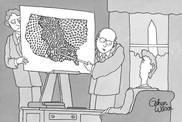
He is awfully young. And vulnerable. And that I believe is key to the cartoon. I honestly didn’t see the obvious caricature of the Cheney-like figure delivering the bad news to the shell-shocked President. In retrospect, it clearly is there. But the character is a bit too young and a bit too shocked for our current leader. No, I went with a young, perhaps ambitious, but certainly naive congressman hearing the worst, the absolute worst. So I asked myself, what is the most awful thing you could do to constituents, the thing for which even you, a man of ambition and unshakable belief and self-love would know in an instant would be too much to overcome? Lie to them? Nah. Cheat? Swindle? Nope, gotta be worse. My answer was there in the drawing, in the crustacean-like, single-cell-looking objects that conjured microscopes and test tubes and Petri dishes. And then it hit me: infect them. That would be bad. Way bad. You cannot do worse to voters than infect them. No apology could save you, no rationale could explain your way out of a mess like that. And the spinmeister behind the board in the left hand corner of the cartoon knows it. His certainty of pending doom was the inspiration for my quip.
How his client got elected in the first place, God only knows.
Do you think Alaska and Hawaii were covered in paisley or dots?
See, I didn’t see tie patterns at all. But I only buy a few a year and when I can, I go to Hermès. They do nice ties there. Not many in paisley or on sale.
Boyle writes on his website, “I seek winter this time of year…. I trudged through the woods, accompanied by my canine friend, kept the fire stoked, read, wrote, relaxed.” How about you? Do you prefer to seek winter or banish it?
I live at 7,000 feet next to a ski resort in the shadows an Olympic luge track covered in ice. As I write, part of my lawn is covered in four feet of snow. I won’t see grass until May. I, too, seek the woods this time of year. Only we call them “trees” and you sail through them on titanium boards strapped to your feet. Not exactly trudging. But hey, I’m sure his dog is nice.
I figure winter is best celebrated, not lamented. Better still when forgotten.
Do you think the Washington Monument is one of the more attractive buildings in our nation’s capital?
Is it a building? Really? Can you call a monument a building? I guess so. Buildings have Starbucks in lobbies now. Or tenants of some sort. It’s a nice obelisk. And not cluttered with paisleys or inexplicable symbols.
If you had to wear a tie in the pattern of the East and West coasts in Wilson’s drawing, or the paisley middle, which would you choose?
The costal risottos for sure.
☆
Legal/philosophical note: James Thurber’s “The Catbird Seat” is actually available online, in a crude sort of format. Is it better for Thurber’s estate, and, more to the point, his literary legacy and future fan base, to link to the e-book purchase page above, or to the story itself? What do you think? —Ed.
Also, this is the brilliant Gahan Wilson’s second caption contest drawing. Is he enjoying this? Perhaps we’ll hear from him.

How do you feel about reviews of the book so far?
Well, the reviews have been tremendous. I mean, I’ve gotten eighty or ninety reviews or something, and all but about five of them have been favorable.
Do the bad ones bug you?
Yeah, they bug me, but especially a couple were written that were kind of malicious. Especially, there was one from the New Yorker that was really–this is really funny. I don’t know exactly what the hell happened at the New Yorker, but some guy wrote a piece on graphic novels? In the New Yorker? [Link] And he shit on everybody. Just shit on everybody. So, and he called me–the New Yorker’s a pretty polite magazine, most of the time. This guy, man, he was fucking nasty. It was kind of funny to see it in the New Yorker. He called me, the unintentional inventor of comic minimalism. That’s like, even if I did something right, it had to be accidental, or something like that. So I guess the thing probably made a lot of people mad. I’m assuming, because about a month later, they published another review by somebody else that was favorable about the book. This time it was in a column called Briefly Noted. But this time it was almost like we’re evening up the score here. To find these reviews, I go to up to the public library, `cause I can’t use a computer myself, I’m a fuckup with machines. And my wife won’t help me. So, I go to the library, and these people at the library are sympathetic to me. And they look on Google for the latest reviews. So when the second New Yorker thing came out–if you look on Google, it’ll cite the review and where it’s published and stuff. And then they’ll maybe give you part of the first sentence of the review or something like that. Well in this one, this makeup review, which was a good review of the book, they said something like, `Harvey Pekar is praised!’ You know what I mean; it was weird! It was like, normally they don’t just get this man, hey! Get this man, this guy’s been praised by us! Or something like that, it was really weird. I think you gotta agree that it’s pretty damn strange for a magazine like the New Yorker to review the same book twice within about two months. If I’m talking too much about it, you really start to wonder about me. Maybe you are already, but it was a funny thing.
The NPR website has a few pages from the book and a Terry Gross interview. Publishers Weekly interviewed Pekar and collaborator Dean Haspiel, too.
Pick a peck of Pekar here. And here, cartoonists on the Comics Journal message board jaw about the Cartoon Issue that contained the Briefly Noted in question. Does that make any sense, I wonder?
Remember T.C. Doyle, author of “And in this section it appears that you have not only alienated voters but actually infected them, too”? What a good caption that is. I don’t like them to be too time-sensitive—they should be candidates for the 100-year cartoon retrospective, reader-submitted or not. Don’t you think? Anyway, Mr. Doyle, an editor who should not be confused with the author who shares nearly his whole name, is kindly answering some of my silly questions (some of which are based on Boyle titles). We’ll check back in with him soon.
They find things fast. Surely this is the clever winner of cartoon caption contest #29, a.k.a. “Republicans have cooties” (OK, maybe it’s just “Politicians have cooties”). Note interesting premonitions of his caption in bold:
T.C. Doyle [email] Senior Executive Editor
As Senior Executive Editor of VARBusiness, Doyle is responsible for mapping out the magazine’s news coverage, including breaking stories, cover features, software, networking, ASPs, ISPs, interviews and analysis.
An editor and columnist with the award-winning publication, Doyle returned to VARBusiness magazine in April 1999.
…
The author of several landmark studies on distribution trends, Doyle has covered the computer industry for more than a decade and has been a frequent speaker at industry events and trade shows…. The author of more than 1,000 technology news articles, columns, features and profiles, Doyle resides in Park City, Utah.
It’s not the first time a winner’s background has proven useful for his or her caption. (It’s also not the first time the great Gahan Wilson has contributed a drawing for the contest.) In any case, how does T.C. Doyle feel about winning the contest whose semifinalist results were published in the same issue as a short story by T.C. Boyle? Has this been a helpful connection or an irksome confusion? What would Boyle think of Doyle’s impish paisley projection? Why does Doyle think the politician in Wilson’s drawing is more Napoleon Dynamite than Jon Huntsman, Jr.? There’s only one way to find out.
Update: He’s out of town for a spell. We’ll catch up with him later.
When we last checked in with them early this morning, recent caption contest winner, snowboarder, and newly minted St. Lawrence University graduate Adam Szymkowicz (who at press time was still not a New York playwright) had replied to the pithy questions of New Yorker cartoonist Drew Dernavich. Now Dernavich gets his say. He’s in boldface, much like his boldly inked drawings (for example, in the cartoon now accompanied by Szymkowicz’s snappy caption).
[Adam Szymkowicz:] All right, my turn to ask questions:
So why parrots on businessmen’s shoulders, and what would you have had the parrot saying?
I think my original idea for the caption is best left to fade into the ether. It didn’t have anything to do with pirates or crackers, however. It’s safe to say that the clip-on idea took it in an unexpected direction.
Who is your favorite cartoonist, and in line with that, how did you decide you wanted to be a cartoonist?
As a youngin’, it was actually the political cartoonists in my local papers that first caught my attention—Jeff MacNelly, Doug Marlette, and the like. I loved their drawings. But of all the cartoons that I soon came to enjoy—”Shoe,” “Calvin & Hobbes,” “The Far Side,” “Zippy the Pinhead”—it was probably Matt Groening’s “Life in Hell” that most inspired me to start drawing cartoons myself. That strip showed me that you don’t have to be a master draftsman as long as you have a keen sense of humor. That’s what I like about the cartoonists in the magazine. There are some incredible artists who draw cartoons, but the art is, in many respects, irrelevant. They have sharp ideas, and that’s what counts.
On a deeper level, I was frustrated as an art student by what seemed to be a lack of criteria about what made a great work of art, and by the subjective and mercurial tastes of the art world. But with cartoons, you either “got it” or you didn’t, and I liked that. You could make an argument that that’s not necessarily true, but that was my experience.
What’s the most ridiculous thing you’ve ever engraved on a headstone?
What do you want engraved on yours?
I’ve engraved lots of things that, when you look at them, you wonder why somebody would choose to be remembered by them—lawnmowers, beer bottles, motorcycles riding off into the sunset with nobody operating them. But the weirdest thing was a grim reaper, and there was no funny caption to go along with it.
What do you prefer, boxers or briefs?
Are you asking because you are buying me a Christmas gift? I’m all set in the underwear department, but I could use a new turtleneck.
If you were given a shovel in a public place, by someone you didn’t know, what would your first instinct be?
To look around and try to find the hidden television camera.
You have ten words to describe yourself, they all must begin with the letter “T”…ready, get set, go!
Ten! That’s The Toughest Task To Try Today! Tomorrow, Too!
Finally, if you were given the choice, would you rather de-pants a bear (assuming bears wore pants) and immediately be mauled, or would you rather be mauled by a bear, knowing that in the future (after you healed) you would be able to de-pants it without injury? Why?
Is this the type of philosophical question that somehow went unanswered during your undergraduate days? I am appalled. My answer would be the same as Aristotle’s, which is on page CDXLVII of Metaphysics.
Good luck, keep up the awesome cartoons, and enjoy answering these questions.
Your friend and fan,
Adam Szymkowicz
Thanks Adam!
Final note: Here’s a cool little video of Dernavich drawing audience suggestions. Videographer Andy Carvin (from whom I stole the image above—thank you, Andy!) writes:
One aspiring cartoonist asked him some questions about the biz, but after that, Dernavich started taking requests. After drawing a picture of a man covered in grass cuttings from his neighbor’s lawn mower, Chewbacca-style, he made eye contact with me and paused to see if I had a drawing request. I drew a blank for a moment, but then asked him how he would portray Boston’s notorious problem with bad street signage. (If you want to get lost in Boston, follow the signs and it’s inevitable.) Dernavich smiled, paused another moment, and got to work, drawing a “Welcome to Massachusetts” sign almost completely obscured by a giant tree…
