
Of this drawing, Paul adds, “I’m worried that this may actually be true.” 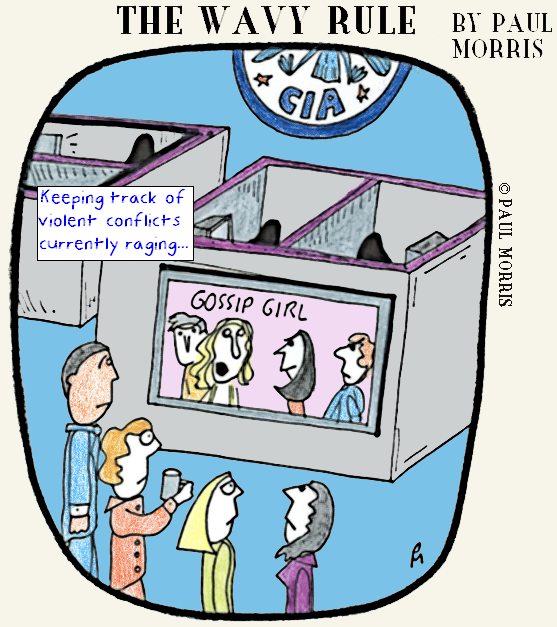
More by Paul Morris: “The Wavy Rule” archive; a very funny webcomic, “Arnjuice“; a motley Flickr page; various beautifully off-kilter cartoon collections for sale and free download at Lulu.
Category Archives: The Catbird Seat: Friends & Guests
The Wavy Rule, a Daily Comic by Paul Morris: Indiana Jones & a Reverse Turing Test
Today, Paul captures an ancient captcha in hieroglyphic captivity. Are you human? No need to prove it–just click to enlarge.

More Paul Morris: “The Wavy Rule” archive; a very funny webcomic, “Arnjuice,” a motley Flickr page, and various beautifully off-kilter (and freely downloadable) cartoon collections at Lulu.
Interns’ Friday Roundup: This Week in New Yorker Podcasts and Blogs
Each Friday, the Emdashes summer interns bring us the news from the ultimate Rossosphere: the blogs and “podcasts”:http://www.newyorker.com/online/podcasts/podcasts at newyorker.com. Here’s this week’s report.
Sarah Arkebauer:
This week’s Book Bench features a conversation with the new United States Poet Laureate, Kay Ryan, in which she shares her thoughts on clichés–listing some malapropisms that would impress even Honey Bunch Morton. Jenna Krajeski’s post in that same blog has given me a fascinating new way to spend time online—reading up on old issues of Poetry magazine.
I began following the Cartoon Lounge this week, and it’s all sorts of amusing. Its variation—thanks to multiple contributors—keeps it smart and fresh. In particular, Zachary Kanin contributed several humorous posts, including a laugh-out-loud set of instructions for what to do when hiring him. Also excellent is the blog’s recurring Crazy Caption Contest, the wackiness of which is all one could desire.
Alex Ross, of The Rest Is Noise fame, went on hiatus yesterday, but posted a playlist that looks promising. Congratulations are also in order for Mr. Ross: his blog was nominated for the BBC Four Samuel Johnson Prize.
Although Andrea Thompson’s post in Goings On about scientific manipulations to decrease the fattiness of beef left me skeptical and more than a little worried, I got a kick out of her inclusion of a 1966 Talk of the Town article discussing the possibilities of other such modifications.
I enjoyed the July 9th New Yorker Fiction Podcast, in which “Aleksandar Hemon read”:http://www.newyorker.com/online/2008/07/21/080721on_audio_hemon?xrail Bernard Malamud’s short story “A Summer’s Reading.” Hemon’s comments were interesting and insightful—he pointed out that the protagonist’s surname indicates he’s Slavic, not Jewish—but I was particularly haunted by Malamud’s description of Mr. Cattanzara, who reads the entire New York Times every night by the light from a shoe store.
Taylor House:
Steve Brodner has his say about the Obama cover controversy by encouraging his readers to want more. Controversy is healthy, he says, and a pile of angry letters on the editor’s desk shouldn’t scare him into toning it down. Click through and help Brodner support strong graphics in media.
The Campaign Trail podcast poses the question: is Obama’s apolitical image just a front? How much of his campaign is manufactured, and how much is sincere? Can a presidential candidate be a successful politician and remain true to himself? (Yes, all, none, no. But it makes for a lively debate.)
Dana Goodyear of Postcard from Los Angeles looks for an iPhone in all the wrong places. But she does find Rick Caruso, a bigtime LA developer with an eye on the mayor’s seat.
Adam Shoemaker:
This week, George Packer writes in Interesting Times about an Iraqi friend’s ordeal in customs at J.F.K. airport, and wonders about the effects of Homeland Security’s senseless indifference to America’s visitors. He contrasts the beauty of one scene, the disembarkation of the world’s “gorgeous mosaic” into the capital of immigration, with the bitterness of another, those held behind for hours for no apparent reason. “This is the Iraqi style,” protests his friend. “Not the American style.” It is one thing, concludes Packer, to balance immigration protocols against the threat of terrorism. It is another, quite indefensible thing to breed animosity among our guests for no better reason than the uncaring incompetence of a few D.H.S. officers.
Sasha Frere-Jones relates the story of a rare interview with Tupac from the early nineties. The rapper’s instinct for performance and his attempt to reconcile fame and authenticity were both on display in the interview, which also included a sober prediction of his own death. Trish Deitch ends the account with a potent example of the complications of Tupac’s self-definition as it was set against rising stardom. Earlier in the week Frere-Jones also reported on the recent sale of Death Row Records and the rights to Shakur’s unreleased material—the mining of which is hardly unprecedented.
The Borowitz Report lends some much-needed aid to America’s comedians by reporting that Barack Obama has released an approved list of jokes about himself. As might be expected, these revolve around foreign oil, foreclosure, and health insurance. Sadly, the kangaroo and horse do little to save them. Then satire it is, I suppose.
On the New Yorker Out Loud podcast, Matt Dellinger speaks with Jill Lepore about her piece on E.B. White’s decidedly unmousy classic Stuart Little. Roger Angell, E.B. White’s stepson, also joins in the conversation. Lepore talks about her fascination with the piece—and the lengths to which that drove her research. The real story, says the author, is not the battle between E.B. White and the celebrated librarian Ann Carroll Moore, but rather the sometimes noble, sometimes cosseted vision of children’s literature the Victorian Moore tried—ultimately, unsuccessfully—to impose on America’s young readers.
Previously: the July 11 report.
We Interrupt This Wavy Rule to Bring You an Important Anniversary Message
In honor of the week of David Remnick’s tenth anniversary at The New Yorker, here’s our tribute, in the form of a drawing by staff cartoonist Paul Morris, to the hardworking reporter and editor’s diverse contributions to the journalistic skyline. Click to enlarge!

The Wavy Rule, a Daily Comic by Paul Morris: Wine Not?
Paul turns his bottomless imagination to something that’s design-, typography-, and libation-related all in one: a mini-series on whimsical wine labels. Here’s the first! Click to enlarge.

More Paul Morris: “The Wavy Rule” archive; a very funny webcomic, “Arnjuice,” a motley Flickr page, and various beautifully off-kilter (and freely downloadable) cartoon collections at Lulu.
The Wavy Rule, a Daily Comic by Paul Morris: Collared
In today’s “Wavy Rule,” Paul explores the question: When there are green jobs, are there green collars, too? Click to enlarge.

More Paul Morris: “The Wavy Rule” archive; a very funny webcomic, “Arnjuice,” a motley Flickr page, and various beautifully off-kilter (and freely downloadable) cartoon collections at Lulu.
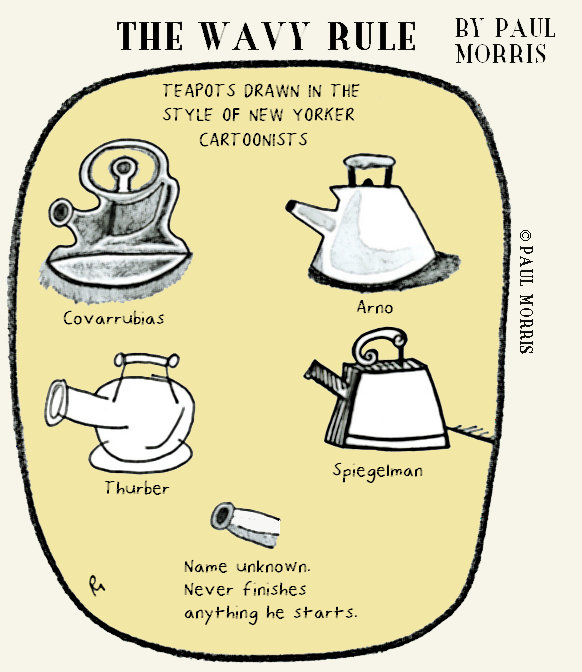
The Wavy Rule, a Daily Comic by Paul Morris: Thurber’s Teapot
What’s there to say about this assembly of teapots drawn in the style of New Yorker cartoonists except: This makes me incredibly happy? Click to enlarge. Feel free to submit your own, particularly if you are, in fact, a New Yorker cartoonist. Write your own Barry Blitt joke here.
More Paul Morris: “The Wavy Rule” archive; his very funny webcomic, “Arnjuice,” a motley Flickr page, and beautifully off-kilter (and freely downloadable) cartoon collections at Lulu.
The Wavy Rule, a Daily Comic by Paul Morris: Airport Extremes
There are Olympic-size high jumps and high jinks in today’s cartoon, about which Paul notes, “Beijing has built the world’s biggest airport for the 2008 Olympics. It’s 501 square miles. That’s big!” Speaking of which, click to enlarge!

More Paul Morris: “The Wavy Rule” archive; his very funny webcomic, “Arnjuice,” a motley Flickr page, and beautifully off-kilter (and freely downloadable) cartoon collections at Lulu.
Friday Feast of Blog Roundups: Our Interns Review the Week at Newyorker.com
This summer’s talented Emdashes interns will be performing many welcome tasks for our contra-profitable yet strangely satisfying project. One of these tasks, I think it’s fair to say, out-metas even our generally mega-meta mode: Each week, Sarah, Taylor, and Adam will explore all the active blogs at The New Yorker‘s website, and post a report each Friday on what they’ve discovered. They each have a variety of beats, which you will see below. They had only a day or two to file their first reports here, by the way, rather than the full week they’ll have hereafter. Let’s see what they have to say!
Sarah Arkebauer writes:
**The Book Bench** this week contained some interesting tidbits. I found Rollo Romig’s mention of Ben Lewis’s new book about the history of Communism fascinating, but what really drew me in was Andrea Walker’s analysis of the cover of Christopher M. Kelty’s new book, Two Bits. The picture of the cover itself piqued my curiosity, while the surrounding text both fed and rebuffed my love of judging books by their covers.
Cartoonist of the Month did not update this week; nor did Malcolm Gladwell.
On his blog, **The Rest is Noise**, Alex Ross brought to light a disturbing trend–the firing of classical music critics and arts writers generally–in his Wednesday post.
Taylor House writes:
Mick Stevens’s I Really Should Be Drawing is my current favorite blog, though unfortunately Stevens has just gone on hiatus to Martha’s Vineyard for an indeterminate period. We might not be seeing much of Stevens this summer, but his archives are full of odd anecdotes describing the cartoonist’s condition and whatever doodles don’t make it into the magazine. In “The Formula,” he lets us in on the secret concoction that transmogrified him into a cartoonist–and his assistants into a neighing Italian pony and a self-conscious fridge, respectively. I
guess even doodlers need to summer.
Dana Goodyear, who writes Postcard From Los Angeles, is just returned from her summer vacation, and breaks her blog fast with a gripping clip from a recent Times piece on the semantic history of South Central (or Eastside, or La Newton). I can’t get enough of this L.A. history stuff–looking forward to much more from Goodyear.
Steve Brodner’s comics are about as menacing as the neocon characters he laments in his Person of the Day posts–and just as unsettling. He does throw in the occasional uplifting tidbit, like this recorded and illustrated interview with John Lennon, but the standard seems to be highlighting vestiges of Nixon in the current administration and strategizing how best to stomp it out next November. The question I’m pondering: is Brodner a political cartoonist? And if yes, how does he differ from the traditionalists? Discuss.
Hilton Als (Et Als) hasn’t posted since February; maybe he’ll make a comeback before the summer’s done.
Adam Shoemaker writes:
At Interesting Times, George Packer meditates this week on Christopher Hitchens, the exhibitionist essayist. When Hitchens took on Vanity Fair‘s dare to subject himself to waterboarding, it was to understand the debate that much better. But for Packer, it was also an opportunity to witness “the limit to Hitchens,” to see why he will never be the next Orwell (Packer admits to sharing Hitchens’s hero worship here). Hitchens’ prolific and contrarian writings (a few here) do tend to make him into a spectacle with, as this writer puts it, a “strong presence of the ‘I'”, and it is useful to read a deconstruction of this character, whom Packer deems compulsively readable if not always worth the serious consideration he demands.
On his blog (subtitled “Notes on politics, mostly”), Hendrik Hertzberg contemplates the value of a journalist’s access when he (in this case, Zev Chavets) fails to exploit its potential (not much) and the crime of hiding behind the Constitution to avoid the very freedom it guarantees. Hertzberg is grateful neither to Chavets nor the New York Times for the Magazine’s portrait of Rush Limbaugh, which he finds long on “the vulgarity and ostentation of [Limbaugh’s] domestic arrangements” and short on substance.
Hertzberg likewise spares no ire in his indictment of Rhode Island Governor Donald L. Carcieri. He dissects the governor’s excuses for vetoing his state’s National Popular Vote bill, and in so doing demonstrates the danger in allowing our statesmen to hide behind their own idea of the Constitution without reading the document on its own terms. “Not all Republicans are averse to popular election,” Hertzberg grants, but there are enough like Carcieri to make him worry about the possibility of reforming the Electoral College, even at the state level.
“Untitled” is the name of Nas’s new album, but **Sasha Frere-Jones** spends three paragraphs considering the title Nas conspicuously removed in May: Nigger. Frere-Jones also wonders about the motivations behind making an elaborate video for “Be a Nigger, Too,” when it too was removed from the album. A slightly different YouTube link gives us “The Walrus Speaks,” an elaborately visualized interview with John Lennon, complete with a satisfying conspiracy based on Canadian squares. I too have known a few.
On Tuesday Frere-Jones chose, reluctantly, a song of the summer. This hesitation, he reports, was due both to the greatness of the tradition and to the sad state of this year’s offerings. In the end he picked Ryan Leslie’s “Diamond Girl,” despite judging him “the last dude I would want at my barbecue.” I’m not sure I’d want this boombox there either.
Meanwhile, for **The Borowitz Report**, Andy Borowitz leads with a story about liberals’ discomfort with Barack Obama’s now seemingly-determined attempts to claim the White House. “Any Democrat who voted for Dukakis, Mondale, or Kerry should regard this as a betrayal,” says Tracy Klugian of “LoseOn.org.” While we can rest confortable that when it comes to November, Howard Dean is not actually trying to “talk him out of it,” Borowitz’s final prediction seems destined to come true even if Obama turns the tide and decides “to lose the thing”: either way, the Democratic candidate “should brace himself for some really mean blog posts.”
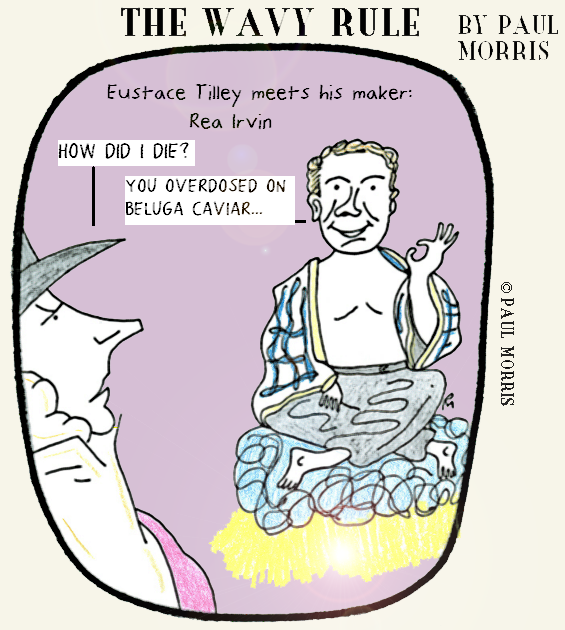
The Wavy Rule, a Daily Comic by Paul Morris: Tilley Meets His Maker
As you might expect, since I just spent a number of months collecting material for a piece about Rea Irvin for PRINT, I am in love with all things Irvin. Paul–whom I thank in the piece because he’s shared numerous invaluable resources and insights with me about Irvin’s aesthetic–is as keen on the early years’ co-genius as I am. About this cartoon, he writes: “Inspired by the photograph of Irvin in Lee Lorenz’s wonderful The Art of The New Yorker. A must read.” I agree. Sweet Knopf: Please bring it back into print! Click to enlarge.
More Paul Morris: “The Wavy Rule” archive; his very funny webcomic, “Arnjuice,” a motley Flickr page, and beautifully off-kilter (and freely downloadable) cartoon collections at Lulu.