Category Archives: The Katharine Wheel: On Fiction

Sylvia Townsend Warner: Don’t Miss Elphenor & Weasel

Benjamin writes:
“Sylvia Townsend Warner” is one of those triple-barreled, aristocratic names reminiscent of an era: it’s the name of an imperious (and rich) great-aunt, loyal to her own relations, who takes care never to mix with yours. It’s also the name of an author who published 164 pieces in multiple genres in The New Yorker between 1936-1977. Forty-one years of publication in TNY is a formidable track record for anyone, and at least 150 of Warner’s contributions to the magazine were fiction, so I determined to look her up. I’m glad I did.
The problem with such a prolific writer, of course, is where to start. Looking over her work in the index to the The Complete New Yorker, however, I noticed that her work appeared in an unusual number of departments: Fiction, Poetry, Comment, The Air, Family Life, and Easel. Curious to see what she contributed that would qualify for “The Air,” “Family Life,” and—was she, I wondered, a painter, too?— “Easel”, I found the following:
Too Cool the Air“, from September 16, 1939, is one of those airy portraits TNY used to specialize in. Narrated in first-person by an unidentified narrator, it’s impossible to say for certain if it’s fiction or creative non-fiction, though it’s likely the former. The narrator relates a chance meeting, after a lacuna of 10 years, with “a crony of my Aunt Angel’s,” the chatty Miss Filleul, who, it transpires, is most probably a “brazen and accomplished thief.”
Fast-forward three years to July 11, 1942, and we find “The Family Revived,” a lightly humorous piece (again with a first-person narrator indistinguishable from a witnessing reporter) about a Mrs. Bogle, who has gathered a group of people in her Dorsetshire cottage for a “Sunday Salvage Afternoon.” It’s wartime, of course, so the guests have gathered to slice the metal butts off old cartridge cases and the like. Mrs. Bogle, a woman full of “predatory good intentions,” sees the war as an opportunity to revive her vision of home life in the old days, when the family would gather around the fire. Her enthusiastic plan is torpedoed, however, by reasonable objections, her husband’s brute practicality, and the embarrassed resistance of her guests. Complicated, for so short a piece, it’s difficult at this distance to be certain one has caught all the ironies.
“Too Cool the Air” and “The Family Revived,” though pleasing, are dated trifles, easily forgotten. The same cannot be said of the gem of the lot, “Elphenor and Weasel,” from the December 16, 1974 issue, which also features Woody Allen’s classic, not-to-be missed story, “The Whore of Mensa.” (Presumably, it’s the word “Weasel” that accounts for Warner’s story being classified in the CNY index under “Easel”.)
Tartly written, “Elphenor and Weasel” tells the story, surprisingly whimsical (though not, ultimately, happy) of Elphenor, a fairy destined to live among human beings, who bumbles along as a necromancer’s assistant until he meets his green-skinned, frivolous love, Weasel. Together, they enjoy a summer of love and breakfasts, and then, when the necromancer makes plans to sell them, they run off together, alternately working and stealing food until they fetch up in a church in the winter time. They choose the belfry as their sanctuary, but sadly, they misunderstand the purpose of churches, and more particularly the power of bells, and a bell-ringers’ practice proves the end of them.
But oh!, the deft compression with which Warner tells the story. Here’s an example, describing why Elphenor, shipwrecked in England and discovered by the necromancer, seems meant to be the man’s assistant: “To tease public opinion, he had studied English as his second language; he was penniless, purposeless, and breakfastless and the wind had blown his shoes off.” I love everything about that sentence, from the idea that fairies might learn English to “tease public opinion,” to the precise hammer-blows of the words, “penniless, purposeless, and breakfastless”—and then, Warner switches rhythm to say he was also shoeless.
Here’s another, fairly random example. Elphenor hails from Zuy, where English elves and fairies—such as his green-skinned, hill-dwelling lover Weasel—are known only by reputation.

At Zuy, the English Elfindom was spoken of with admiring reprehension: its magnificence, wastefulness, and misrule, its bravado and eccentricity. The eccentricity of being green and living under a hill was not included. A hill, yes. Antiquarians talked of hill dwellings, and found evidence of them in potsherds and beads. But never, at any time, green. The beauties of Zuy, all of them white as bolsters, would have swooned at the hypothesis. Repudiating the memory of his particular bolsters, [Elphenor] looked at Weasel, curled against him like a caterpillar in a rose leaf, green as spring, fresh as spring, and completely contemporary.

But you must read it yourself. And if you’re already a fan of Warner, what other works of hers do you recommend?

John Updike at Rest

Benjamin Chambers writes:
I’ve been on vacation, and so missed the momentous news, yesterday, of John Updike’s passing. His fiction was never my cup of tea, but I mourn his loss just the same. Universally admired for the smooth, sparkling facility of his sentences, he was what most writers wish they could be: able to laugh at himself, but deadly serious about his work; supernaturally and steadily productive in multiple genres; critically admired and at the same time a household name; a thoughtful and perceptive critic who read widely; and (though he has never been given much credit for this by readers of his fiction) omnivorous in his interests.
If that list is a bit jumbled, it merely reflects the breadth of Updike’s wide range. And for those with fixed ideas of Updike, based perhaps on his recent stories, I urge them to go back and read “Friends from Philadelphia,” the first story he published in The New Yorker, back in 1954. I read it for the first time last year; though I didn’t comment on this at the time, I was pleasantly surprised by its multiple subtexts, and a piquancy that age has not dimmed.
Years ago, a friend of mine, a New Yorker, passed on a quote she swore was from Updike, something to do with “… the secret sense that anyone not from New York had to be, in some sense, kidding.” Nonetheless, that was how I felt when I heard the news about his death: that someone, somewhere, has got to be kidding. I feel it still.

New Yorker Fiction Podcasts–2008 Highlights

Benjamin Chambers writes:
2008 was the first full year of The New Yorker fiction podcast, and I gotta say, it was a very fine year. Fiction Editor Deborah Treisman’s unhurried confidence sets a nice tone, and the authors nearly always choose interesting work and read it well (not the way actors would, but sensitively nonetheless). They also tend to have interesting things to say about the work, or their reasons for choosing it, that help you see it in new ways. It’s sort of like sitting in on the bull session in the bar after a graduate writing workshop.
Anyway, here are my picks for the best of the bunch:
Best at Getting Me Interested in a Classic Author I’d Never Read: E. L. Doctorow reading and discussing John O’Hara’s 1943 story “Graven Image,” which had the singular effect of making me want to read more O’Hara, whose Appointment in Samarra once failed to entice.
Best Reading of a Classic Short Story First Published in 1948: I can’t decide. I’m sorry; I know you look to Emdashes for firm opinions, but I just can’t do it. It’s a toss-up between Mary Gaitskill tackling Nabokov’s terse story “Symbols and Signs,” and A. M. Homes narrating Shirley Jackson’s creepy chestnut, “The Lottery” (which you can see on film here). What are the odds that two authors featured on the podcast in the same year would both choose stories from 1948? Who cares? Just don’t make me choose.
Best Story by a Contemporary Writer I’d Never Heard of: Stephanie Vaughn’s “Dog Heaven,” read exceedingly well by Tobias Wolff. The upshot? I’ve just picked up a collection of Vaughn’s stories from the library.
Most Interesting Commentary on a Story I Wasn’t Crazy About: Once again, a toss-up. I enjoyed hearing Roddy Doyle talk in his warm Irish accent about having TNY writer Maeve Brennan live with his family in the 1970s; but I also enjoyed hearing Jeffrey Eugenides, after reading Harold Brodkey’s 1994 “Spring Fugue,” chat with Treisman about Brodkey’s lack of appeal to some readers, in spite of his obvious talent.
Podcast I Liked Best In Spite of Myself: T. Coragahessan Boyle reading Tobias Wolff’s 1995 story “Bullet in the Brain.” I admire Wolff’s stories, but this one isn’t his strongest. Nonetheless, it reads well aloud, and it was a smart choice by Boyle, whose discussion of the piece is quite winning, though I’m surprised that he never once mentions the story’s obvious model, Ambrose Bierce’s “An Occurence at Owl Creek Bridge.”
Best Fiction Podcast of the Year: I’ve already talked my fool head off in several posts about how much I liked Louise Erdrich’s reading of Lorrie Moore’s 1993 story “Dance in America.” Surely, ’nuff said. But if you listen to only one fiction podcast from last year…
For Completists: Here’s the entire list of TNY podcasts, going back to 2007. (There’s some good’uns from 2007, too.)
If You’re Eager for More: Go right head and check out the January 2009 podcast, in which Thomas McGuane reads Jame Salter’s kick-ass 2002 story “Last Night.” Not to be missed. Just be sure you’re ready for a fright.

Top Dog of New Yorker Fiction: Morley Callaghan…?

Benjamin Chambers writes:
In an article in the Canadian newspaper The National Post, Philip Marchand writes,

Whatever happened to the reputation of Morley Callaghan, who was once every bit as much an icon of Canadian literature as Margaret Atwood? For a while he practically owned The New Yorker, in the manner of Alice Munro. In 1965 Edmund Wilson—at that time the most prestigious literary critic in the English-speaking world—compared him to Chekhov and Turgenev. Yet today he is rarely taught in Canadian literature courses, and his works seldom opened. Are we so sure what happened to Callaghan won’t happen to Atwood?

If you’re scratching your head and muttering, “Morley Callaghan?”, you’re not alone. A quick check of the Complete New Yorker showed me that Callaghan published 20 stories in TNY between 1928 and 1938. That surprised me, since Wilson lauded him in 1965.
I wondered why Callaghan’s stories stopped appearing in the magazine so suddenly, but Wikipedia says that he wrote almost no fiction between 1937 and 1950, which partially explains why he didn’t show up there again. (Wikipedia also informed me that Callaghan knocked down Hemingway in a boxing match refereed by F. Scott Fitzgerald…)
In any case, it’s obvious Callaghan was both a prolific writer and a well-regarded one, so I look forward to reading his New Yorker stories.
Of course, it’s not always clear, years later, why an author of the past used to take home all the laurels. Taste, like tempus, fugit.

New Yorker Fiction By the Numbers, 2003-2008 + Quiz

Benjamin Chambers writes:
The folks over at The Millions have got a great post showing the stats on fiction in The New Yorker for the past six years: male/female ratio, frequency with which authors appear, etc.
While TNY undeniably relies heavily on some of the same authors over and over, I can attest to the fact, after reading every story the magazine published last year, that it often publishes authors of whom I’ve either never heard, or have never read—and many of them are not exactly household names. That got me wondering whether I was just out of the loop, or if others had had the same experience.
So, here’s a quiz. Check out this list of all the stories the magazine published in 2008, and ask yourself how many authors on the list you’d heard of before they appeared in the magazine. I’m reasonably well-read, but of 40 authors, I’d never heard of eight: John Burnside, Rivka Galchen, Yiyun Li, Chimamanda Ngozi Adichie, Daniyal Mueenuddin, Sarah Shun-lien Bynum, J. M. G. Le Clezio, and Wells Tower. That’s not a bad percentage of new-to-me authors.
In the spirit of being ruthlessly honest, I will also add in authors I’ve heard of but have never gotten around to reading (though in some cases I’m embarrassed to admit it), such as Joshua Ferris, Tessa Hadley, Ha Jin, Hari Kunzru, Janet Frame, Ruth Prawer Jhabvala, Roberto Bolaño, Daniel Alarcon, and Edwige Danticat.
That’s another nine authors, which means I’d never read 17 out of 40 authors the magazine published last year. I may be an uncultured boor, but thanks to The New Yorker, I’m significantly more cultured than I was as of 2007.
Write in and tell us how you did on the quiz … and in case you’re curious about the magazine’s editorial policies, check out this recent Q&A with TNY fiction editor, Deborah Treisman.

Reading (and Watching and Listening to) New Yorker Fiction 2008

Benjamin Chambers writes:
C. Max Magee at The Millions just did my job for me and provided capsule reviews of all the short stories The New Yorker published in 2008, as well as links to others who wrote about them, including Emdashes. My story picks would differ some from his, but who am I to quibble? First one in the pool gets to say how nice the water is.
But I read and posted about a lot of TNY fiction in 2008 that didn’t appear in the magazine last year, so I thought a brief summary of my ’08 posts would be appreciated, especially now that all the old stuff is easily accessible through the TNY Digital Edition.
Read on for my tips on the best TNY story I read all year (from 1959); the funniest (from 1958); the most mysterious (from 1966); and which episode of this year’s fiction podcast was most enjoyable.
Feb 8th—Temporary Outages: Updike, Doctorow, and Boyle—my first post for Emdashes, in which I was disappointed by the first three TNY stories of the year.
Feb 19th—I praised Jean Stafford’s superb 1953 story, “In the Zoo,” and compared it with three other stories of hers that appeared in TNY, including 1948’s “Children are Bored on Sundays.”
Feb 25th—Ever wonder who’s published the most short stories in TNY? Now you can find out the answer.
Feb 28—The great Canadian short story writer, Mavis Gallant (who was Alice Munro before Alice was Munro), is interviewed; and Adam Gopnik, too.
March 11th—Louise Erdrich wins a demolition derby, in which I compare four stories that share the keyword “demolition” in the Complete New Yorker index. Besides a 2006 story by Erdrich, I also covered a 1959 story by Thomas Meehan, a William Gaddis story from 1987, and a Haruki Murakami story from 1991.
March 26th—Certainly the funniest New Yorker story I read all year: Michael J. Arlen’s 1958 casual on losing the novel race to the Soviets.
April 10th—Translations from the British rounds up Britishisms that slipped into the otherwise very American New Yorker in 2008 stories by Ha Jin, Tessa Hadley, John Burnside, Hari Kunzru, and Roddy Doyle.
April 16th—Best TNY podcast of the year? Louise Erdrich reading Lorrie Moore’s 1993 story, “Dance in America.” (Rumor has it that Moore has a new novel coming out in September. Cause for celebration.)
April 21st—“In Praise of Shirley Hazzard” examines stories from 1976, 1977, and 1979 that later appeared in her novel, The Transit of Venus. The title of this post says it all.
May 14th—Hilton Als singles out Jean Stafford’s 1948 “Children Are Bored on Sundays” for reading and discussion on the fiction podcast.
May 30th—Louise Erdrich and Lorrie Moore came out with a novel and a “collected stories,” respectively; here, I rounded up reviews.
June 11th—Muriel Spark got a turn, in this post about two stories of hers from 1960 and 1966, including the ineffable and wonderful “The House of the Famous Poet,” which was one of my top favorites of the year.
June 17th—A few excellent retrospectives on Richard Yates’s life and work before he hit the big time late last year, when the movie Revolutionary Road, based on his novel of the same name, came out.
June 26th—In 1999, Daniel Radosh wrote entertainingly about the difficulty of translating Harry Potter from the British for American readers.
July 8th—A quick post about William Styron’s forthcoming (though posthumous) collection of fiction.
July 9th—Unquestionably the best short story I read all year (and maybe in the past several): Mary Lavin’s “The Wave,” from 1959. They don’t make ’em like that anymore. I wrote about it here.
July 16th—Turns out John Cheever’s 1960 short story, “Some People, Places and Things That Will Not Appear in My Novel” is longer than the final version that appears in his Collected Stories. I had a lot of fun looking closely at this knotty piece of metafiction.
Aug. 7th—C’mon, ‘fess up. You always wanted to hear E.B. White read Charlotte’s Web. You can find a recording here, attached to an appreciation of the book that appeared on NPR.
Aug. 14th—In 2008, Ruth Prawer Jhabvala marked her fifty-first year publishing stories in TNY—an anniversary I celebrated by reading her for the first time, looking closely at the first story she published in the magazine, and her latest.
Aug. 15th—If you ever had doubts about the reading public, a column on the Obama cover quoting Shirley Jackson on public reaction (and failure to comprehend) her infamous story, “The Lottery” won’t help any.
Aug. 26th—In which Emdashes said “So long,” to the great Esquire fiction editor and TNY contributor Rust Hills, and “See you tomorrow,” to TNY fiction editor William Maxwell.
September 9th—Check out Donald Barthelme’s syllabus for students, his 1974 story “The School,” and why reading more fiction is good for you.
September 18th—The late, lamented David Foster Wallace’s not-so-serious reading list.
November 3rd—In case you missed it when it came out in 1969, you can now check out this short film of Shirley Jackson’s 1948 story, “The Lottery” online. Then, you can listen to A.M. Homes read it aloud on the TNY fiction podcast.
Nov. 14th—Obama’s win spurred a look through the archives for stories that had presidents in them. That turned up two of my favorite TNY short stories, by Donald Barthelme and Mark Strand (from 1964 and 1979, respectively): both loopy, poetic pieces having to do with the President as a fictional character.
Nov. 20th—My search for presidential fiction turned up a lot of satire, including a piece by Garrison Keillor, in which he skewers the Other Bush.
Dec 13th—Leaping Lepidopterists! It’s Nabokov on YouTube, along with his 1998 (posthumous, natch) review of his own memoir, Speak, Memory.
Dec 25—I closed out the year with a review of all four stories in the 2008 Winter Fiction issue, by Donald Antrim, Roberto Bolaño, Alice Munro, and Colson Whitehead. Maybe it was the season, but I found a lot to like.
Whew! Stay tuned: next, I’ll cover the year’s fiction podcasts!

J.D. Salinger Turns 90 Today

Benjamin Chambers writes:
Charles McGrath has an excellent article in The New York Times on J.D. Salinger’s last published piece, “Hapworth 16, 1924“. The 25,000-word novella appeared in the June 19, 1965 issue of The New Yorker, and never anywhere else. Thanks to the magic of the Digital Edition, it’s more accessible now than ever before. (Many of Salinger’s other classic works first appeared in the magazine too, although you’d search in vain for Catcher in the Rye because, as Louis Menand pointed out in a 2001 retrospective, the magazine rejected it.)
McGrath has some perceptive things to say about the charm of Salinger’s writing, and why it remains influential. He also hits the nail on the head when he talks about the chief drawback of Salinger’s chronicles about his fictional family, the Glasses:

The very thing that makes the Glasses, and Seymour especially, so appealing to Mr. Salinger— that they’re too sensitive and exceptional for this world— is also what came to make them irritating to so many readers.

Nevertheless, I’d like to wish this great American writer a very happy birthday.

Winter Fiction Issue: What to Read

This holiday, I have very good news: I don’t think you can go wrong with any of the fiction in the December 22 & 29, 2008 double-issue of The New Yorker. Even for our beloved TNY, that’s some feat.
I have caveats, of course. (Spoiler warning! Below, I reveal key details of several stories.) For example, Donald Antrim’s “Another Manhattan,” though sad and graceful toward the end, is shrill and artificial for most of its length.
Jim and Kate are married, and involved in a love quadrangle with another couple, Elliot and Susan. Most of the narrative involves Jim’s nearly doomed attempt to get a bouquet of flowers for his wife—his motives mysterious, calculating, and mixed up in his attraction to the florist helping him. Meanwhile, Kate is attempting to end her affair with Elliot.
Miscommunication is rife—most conversations take place on cell phones, in a farcical, four-sided dance that feels too obviously symbolic to be fully effective. As for the rest, Jim’s tortured assessments of what behavior or choices might be appropriate (either to hide his now-ended affair with Susan, or to balance his desire to surprise his wife with a bouquet with his desire for the florist) are a hallmark. In the end, Jim finally does arrive at the restaurant with the enormous, wind-battered bouquet, his face bleeding from rose thorns.
And though even that image seems intended to be Significant, it’s right about there that the story turns from a tale of unreal, unlikeable people into something else entirely. Jim arrives; Kate bursts into tears when she sees the flowers and his bleeding face.

“I’m here,” he said, and his own tears started. He wanted to tell her that everything would be better, that he would be better, that one day soon he would work again, and start paying some bills, and take the burden off her shoulders; that they would be able, at last, to leave the little apartment with the busted plumbing. He wanted to tell her how much he needed her.

But he could see, out of the corner of his eye, his horrid reflection in the mirror behind the bar. He looked down at Kate’s hands, the blood smeared across her palms. And he saw the restaurant-goers and the waiters and waitresses and busboys, who, not knowing what to make of the bleeding and the crying and the broken lilies arcing over Jim and Kate’s heads like some insane wedding canopy, had come from the kitchen or the bar to stand mutely around them. The pain in his body grew, and the words that spilled out of him were not words of love. Or they were. He spoke to his wife, as he spoke to the people gathered.

He tells her that he must go back to the mental hospital, that he doesn’t belong anywhere else. The rest of the story is a melancholy slide, all of the story’s earlier tension burned away, as the narrative follows the four of them to the emergency room, where it’s just Kate and Jim; and then into the locked ward, where it’s just Jim, in “a room of his own.” Taken as a whole, it’s quite lovely, really.
Alice Munro, of course, is so steadily reliable a writer that it’s hard to go wrong with her work, which is why I was particularly disappointed with “Face,” which appeared in the September 8, 2008 issue. “Face” contained no drama at all except at its end, when it promptly veered into melodrama: a little girl slices up her face to approximate the narrator’s birthmark; they never see each other again, not really, though years later she visits him in the hospital after he’s been temporarily blinded. She doesn’t identify herself directly, but quotes lines from Walter de la Mare before leaving forever…Puh-leeez!
But this month’s “Some Women” felt like a return to form. The narrator looks back on an incident that happened during or after the second World War, when she was thirteen, and temporarily employed to look after a former fighter pilot, Bruce, dying of leukemia. She does this two days a week, when his wife Sylvia is teaching classes at the college.
Bruce’s stepmother, referred to in town as Old Mrs. Crozier, crustily dominates the household; all she “really cares about”, the narrator says, is “her flower garden.” So it’s a bit of a surprise when it turns out she has a masseuse, Roxanne, who visits her in the home. (Which struck me as anachronistic, but I’m probably wrong.) Roxanne is brassy and teasing, and forces an introduction to Bruce, whom she flirts with and makes a show of coddling. Seeing him becomes part of her weekly routine.

She was never at a loss. Sometimes she came equipped with riddles. Or jokes. Some of the jokes were what my mother would have called smutty and would not have allowed around our house, except when they came from certain of my father’s relatives, who had practically no other kind of conversation …

“Isn’t that awful?” she always said at the finish. She said she wouldn’t know this stuff if her husband didn’t bring it home from the garage.

The fact that Old Mrs. Crozier snickered disturbed me as much as the jokes themselves. I wondered if she didn’t actually get the jokes but simply enjoyed listening to whatever Roxanne said.

Mr. Crozier doesn’t laugh at these jokes, exactly, but doesn’t object, either.

I tried to tell myself that this was just good manners, or gratitude for her efforts, whatever they might be.

I myself made sure to laugh so that Roxanne would not put me down as an innocent prig.

Even so, the narrator doesn’t like Roxanne:

I began to understand that there were certain talkers—certain girls—whom people liked to listen to, not because of what they, the girls, had to say but because of the delight they took in saying it. A delight in themselves, a shine on their faces, a conviction that whatever they were telling was remarkable and that they themselves could not help but give pleasure. There might be other people—people like me—who didn’t concede this, but that was their loss. And people like me would never be the audience these girls were after, anyway.

The question, of course, is why Mrs. Crozier—so staid and ungiving normally—puts up with Roxanne; the narrator even wonders if Mrs. Crozier is paying her to flirt with Bruce, for it becomes clear that she doesn’t care for Bruce’s wife, Sylvia. In fact, it seems that Mrs. Crozier feels hemmed in by Sylvia: “No chance of having anything special with her around,” she complains to Roxanne.
But on Sylvia’s last day of teaching, Bruce locks himself in his room so that Roxanne and Old Mrs. Crozier can’t get in. The narrator helps him, and, acting on his instructions, gives the key to his room to Sylvia when she gets home from the college. This turns out to be decisive.

I understood pretty well the winning and losing that had taken place between Sylvia and Roxanne, but it was strange to think of the almost obliterated prize, Mr. Crozier—and to think that he could have had the will to make a decision, even to deprive himself, so late in his life. The carnality at death’s door—or the true love, for that matter—was something I wanted to shake off back then, just as I would shake caterpillars off my sleeve.

Munro’s subtlety ensures that it’s only here, in the story’s penultimate section, that the nature of the struggle at its heart is fully revealed, a quiet detonation. Still, it’s not quite the right note to end on, and she indulges in a summary coda, wrapping up loose ends with efficient terseness. The final line: “I grew up, and old,” is both great—many a great novel could be summarized in this way—and rushed, underscoring the narrator’s ultimate irrelevance to the story, except as a vessel for its telling. All in all, however, this is the strongest story of the issue.
I’m new to Roberto Bolaño, having read only the unimpressive “Clara,” a story of his that appeared in the August 4, 2008 issue. But I’ve heard very good things about his novels, The Savage Detectives and 2666, and so I’m well-disposed to like his work. Consequently, my heart sank when I began “Meeting with Enrique Lihn,” because right away it was obvious the narrator was a writer, and he was about to relate a dream.
Why does it matter if the main character is a writer? If one had to list the profession that fiction writers most often choose for their characters, it would be that of author: it’s as if they cannot imagine anything else. But it can be done well, and in this case, the fact that the narrator is a writer is integral to the story’s theme, but not obtrusive.
Dreams, for their part, allow the writer what Stanley Elkin used to call “a terrible freedom,” by which he meant the freedom to be arbitrary, to ignore on a whim the emotional and practical physics of human existence, and the freedom to create objects and situations overdetermined with Meaning. With this in mind, Bolaño is guilty on all counts; and yet, the dream he writes about is remarkably absorbing.
The main character dreams that he meets another, more famous writer, the “Enrique Lihn” of the title. At one point, Lihn reveals to the narrator that he has to take a pill every three hours:

Lihn began to break it up with a spoon, and I realized that the pill looked like an onion with countless layers. I leaned forward and peered into the glass. For a moment I was quite sure that it was an infinite pill. The curved glass had a magnifying effect, like a lens: inside, the pale-pink pill was disintegrating as if giving birth to a galaxy or the universe. But galaxies are born or die (I forget which) suddenly, and what I could see through the curved side of that glass was unfolding in slow motion, each incomprehensible stage, every retraction and shudder drawn out as I watched. Then, feeling exhausted, I sat back, and my gaze detached from the medicine, rose to meet Lihn’s, which seemed to be saying, No comment, it’s bad enough having to swallow this concoction every three hours, don’t go looking for symbolic meaning—the water, the onion, the slow march of the stars.

Of course, the pill is symbolic, or at least evocative, of the universes contained in passing time. Other images in the story are nearly as dense; all point to existential themes: Lihn, despite his fame and skill as a writer, is dead, in and outside of the dream; the narrator, once one of a set of promising poets, has not lived up to his promise, and neither have his compatriots. In essence, the story is about what life does to one’s ambitions; and how death levels us all.
So, even though the story ultimately feels minor—precisely the sort of work that good authors produce on an off day and publish posthumously (for Bolaño, like Lihn, is now dead)—it’s actually quite enjoyable.
Curiously enough, the fragmentary nature of Bolaño’s story is analogous to the baggy-monster feeling of Colson Whitehead’s “The Gangsters“, for neither piece reads as though it’s meant to be a short story. Bolaño’s is unsatisfyingly short, whereas Whitehead’s is so leisurely and random that it feels like a random section from a novel. And as it turns out, this is exactly what it is, as a Q&A with Whitehead confirms.
“The Gangsters” describes a few incidents in the lives of a group of young black teenagers who summer with their families in Sag Harbor, New York during the 1980s. Part bildungsroman, part exploration of the evolution of black culture, and part evocation of a period, the story meanders through a series of incidents in which the narrator, his brother, and their friends and acquaintances take up guns—BB guns—and it’s all fun and games until someone (nearly) puts out an eye.
I have a huge amount of respect for Whitehead (though I vastly prefer his first novel, The Intuitionist to his subsequent work, such as the clever-but-arid Apex Hides the Hurt), and I’m going to want to read this novel when it does come out. It’s just that, cut down to story-size, so much of it is unsatisfying. For example, these lines:

The trick of those early-morning jaunts was to wake up just enough to haul a bag of clothes down to the car, nestle in, and then retreat back into sleep. My brother and I did a zombie march, slow and mute, to the back seat, where we turned into our separate nooks, sniffing the upholstery, butt to butt, looking more or less like a Rorschach test. What do you see in this picture? Two brothers going off in different directions.

You would think, with a lead-in like that, the story would be centrally concerned with the brothers’ relationship, but in fact it’s peripheral, despite a third-act rapprochement of sorts between the brothers.
Or, for example, when the narrator nearly does put out his eye with a BB, he and his brother spend a lot of time trying to hide the evidence and think up a cover story so that their parents won’t ground them for life. Here’s how this is resolved: “But they got home and never noticed. This big thing almost in my eye.” Kind of lets the air out of the tires, doesn’t it?
When Whitehead is asked in the Q&A how he differs from his main character, he observes sardonically, “I tend not to do things that lend themselves to dramatic unity, aesthetic harmony, and narrative discharge.” Which is funny and dead-on, as far as it goes, but the trouble with “The Gangsters”, finally, is that it doesn’t display much dramatic structure, either.
That might be why Whitehead is hard-pressed to convince Deborah Treisman, fiction editor for TNY, that his story isn’t autobiographical. I believe him when he says it’s not; but it sure reads like memoir, and oddly enough, so does the Bolaño piece, despite the fact that it consists of the retelling of a dream, and the Munro story (though this is an effect she seems either unconcerned by, or wishes to encourage). Regardless, as long as you don’t go looking for dramatic unity, meandering through “The Gangsters” will yield up a number of pleasures.
As I said, you can’t go wrong with this issue. But the most quotable moment in the issue doesn’t occur in one of the stories. You’ll find it when fiction writer Zadie Smith quotes fiction writer Martin Amis in her memoir, “Dead Man Laughing“:

In birth, two people go into a room and three come out. In death, one person goes in and none come out.

Leaping Lepidopterists! Nabokov on Lo, Plain Lo, and Lit


Here’s the master, reading the amazing opening of Lolita in French and Russian; talking a little about a book he’s writing “about the texture of time” that will eventually become Ada; playing speed chess with his dithering wife, Vera; and walking into dinner in Montreux with Vera and his son, Dimitri.
Oh, yeah: even though the clip is under 7 minutes long, Nabokov also manages to dis Mann, Pasternak, and Proust; and read, snorting, from a list of things he hates (example: “humility”). It’s narrated in French, but Nabokov speaks in English, so if French isn’t your thing, you won’t miss much. (Thanks to Martin and kottke.org for the link.)
I’d never seen Nabokov on video or heard his voice before, but he was almost exactly what I would’ve expected. I was going to make a crack here about how he would’ve been a terrible talk show guest, but then I ran across a clip of him on a talk show with Lionel Trilling, and had to eat my unspoken words:

(Go here for part 2.)
The show itself is strikingly dated (Nabokov answers the interviewer’s first question by reading from prepared notecards, and more than once during part 2, the interviewer blocks the camera’s view of Trilling simply by leaning forward to get something from the coffee table). Still, it’s worth watching if you’re interested in what Nabokov wanted people to think he thought about Lolita, and because he gets off a great zinger: “I don’t wish to touch hearts, and I don’t even want to affect minds, very much,” he says, and then adds, “I leave the field of ideas to Dr. Schweitzer and Dr. Zhivago….”
It’s fascinating to watch Nabokov claim, with apparent sincerity, that “the good reader” will know that he and Humbert Humbert are not one and the same because Humbert Humbert confuses hummingbirds with another creature. “Now, I would never do that,” Nabokov says, “being an entomologist.”
It’s hard to know if he seriously expects us to find that convincing (after all, he’s presuming that all of his “good readers” will know that he’s an entomologist), or if he’s being deeply ironical. Before seeing him on tape, I would’ve said the latter, given his capacity for games within games, but now I wonder.
In any case, that’s not the end of the Nabokoviana I’ve got in store for you today. First, there’s this delightful photo of Nabokov and his wife hunting butterflies, courtesy of Life magazine and Martin; next, there’s Christopher Plummer’s eerie recreation of Nabokov lecturing a class at Cornell on Kafka, taken from a 30-minute film made in 1989; and then a fascinating piece about Nabokov’s gay younger brother, Sergei, who died in a concentration camp in 1945.
Lastly, we come to Nabokov’s review of his own memoir, Speak, Memory. The review appeared posthumously, in the December 28, 1998 issue of The New Yorker. I’m not certain why it wasn’t published during his lifetime, but I’d like to think that Nabokov knew the piece didn’t work.
Though the fictitious reviewer is supposedly reviewing “Speak Memory” along with another book (which is as fictitious as the reviewer), he devotes all his time to Nabokov’s memoir and never says anything about the other book, beyond a few lines of glancing praise. In part, Nabokov was making a point about how little there was to say about cliched, sentimental books, but of course, his own book turns out to be the only thing worth talking about, and so the whole piece, rather than being a delightful riff on authenticity, ends up feeling like an early case of astroturfing.
Nevertheless, it’s enlightening; yet another view of the trickster behind the scenes.

A Storied Presidency: the Other Bailout

Inspired by Obama’s win, I checked the index of the Complete New Yorker for items in the “Fiction” category that contained the word “president.” I got 167 hits, and I’ve been happily reading ever since. This is the second of a series on the results. The first one is here.

***

When the big credit crunch came to a head this fall, you might have heard occasional mention of the other bailout, that of the savings and loans in the late 1980s. If you want a brief, totally inaccurate primer on that event, you can do no better than Garrison Keillor’s “How the Savings and Loans Were Saved.” (Digital Edition link here.)
Huns invade Chicago, and President Bush (the First) nearly fails to act, with no political consequences: “… a major American city was in the hands of rapacious brutes, but, on the other hand, exit polling at shopping malls showed that people thought he was handling it O.K.”
Throughout, Keillor lampoons the terms that must have been used in the press to describe Bush’s lack of response: e.g., he appears “concerned but relaxed and definitely chins-up and in charge”, or he appears “burdened but still strong, upbeat but not glib … confident and in charge but not beleaguered or vulnerable or damp under the arms, the way Jimmy Carter was.”
Bush is always vacationing: playing badminton in Aspen, croquet at the White House, tennis and fishing in Kennebunkport. Meanwhile, the barbarians

made their squalid camps in the streets and took over the savings-and-loan offices,” where “they broke out all the windows and covered them with sheepskins, they squatted in the offices around campfires built from teak and mahogany desks and armoires, eating half-cooked collie haunches and platters of cat brains and drinking gallons of after-shave.

They demand a ransom of “three chests of gold and silver, six thousand silk garments, miscellaneous mirrors and skins and beads, three thousand pounds of oregano, and a hundred and sixty-six billion dollars in cash.”
Eventually, of course, Bush agrees to their primary demand.

The President decided not to interfere with the takeover attempts in the savings-and-loan industry and to pay the hundred and sixty-six billion dollars, not as a ransom of any type but as ordinary government support, plain and simple, absolutely nothing irregular about it, and the Huns and the Vandals rode away, carrying their treasure with them …

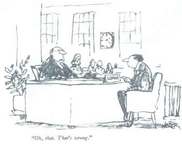
Absolutely no similarity, there, of course, to the credit crisis … or is there? This Robert Weber cartoon, from the July 18, 1983 issue (a few years, granted, before the S&Ls began to fail) sure sounds familiar:
thatswrong.jpg
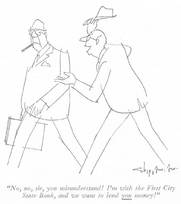
What’s more, this Weber cartoon from the February 22, 1988 issue weirdly presages the crazed loan practices typical of the mortgage industry up until a few months ago.
But in the austere light of the credit crisis, perhaps you’ll find this Vahan Shirvanian cartoon from the May 17, 1969 issue a comforting reminder of better times:
lendYOU$$$.jpg