Yes, everyone’s talking about the Ken Auletta piece.
Monthly Archives: December 2005
Original “Brokeback Mountain” Online
Recently posted to the magazine’s website: Annie Proulx’s October 13, 1997, short story, which inspired the film. (Update: The magazine’s taken down the link. Copyright conflicts? Profits to be generated from sales of the story-to-screenplay mini-book? But a commenter saved the day—the link above is now to Outspoken Clothing, which is bravely hosting the story itself. Thanks, commenter and host!) Proulx talks about writing it in the L.A. Times:
Proulx, 70, in town recently for the premiere of Ang Lee’s film adaptation of “Brokeback Mountain,” says that while she was “blown away” by the movie, she doesn’t welcome the return of Ennis and Jack to the forefront of her consciousness.
“Put yourself in my place,” the author says. “An elderly, white, straight female, trying to write about two 19-year-old gay kids in 1963. What kind of imaginative leap do you think was necessary? Profound, extreme, large. To get into those guys’ heads and actions took a lot of 16-hour days, and never thinking about anything else and living a zombie life. That’s what I had to do. I really needed an exorcist to get rid of those characters. And they roared back when I saw the film.”
The story bubbled forth from “years and years of observation and subliminal taking in of rural homophobia,” says Proulx, whose Pulitzer Prize-winning novel, “The Shipping News,” was also adapted for the screen. She remembers the moment when those years of observed hatred began taking form. It was 1995 and Proulx, who lives in Wyoming, visited a crowded bar near the Montana border. The place was rowdy and packed with attractive women, everyone was drinking, and the energy was high.
“There was the smell of sex in the air,” Proulx remembers. “But here was this old shabby-looking guy…. watching the guys playing pool. He had a raw hunger in his eyes that made me wonder if he were country gay. I wondered, ‘What would’ve he been like when he was younger?’ Then he disappeared, and in his place appeared Ennis. And then Jack. You can’t have Ennis without Jack.”
Proulx didn’t think her story would ever be published. The material felt too risky; Ennis and Jack express their love with as much physical gusto as any heterosexual couple, and it happens in full view of the reader, without any nervous obfuscation. The backdrop is that wide expansive West that bore forth John Wayne and the Marlboro Man — but here the edges of the mythos fray, and the world becomes chilly and oppressive.
The story was published in the New Yorker magazine in 1997, and screenwriter Diana Ossana read it one night when she couldn’t sleep.”It just floored me,” Ossana says, speaking after a screening of “Brokeback Mountain.” She ran downstairs to show it to her writing partner, who happens to be Larry McMurtry (“The Last Picture Show,” “Lonesome Dove”) and suggested they turn it into a screenplay.
…
The movie, like the story, does not pull any punches. The sex is just as graphic, the critique of rural homophobia just as angst-ridden and raw. Proulx doesn’t pretend to know how the movie will play with audiences, but she likes that her message will be broadcast through such a popular medium.“There are a lot of people who see movies who do not read,” Proulx says. “It used to be that writing and architecture were the main carriers, permanent carriers, of culture and civilization. Now you have to add film to that list, because film is the vehicle of cultural transmission of our time. It would be insane to say otherwise, to say that the book is still the thing. It isn’t.”
In the Southern Voice, more about the hard ride between story and screenplay:
“I recognized immediately that this was a story that was a work of genius,” says McMurtry…”And I wondered, why didn’t I write it? I’ve been there in the West my whole life.”
Before the end of the year, the two had optioned Proulx’s short story with their own money, but waited in vain as directors and stars came and went on the project. Gay filmmaker Gus Van Sant was attached for a while, as was fellow gay auteur Joel Schumacher.
Actors who saw the screenplay would tell Ossana it was the most beautiful script that they’d ever read but then, a few months later, would strangely distance themselves from the project…. Continued.
Update: There’s a good, concise history of gay material in movies in the SF Chronicle. If you still haven’t seen The Celluloid Closet, rent it–it’s so entertaining as well as true, right, informative, etc. One of the best bits is when Tom Hanks says something like, “I don’t exactly walk into a room and intimidate people. So when I’m cast as a gay man with AIDS, people are like, ‘Aw, look, it’s little Tommy Hanks! That’s not scary.’ ” It made me sorta like him again. Susan Sarandon is also, of course, great: “You wouldn’t have to get drunk to bed Catherine Deneuve, I don’t care what your sexual history to that point had been.”
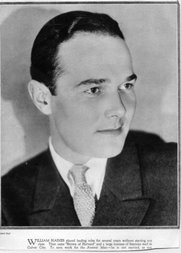
And I really hope someone’s working on a screenplay from William Mann’s riveting and galling Wisecracker: The Life and Times of William Haines, Hollywood’s First Openly Gay Star, a biography of the forgotten early-film headliner (pictured above). When the book was published, Film Forum showed a week’s worth of Haines’ movies (silent and talkies–he made the transition with panache), and I’m telling you, they were great. He used to get top billing over Joan Crawford! Maybe now’s the time to do this stylish, audacious, history-correcting story, especially with Tab Hunter coming out and all. ( I met a savvy, award-winning screenwriter named J. T. O’Neal at the movies recently; I bet he could do it.) Think of the hot actors who’ll run for the part, now that they see how it’s done.
Update update: Isn’t the wording interesting throughout this Catholic News Service review of Brokeback Mountain?
As the Catholic Church makes a distinction between homosexual orientation and activity, Ennis and Jack’s continuing physical relationship is morally problematic.
The adulterous nature of their affair is another hot-button issue. But the pain Jack and Ennis cause their families is not whitewashed. (The women are played with tremendous sympathy, not as shrill harridans.) It’s the emotional honesty of the story overall, and the portrayal of an unresolved relationship — which, by the way, ends in tragedy — that seems paramount.
Director Ang Lee tells the story with a sure sense of time and place, and presents the narrative in a way that is more palatable than would have been thought possible.
…
Looked at from the point of view of the need for love which everyone feels but few people can articulate, the plight of these guys is easy to understand while their way of dealing with it is likely to surprise and shock an audience.Except for the initial sex scene, and brief bedroom encounters between the men and their (bare breasted) wives, there’s no sexually related nudity. Some outdoor shots of the men washing themselves and skinny-dipping are side-view, long-shot or out-of-focus images.
While the actions taken by Ennis and Jack cannot be endorsed, the universal themes of love and loss ring true.
Update update update: More on Proulx, Lee, Ossana, McMurtry, and the story’s journey to the screen, in the Austin American-Statesman (originally in the Denver Post).
Update x 4 for you lovely googlers: Read the always brilliant James Wolcott on bloggers who protest too much and “the genteel homophobia hovering behind the he-man hand-fluttering about Brokeback Mountain’s mainstream prospects.”
And here’s the Out review.
Clip-On Parrots and Doppelgangers
I just spoke with the good-natured, self-deprecating Adam Szymkowicz, winner of the most recent caption contest. “I was psyched to win. I’m finally known for something!” he laughed. He’s out West snowboarding at the moment, but happily agreed to do an email interview with cartoonist Drew Dernavich (whose cartoons he likes a lot) in coming days. Look for that soon.
I warned Adam that other contest winners have reported getting cantankerous letters from readers. “Uh-oh, I hope they don’t have anything against clip-on parrots!” Yes, about that caption: He wasn’t sure if it “was necessarily in the vein of The New Yorker,” he says, so he was extra-pleased it was chosen.
Meanwhile, he’s already contending with one of the drawbacks of fame: being impersonated. Another Adam Szymkowicz, a New York playwright and screenwriter (Pretty Theft, Deflowering Waldo), keeps getting congratulated for winning the contest. As our Adam reports, “we’ve had this little email thing going on for a couple of days.” From his jesting letter:
So you don’t know me…
But you have something of mine. My name. yeah, my name. Adam Szymkowicz. When I took it, hell, I thought no one else would want that lackadaisical jumble of consonants and just two and a half vowels. Apparently I was wrong…. [W]e’re gonna have to have it out over this shit at some point. It’ll be a total literary style high-noon showdown. Totally. OK corral style; complete with dust, blood, shotguns and scantily-clad prostitutes watching furtively from behind grimy half veiled upstairs saloon windows.
I like that half a vowel—it reminds me of an improv bit my friend Scott Prendergast did in which the letter Y showed up to rehearsal for Vowels—The Musical!, although he’d been told to come in only “sometimes.” In any case, as Caption Adam notes, “He put it on his blog, so I guess he’s not mad.” Emily Fox Gordon and I know well that having a name clone can be inconvenient, but it does have a big plus—it makes you seem really, really prolific. Congratulations to the new Szymkowicz in town, and don’t touch that dial; look for his dialogue with Drew Dernavich here soon. (Update: Real soon—these guys are prompt!) Come join the youth and beauty brigade!
Other Emdashes caption-contest interviews:
- David Kempler, winner #100 (“Don’t tell Noah about the vasectomy.â€)
- David Wilkner, winner #99 (“I’d like to get your arrow count down.â€)
- Richard Hine, winner #98 (“When you’re finished here, Spencer, we’ll need you on the bridge-to-nowhere project.â€)
- Carl Gable, winner #40 (“Hmm. What rhymes with layoffs?â€)
- T.C. Boyle, winner #29 (“And in this section it appears that you have not only alienated voters but actually infected them, too.”)
- Evan Butterfield, winner #15 (“Well, it’s a lovely gesture, but I still think we should start seeing other people.”)
- Jan Richardson, winner #8 (“He’s the cutest little thing, and when you get tired of him you just flush him down the toilet.”)
- Roy Futterman, winner #1 (“More important, however, is what I learned about myself.”)
New occasional feature: NY Sun articles we can’t read
Since we’re (you and I, I mean—I’m making some assumptions) not subscribers. Too bad, since the Sun covers The New Yorker and related subjects a lot, and by all accounts, well. Oh well! Here’s a taste of the forbidden fruit (click to enlarge, and subscribe to be enlightened):

And speaking of cool cartoonists…

The hilarious, winsomely enterprising, and soon to be caption-contest-contributing cartoonist Matt Diffee will be jokin’ and playin’ at Pete’s Candy Store Friday (as in tomorrow) at 9, along with Andy Friedman and the Other Failures. It’s hard to go wrong at Pete’s, and if you didn’t get to hear Diffee and friends’ jaunty, tuneful Dougless Trio at the New Yorker Festival, why, I hope you’re feeling lucky now. For free, yet! As Diffee noted at the festival, “We figure that among New Yorker cartoonist bluegrass bands, we’re in the top five.” At least.
Here’s an interview with Diffee that I’m not sure I ever posted, but meant to; it’s very entertaining.
(12.12.05 issue) Wunderkind wins caption contest
Surely, this recent St. Lawrence University graduate, writing tutor, and native of Shoreham, VT, is the same Adam Szymkowicz who’s just won the latest caption contest. (It’s the one with the corporate parrot meeting.) And won it, I should add, with a caption that’s as funny as the best of the entries so far. Although I’m happy to reach out to contest winners myself (hi, paranoid L.A. makeup artist! salut, charming other people!), I’m even happier when they contact me first. So, Adam, I’m looking forward to your email. I’m especially glad that his appropriately twentysomething-snappy caption—”Shut up, Bob, everyone knows your parrot’s a clip-on”—is paired with a Drew Dernavich drawing, since Dernavich is one of my favorites of the younger cartoonists at the magazine. These two New Englanders might well enjoy one another, and perhaps I can arrange that in a virtual sort of way.
The cheerful-looking and Frisbee-playing Adam is a visual artist himself; at least if I’m correct about his identity, he contributed to an experimental group show called Learning to Love You More in the North Country while he was still in school. Even more impressively, he’s written a caption that makes an already beautifully strange drawing even stranger. Like proper improv, a good caption like this does more than echo the immediate joke and doesn’t contradict the visual setup, either, but extends it by inventing a whole new weird world and set of relationships—in ten words. This was the right choice, although Radosh’s imps likely have their own preferences.
The Complete New Yorker: Printing tips
From Jon Michaud, the magazine’s unfailingly helpful Head of Library, the answer to the reader’s query about trouble printing archive pages from the complete DVD, and to my own note about trying in vain to print Donald Antrim’s matchless essay “I Bought a Bed”:
I noticed your posting on printing problems with The Complete New Yorker. We have had no such problems here in the library, where we use the archive on a daily basis. I checked with other members of the team who worked on it and it seems that certain printer models do cut off the bottom of the page. One way to avoid this is to save the desired page(s) as a PDF and then print the PDF. This seems to work, though the print quality suffers slightly.
He adds:
The New Yorker‘s paper quality varied over the years, and was noticeably poorer from 1944-1955 or so. This may account for some fuzziness, since the images in the archive were scanned from original issues…. We really want to help users as much as possible and also are eager to learn about any problems with the archive so that they can be fixed in future updates. Anything you or your correspondent tell me will be shared with the group here with the aim of trying to find a solution.
I just tried to print the Antrim and saw that the date and page number were indeed cut off. Printing to PDF preserved the footer material but reduced the print quality a little. The New Yorker has changed its size over the years. The loss of this footer text may be a result of slight re-sizing of the page image to uniform dimensions.
Michaud is everything you would hope the New Yorker library chief would be, and I hope he’s at Pastis right now savoring something appropriately literary-historical, though possibly less head-clouding than Pernod. Please email me any further comments about the technical side of using the archive (or, indeed, anything at all about it), and I’ll print them here. Speaking of print, the current issue of Print includes my review of the DVDs. This is an expensive anniversary issue, but, as always, well worth it.
Also, much, much later: (also added to the original post) The Complete New Yorker troubleshooting page now has this Jon-echoing note.
I am a Mac user, and I can’t get the last 2 or 3 lines of each column on the page to print properly. I’ve already tried adjusting the page size and my printer is working fine. What should I do?
From the print dialog box, select “Save as PDF,” and specify a location where you want to save it. The PDF file that is generated should open in Preview automatically. In the PDF, select Page Setup from the File Menu, and change the scale option from 100% to 95%. Click OK, and then print the PDF file. (You may need to change the scale % more or less, depending on your printer.)
A reader writes: DVD archives don’t print right

I’ve had some problems with getting the archive pages to print properly, too. As with Jessica Simpson’s shorts, the bottoms keep getting cut off. (The Capote image above is a mere demonstration of the archive’s cool contents and the DRM-skirting power of Grab, not a dramatic exaggeration of the printing snafu, although it could be that, too.) Coincidence? Bug? Feature? The flummoxed reader’s report:
Are you having any trouble printing pages? When I print, the pages come out looking like shite, and I’ve got a pretty up-to-date printer (HP 720C). I e-mailed their technical service line, but I never heard back.
Update: New Yorker Head of Library Jon Michaud has the answers.
Also, much, much later:: The Complete New Yorker troubleshooting page now has this Jon-echoing note.
I am a Mac user, and I can’t get the last 2 or 3 lines of each column on the page to print properly. I’ve already tried adjusting the page size and my printer is working fine. What should I do?
From the print dialog box, select “Save as PDF,” and specify a location where you want to save it. The PDF file that is generated should open in Preview automatically. In the PDF, select Page Setup from the File Menu, and change the scale option from 100% to 95%. Click OK, and then print the PDF file. (You may need to change the scale % more or less, depending on your printer.)
Star cartoonist panel: Good news!
It’s been postponed. Now neither you nor I will have to miss it! Since I’m going to Cynthia Hopkins’ Must Don’t Whip ‘Um tonight, if I possibly can. It is guaranteed to rock your soul. The new cartoon-talkin’ info:
Conversations with Cartoonists at Dixon Place, a panel with Gahan Wilson, Sam Gross, Victoria Roberts, and Barbara Smaller discussing their favorite cartoons, scheduled for December 7th, has been postponed. The new date is Thursday evening, January 12th, at 8 pm.
Glad? Well, to his surprise, yes
Bob Haynes writes in the Benton Country (Arkansas) Daily Record:
I’m not usually a reader of The New Yorker magazine. I don’t often even go to places where it can be found lying around. However, when my wife and I visit her doctor, the waiting room is filled with magazines with medical articles I don’t even understand, but once in a while, there it will be — shining out as though it were on fire and just yearning for me to pick it up — a copy of The New Yorker magazine.
…
I began to skim through it as I often do when picking up a magazine that I don’t own — looking for pages that someone else must have found provocative because they would dog-ear that page or those pages. The first such dog-ear I found was an article by Malcolm Gladwell called “The Cellular Church.” It was an article about Rick Warren and Saddleback Church and the sub-title indicated that the article would point out “How Rick Warren’s congregation grew.” After only reading the first two paragraphs, I was smitten. Feel the love; continued here.
Boldface and link are, of course, mine. I love that “shining out as though it were on fire.”