Monthly Archives: May 2007

Why Dorothy Parker? Five Questions for an Expert

The typographically complex but clearly sensible Dark Party Review has a nice interview with Dorothy Parker Society impresario Kevin Fitzatrick today.

DP: Next month is the 40th anniversary of Parker’s death and your organization is holding “A Journey into Dorothy Parker’s New York” on June 4. What exactly was Parker’s New York?

Kevin: That is what makes Dorothy Parker timeless. Her New York still exists: cocktail lounges, hotel lobbies, jazz clubs, magazine offices, crowded subway cars, long taxicab rides at night. Almost all the places she lived 40, 60, 80 years ago are still standing. You don’t have to go too far in Manhattan to find the milieu that she lived in. However, since the mayor’s smoking ban, the cigarette smoke has been removed from the picture.

DP: Is Parker still an important literary figure in 2007? If so, why?

Kevin: The fact is Dorothy Parker has never gone out of print. Work that she created before World War I is still on bookshelves. There are not that many American writers, male or female, who are in that company; certainly not a writer such as Parker, who had a limited output.
I’ve often said that the reason Dorothy Parker is still read today, and remains popular while others of her era have been forgotten, is because she wrote about the human condition. Getting your heart smashed into a million pieces feels the same in 2007 as it did in 1927. Read the whole interview.

Grafs: Love Calls Us to the Things of This World

An occasional feature in which, instead of writing unjustly hasty sentences when pressed for time, I offer you a fizzy thimbleful of each noteworthy article.
Emdashes friend B—— points us to this welcome sight: more Little King animations. You’ll remember this first Soglow find, which puts both the King and Santa in some peculiar situations.
From Nourishing Obscurity, a link to Jonathan Yardley on James Thurber:

Thurber in my youth wasn’t something you went to the bookstore for — though of course you could — but something that came in the mail almost every week, as regular and reliable as the clocks of Columbus, Ohio, which he wrote about in the pages of the New Yorker…. One does indeed turn to Thurber for the drawings, but the great glory is his prose. Whether he was the funniest of all American writers can be debated to the end of time, but he was much more than funny. Like his friend White he was wise, and there was a soft spot to him.

There’s a scrumptious selection of New Yorker covers here at Joanna Rees Photography; Rees introduces the gallery thus:

Today I presented a lecture on the cover art of The New Yorker magazine based on the USA Today article (2005) ‘That Should “Cover” It’ by Francoise Mouly. As I prepared the power point presentation I became delighted and intrigued by the covers and spent a considerable amount of time unearthing some of The New Yorker’s hidden gems…. Saul Steinberg describes the covers as ‘pictures that change the way a person sees the world, making visible concepts so fundamental that the viewer cannot remember how he or she thought before seeing them.’

The Christian Science Monitor reports on the magazine industry, which is still (partly) in excellent health:

While there have been some high-profile magazine failures in the last decade (including Talk, George, and, most recently, the movie magazine Premiere), the total circulation of American magazines rose to 370 million in 2006, the highest since 2000…. High-brow magazines like The New Yorker and The Economist are doing especially well, and there are some 200 more magazines about just three subjects – dogs, golf, and interior design – than there were just a decade ago.

Here’s cartoonist Mike Lynch (and Eli Stein, who Lynch links to) on the agony of cartoon look day, with a great vintage photo of an extremely clean-cut cartoonist crew from the old Saturday Evening Post.

Boing Boing’s vintage boombox reminds me of that dazzling 1959 iPod that I posted around the dawn of time. Someone or other picked it up, and it was one of my most dramatic hit days ever—certainly the biggest non-New Yorker-related spike in Emdashes history. I’ve heard before that anything at all Apple-related (e.g., my post about NYPD iPod flyers) is catnip for the international blogosphere, and I can attest to that.

And finally, Manifest Destiny would like you to stop using the construction “an historic.” What will Ben Yagoda say about this, I wonder? And who did his clever cover design?

Ask the Librarians (V)

A column in which Jon Michaud and Erin Overbey, The New Yorker’s head librarians, answer your questions about the magazine’s past and present. E-mail your own questions for Jon and Erin; the column has now moved to The New Yorker‘s Back Issues blog. Illustration for Emdashes by Lara Tomlin; other images are courtesy of The New Yorker.
Q. How does The New Yorker collect the newspaper clippings with the funny typos and malapropisms?
Jon writes: The clippings, which have been appearing in the magazine since its first year of publication, are called newsbreaks. They are submitted to The New Yorker by its readers and also gathered by members of the magazine’s staff. They were originally used to fill up leftover column inches at the end of stories, but quickly became a popular department in their own right. By the early 1930s, readers were sending in as many as a thousand newsbreaks a week; at that time, the magazine also employed staff members whose duties included scanning the daily newspapers for potential breaks.
The writer most closely associated with newsbreaks is E.B. White. Harold Ross gave White a batch of newsbreaks as a test before hiring him, and was pleased enough with the results to make newsbreaks one of White’s first assignments at The New Yorker. (At that time, the newsbreaks department was considered the lowliest position on staff.) White quickly made them his own, generating witty taglines (the tagline was known in-house as the “snapper”) and creating many of the now-familiar headings, such as Neatest Trick of the Week and Constabulary Notes from All Over. In the foreword to Ho Hum: Newsbreaks from “The New Yorker” (1931), White noted, “There is a secret joy in discovering a blunder in the public prints. Almost every person has a little of the proofreader in him.”
White continued working on newsbreaks well into the 1970s, long after he and his wife Katharine had quit New York for Maine. Writing to Ross in 1943, he said, “My breaks are raised right in the home from hardy vigorous stock.”
Since White stopped doing them, newsbreaks have been handled by a number of editors. These days, the magazine receives far fewer clippings than in earlier decades, and no one on staff is now employed to scan newspapers and other publications for potential breaks. Even so, most of the newsbreaks printed in The New Yorker still come from the magazine’s readers.
Q. What did Garrison Keillor write for the magazine?
Erin writes: Garrison Keillor, the popular Prairie Home Companion host who is also a writer and satirist, began writing for The New Yorker in the early 1970s, around the same time he began his radio career in Minnesota. His first piece for the magazine was a short casual (now called Shouts and Murmurs) titled “Local Family Keeps Son Happy,” which ran in the issue of September 19, 1970. It’s a humorous account of a suburban family that hires a prostitute as a live-in companion for their unhappy teenage son. According to Ben Yagoda’s About Town: The New Yorker and the World It Made, when editor Roger Angell first read Keillor’s piece, he walked the corridors of the office, waving the manuscript and shouting, “This is great!”
In his twenty-two-year career at The New Yorker, which spanned 1970 to 1992, Keillor contributed a total of one hundred and three pieces. He primarily wrote humor casuals, short stories, and Comments, but he also contributed two features to the magazine: an Onward and Upward with the Arts on the Grand Ole Opry (May 6, 1974) and a Reporter at Large about country musicians and golf (July 30, 1984). It was while researching his piece on the Grand Ole Opry that Keillor conceived the idea of A Prairie Home Companion, which debuted two months after his article appeared in the magazine. The following is an excerpt from that piece:

The Grand Ole Opry is the oldest continuous radio show in America today…. You listen to the Opry and pretty soon you have a place in mind—a stage where Uncle Dave [Macon] sang and told jokes and swung the banjo, where the Great [Roy] Acuff wept and sang “The Great Speckled Bird,” where Hank Williams made his Opry debut with “Lovesick Blues”…and the crowd wouldn’t let him go, where Elvis sang (and Bill Monroe sings) “Blue Moon of Kentucky,” where Cousin Minnie calls out “How-dee! I’m just so proud to be here”…. I watched my first Opry from the Allright Parking lot beside Ryman [Auditorium, in Nashville]…. The music drifted out—high lonesome voices, sweetened with steel guitars, singing about being left behind, walked out on, dropped, shunned, shut out, abandoned, and otherwise mistreated, which a fellow who’s driven eight hundred and sixty-one miles to crouch in a parking lot can really get into.

In the introduction to his book We Are Still Married: Stories and Letters (1989), Keillor writes that he first encountered The New Yorker as a teenager in Anoka, Minnesota. “I read Talk as the voice of inexhaustible youth,” he writes, “charged with curiosity and skepticism, dashing around the big city at a slow crawl, and tried to imitate its casual worldly tone, which, for a boy growing up in the potato fields of Brooklyn Park township, was a hard row to hoe, but I tried. The magazine was studded with distinguished men of initials, including E.B., A.J., S.J., E.J., and J.D., so I signed myself G.E. Keillor for a while, hoping lightning would strike.” E.B. White was one of his earliest—and most enduring—influences.

Keillor elucidated his view on humor writing in his first story collection, Happy to Be Here (1981): “It is more worthy…if a writer makes three pages sharp and funny about the lives of geese than to make three hundred flat and flabby about God or the American people.” In an interview on PBS in 2006, he indicated that–of the current crop of New Yorker humorists–he enjoys Ian Frazier, Paul Rudnick, and David Sedaris. Collections of Keillor’s stories for the magazine can be found in Happy to Be Here, We Are Still Married, and The Book of Guys (1993); a fictional account of his tenure at The New Yorker appears in his novel Love Me (2003).

Q. Where is New Yorker founding editor Harold Ross buried?
Jon writes: Harold Ross died on Thursday, December 6, 1951, while undergoing surgery to remove a cancerous growth from his lung. The following Monday, more than 1,500 people attended a memorial service for him at the Campbell Funeral Church on Madison Avenue and Eighty-first Street. An account of the service in The New York Times stated, “The body of the 59-year-old editor was cremated and burial was at Ferncliff Cemetery in Ardsley, New York.” Thomas Kunkel notes in Genius in Disguise (1995), however, that in 1956, in accordance with his final wish, Ross’s ashes were scattered over the Rocky Mountains near his birthplace, Aspen, Colorado. As such, there is no gravestone or memorial site to visit. Perhaps the closest is the plaque near the entry to The New Yorker‘s old offices at 25 West Forty-third Street where Ross presided for the last sixteen years of his editorship. A portrait of Ross taken by Fabian Bachrach in 1944 still hangs in the editorial department of the magazine’s current offices in Times Square.
Q: What are some of the funniest or most mysterious pseudonyms in the archives of The New Yorker? Did you have to make any educated guesses for The Complete New Yorker‘s DVD book?
Erin writes: The New Yorker has a long history of writers using pseudonyms. In the beginning, many of the contributors—who were working for other magazines and newspapers at the time—used pseudonyms to hide the fact that they were writing for a new rival magazine. Other writers used pen names as a device to allow them to write in a different voice. Genêt, a.k.a. Janet Flanner, is probably the magazine’s most famous example of pseudonymous reportage. When Flanner began writing her column, Letter from Paris (or Paris Letter, as it was known then), it was editor-in-chief Harold Ross who decided to dub her the more French-sounding Genêt.
Robert Benchley originated The Wayward Press column with the nom de plume Guy Fawkes, and Dorothy Parker wrote a popular books column in the twenties under the pen name Constant Reader. The fashion writer Lois Long wrote two columns, Our Washington Correspondent and Tables for Two, under the pseudonym Lipstick. Most of the magazine’s sports columnists, from Russell Maloney to David Lardner, also wrote under pseudonyms. The prolific G.F.T. Ryall wrote a horse-racing column, The Race Track, under the pen name Audax Minor, and an automobile column under the name Speed. (And who can forget the engaging Talk of the Town pieces by Maeve Brennan and Rogers E.M. Whitaker, filed under the pseudonyms The Long-Winded Lady and E.M. Frimbo, respectively?)
Several of the magazine’s best-known contributors used pseudonyms for occasional articles and stories rather than for recurring columns. James Thurber wrote multiple pieces in the mid-thirties under the pseudonym Jared Manley; both Wolcott Gibbs and Alexander Woollcott wrote stories under various pen names at one time or another. E.B. White may be the writer with the most plentiful (seventeen) pseudonyms, among them Elmer Hostetter, Baedeker Jones, Squire Cuthbert, and Lee Strout White. My own favorite pseudonym is E. Bagworm Wren, one of White’s various noms de plume. The New Yorker‘s frequent use of pseudonyms tapered off in the forties and fifties, and today it’s rare that a writer uses one. (One notable exception is the Cop Diary series written in the late nineties by an undercover N.Y.P.D. officer under the pen name Marcus Laffey.) Fortunately, the magazine’s library contains an archive matching all of the pseudonyms with the writer they belong to, so there was no need for educated guesses when the DVD index for The Complete New Yorker was being created.
Q. When did The New Yorker publish its first cartoon featuring a board of directors?
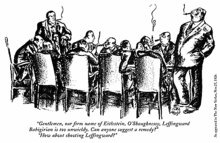
Jon writes: Though cartoons depicting businessmen and executives (often of the fat-cat variety) have appeared in The New Yorker from its very first issue, it took more than a year for the magazine to print one featuring a board meeting. The first single-panel cartoon of a board meeting was by Carl Rose; it ran in the November 27, 1926, issue. The drawing is of a group of businessmen sitting around a table smoking cigars. The caption reads: “Gentlemen, our firm name of Eitlestein, O’Shaugnessy, Leffingward and Babigirian is too unwieldy. Can anyone suggest a remedy?” “How about shooting Leffingward?” comes the reply. Though the artwork, in heavy charcoal, is clearly from the magazine’s early days, the caption still feels contemporary. It calls to mind a Charles Barsotti cartoon from October 11, 2004, in which an executive says to one of his employees, “I won’t, of course, Hollingsworth, but I could have you killed.”
TNY-nov.27.1926.pg31-toon.gif


Addressed elsewhere in Ask the Librarians: VII: Who were the fiction editors?, Shouts & Murmurs history, Sloan Wilson, international beats; VI: Letters to the editor, On and Off the Avenue, is the cartoon editor the same as the cover editor and the art editor?, audio versions of the magazine, Lois Long and Tables for Two, the cover strap; V: E. B. White’s newsbreaks, Garrison Keillor and the Grand Ole Opry, Harold Ross remembrances, whimsical pseudonyms, the classic boardroom cartoon; IV: Terrence Malick, Pierre Le-Tan, TV criticism, the magazine’s indexes, tiny drawings, Fantasticks follies; III: Early editors, short-story rankings, Audax Minor, Talk’s political stance; II: Robert Day cartoons, where New Yorker readers are, obscure departments, The Complete New Yorker, the birth of the TOC, the Second World War “pony edition”; I: A. J. Liebling, Spots, office typewriters, Trillin on food, the magazine’s first movie review, cartoon fact checking.

Tonight! William Trevor’s Radio Plays Premiere at 92nd St. Y

Talk about an excursion in the real world. From the Y:

Celebrated by The New Yorker as “probably the greatest living writer of short stories in the English language,” William Trevor is also a bestselling novelist and, in England and Ireland, well known draftsman of radio plays, many of which he himself has adapted from his fiction. On Monday, May 14, at 8:00 PM, the 92nd Street Y presents the American premiere of two of those plays: Going Home and Mr. McNamara, based on short stories Mr. Trevor wrote in 1972 and 1976, respectively. The event is part of the 2006/07 season of literary programs presented by the 92nd Street Y Unterberg Poetry Center. Tickets are $18 and can be purchased at the 92nd St. Y website and 212.415.5500. For full cast information and bios, please call 212.415.5455.

Dept. of Fresh Faces: The Intern Speaketh

You may remember that a little while back, I sought an intern. John Bucher, the one I found—or vice versa—is splendid, he already writes intelligently about The New Yorker, and he’s Canadian, too. There will be a logo for such posts, by the way, but Rome wasn’t built in a day, and neither was Rome.com. (There is now; thanks, Pretty!) Read on.
Hello from Vancouver—John the Intern here. I’m the journalism student from the University of British Columbia who’s won the right to toil in the Emdashes archives for the summer. It’s a step up; the bulk of my year went into learning the unhappy art of newswriting, and also something called “multiplatform” journalism—technical training for a mixed-up future in TV, print, and online. Anyway, I’m supposed to return to school in September, but, with a few good bounces, this interstitial summer will run deep into my forties.
My relationship with The New Yorker began a decade ago, when I was twenty, with a raft of back issues borrowed from my Aunt Susan and consumed in a basement in Esquimalt, B.C. I got a subscription for my next birthday, and I’ve been a steady reader since. The magazine, while always a reason to look forward to the mail, became an intellectual lifeline during my three years as an editor in Taiwan, where my only contact with proper English was Starbucks menus and The Taipei Times.
New Yorker Comment, my blog about the magazine, began as a class assignment in January of this year. We were supposed to write about a “beat,” and so, having promiscuous interests, I chose one with no practical limits. The site has done okay—several thousand people seem to have read it—although I just made the dispiriting discovery that 60 percent of my visitors leave after ten or so seconds. Perhaps I’ll pick up a bit of snap by osmosis here at Emdashes.
For cadence and pitch I like Hendrik Hertzberg, and E. B. White’s quietly moral “An Approach to Style” is the neatest summary of my writerly aspirations. The next step for me is getting a job and paying down my student debt, and I’m on the lookout for prospects, at home and elsewhere.
You’ll hear from me again, and in the meantime, if you see anything particularly inspiring or functioning especially well on Emdashes, you may give me all the credit. [I wrote that last bit. Welcome, John! We’re so glad to have you. —Ed.]

The Pigeon Files, Part the Second

Squib Report bureau chief Martin Schneider continues his investigation into the worthy subject of pigeons in The New Yorker.
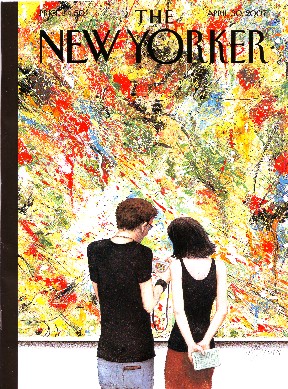
My new favorite New Yorker cover artist is Harry Bliss, and I have a feeling I’m not alone—Emily has already noted that his lovely, witty April 30 cover has drawn kudos from as far afield as New Zealand, since which time Jason Kottke has pointed out an interesting reaction to the cover, even leading to the discovery of a likely Norman Rockwell connection. Oh, that messy Jackson Pollock does attract satirists, does he not? (If I hadn’t temporarily misplaced my Complete New Yorker Disk 5, I could direct readers to Dana Fradon’s November 5, 1960, cartoon referencing Pollock in the full knowledge of its contents.)
That Bliss is poking fun at the YouTube generation does not seem in doubt. The interesting question is whether the young lady depicted partakes in the same technophilia as her companion or is, instead, nonplussed. The relevant data here seems to be the distance between the two, along with the subtle curvature of her shoulder away from him. Dissenters might point out that the gap is simply necessary for the reader to see the digicam.
Has Bliss weighed in? Or is he letting the picture speak for itself (without the help of digicams)? And while I’m asking questions, does anyone know the name of the Pollock painting in the image? Is it at MoMA?
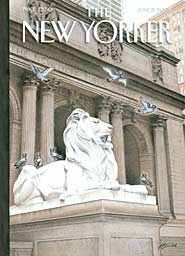
All this is preamble to a Bliss-related pigeon item. Turns out my concern about the lack of pigeons in recent New Yorker covers was utterly unfounded, as this typically fanciful Bliss cover of June 3, 2002, demonstrates. It’s just as witty as the Pollock/digicam one.

2002_06_03_v256.jpg

As many New Yorkers and tourists are aware, the famous lions are known as Patience and Fortitude—they were once known as Lady Astor and Lord Lenox!—with Patience occupying the left-hand slot. So that makes it Patience depicted in the cover. Waiting more than ninety years to munch on some primo Columba livia (Latin for “lives near Columbia University,” as you know)—now that is patience, to be sure.
—Martin Schneider

Bansky: Pranksy

If you’re digging Lauren Collins’s story on Banksy this week (plus the slide show), you’ll also like this tale of a westward journey in pursuit of Banksy, by my colleague James Gaddy. Who and what did he find? A few more images from the elusive trickster are within. We’ve had a recent run of Beatles heds.

Lost in the hoopla and media coverage was serious consideration of the graphic power of Banksy’s work. His early images showcased drawing and stencil-cutting prowess with an added edge: his seemingly effortless wit. Using an engaging trompe l’oeil technique, he created a range of visual puns—rats taking photos of pedestrians, policemen kissing, the Mona Lisa with a rocket launcher—and expanded on the stencil-graffiti syntax established by Blek Le Rat, softening the hard edge of the stencil with clever takes on clichéd images of war, government, religion, and art.

His vandalism also interacted with the city’s urban furniture on a visceral level: Rats spilled toxic fluid off the wall and into the street, policemen spray-painted their own graffiti on the walls, a diver appeared from a public fountain holding a drain plug. The style reflects its environment, says Tristan Manco, the Bristol-based author of the book Stencil Graffiti, by blending elements of official signage with those of punk bands like Crass, who used stencils to make their logo. The pranks were a natural outgrowth of his sense of humor as well: A mixture of meta-graffiti and wry social commentary, they were a pie in the face of stuffy elitism. Read on.

A Rolling Stone Gathers No Mossberg

Perhaps the best reason to start a blog is to use all the nonsensical puns that are ever-present in your head but that your actual job must restrain you daily from using during the sober act of headline-writing. Anyway, remember Engadget founder Peter Rojas, quoted in this week’s story on Walter Mossberg by Ken Auletta? There’s a fetching photo of the two of them on Rojas’s blog. Technology reporter and Engadget contributing editor Cyrus Farivar is more critical of Mossberg, but acknowledges, “I get the impression that there’s a bit of jealousy amongst almost every journalist that I know…. The fact of the matter is that I respect what he does, but I don’t want his job.” Former Palm C.E.O. Donna Dubinsky, also quoted in Auletta’s piece, comments several times on the post, Farivar replies, and hey presto, a spirited dialogue.

Jello Shots With Remnick, Gladwell, Surowiecki, &c.

Really! That was at the cocktail party after the whizbang New Yorker Conference yesterday; I’m using the festival illustration to the left there because I love this portrait of me by Carolita. I’ll post proper notes later, and I’m writing up the conference for PRINT‘s website, too. For now, I’ll say the conference was very well organized and run (no technical glitches in all twelve hours, as far as I could tell, except when the hit predictor balked), the Frank Gehry IAC building is beautiful, and the laptops on hand for compulsive email checking were from the Dark Star, but I confess I liked them anyway—superfast, with freakish, alive-seeming screensavers. Anyway, some of the high points for me were watching the events with Yves Béhar, Tim Wu, Jonathan Haidt, and Younghee Jung; talking to David Denby (who probably thought I was tracking him with a GPS, but I was just giddy to be sitting near him) and Cressida Leyshon; laughing at the antics of Barry Diller, Arianna Huffington, and Craig Newmark; seeing David Remnick do an ace interview with Cory A. Booker, the plucky mayor of Newark; and meeting Judith Thurman, Ken Auletta, Jeffrey Toobin, John Seabrook, and the unimpeachable Michael Specter. The Spore demonstration was hasty but tantalizing, and the drinks were delicious. What a treat!

The New Yorker Is the New Spectacular, Also the Old Spectacular

The Paddle writes with approval:

I can’t help it. The Shouts & Murmurs pages of the New Yorker is standing on the pinnacle of sly humor these days. After last issue’s take on crushes (all of which I’ve experienced), and this issue’s review of another aspect of my life, there is no way to make it any better in the next issue. This particular section of the magazine has always been hit-and-miss with me – I’m often into it for just one paragraph before moving on – but they’ve now laid purchase to at least three solid, future months of my reading time. Genius.

Beattie’s Book Blog loves this Harry Bliss cover. How’s your thumb, Harry?

Speaking of cartoonists, I’m extremely glad to report that three cartoonists from The New Yorker are nominated for the National Cartoonists Society’s Reuben Award for Gag Cartoons: Drew Dernavich, Mick Stevens, and P.C. Vey. I might have my preference, but whichever way this one goes, it’s pretty much in the bag for the magazine. Winners will be announced May 26, so place your bets, you crazy gamblers.

Also, I’m pleased that someone has assembled this bunch of video clips from the ’20s, which will help set the mood for the next party with the Dorothy Parker Society, which is coming up on June 4 and will be fizzy fun. Go! Here are the details, direct from Parker Society impresario Kevin Fitzpatrick:

The 40th anniversary of Dorothy Parker’s death is June 7. On June 4 the DPS is having an event to mark the anniversary is true Parker style: with a party at a Communist bookstore. It is Monday, June 4, at Revolution Books, 9 West 19th St, 6:30 to 8:00 p.m. …. There will be talks, readings, and of course, drinking. It is FREE and open to the public. Why a Communist bookstore? Just listen when I read from Mrs. Parker’s FBI file!

So Adam Moss is many things, but the new David Remnick? What does that even mean? New York is like Spy‘s beautifully designed new website along with some Vanity Fair, New York Observer, and various beloved periodicals of New York’s past stirred into a bright smoothie, and it’s loads of fun. I read and use it often, if not faithfully. But would anyone want a DVD of the entire contents of the present-day New York, to cherish, cite, and reread? That’s not what it’s for, and that’s all well and good. But it’s an absurd comparison and I won’t countenance it. Thank you, but the current David Remnick suits us very well.

Speaking of much-missed publications, won’t someone please bring back those weekly single-page photocopied listings of movies and poetry readings that you used to be able to buy at newsstands for something like a quarter and pick up at good bookstores, respectively? The web and the barely tolerable Moviefone and Fandango still can’t satisfy the city’s critical need for both. When you’re walking down the street, you don’t want to press buttons through endless menus—you just want to know what’s playing kinda near here pretty soon, or who’s reading this week. Perhaps the newsletters could be digital holograms for the 21st century, hovering at will till you dismiss them and head for your cinematic or poetical fix.