I read Renata Adler’s 1976 novel Speedboat last week. I found it a fascinating testament to…
…and right about there is where my difficulties began.
I had originally wanted to write that the book, while brilliant, is not a novel, at least not a novel with recognizable characters embroiled in a plot that’s resolved in some fashion, but after reading a bit of the critical commentary about it, I realized that this reaction is unoriginal and not so interesting. So what is there to say?
It’s not that Speedboat is simply dated. It is dated, very dated, but the book is also good, an unmitigated pleasure to read. Lots of books are dated in much more ordinary ways that make them difficult to read or enjoy today. Speedboat isn’t like that.
Perhaps this is the notion I’m groping for: A book like Speedboat couldn’t be published today in this form, much less receive the rapturous critical reaction it seems to have received in 1976. To use a medical metaphor, Speedboat is a diagnosis of the ’60s that cannot escape also being a symptom of the ’60s.
I don’t mean to offend. It’s a nifty book; it’s rare that one can say one has read a novel in which there is a pleasure to be found on virtually every page. But the techniques involved are so out of fashion that I’m not sure an editor would let it pass his or her desk in its published form. A novel consisting of a series of penetrating and thinly connected observations in which no plot point can be said to occur? It sounds like a hard sell, today.
Maybe we’re the poorer for it. Maybe their fashions were better than our fashions. Maybe I’m a terrible conservative when it comes to plot.
OK, that’s the meat of my reaction. A few odds and ends about the paperback edition I was reading, pictured below, found at the $0.48 bin at the Strand.
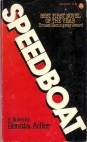
On the back is a picture of Adler by Richard Avedon, and underneath it says, in big red letters (hilariously, in my view): “JEN FAIN IS THE REAL THING.” Then underneath, in regular type, there are the words, “She is beautiful, hip, brilliant. She had been everywhere, done everything, known everyone.” And so on from there. It’s not that any of that is inaccurate, exactly, but it does create expectations the book isn’t designed to meet.
At the end of the book are a few pages of advertisement for other writers carried by the Popular Library imprint. One page touts Anne Tyler (spelled correctly), followed by a blurb from People: “To read a novel by Ann [sic] Tyler is to fall in love.” (Who’s that?) On the next page, we learn that a writer named Dorothy Dunnett “could teach Scheherazade a thing or two about suspense, pace, and invention.” And the page after that it says that “no other modern writer is more gifted a storyteller than Helen Van Slyke.”
Why is dated hype is so much funnier than other kinds?