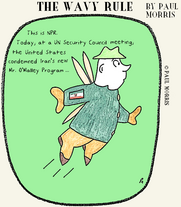
Sure, but the more relevant question in today’s “Wavy Rule” is, Were their hippos even hungrier? Paul notes about this K-strategic drawing, the first of two to commemorate the end of this year’s Olympics, “This joke, obviously inspired by the Olympics, also reminds me of an old New Yorker short story: Edward Allen’s ‘Hungry Hungry Hippos,’ published July 30, 1990.” Click to enlarge!
Also, this important message! Don’t forget to enter the Emdashes contest to name the upside-down question mark! Today, August 25, is the last day we’re accepting submissions, until midnight West Coast time. ¿Can you best the entries that have already been posted? There’s only one way to find out! Back to our regularly scheduled program.

More by Paul Morris: “The Wavy Rule” archive; “Arnjuice,” a wistful, funny webcomic; a smorgasbord at Flickr; and beautifully off-kilter cartoon collections for sale (and free download) at Lulu.
Monthly Archives: August 2008
From Burma to Bigfoot: This Week on Newyorker.com, From Our Interns
Each Friday, the Emdashes summer interns bring us the news from the ultimate Rossosphere: the blogs and podcasts at newyorker.com. Here’s this week’s report.
Adam Shoemaker:
George Packer devoted most of this week’s posts in Interesting Times to Burma, complementing his wonderful article in the latest issue of The New Yorker. He gives us a slideshow of photographs, a list of good charities focusing on the region, and thoughts on being a journalist in that tormented land. He marvels at the Burmese people’s extraordinary bravery in helping him in spite of their legitimate paranoia. “I’ve never been anywhere I liked the people more and the government less,” Packer writes. These posts add a personal dimension to his article, showing us what it is to live in the Dickensian Burma, which one interviewee said “is at least one or two centuries behind the Western world,” and where we might direct our efforts to fight the junta’s repression, a power that has placed the land under a “magic spell that only some external force can break.”
Packer also wonders at NBC’s refusal to spend even a small portion of its Olympics coverage on legitimate criticisms of the Chinese government’s “full-court press against any negative moment marring the coming-out party.” Having just returned from Beijing myself, it’s depressing to hear that America’s experience of the games has differed so little from that of the Chinese, aside from swapping CCTV’s blatant Nationalism for NBC’s all-absorbing patriotism.
Notes on Politics, Mostly: I’ll admit it was a little hard to focus on Hendrik Hertzberg’s lament on Barack Obama’s wasted opportunity at Saddleback Church; the photo he attached to the post was just a little too amazing. It reminds me how little has been made of Obama’s Hawaii years (and the surfing pictures sure to accompany them) and how unfortunate that it is. Hertzberg reports on pastor Rick Warren’s interviews with both Sen. Obama and Sen. John McCain, in which he thinks Obama should have stood taller, and which also illuminate the strange role of evangelical Christianity in this election. Hertzberg also writes about his eager anticipation of a new book. Obama’s Challenge, by Robert Kuttner, he writes, illustrates persuasively that the Illinois senator has a “fighting chance to lead the country into a deep and lasting era of positive change.” Hertzberg only hopes that he can first survive the “Republican onslaught based on crude nationalism, simpleminded militarism, “cultural” xenophobia, fear, and lies.”
Meanwhile over at his blog, Sasha Frere-Jones reports on African hip-hop, his inability to grasp the “beef between Nigeria and Ghana” (shared by this intern), and the joys of Eba, a common Nigerian food that tastes “like a savory version of cookie dough.” This followed on an earlier post in which Frere-Jones considered the attraction of Lil Wayne’s “A Milli,” a song with a beat that is “simple, genuinely odd, and half-empty, ready to be filled with words.” Wayne’s filler includes a boast that he is “tougher than Nigerian hair,” inspiring Frere-Jones’ investigation into African rap responses. He hasn’t found any yet, but I think cookie dough is a pretty good consolation prize.
Over at The New Yorker Out Loud, Matt Dellinger interviews the composer John Adams, who writes about finding his musical voice in this week’s issue of the magazine. Adams’ phone conversation provides more background and personal details about his early days in California in which he wrestled with the profound influence of John Cage’s minimalism and attempted to reconcile his foray into avant-garde composition with his love of Classical music and the enduring power of harmony (a “bugaboo” for modern composers).
Finally, in the Borowitz Report, Andy Borowitz enters the political fray with breaking news about Sen. Joe Biden’s anticipatory 50,000-word acceptance speech for the Democratic Vice Presidential nomination. The three-day oration is apparently a trimmed-down version of the 200,000-word piece the senator hoped to deliver upon accepting the Presidential Nomination in 1988. At that length, I suppose a lack of originality is inevitable.
Sarah Arkebauer:
I dug through the archives of the New Yorker Fiction Podcast and found a gem from March of this year. It’s Jonathan Lethem reading James Thurber’s “The Wood Duck.” The story has a sharp, movie-like quality that makes me wonder why Thurber is often so underappreciated.
Over at The Rest Is Noise, Alex Ross posted just one short item: a link to an article he wrote on Shakespeare at Glimmerglass. I first heard about Glimmerglass from a Nancy Drew book I read as a child, but since then I’ve discovered its cultural offerings to be on a much higher plane. This series should be no exception.
I was happy to see two posts, by Sally Law and Jenna Krajeski, in the “Bookspotting” category at the Book Bench this week. Macy Halford also notes a development in the saga of what will become of Kafka’s papers. Also worth looking at is Ligaya Mishan’s post about the newest City of Literature, which also contains information on honored cities of years past and information on how your city can become a City of Literature as well.
The Cartoon Lounge added installments six and seven to the Sandwich Duel banter. Drew Dernavich also alerted me to a hilarious new web project from the “I Can Has Cheezburger” people. The project is a space for users to upload humorous graphics they create using Microsoft Excel. It almost makes me want to whip out my spreadsheet skills.
Mike Peed at Goings On just posted yesterday with an important finding for anyone who loves tasty, organic street food. I also enjoyed finding out from Ben Greenman what music is on Michael Phelps’s iPod, learning (from Andrea Thompson) about what’s behind the names of New York restaurants and shops, and, via Greenman once
again, putting my mind at ease in the wake of the supposed Bigfoot discovery.
Taylor House:
Dana Goodyear at Postcard From Los Angeles spots a bittersweet missed connection stapled to a telephone pole in North Hollywood. Ed Ruscha’s old open-air studio space in Venice is being paved over and converted to a parking lot. Some say Ruscha’s presence in the city is one of the main reasons for its current popularity.
Mick Stevens visits the infamous Jack Z over at I Really Should Be Drawing. They talk comics over olive-filled martinis and ask the all important question, “When you’re working, which comes first, the drawing or the caption?”
Steve Brodner catalogues his recent trip to Israel in photos and text at Drawger. Little commentary but lots of great visuals. No worries, though, he’s still jabbing at John McCain.
Previous intern roundups: the August 15 report; the August 8 report; the August 1 report; the July 25 report; the July 18 report; the July 11 report.

The Wavy Rule, a Daily Comic By Paul Morris: Our Man O’Malley
An important message from “The Wavy Rule”: Don’t forget to enter the Emdashes contest to name the upside-down question mark! We’re accepting submissions through this Monday, August 25. ¿Can you best the entries that have already been posted? There’s only one way to find out! Back to our regularly scheduled program; Paul writes of today’s aerodynamic cartoon:
Mr. O’Malley was the product of Crockett “Harold and the Purple Crayon” Johnson’s imagination, and a character in Johnson’s “Barnaby.” Mr. O’Malley, a fairy godfather, was a member in good standing of the Elves, Leprechauns, Gnomes, and Little Men’s Chowder & Marching Society, ran for Congress, worked as a Wall Street tycoon, and smoked Havana cigars. A great resource on Barnaby and Crockett Johnson can be found at Philip Nel’s site. Click to enlarge!
More by Paul Morris: “The Wavy Rule” archive; “Arnjuice,” a wistful, funny webcomic; a smorgasbord at Flickr; and beautifully off-kilter cartoon collections for sale (and free download) at Lulu.
Dorothy Parker (& Her Society) Will Always Be Newsworthy
Martin Schneider writes:
City Scoops, a periodical that can be found in some of our city’s most luxurious lobbies, has a swell two-pager by Larry Getlen on the Dorothy Parker Society, run by our friend Kevin Fitzgerald. Click here to read it on pages 8 and 9 of the pdf file (click on the Marsalis image, at least until the next issue comes out). The pdf file itself can be found here.
New Yorker Festival 2008: A First Glimpse at the Lineup
Martin Schneider writes:
Finally, The New Yorker has gratified our curiosity by divulging details about the upcoming New Yorker Festival in October. There are a lot of terrific people listed here; our cup runneth over!
In its entirety, here is the press release:
The 2008 New Yorker Festival
New York, August 21, 2008 – During the weekend of October 3rd-5th, The New Yorker will present its ninth annual Festival, a three-day series of events that brings together an eclectic array of writers, artists, actors, directors, musicians and politicians at venues throughout the city. This year’s Festival takes place one month before the Presidential election, and there will be a special emphasis on politics in the Festival’s programming, as well as a weekend-long voter-registration drive. In past years, Festival events have sold out quickly, drawing more than seventeen thousand people from around the world. The full program guide of fifty events will be included in the September 15, 2008, issue of the magazine, on newsstands September 8th, and will be available at http://festival.newyorker.com. This year’s highlights include:
Right to Vote–The New Yorker Festival will partner with the New York City Board of Elections for a weekend-long voter-registration effort at all Festival venues and at Festival HQ, where special guests will be registering voters.
The annual New Yorker Town Hall Meeting will address the topic of race and class in America. David Remnick will moderate a discussion among the journalists Barbara Ehrenreich and Thomas Frank, the linguist John McWhorter, the political market-research expert Leslie Sanchez, and the scholar Cornel West.
A panel on political humor will feature “The Daily Show with Jon Stewart” correspondents Samantha Bee and John Oliver; the “Saturday Night Live” writer James Downey; the humor writer Andy Borowitz; and Allison Silverman, the executive producer of “The Colbert Report.”
Democratic strategists Donna Brazile and Joe Trippi and Republican strategists Alex Castellanos and Edward J. Rollins will discuss what they would do if they were running the Presidential campaigns, in a conversation moderated by Jeffrey Toobin.
In “Covering the Candidates,” The Atlantic’s Ta-Nehisi Coates, the New York Times’s Bill Keller, the Wall Street Journal’s Peggy Noonan, and Slate’s Jack Shafer will discuss what the press did right–or wrong–in covering the Presidential race, in a conversation moderated by Ken Auletta.
Featured interviews include the TV personality Stephen Colbert; Republican Senator Chuck Hagel; the attorney and health-care advocate Elizabeth Edwards; the actor and director Clint Eastwood; the actor Paul Rudd; the actress Mary-Louise Parker; the guitarist Tom Morello (of Rage Against the Machine and Audioslave); the soprano Dawn Upshaw; the actor Tommy Lee Jones; the dancer and choreographer Alexei Ratmansky; the fiction writer Alice Munro; the Nobel Prize-winning poet Seamus Heaney; and the novelist Haruki Murakami.
Film events will include Oliver Stone discussing his work with David Denby and showing clips from his upcoming film, “W,” based on the life of George W. Bush.
The “Young Shakespeareans” panel will feature the actors Lauren Ambrose, Ethan Hawke, Kristen Johnston, Martha Plimpton, and Liev Schreiber, who will discuss performing in Shakespeare’s plays.
The magicians Matthew Holtzclaw, Charles Reynolds, Jamy Ian Swiss, and Johnny Thompson will join Adam Gopnik for a morning of illusions and conversation.
About Town excursions and events throughout the city will include: a bike tour of Governors Island, led by Paul Goldberger, with a discussion about the island’s future with the architects Adriaan Geuze and Ricardo Scofidio and Leslie Koch, the president of the Governors Island Preservation and Education Corporation; a tour of the Frick Collection, conducted by Peter Schjeldahl, before public hours begin; Calvin Trillin‘s eighth gastronomic walking tour of Chinatown and Little Italy, with stops at some of his favorite eateries; a tour of John Currin‘s studio, followed by brunch and conversation with Calvin Tomkins; and a conversation between Claudia Roden and Jane Kramer about Roden’s latest culinary discoveries, while tastings of her dishes and wine pairings are served.
The cartoonists Matt Groening and Lynda Barry will discuss their careers in cartooning, and Robert Mankoff, the magazine’s cartoon editor, will host a live version of the Cartoon Caption Contest.
Friday Night Fiction events will feature writers discussing the themes in their work: T. Coraghessen Boyle, Jeffrey Eugenides, and Jhumpa Lahiri will address the ever elusive American Dream; Roddy Doyle, Anne Enright, and Tobias Wolff will uncover family secrets; Sherman Alexie, Shalom Auslander, and Junot DÃaz will talk about home, whether a place or a state of mind; Peter Carey, Hari Kunzru, and Gary Shteyngart will discuss writing about outlaws; Sana Krasilov, Yiyun Li, and Manil Suri will discuss writing about their homelands; and Matthew Klam, Elmore Leonard, and Joyce Carol Oates will talk about the devils that lurk within.
A duet of “Worst Nightmares” panels will explore the dark side of film. Part 1 features scary-movie directors Wes Craven and Hideo Nataka. Part 2 will include a screening of the new animated film “Fear(s) of the Dark” and a conversation with two of its directors, Charles Burns and Lorenzo Mattotti.
Malcolm Gladwell, Salman Rushdie, Art Spiegelman, and Paul Theroux will explore topics as diverse as comics and railways in a series of New Yorker Talks.
A series of master classes will feature Steve Brodner and Barry Blitt on political illustration, Ian Frazier and Mark Singer on humor writing, and James Wood on literary criticism.
Sasha Frere-Jones will host the annual New Yorker Dance Party, with special guest d.j. Ghislain Poirier.
The presenting sponsors of the New Yorker Festival are Acura and Citi. The event is co-sponsored by the Alliance for Climate Protection, Banana Republic, BlackBerry, and Westin(R) Hotels and Resorts. Don Julio, SOYJOY, and Stella Artois are supporting sponsors.
Tickets go on sale Friday, September 12, 2008, at noon E.T., at festival.newyorker.com or by calling 800-440-6974. Tickets will also be sold during Festival weekend at Festival HQ, at Metropolitan Pavilion, 125 West 18th Street, and at event doors. Updated Festival information will be available online at festival.newyorker.com.
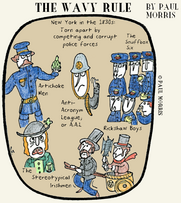
The Wavy Rule, a Daily Comic By Paul Morris: The Thin Blue 1830s Line
Paul takes a look at the very serious historical issue of moustaches, four-leaf clovers, and the Snuffbox Six in Gotham City, circa some time ago. Click to enlarge, but stay on the right side of the law!
More by Paul Morris: Enter our exciting contest to name the upside-down question-mark! Entries accepted until August 25. Plus, “The Wavy Rule” archive; “Arnjuice,” a wistful, funny webcomic; a smorgasbord of multimedia at Flickr; and beautifully off-kilter cartoon collections for sale and free download at Lulu.
Tilley, Anyone? Eustace Is, As We Knew, All the Fashion
Via the continuously indispensable Manhattan User’s Guide, here’s a new source of Tilleyiana I hadn’t expected. Here’s Charlie Suisman’s description: “Local clothing deals tend to be for women; The Choosy Beggar wants to restore some balance for the guys.” True enough, and also, TCB’s blog icon has a swell familiarity to it. Who says a dandy has to spend a fortune to be a Beau Brummel?
What’s in a Trope? We Find Clues in Cartoons From Vintage Gourmets
From our friend Jonathan Taylor, who recently wrote a meditation on John McPhee and the evolution of greenmarkets:
“The great urban visual art is the cartoon,” Jonathan Raban writes in his 1974 book Soft City. The book is a meditation on the idea that cities are where strangers live. A common observation, perhaps, but so ruling a reality that after fifteen years of living in New York City, I think I am only now really awakening to this philosophy’s peculiarity and implications.
And that bears out Raban’s point: cities permit, and require, their dwellers to inhabit the most private worlds, which they then interpret as “life” itself. Raban describes the “person-spotting” skills developed in the city to make instant judgments of strangers–who will remain strangers–through the most immediate visual emblems: “accents, clothes, brands of car, my reactions to endomorphic or ectomorphic figures.” Hence, the cartoon.
The acknowledgments in Soft City note that parts of the book had previously been published in Encounter, London Magazine and The Listener, all now-defunct exemplars of the 20th-century magazine. And the “New Yorker cartoon,” with its stock characters denoted with ideographic brushstrokes–the lawyer, the psychiatrist, the boozer at the bar–is itself the near-lone survivor of a genre once common to that stripe of magazine.
There’s a nice reminder of this in Gourmet‘s online gallery of some of the single-panel cartoons that ran in every issue of the magazine in the 1940s and 1950s. They have their own subset of spottable strangers: short-order cooks, ladies who lunch, and waiters in jackets (back when, as I wrote here recently, “foodies” were “gourmets”). Some are as deflating as a weak New Yorker caption contest winner, but it’s key for a magazine historian or admirer to understand what met rigorous standards of semifunniness in the past. The “punch line” to this one gives satisfaction of perhaps more of the puzzle-solving kind than the humorous one. And this cartoon is a downright prescient take on what Raban calls the “emporium of styles,” the city in which classes are no longer defined by what they produce, but by what they consume.
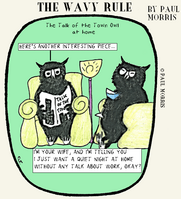
The Wavy Rule, a Daily Comic By Paul Morris: Owl in the Family
Paul and I are both intrigued by the inner life of the Talk of the Town owl. Here he is at home, having a little bit of familiar-sounding domestic friction.
More by Paul Morris: Enter our exciting contest to name the upside-down question-mark! Entries accepted until August 25. Plus, “The Wavy Rule” archive; “Arnjuice,” a wistful, funny webcomic; a smorgasbord of multimedia at Flickr; and beautifully off-kilter cartoon collections for sale and free download at Lulu.
Flake and Fruhlinger, Two Goofball Geniuses, on Newyorker.com
I’ve rhapsodized about Josh Fruhlinger’s The Comics Curmudgeon, which does to “Mary Worth” what Gawker does to Julia Allison; I’ve raved (as long ago as 2005!) about Emily Flake’s diabolically bee-stung comic “Lulu Eightball.” Now, they’re both interviewed at the Cartoon Lounge on newyorker.com, which is a delightful surprise.
Here’s the interview with Josh, by Zach Kanin; here’s Drew Dernavich in conversation with Emily. My 5,000 hats of Bartholomew Cubbins are off to both of these beautifully warped minds, at all times.