

Click on the cartoon to enlarge it!
Read “The Wavy Rule” archive.
Monthly Archives: November 2008
All I Want for Christmas is a Hand-Forged Kramer Chef’s Knife
_Benjamin Chambers writes:_
I don’t tend to like theme issues; I find the uniformity of subject matter makes me less interested in reading. But in the The New Yorker’s November 24, 2008 “food” issue, one piece jumped out at me: Todd Oppenheimer’s profile of Bob Kramer (Digital Edition link here), who is one of the only 122 people in the world certified as a Master Bladesmith.
To be certified, Kramer had to hand-forge six knives.
One of those was a roughly finished, fifteen-inch bowie knife, which Kramer had to use to accomplish four tasks, in this order: cut through an inch-thick piece of Manila rope in a single swipe; chop through a two-by-four, twice; place the blade on his forearm and, with the belly of the blade that had done all the chopping, shave a swath of arm hair; and, finally, lock the knife in a vise and permanently bend it ninety degrees.
If I used that bent knife to carve the Thanksgiving Day turkey, it would be far more effective than the bludgeons we keep in our kitchen for cutting up food.
Perhaps, in this post-consumer economy we’ve now entered, I might be excused an anachronistic desire to possess a well-made tool?
Spokespigeon: This Week, We’re Glad Not to Be Turkeys
Emdashes applauds the plentiful presence of pigeons on Harry Bliss’s cover this week!
Prior muckraking “Emdashes TNY/pigeon coverage”:http://emdashes.com/mt/mt-search.cgi?tag=pigeons&blog_id=2.
Jane Mayer Wins 2008 John Chancellor Award
_The New Yorker_’s Jane Mayer was presented with the “John Chancellor Award”:http://www.cjr.org/audio/on_the_importance_of_cultivati.php for Excellence in Journalism last week. Mayer was honored for her reporting on the use of torture by the Bush administration. (Andrew C. Revkin of _The New York Times_ is the other recipient, for his coverage of climate change.)
Mayer and Revkin spoke at Columbia’s Graduate School of Journalism, and we’ve got “audio”:http://qtstreaming.jrn.columbia.edu/CJR/2008/mayerrevkin1119.mov. After some minor A/V difficulties, it’s a very interesting discussion about reporting from two people who know a great deal about it.
Also, “Floyd Abrams”:http://en.wikipedia.org/wiki/Floyd_Abrams gets mentioned. Floyd Abrams rocks.
The Wavy Rule, a Daily Comic by Pollux: Soon We’ll All Be Little Tramps
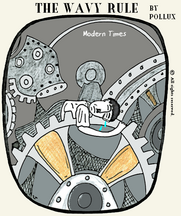
Click on the cartoon to enlarge it!
Read “The Wavy Rule” archive.
The Wavy Rule, a Daily Comic by Pollux: Bad Old Days Are Here Again

Click on the cartoon to enlarge it!
Read “The Wavy Rule” archive.
A Storied Presidency: the Other Bailout
Inspired by Obama’s win, I checked the index of the Complete New Yorker for items in the “Fiction” category that contained the word “president.” I got 167 hits, and I’ve been happily reading ever since. This is the second of a series on the results. The first one is here.
When the big credit crunch came to a head this fall, you might have heard occasional mention of the other bailout, that of the savings and loans in the late 1980s. If you want a brief, totally inaccurate primer on that event, you can do no better than Garrison Keillor’s “How the Savings and Loans Were Saved.” (Digital Edition link here.)
Huns invade Chicago, and President Bush (the First) nearly fails to act, with no political consequences: “… a major American city was in the hands of rapacious brutes, but, on the other hand, exit polling at shopping malls showed that people thought he was handling it O.K.”
Throughout, Keillor lampoons the terms that must have been used in the press to describe Bush’s lack of response: e.g., he appears “concerned but relaxed and definitely chins-up and in charge”, or he appears “burdened but still strong, upbeat but not glib … confident and in charge but not beleaguered or vulnerable or damp under the arms, the way Jimmy Carter was.”
Bush is always vacationing: playing badminton in Aspen, croquet at the White House, tennis and fishing in Kennebunkport. Meanwhile, the barbarians
made their squalid camps in the streets and took over the savings-and-loan offices,” where “they broke out all the windows and covered them with sheepskins, they squatted in the offices around campfires built from teak and mahogany desks and armoires, eating half-cooked collie haunches and platters of cat brains and drinking gallons of after-shave.
They demand a ransom of “three chests of gold and silver, six thousand silk garments, miscellaneous mirrors and skins and beads, three thousand pounds of oregano, and a hundred and sixty-six billion dollars in cash.”
Eventually, of course, Bush agrees to their primary demand.
The President decided not to interfere with the takeover attempts in the savings-and-loan industry and to pay the hundred and sixty-six billion dollars, not as a ransom of any type but as ordinary government support, plain and simple, absolutely nothing irregular about it, and the Huns and the Vandals rode away, carrying their treasure with them …
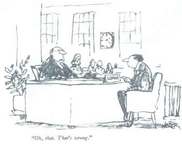
Absolutely no similarity, there, of course, to the credit crisis … or is there? This Robert Weber cartoon, from the July 18, 1983 issue (a few years, granted, before the S&Ls began to fail) sure sounds familiar:
What’s more, this Weber cartoon from the February 22, 1988 issue weirdly presages the crazed loan practices typical of the mortgage industry up until a few months ago.
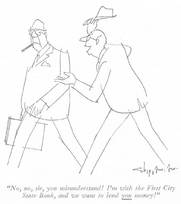
But in the austere light of the credit crisis, perhaps you’ll find this Vahan Shirvanian cartoon from the May 17, 1969 issue a comforting reminder of better times:
The Wavy Rule, a Daily Comic by Pollux: The Bee’s Knees (If Bees Had Knees, and I Think They Don’t)
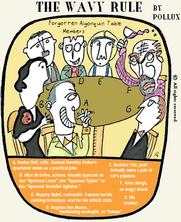
Click on the cartoon to enlarge it!
Read “The Wavy Rule” archive.
Renata Adler: Finally, Some Insight into the “Dime” Mystery
In 2004, Robert Birnbaum “interviewed”:http://www.themorningnews.org/archives/personalities/birnbaum_v_renata_adler.php Renata Adler at “The Morning News”:http://www.themorningnews.org/; unsurprisingly, the matchup of these two idiosyncratic people produced an interesting, wide-ranging, scattershot interview touching on many aspects of writing and reporting and publishing.
My colleague Benjamin Chambers has “twice”:http://emdashes.com/2008/07/speedboat-jen-fain-is-the-writ.php expressed “befuddlement”:http://emdashes.com/2007/03/other-things-im-excited-about.php at Adler’s inability to quote the last line of her own novel Speedboat accurately. The line Adler mangled, in her book _Gone: The Last Days of The New Yorker,_ runs as follows: “It could be that the sort of sentence one wants right here is the kind that runs, and laughs, and slides, and stops right on a dime.”
With this in mind, here’s the sentence that jumped out at me: “I have this quirk, this neuroticism, [pause] this habit . . . of editing all the way down to the wire and past.”
So that’s it. She was just editing past the wire again!
The Wavy Rule, a Daily Comic by Pollux: Hey, Your Gaming Table Has Both Red and Blue Grids
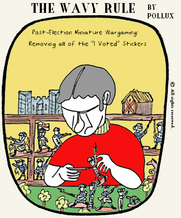
Click on the cartoon to enlarge it!
Read “The Wavy Rule” archive.