

Click on the cartoon to enlarge it!
Read “The Wavy Rule” archive.
Monthly Archives: March 2009
“How Much Can They Laugh? They’re Laughed Out.”
Martin Schneider writes:
Our friend Toby Gardner makes an astute observation: Having David Sedaris and Woody Allen in the same issue of The New Yorker is the precise magazine reenactment of the scene in Annie Hall in which Alvy Singer complains about having to follow a standup comedian at an Adlai Stevenson rally. And they even put Woody’s piece right after Sedaris’s.
It’s practically an homage.
New Yorker Blog Roundup: 03.25.09
Martin Schneider writes:
This batch seems somewhat “urgent” to me, in a good way. Have a look.
(This content is taken directly from the left nav bar on the magazine’s website.)
George Packer discovers George Orwell was a loving father.
Evan Osnos mourns the Chicago Tribune‘s foreign bureaus.
Steve Coll thinks the Treasury’s plan does what’s politically possible, not what’s necessary.
James Surowiecki challenges Joseph Stiglitz’s distortions of the Geithner plan.
Hendrik Hertzberg applauds another Bill O’Reilly target.
The Front Row responds to A. O. Scott.
News Desk: Signs of progress, the President and the Pope.
Sasha Frere-Jones hosts a roundtable about Haitian music.
The Book Bench: If Samuel Beckett used Twitter, Bulgaria’s favorite book.
The Cartoon Lounge: North by Northeast, reports of nose skirts from SXSW.
Goings On: The New York Dolls‘ “Cause I Sez So,” second-generation rock drummers.
From the 5¢ Token to the $103 Monthly Unlimited: ‘The Subway Fare Problem’ in The New Yorker
Jonathan Taylor writes:
Although the one voted today really is the most shocking in recent memory, subway fare hikes are perpetual grist for New Yorkers’ mills—as seen in The New Yorker‘s own archives: from the 1927 two-cent hike proposal that went all the way to the Supreme Court, to the introduction of the $2 fare, subject of a 2003 Talk piece.
The Wavy Rule, a Daily Comic by Pollux: Mark My Words

“The series continues.”:http://emdashes.com/2009/02/the-wavy-rule-a-daily-comic-by-161.php Click on the cartoon to enlarge it!
Read “The Wavy Rule” archive.
True! Twitterers Tout, Twit “Tweedy” Weekly
Martin Schneider writes:
One of two things will happen: Either Twitter will gain sufficient acceptance that nobody will bother being annoyed it, or it’ll stop being used enough to warrant any attention at all. In the meantime, some messages:
mldrabenstott @genmarshall A weekly New Yorker equals 6-8 monthly mags. Quality, not quantity.
ljhliesl I just put a lot of staples through the New Yorker so Blake could take them out again. He is a staple-remover and a confetti-maker.
youngamerican Can anyone deny that for the last two or three months, this has been the best part of each and every New Yorker? http://bit.ly/ofuim
BananaEsq The New Yorker consistently misuses the word “insure.” Please stop.
splendid Weird: Marina showed 8-sec clip of artist performing by getting rifle shot in arm; get home, open New Yorker, see article about that artist
guttersniper Going to the John Updike tribute at the NYPL tonight. Expecting tweed.
MitMoi “Editing is the same as quarreling with writers – same thing exactly” Harold Ross: American Writer, New Yorker founder
LaurenProctor32 Lauren Collins’ article in this week’s New Yorker is wonderfully well written. She’ll always be a favorite. [I think this was referring to the article about Bill Cunningham.]
dbrauer The New Yorker’s partisan cover fetish has become boring.
mrcornie Reading short story in 3/23 New Yorker & it talks of Facebook & Wii. Fascinated when new-ish pop culture phenoms start showing up in my lit.
suzannegangi Asked w/utmost respect: How old is Mr. John McPhee, esteemed author & “New Yorker” contributor? He made la crosse(!) interesting (3/23 NYer) [I wrote back, informing her that McPhee had turned 78 about two weeks earlier.]
VelocityWong My fave part of the New Yorker’s Burris piece is how almost every mention of an IL pol has a parenthetical epilogue about their crimes.
The Wavy Rule, a Daily Comic by Pollux: Upper Class Stock
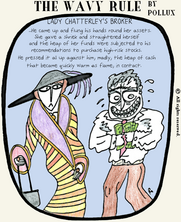
Click on the cartoon to enlarge it!
Read “The Wavy Rule” archive.
Brody and Scott on Realism, and Raban on Northwestern Reality
Jonathan Taylor writes:
A.O. Scott has posted a reply to Richard Brody’s Front Row critique of his Times magazine article on “neo-neorealism.”
I’ll note in passing “Metronatural America,” an article by Jonathan Raban from a recent New York Review of Books about the films of Kelly Reichardt, particularly “Wendy and Lucy.” I think Raban captures the “complexity and ambiguity” in these films that Brody suggests is lacking. At the same time, the contrast Raban notes between these films and the stories of Jon Raymond in Livability (from which both “Old Joy” and “Wendy and Lucy” were adapted) perhaps jibes superficially with Brody’s claim that the movies put “emphasis on outer life at the expense of inner life”:
Where Kelly Reichardt practises a strict, Carveresque minimalism, leaving out far more than she puts in, Raymond is a prose maximalist. Although his characters have difficulty relating to each other, they relate to the reader with unbuttoned, occasionally garrulous, intimacy. To the reader alone, they entrust their memories, thoughts, feelings, landscape descriptions, even as they explain to the reader why these private riches can’t be shared with the person closest to them in the story.
Still, I think that what Reichardt does with “the outer life” and the constraints it puts on the conduct of “the inner life,” is as profound a portrait of the latter as anything.
I was recently talking to a friend about “Old Joy,” and the question of whether it was “depressing” came up; to which I responded that I did find it a bit depressing, but was thrilled, in a way, that it had left me precisely as mildly depressed as might be described as my resting state. For me solipsistically, at least, an indicator of the film’s unusual “realism.”
The Wavy Rule, a Daily Comic by Pollux: The Password Is Always Swordfish

Click on the cartoon to enlarge it!
Read “The Wavy Rule” archive.
Sempé Fi (On Covers): Elle
_Pollux writes_:
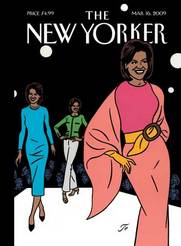
The _Chicago Tribune_ “once asked”:http://www.chicagotribune.com/news/politics/obama/chi-michelle-obama-dress-story,0,1949360.story, “With her gumball pearls, flip hairstyle and chic dresses, could Michelle Obama be the next Jacqueline Kennedy for stylephiles?” The March 16, 2009 issue of _The New Yorker_ is “The Style Issue” and who better to grace its cover than Mrs. Obama, who has quickly become a new fashion icon and a new source of fashion excitement? Michelle Obama is, “as one French blog described her”:http://lhommedanslafoule.blogspot.com/2009/03/new-yorker-couverture-16-mars-2009.html, _la nouvelle first lady des Etats Unis d’Amérique pour un numéro “The Style Issue.”_
That Michelle Obama has chosen to wear the most exciting names in American fashion is an indication of the qualities that also characterize her husband: confidence, self-assurance, elegance, and optimism. Having assumed the mantle of fashion icon, the First Lady has taken advantage of this new role to wear clothes designed not by established, big-name designers, but by rising stars in the world of fashion (Jason Wu, Isabel Toledo, Jimmy Choo), and she has mixed designer clothes with brands like J. Crew.
The choice of “Floc’h”:http://en.wikipedia.org/wiki/Floc%27h as cover artist is significant: a practitioner of the precise drawing style known as _ligne claire_, Floc’h has contributed illustrations to _Elle_ and _GQ_. The French cartoonist has also created drawings for the Parisian men’s wear shop known as Albert’s on the Rue de Courcelles, and contributed “fashion sketches”:http://www.breuer.fr/site.html for the Spring-Summer 2009 catalogue for the Breuer house of fashion.
His enormous output (Floc’h has been an illustrator since the late ’70s) includes “book cover designs”:http://bookdesign.wordpress.com/2008/12/22/floch-illustrateur-de-livres/, movie posters, and collections of comics often issued as handsome limited editions bound like portfolios and replete with lavish lithographs. Floc’h’s collaboration with the writer François Rivière, _Une trilogie anglaise_, which features the adventures of Olivia Sturgess and Sir Francis Albany, are a celebration of British elegance, fashion, and class. And his collaboration with another writer, Jean-Luc Fromental, has produced works like _Jamais deux sans trois_ (“Things Always Happen in Threes”), the story, inspired by the writings of F. Scott Fitzgerald, of a love triangle affecting three chic protagonists.
Floc’h’s “past covers for _The New Yorker_”:http://www.cartoonbank.com/search_results.asp?mscssid=N75BLQT1QCKS9NR183NUWJWU397MBJ28&sitetype=1&advanced=1§ion=all&artist=Jean+Claude+Floc%27h always had a timeless sense of class about them, with their depictions of ski-wear, evening gowns, and well-tailored indoor wear. Floc’h loves to draw clothes, and he draws them precisely.
Floc’h’s “Michelle O” is less a caricature or portrait of Michelle Obama than a portrait of the Michelle Obama Collection, of the fashions inspired by a woman who is of course more than just a manikin. A “recent article in _The Economist_”:http://www.economist.com/world/unitedstates/displaystory.cfm?story_id=13326771 warns of the “Oprah-isation” and “Jackiefication” of a First Lady who is more than a “celebrity mother-cum-clothes-horse” and condemns the media’s obsession with Michelle’s decision, for example, to go bare-armed in public. The article refers to Floc’h’s “cover of the March 16th issue [which] features the first lady strutting on the catwalk in three different outfits (none of them featuring bare arms).” I, too, feel, like the article’s author, that “it would be good to hear a bit more about what Mrs Obama thinks and a lot less about what she wears.”
But if her fashions bring a sense of hope and color (whether those colors be summer sky blue, periwinkle, or volcanic red) to a depressed nation, there is nothing unjust or iniquitous about featuring her on the cover of “The Style Issue.” She has style, and many other qualities besides. Her thoughts and speeches, no doubt, will be the subject of other drawings -not necessarily by the fashion-loving Floc’h, but by other writers and artists who will explore other sides of her character and good sense.
The goal of Floc’h’s cover is to introduce us to the clothes of a new age, and it is a role befitting a French Anglophile who has worked on both sides of the Atlantic, and who is very modern but also very consciously inspired by fashions from earlier decades, and whose output includes as much commercial work as artistic and literary.
The First Lady’s sure-footed and self-assured style of course extends beyond the realm of fashion, but the focus here is on the excitement inspired by her goal to sweep away the dowdiness of the past four decades. Floc’h’s Michelle represents the promise and bright colors of a new era.