
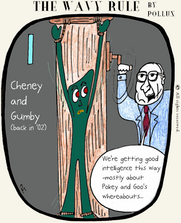
Click on the cartoon to enlarge it!
Read “The Wavy Rule” archive.
Monthly Archives: May 2009
Of Pixels and Pastels: New Yorker artist Jorge Colombo’s iPhone Art
_Pollux writes_:
If you call “Jorge Colombo”:http://www.jorgecolombo.com/, he may not pick up.
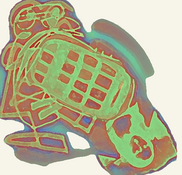
He’s busy using his phone for something other than talking, e-mailing, and finding directions. He’s creating artwork with his iPhone, whose Brushes feature is a sophisticated “mobile painting” application complete with color wheel, undo/redo functionality, and a selection of brushes.
This is powerful technology, and the Portuguese-born Colombo applies an artist’s sensibility to create immensely delicate and interesting iSketches that capture the city in a new medium. The iPhone has become one more tool in the artist’s kit. “I got a phone in the beginning of February, and I immediately got the program so I could entertain myself,” Colombo “remarks.”:http://www.newyorker.com/online/blogs/tny/2009/05/jorge-colombo-iphone-cover.html
But Colombo’s art isn’t gimmicky ephemera, and his art is not, thankfully, trapped on his phone. The June 1, 2009 “_New Yorker_ cover”:http://www.newyorker.com/online/blogs/tny/2009/05/jorge-colombo-iphone-cover.html is in fact a Colombo iArtpiece. He is also selling 20×200 iPhone drawings “at 20 x 200.”:http://www.20×200.com/aaa/jorge-colombo/
Colombo, born in Lisbon in 1963, is not a greenhorn graphic designer or emerging artist (not that there’s anything wrong with that), but an established illustrator, filmmaker, and photographer, who has worked as art director for various Chicago, San Francisco, and New York magazines. He has books under his belt, including the photographic novel “”Of Big and of Small Love””:http://www.jorgecolombo.com/bsl/index1.htm (”Do Grande e do Pequeno Amor”), a work of half-photography and half-fiction writing. iPhone’a Brushes app, then, is for him a new and useful tool rather than a replacement for camera or pen.
Paul Éluard once remarked that “the poet is not he who is inspired but he who inspires.” In the same way, Colombo is a poet who, no doubt, will inspire a new market for iPhone-generated art.
**James Falconer** “reports”:http://www.intomobile.com/2009/05/25/iphone-and-brushes-app-used-to-create-june-1st-cover-art-for-the-new-yorker.html on this story, and includes an image of Colombo’s cover.
The **Knight Center** “covers Colombo’s new artwork.”:http://knightcenter.utexas.edu/blog/?q=en/node/4118
Colombo’s isn’t the only one: the “iPhone Art Flickr group.”:http://www.flickr.com/groups/brushes/
The Wavy Rule, a Daily Comic by Pollux: Grunge Fonts
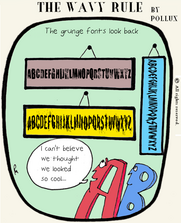
Click on the cartoon to enlarge it!
Read “The Wavy Rule” archive.
What’s in This Week’s New Yorker: 06.01.09
Martin Schneider writes:
A new issue of The New Yorker comes out tomorrow. A preview of its contents, adapted from the magazine’s press release:
In “Slim’s Time,” Lawrence Wright profiles Carlos Slim Helú, the Mexican businessman who is sometimes ranked as the richest man in the world, and who agreed to extend a two-hundred-and-fifty-million-dollar loan to the New York Times Company earlier this year.
Atul Gawande explores how to contain the rising costs of health care by looking at McAllen, Texas, one of the most expensive health-care markets in the country, and at the Mayo Clinic, one of the country’s most effective, low-cost health systems.
Jill Lepore chronicles the parrot fever of 1930, a “medical mystery” that transfixed the nation with the possibility of a pandemic and set a precedent for the coverage of future outbreaks and epidemics.
On the cover, an image by Jorge Colombo, “Finger Painting,” drawn entirely on his iPhone—a first for the magazine.
Jeffrey Toobin, in Comment, reflects on President Obama’s and Dick Cheney’s recent speeches on national security.
In the Financial Page, James Surowiecki explores how corporate boards of directors could be reformed to protect shareholder value.
In Shouts & Murmurs, Andy Borowitz demonstrates how to make the most of your “quiet time.”
In a sketchbook, Roz Chast offers sea chanteys for the subway.
Calvin Tomkins examines the life and works of artist Bruce Nauman.
Peter Schjeldahl visits the Francis Bacon retrospective at the Met.
John Lanchester considers the role human nature played in the banking crisis.
John Lahr attends Wallace Shawn’s first play in more than a decade, Grasses of a Thousand Colors.
Anthony Lane reviews Terminator Salvation and Jerichow.
There is a short story by Craig Raine.
Sempé Fi (On Covers): Forgotten Little Animals

_Pollux writes_:
In 1930, New York City, as described by the Spanish poet Federico GarcÃa Lorca, was inhabited by those “who lift their mountains of cement / where the hearts beat / inside forgotten little animals / and where all of us will fall / in the last feast of pneumatic drills.”
In 2009, New York’s mountains of cement are still rising, and we have yet to fall in the last feast of pneumatic drills. However, we still receive reminders of the world that we have paved over and littered with mushrooming forests of steel and plastic and cement.
“Eric Drooker’s”:http://www.drooker.com cover for the May 18, 2009 issue of _The New Yorker_ gives us such a reminder.
A single yellow butterfly, a forgotten little animal, rises above the sterile city and shows itself to one of the city’s builders. We are not sure if the wrench-wielding construction worker looks upon the creature with disgust, apathy, hope, or anger -but at least he’s looking. Is it a life-changing moment? Perhaps not. But at least it’s stopped him, at least for a moment, from helping to elevate these peaks of cement still further.
Drooker’s cover is named “Coming Up For Air,” and it is not just the butterfly that is coming up for air, but the solitary construction worker as well, perched on a girder high above the vertical limbs of the city. Thousands of feet up in the air, life reasserts itself.
There are in fact three living beings on this cover: the butterfly, the worker, and the city. In Drooker’s work, New York City metamorphoses as much as the nymphs and gods of Greek mythology do.
“A slideshow of his work”:http://www.cartoonbank.com/product_details.asp?mscssid=N75BLQT1QCKS9NR183NUWJWU397MBJ28&sitetype=1&did=5&sid=123086&pid=&keyword=eric+drooker§ion=all&title=undefined&whichpage=1&sortBy=popular will show you multiple New York Cities: you’ll see the city from different angles, from various perspectives, from surreal and fantastical approaches.
Drooker’s bird’s-eye views, dog’s-eye views, and worm’s-eye views reveal a city that is different things to different people. All you have to do is look up, look down, or look differently. There are viewpoints from pigeons and dogs and men on stilts. A homeless’-eye view reveals a different city, in which a bonfire in a trashcan provides limited protection in a cold winter’s night near Brooklyn Bridge.
Drooker not only works with oblique angles and aerial viewpoints but also works at transplanting the city, either parts of it or as a whole, into different temporal or geographic zones. A businessman emerges from a New York subway station located in some sweltering jungle. There exists a subway station with cave paintings, and an arctic subway station at 125,000 Street bustling with harpoon-wielding commuters. In various dimensions, there exists a neo-Egyptian New York; the Big Apple as a city of books; a surreal city of smokestacks; as a transplanted single building on a desert island; as a geographically ambiguous city as seen from a jungle with toucans and monkeys; as an electric blue metropolis of romance where two lovers kiss.
Drooker’s latest cover depicts a scene that is evocative of the 1930s, and especially of the famous 1932 “photo”:http://en.wikipedia.org/wiki/Lunchtime_atop_a_Skyscraper, by “Charles C. Ebbets”:http://en.wikipedia.org/wiki/Charles_C._Ebbets, of construction workers lunching on a cross-beam. Our point-of-view is that of a bird or cloud; we float above the gaunt-faced construction worker, as freely as the butterfly that distracts him temporarily from his work.
Drooker, a native of Manhattan, does not stand at a distance from the city he depicts so frequently. He has worked as a tenant organizer, struggled against police brutality aimed at unlicensed street artists and musicians, and contributed to leftist magazines such as _People’s Daily World_, _The Progressive_, and _World War 3 Illustrated_. His first graphic novel, “_FLOOD! A Novel in Pictures_”:http://www.drooker.com/sequences/flood.html, is a wordless series of scratchboard images that evoke Lorca’s “forgotten little animals.” There is enough rain pouring down in _FLOOD!_ to drown the city’s inhabitants; one gets the feeling the city will nonetheless live on, inhabited by empty humming streetcars and roving hungry thylacines.
Drooker’s delicate butterfly is not just any butterfly, but the butterfly that “so entranced the first Eustace Tilley”:http://archives.newyorker.com/?i=1925-02-21 and successive generations of Eustace Tilleys. I don’t think “Rea Irvin”:http://www.printmag.com/Article.aspx?ArticleSlug=Everybody_Loves_Rea_Irvin had a specific butterfly species in mind when he first drew the butterfly that so captivated his monocled mascot, but I would like to put forward a possible candidate: _Colias philodice_, or in the common tongue, a Clouded Sulphur.
The Clouded Sulphur’s range includes New York City and its coloring and markings match the New Yorker’s butterfly. “Take a look.”:http://www.mariposasmexicanas.com/colias_philodice_eriphyle.htm
The cover is subtle in its message, and not as subtle one would expect from someone who in past decades organized rent strikes and drawn politically-charged posters and lapels. “I’m still very concerned with trying to persuade people of certain ideas, educate them,” Drooker “has remarked.”:http://www.robwalker.net/html_docs/drooker.html “But I think I could be more effective if the propaganda doesn’t _look like_ propaganda.”
Like the Clouded Sulphur, the message in an artist’s work has to flutter near us. Perhaps we’ll notice it; perhaps not.
Experience Gopnik and McLemee Virtually, This Saturday
Martin Schneider writes:
This, from the National Book Critics Circle, made its way to my in-box:
How reviewers are adapting to the new digital order has been one of the burning themes among NBCC members for the past year. NBCC board member Scott McLemee sends along notice of his own intervention of sorts: On Saturday, from 5 to 7 PM EST, he’ll be hosting an on-line book salon about Adam Gopnik’s Angels and Ages at Firedoglake.com. The transcripts of previous FDL salons, which have featured contributors ranging from Thomas Ricks to Rick Perlstein are here.
How intriguing! I’m sure that’ll be terrific.
Update: Rich/Mayer 92nd St. Y Chat Captured on Video
The Wavy Rule, a Daily Comic by Pollux: The Innovators (#5)
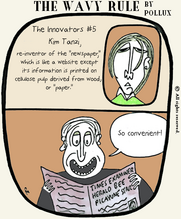
A mini-series in honor of the “Innovators Issue”:http://www.newyorker.com/services/presscenter/2009/05/11/090511pr_press_releases of _The New Yorker_ (May 11, 2009). Click on the cartoon to enlarge it!
Read “The Wavy Rule” archive, and “order your Wavy Rule 2008 Anthology today!”:http://emdashes.com/2009/03/the-wavy-rule-anthology-now-fo.php
Report: Frank Rich, Jane Mayer at the 92nd St. Y
Martin Schneider writes:
To see New York Times columnist Frank Rich interview New Yorker reporter Jane Mayer about the Bush administration’s torture policies at the 92nd Street Y, as I did last Tuesday in the delightful company of Emily and Jonathan, is to experience (in the audience) a certain kind of informed liberal orthodoxy in its most undiluted form. At times I felt that if we were to concentrate any more intently, we might inadvertently summon the corporeal form of Keith Olbermann, if not I.F. Stone himself.
As it happened, it was that degree of obvious advocacy and affection in the audience that permitted the conversation to be as focused, and yet as unfussy, as it was. In other words, Mayer and Rich scarcely had to adjust their dialogue to the audience—we were all on the same page. Rich wanted Mayer to explain what was happening with the torture story, and that’s exactly what she did. We were along for the ride.
Mayer’s latest book, The Dark Side, is now out in paperback. She is certainly one of the best-informed people in the country (not on a government payroll) when it comes to our government’s recent rendition and torture practices. She confessed a desire to investigate some new story, but as the facts of this one are not yet out, she keeps getting drawn back in.
On Obama, Mayer ventured a familiar combination of hope and incipient disappointment. Rhetorically Obama has been so good on the subject that it’s difficult to assess the obvious backsliding. The Bush administration left behind an intractable legal problem—how to prosecute dangerous members of Al Qaeda (almost certainly) whose rights have egregiously been violated and whose cases would surely be thrown out of court under any normal circumstances. As one CIA employee told her, “The problem was always the disposal plan.” The Obama administration clearly regards the matter of Ali Saleh Kahlah al-Marri, the subject of Mayer’s February 2009 article in The New Yorker, as a test case to see how this will play out, so keep your eye on that. On the subject of disposal, the Bush administration apparently contemplated with some seriousness a plan of putting the prisoners on a ship that would then circumnavigate the globe in perpetuity, an idea Rich instantly dubbed “Halliburton cruises.”
One interesting revelation was that journalists are not permitted to interview convicted terrorists—and they are also not permitted to interview people who for legal reason have had access to them, this “two degrees of separation” prophylactic approach bearing the bland appellation “special administrative measures.”
Mayer noted that there are detailed reports produced by the likes of the CIA’s inspector general and the Justice Department’s Office of Professional Responsibility that have yet to be released, an eventuality that is likely, in her view. So brace yourself for more shocking revelations. One of the tiny number of people permitted to see the interrogation transcripts called them the “the most disgusting thing he had ever seen.” Like any good reporter, Mayer takes the view that disclosure of these practices is essential to the maintenance of an open society.
Simplistic as it sounds, that process will yield heroes and villains. Doug Feith, David Addington, John Yoo, and their ilk are apparently “very nervous,” while others, like Alberto J. Mora, once general counsel of the United States Navy (as Mayer reported in 2006), distinguished themselves with their courage in opposing these reprehensible practices. Addington et al. prompt the question, were they imparting sound legal advice or did they have their collective thumb on the scale? The absence of an important 1983 waterboarding precedent in Yoo’s internal memoranda prompts the latter interpretation, an inauspicious sign.
One of the most interesting questions that remains is the degree to which the torture regime was a sincere effort to obtain valid intelligence or a cynical attempt to manufacture a justification for the war in Iraq. In my opinion, the available facts aren’t encouraging. If that manufacturing is exposed, it’s going to take a very long time for our country to come to terms with the official, costly duplicity in which our governmental representatives engaged.
The first question of the audience Q&A section demanded an impossible degree of information, albeit one close to the concerns of this blog: “Can you describe the process of writing a New Yorker piece from start to finish?” Mayer’s comments were appreciative yet betrayed a glimpse of the pressure that such high standards bring: “The process is endless, no one would believe it. . . . We have an in-house grammarian who will mark up your copy to the point that you want to cry—or change professions. . . . I have a hunch that it’s the typeface that makes us look so good.” She also singled out editor Daniel Zalewski for his unerring instincts.
There was more, but my hand can furtively scribble only so much, and the remainder of my markings are unintelligible, even to me.
The Wavy Rule, a Daily Comic by Pollux: The Innovators (#4)

A mini-series in honor of the “Innovators Issue”:http://www.newyorker.com/services/presscenter/2009/05/11/090511pr_press_releases of _The New Yorker_ (May 11, 2009). Click on the cartoon to enlarge it!
Read “The Wavy Rule” archive, and “order your Wavy Rule 2008 Anthology today!”:http://emdashes.com/2009/03/the-wavy-rule-anthology-now-fo.php