Monthly Archives: May 2009

Milton Glaser, David Remnick, and An Unnamed Aide … Sing Together

Martin Schneider writes:
The indispensible Jason Kottke today posted a passage from Milton Glaser’s Ten Things I Have Learned, about how to detect when you are being nourished or sapped by a given person:

And the important thing that I can tell you is that there is a test to determine whether someone is toxic or nourishing in your relationship with them. Here is the test: You have spent some time with this person, either you have a drink or go for dinner or you go to a ball game. It doesn’t matter very much but at the end of that time you observe whether you are more energised or less energised. Whether you are tired or whether you are exhilarated. If you are more tired then you have been poisoned. If you have more energy you have been nourished. The test is almost infallible and I suggest that you use it for the rest of your life.

Shrewd words indeed. They reminded me of a passage from “The Wilderness Campaign,” a David Remnick Profile of Al Gore from 2004 (the bearded, liberated, post-2000 Al Gore), describing why, for all of Gore’s success in politics, it might have been an awkward fit for him. Here it is (emphasis mine; New Yorker don’t truck with no bold text):

Other aides were less harsh, saying that Gore was brusque and demanding but not unkind. Yet, once freed of the apparatus and the requirements of a political campaign, Gore really did savor his time alone, thinking, reading, writing speeches, surfing the Internet. “One thing about Gore personally is that he is an introvert,” another former aide said. “Politics was a horrible career choice for him. He should have been a college professor or a scientist or an engineer. He would have been happier. He finds dealing with other people draining. And so he has trouble keeping up his relations with people. The classical difference between an introvert and an extrovert is that if you send an introvert into a reception or an event with a hundred other people he will emerge with less energy than he had going in; an extrovert will come out of that event energized, with more energy than he had going in. Gore needs a rest after an event; Clinton would leave invigorated, because dealing with people came naturally to him.”

That’s all. It jogged a memory, and I couldn’t rest until I had posted it here.

You Don’t Have to Read Gawker to Know That Americans Are Short

Emily Gordon writes:
Gawker notes today that an Organisation for Economic Co-operating and Development study is reporting alarming (to some) news that Americans aren’t getting taller, even though people in the other countries in the OECD (including Canada and the U.K.) are inching steadily upward.
But New Yorker-ophiles will remember Burkhard Bilger’s findings back in April 2004, in his Reporter at Large called “The Height Gap.” Bilger writes, in part:

Walking along the canals of Amsterdam and Delft, I had an odd sensation of drowning–not because the crowds were so thick but because I couldn’t lift my head above them. I’m five feet ten and a half–about an inch taller than the average in the United States–but, like most men I know, I tend to round the number up. Tall men, a series of studies has shown, benefit from a significant bias. They get married sooner, get promoted quicker, and earn higher wages. According to one recent study, the average six-foot worker earns a hundred and sixty-six thousand dollars more, over a thirty-year period, than his five-foot-five-inch counterpart–about eight hundred dollars more per inch per year. Short men are unlucky in politics (only five of forty-three Presidents have been shorter than average) and unluckier in love. A survey of some six thousand adolescents in the nineteen-sixties showed that the tallest boys were the first to get dates. The only ones more successful were those who got to choose their own clothes.

The average American man is only five feet nine and a half–less than an inch taller than the average soldier during the Revolutionary War. Women, meanwhile, seem to be getting smaller. According to the National Center for Health Statistics–which conducts periodic surveys of as many as thirty-five thousand Americans–women born in the late nineteen-fifties and early nineteen-sixties average just under five feet five. Those born a decade later are a third of an inch shorter.

Just in case I still thought this a trivial trend, Komlos put a final bar graph in front of me. It was entitled “Life Expectancy 2000.” Compared with people in thirty-six other industrialized countries, it showed, Americans rank twenty-eighth in average longevity–just above the Irish and the Cypriots (the Japanese top the rankings). “Ask yourself this,” Komlos said, peering at me above his reading glasses. “What is the difference between Western Europe and the U.S. that would work in this direction? It’s not income, since Americans, at least on paper, have been wealthier for more than a century. So what is it?”

Well, which would you rather read, some chart or the mellifluous Bilger? I’m going to read this one again, and for the record, I’m 5’7″ on my very best days.

Catch Gladwell and Borowitz at the Moth, May 21

Martin Schneider writes:
Talk about fortuitous timing—no sooner does a big Malcolm Gladwell article hit the newsstands than we receive word about an appearance he will be making in New York City this month, at the Moth Members’ Show at Symphony Space on May 21. Since a recent appearance at the Moth raised a few eyebrows, we’re glad to see that he’s diving in again.
Andy Borowitz, who appeared last week at the 92nd Street Y to celebrate/mock Obama’s 100th day in office, will host.
Here’s the press release:
Our Annual Moth Members’ Show
Thursday, May 21 at Symphony Space
Crack up: Stories about Comedies and Calamities
Storytellers include:
Malcolm Gladwell
Author of The Tipping Point, Blink and Outliers: The Story of Success
Sarah Jones
Tony award-winning playwright, performer, author and poet
Steve Osborne
Former lieutenant in NYPD detective bureau, Manhattan Gang Squad
Peter Zilahy
Essayist, playwright, and author of dictionary-novel, The Last Window-Giraffe
Hosted by:
Andy Borowitz
Comedian, actor and writer, featured regularly in The New Yorker, The
New York Times, and at borowitzreport.com
Become a Moth Member and receive 2 FREE tickets
With a $100 donation you will receive two tickets to the Members’ Show
($70 value) as well as our brand new double CD, with stories by
Richard Price, Sam Shepard, Mike Birbiglia, A.J. Jacobs ($15 value,
available only with membership), among other benefits.
When you join at a higher level of membership you get even more
benefits and perks. For a complete list of member levels and benefits
and to join go to www.themoth.org/membership.
We Need Your Support
Moth members are hugely important in helping us present unique voices
at our Mainstage and StorySLAM series, as well as our community
outreach program, MothShop, which brings storytelling workshops free
of charge to underserved communities. Moth Members also help us
produce our free–and commercial-free–podcast each week. Take a moment
to read about the importance of the membership program and what our
members have helped us to accomplish this year.
In these turbulent times, everyone needs a place to tell their stories
and hear the tales of our time. The Moth is that place. Please help
us offer more storytelling opportunities by becoming a Moth member.
How to Join:
Join online.
Call The Moth office at 212-507-9833 with your credit card information.
Mail a check, payable to Storyville Center for the Spoken Word, and
mail it with your name, mailing and email addresses to:
The Moth
330 West 38th Street, Suite 1403
New York, NY 10018
Storyville Center for the Spoken Word, d/b/a The Moth, is a 501 (c)
(3) not-for-profit organization. All donations are 100% tax deductible
and all donors receive a receipt for tax purposes.
Thank you for your support!
The Moth Board & Staff
P.S. Don’t Forget to RSVP to The Members’ Show when you join!
(to David Mutton at 212-507-9833 or rsvp@themoth.org)
Don’t wait for your donor receipt, call or email to RSVP as soon as
you have processed your online membership or mailed your check.
Show Information:
Crack up: Stories about Comedies and Calamities
at Symphony Space
2537 Broadway (at 95th St)
6:30pm Doors open
7:30pm Stories begin
Member tickets need to be reserved by calling 212-507-9833 or emailing
rsvp@themoth.org, and can be collected on the evening of the show from
Symphony Space box office.
A limited number of tickets are on sale at $35 from Symphony Space.

What’s in This Week’s New Yorker: 05.11.09

Martin Schneider writes:
The “Innovators” issue of The New Yorker comes out tomorrow. A preview of its contents, adapted from the magazine’s press release:
Malcolm Gladwell looks at the ability of underdogs to triumph over their stronger adversaries. “David can beat Goliath by substituting effort for ability—and substituting effort for ability turns out to be a winning formula for underdogs in all walks of life,” Gladwell writes.
Adam Gopnik ruminates on what spurs invention: necessity, or superfluity? Observing the abundance of razors in his medicine cabinet, all of which are about equally useful, Gopnik notes “a strange but basic truth of life and marketing alike: that it is after a problem has already been solved that ever more varied and splendid solutions to it start to appear.”
Douglas McGray writes about Green Dot Public Schools, a charter-school group that is California’s largest, by enrollment, and one of its most successful, sending nearly eighty percent of their kids to college.
Rebecca Mead observes the work of Christian Scheidemann, who “is among just a handful of private conservators who specialize in contemporary art,” and who “has become particularly admired for his skill in working with organic substances.”
John Colapinto profiles the behavioral neurologist V.S. Ramachandran, “one of a dozen or so scientists and doctors who, in the past thirty years, have revolutionized the field of neurology by overturning a paradigm that dates back more than a hundred years: that of the brain as an organ with discrete modules (for vision, touch, pain, language, memory, etc.) that are fixed early in life and immutable.”
Evan Osnos explores the life and career of Jia Zhangke, the Chinese filmmaker behind the award-winning film Still Life, about the social and physical demolition wrought by China’s Three Gorges Dam, and, more recently, 24 City, about a factory closing.
In Comment, Philip Gourevitch asks who should be held accountable for the torture memos.
In the Talk of the Town, Alma Guillermoprieto reports from Mexico City, under siege by swine flu.
In the Talk of the Town, Lauren Collins looks at the linguistic implications of the disease’s porcine name
In the Financial Page, James Surowiecki explains why the financial industry needs to shrink.
In Shouts & Murmurs, Amy Ozols makes friends on an airplane.
There is a comic strip by Chris Ware.
Judith Thurman writes Helen Gurley Brown and the Cosmo Girl.
Adam Kirsch explores the poetry of Gerard Manley Hopkins.
Hilton Als reviews Desire Under the Elms.
Sasha Frere-Jones listens to Grizzly Bear’s new album.
David Denby reviews X-Men Origins: Wolverine, Fighting, and Tyson.
There is a story by the recently departed writer J. G. Ballard.

Sempé Fi (On Covers): In the Dog-House

Staake_Bo_4-27-09.jpg
_Pollux writes_:
Stories and news reports about Bo, the First Dog, had for a time that whiff of newness and now-ness, like the snatches of a Susan Boyle song. But the whiff of newness has now been replaced by that regular doggy smell, and taking care of Bo has been added to Obama’s long, long list of concerns, worries, and responsibilities. _The New Yorker_ “once depicted”:http://www.newyorker.com/magazine/toc/2008/12/08/toc_20081201 Obama carefully interviewing potential candidates for the First Pet position.
“Bob Staake’s”:http://www.bobstaake.com cover for the April 27, 2009, issue of _The New Yorker_ now gives us Bo and gives us Bo’s new, immense domain: the White House Lawn. The lawn looks lush, welcoming, velvety, and verdant—and lonely. Have we forgotten Bo?
“The mob is fickle, brother,” Lucilla says to her brother, the Emperor Commodus, in a scene from _Gladiator_. “He’ll be forgotten in a month.” Commodus, as played by Joaquin Phoenix, gives her a sickly grin. “No, much sooner than that,” he replied. “It’s been arranged.”
Whoever arranges the sequence of news stories at Fox and CNN (I imagine the culprits are the same Ringwraiths who pursued Frodo and friends in the _Lord of the Rings_ trilogy) has arranged for the Bo Story to slip from the public consciousness. We are interested in newer things now—did you know that they’re coming out with “an Octomom musical?”:http://www.tmz.com/2009/04/25/now-casting-octomom-the-musical/
Perhaps no one cares about Bo anymore; the months of anticipation leading up to it may be responsible for that. We’ve burned ourselves out, like a child sitting in a pile of destroyed wrapping paper on Christmas Day.
If the general public has forgotten Bo, _The New Yorker_ certainly has not, nor has Staake, who is finding a publisher for his new book, _The First Pup: The Unofficial Story Of How Sasha and Malia’s Dad Got the Presidency—And How They Got a Dog_.
“You put any dog on the cover and everyone goes crazy,” Staake “has remarked.”:http://www.newyorker.com/online/blogs/books/2009/04/bob-staake-and-the-first-dog.html “This cover is good at being cute, but it also works as a metaphor for Obama. The best _New Yorker_ covers are the ones where the reader looks and brings their own interpretation, which brings the image to a new dimension.”
_The Phoenix_ “has suggested”:http://thephoenix.com/BLOGS/dontquoteme/archive/2009/04/21/the-new-yorker-s-obama-cover-addiction.aspx that the cover is symptomatic of a general fixation with Bo, and Obama in general, that exists at _The New Yorker_ offices. “We’re now reaching the point where it’ll be a surprise,” Adam Reilly of _The Phoenix_ writes, “when the New Yorker _doesn’t_ feature an Obama-related image on its cover—and the problem actually seems to be intensifying. Two Obama-pooch covers in short succession? What were they thinking?!?”
But I believe that Staake’s cover isn’t so much emblematic of a fixation with Bo as much as it comments on the fact that, now that the excitement over the selection of the First Pet has receded, we are now left only with all that we see on this cover: a dog, a lawn, and a house. And that’s a general artistic comment that isn’t necessarily based on a burning social issue of our time, but it is one that is effectively made nonetheless.
Staake’s covers, composed of digitally constructed shapes and soft PhotoShop brushes, are effective in their simplicity: the vast green square that fills the New Yorker cover has almost swallowed Bo up. This dog is one Magic Eraser click away from being digitally eradicated.
Obama’s dog doesn’t have a normal life anymore. Neither does Obama. Staake’s White House is beautiful, imposing, and lifeless. There isn’t a living soul on this cover besides Bo himself, who presumably has the run of the house. Maybe the house has the run of the dog.
The “website”:http://www.pwdca.org/breed/FAQs.html for the Portuguese Water Dog Club of America, which I imagine saw a lot of traffic in recent weeks, recommends that “Porties” not be “left alone for long periods of time.”
It’s lonely at the top—for Portuguese Water Dogs as well as for humans.

Happy Day! The New Yorker and Print Take Home Ellies!

Martin Schneider writes:
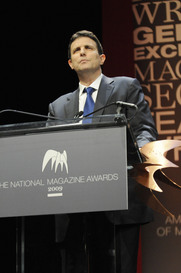
Last night, at the American Society of Magazine Editors awards ceremony (our coverage of the nomination announcement is here and here), The New Yorker took home awards for fiction by E. Annie Proulx and Aleksander Hemon, photography by Platon, and criticism by James Wood. Congratulations to all!
remnick_ellies.JPG

David Remnick accepting an Ellie for The New Yorker


Judging from the reaction on Twitter, the victory of Field and Stream over The New Yorker and Vogue in the 1,000,000+ circulation category was a bit of a shocker.
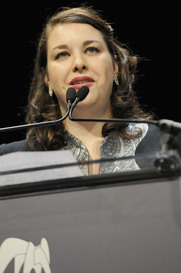
Meanwhile, Print won the award for general excellence, under 100,000 circulation. Congratulations to Emily and everyone at that outstanding publication for the well-deserved recognition!
EG_accepting.JPG
Emily Gordon, editor-in-chief of Print (and founder of Emdashes)