

Emily Gordon writes:
Can I imagine life without the cartoonist-writer-painter-animator-multimedia artist-graphic designer-comrade-confidante-friend known to Emdashes readers as the daily comic commentator Pollux? No, I cannot.
Paul Morris arrived at my virtual doorstep in January 2008 like an encyclopedia salesman, except that the encyclopedia he was selling was himself, and he asked for no down payment. He soon became my co-conspirator in the quest to reinstall founding New Yorker art director Rea Irvin in the collective mind as the uncompromising impresario he was.
Not long after that, I started reading Paul’s online comic, “Arnjuice,” noting how the drawings’ elegant angles and intense conservation of line mirrored the dialogue’s dreamy humor and sharp insight into the vagaries of the human animal. As I dug deeper into his oevre, which is not a word you can use for the output of every twentysomething, and caught a glimpse of its fine art (like these recent portraits of jazz musicians—that’s “The Banjoist,” above), I further observed how Paul’s Spanish and British heritage expressed themselves in all his work in linguistically limber, deeply colorful, and agreeably dissonant ways. I was impressed.
So I asked on a whim if he was willing to draw a comic for Emdashes. He was. We named it “The Wavy Rule” after Irvin’s famous wiggly dividing lines. I was thinking of some sort of regular contribution; Paul made it daily. We needed someone to fill in on a few written posts for the blog; he did it so charmingly that he now writes a weekly column just about the cover art of The New Yorker. He stands at the essential center of the Emdashes tapestry along with Martin Schneider, Benjamin Chambers, Jonathan Taylor, Erin Overbey, and Jon Michaud, all of whom I applaud daily, if not hourly. How this all happens every day—often, these days, without me even clicking my mouse—is a never-ending source of wonderment. Paul, like everyone I name above, is (as Dylan Thomas would say) the force that through the green fuse drives the flower.
In short, we are in awe. That this is going to make him radish-red with embarrassment is one of the reasons he is so beloved to us. We here at the disparate dots on Google Maps known as Emdashes HQ celebrate all that is Paul, Pollux, and everything he is set to become. We couldn’t do without him, and we wish him a very happy birthday indeed.
Monthly Archives: June 2009
The Wavy Rule, a Daily Comic by Pollux: The Reverse Pygmalion
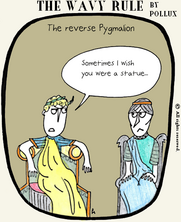
Click on the cartoon to enlarge it!
Read “The Wavy Rule” archive, and “order your Wavy Rule 2008 Anthology today!”:http://emdashes.com/2009/03/the-wavy-rule-anthology-now-fo.php
The Wavy Rule, a Daily Comic by Pollux: Wine Labels #8
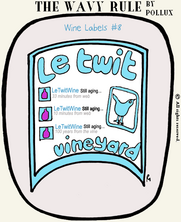
Click on the cartoon to enlarge it!
Read “The Wavy Rule” archive, and “order your Wavy Rule 2008 Anthology today!”:http://emdashes.com/2009/03/the-wavy-rule-anthology-now-fo.php
The Wavy Rule, a Daily Comic by Pollux: Kapuĉinoj
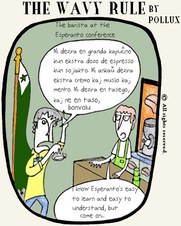
Click on the cartoon to enlarge it!
Read “The Wavy Rule” archive, and “order your Wavy Rule 2008 Anthology today!”:http://emdashes.com/2009/03/the-wavy-rule-anthology-now-fo.php
Potentially Controversial Observation Re: Buffalo Sentence
Martin Schneider writes:
Has anyone entertained the notion that perhaps “Buffalo buffalo Buffalo buffalo buffalo buffalo Buffalo buffalo” is not a valid English sentence?
If you are not aware of what I’m talking about, by all means head over to Wikipedia and catch up, it’s a marvel.
(Very quickly, because these things get complicated, if you imagine a (purely optional) comma after the fifth “buffalo,” you might glimpse a valid sentence that means something like, “Those NY-state bison that NY-state bison often bully, they also bully NY-state bison.”)
As far as I know, I believe that anyone who is able to follow the grammar of the sentence accepts the premise that the sentence is valid. That is to say, the set of people who deny its validity is congruent to the set of people who don’t get it. Seeing the argument for its validity is the same thing as accepting its validity.
I’m wondering if that’s really the case. Maybe you can see why it works, but also deny that it counts as a valid sentence. I’m going to throw it out there.
Before we continue, I must invoke the classic sentence devised by Noam Chomsky, “Colorless green ideas sleep furiously,” which serves to establish that a sentence can be grammatical while having a nonsensical semantic meaning (these words are cribbed directly from the Wikipedia entry on the sentence). I think I’m arguing that “Buffalo buffalo Buffalo buffalo buffalo buffalo Buffalo buffalo” might be a grammatical sentence without a valid semantic meaning—if that matters. I’m not sure it does matter, but it might.
In my “comprehensible” rendering of the sentence in the parenthetical above, I’m concerned about the insertion of the word “also,” which is, I think, conceptually necessary to make the sentence work, but also threatens the sentence’s validity. Can a purely tautological sentence be said to be valid?
The trouble is that the activities and entities involved are congruent. So the group of “buffalo from Buffalo” who buffalo “buffalo from Buffalo”—what is it they do, now? Oh yes. They buffalo “buffalo from Buffalo.”
But no: in order to avoid pure tautology, they do not merely “do that.” They also “do that.” It’s always phrased that way in the rendering, they “also” buffalo Buffalo buffalo.
As evidence, citing the Wikipedia page, here are two more ways to explain the sentence:
Bison from Buffalo, New York, who are intimidated by other bison in their community also happen to intimidate other bison in their community.
THE buffalo FROM Buffalo WHO ARE buffaloed BY buffalo FROM Buffalo ALSO buffalo THE buffalo FROM Buffalo.
Note that both examples take pains to include the word “also.” But you can’t “also” move from one activity to the same activity. Can you? Let’s see if it holds up in a different context:
My hamster, who enjoys lettuce, also enjoys lettuce.
Is that a valid sentence? I think it’s not clear.
Moving on. There’s a related problem, which is the absolute congruity of the groups “Buffalo buffalo.” I don’t really know if that set of animals truly can be said to bully … itself.
The sentence works if you think of it as describing a situation in which some Buffalo buffalo do something to some other Buffalo buffalo, as in the first example just cited: “Bison from Buffalo, New York, who are intimidated by other bison in their community also happen to intimidate other bison in their community” (emphasis mine). I’m just not sure that that’s what the words mean. Let’s try a test case:
New Yorkers root for New Yorkers, who in return root for New Yorkers.
Is there really a distinct subject and object there? I’m not sure there is. Is that describing two actions, or one action twice?
Now: it’s possible that the sentence means both things. It means something without semantic coherence, along the lines of my “New Yorkers” example, while also meaning something closer to “some buffalo do things to other buffalo.” Because humans and their brains are complicated and can read identical sentences with varying precision.
And maybe that ambiguity is all one requires to give the sentence semantic heft.
Thank you.
Celebrate Pauline Kael’s 90th Birthday at the Cooler!
Martin Schneider writes:
Pauline Kael was born 90 years ago this Friday, June 19. Jason Bellamy of the Cooler, a website dedicated to “cinema ruminations,” has chosen to dedicate the week to the one critic who probably influenced more movie bloggers than any other (and many other writers and critics too).
All week long, he’ll be posting some of Kael’s more noteworthy reviews and then open the floor to discussion.
The inaugural post features Kael’s review of A Clockwork Orange, and focuses on her thoughts on violence in movies.
I think Kael is one of those people who’s so influential that her name doesn’t even come up that much; it’s like it’s superfluous. Kudos to Jason for bringing her name into view a bit.
As Jason says, the celebration lives or dies on the participation of others, so please, do go over and comment!
The Wavy Rule, a Daily Comic by Pollux: Non Sequitur’s
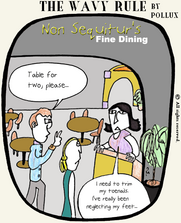
Click on the cartoon to enlarge it!
Read “The Wavy Rule” archive, and “order your Wavy Rule 2008 Anthology today!”:http://emdashes.com/2009/03/the-wavy-rule-anthology-now-fo.php
What’s in This Week’s New Yorker: 06.22.09
Martin Schneider writes:
A new issue of The New Yorker comes out tomorrow. A preview of its contents, adapted from the magazine’s press release:
In “The Secret History,” Jane Mayer speaks with Leon Panetta, the C.I.A.’s new director, in an exclusive interview about the agency’s legacy of torture, and examines the Obama Administration’s “attempts to restore the rule of law in America’s ï¬ght against terrorism without sacriï¬cing safety or losing the support of conservative Democratic and independent voters.”
In “Don’t Shoot,” John Seabrook looks at the innovative strategies that David Kennedy, a professor in the anthropology department at John Jay College of Criminal Justice, in New York City, has developed to reduce gang-related violent crimes. Employed to great success in Cincinnati, Providence, and several other communities in the U.S., Kennedy’s program, widely known as Ceasefire, imparts a moral component to crime deterrence.
Hendrik Hertzberg, in Comment, examines the impact of President Obama’s recent speech in Cairo on elections in the Middle East.
In the Financial Page, James Surowiecki looks at the effects of rising gas prices on consumer confidence.
In Shouts & Murmurs, Paul Rudnick describes a Utah Mormon’s experience with same-sex marriage on a family trip to Massachusetts.
Jon Lee Anderson explores Spain’s efforts to confront its civil-war past, including a pending exhumation of poet Federico GarcÃa Lorca’s remains.
Lauren Collins profiles romance writer Nora Roberts.
Sasha Frere-Jones listens to Sonic Youth’s latest release, The Eternal.
Kelefa Sanneh examines the recent movement away from the corporate work world and back to small business.
Hilton Als reviews the musical Coraline.
Anthony Lane reviews The Taking of Pelham 1 2 3 and Whatever Works.
There is a short story by Tim Gautreaux.
The Wavy Rule, a Daily Comic by Pollux: Wilbur and the Wind Farm
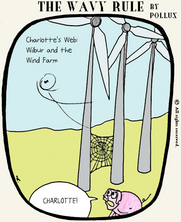
Click on the cartoon to enlarge it!
Read “The Wavy Rule” archive, and “order your Wavy Rule 2008 Anthology today!”:http://emdashes.com/2009/03/the-wavy-rule-anthology-now-fo.php
Anonymous Book Reviewer Nails It: Gawande Infiltrates Halls of Power
Martin Schneider writes:
In 2007 I reviewed Atul Gawande’s book Better for Publishers Weekly. I ended the review with this sentence: “Indeed, one suspects that once we cure the ills of the health care system, we’ll look back and see that Gawande’s writings were part of the story.”
How quickly predictions come to pass. It turns out Gawande does have a well-positioned fan in the White House. According to The New York Times:
President Obama recently summoned aides to the Oval Office to discuss a magazine article investigating why the border town of McAllen, Tex., was the country’s most expensive place for health care. The article became required reading in the White House, with Mr. Obama even citing it at a meeting last week with two dozen Democratic senators.
“He came into the meeting with that article having affected his thinking dramatically,” said Senator Ron Wyden, Democrat of Oregon. “He, in effect, took that article and put it in front of a big group of senators and said, ‘This is what we’ve got to fix.'”
Furthermore, America’s hippest health care wonk, Ezra Klein, called Gawande’s piece possibly “the best article on health care you’ll ever read,” which is even more impressive.
Update: Enjoy Gawande’s University of Chicago commencement speech, delivered this morning.