
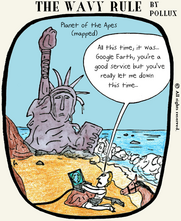
Click on the cartoon to enlarge it!
Read “The Wavy Rule” archive, and “order your Wavy Rule 2008 Anthology today!”:http://emdashes.com/2009/03/the-wavy-rule-anthology-now-fo.php
Monthly Archives: August 2009
The Wavy Rule, a Daily Comic by Pollux: The Policeman, the Professor, and the President
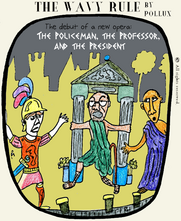
“The stuff of drama.”:http://en.wikipedia.org/wiki/Arrest_of_Henry_Louis_Gates Click on the cartoon to enlarge it!
Read “The Wavy Rule” archive.
Yet Another Reason That Edmund Wilson Rules
Martin Schneider writes:
Courtesy of Russell Jacoby at Crooked Timber, an amazing card that Edmund Wilson sent to people asking him to do things.

Just marveling at the combination of wit and ego bound up in that! Wow. Love it.
I want one!
The Wavy Rule, a Daily Comic by Pollux: All We Ever Do is Say Hello

Click on the cartoon to enlarge it!
Read “The Wavy Rule” archive, and “order your Wavy Rule 2008 Anthology today!”:http://emdashes.com/2009/03/the-wavy-rule-anthology-now-fo.php
What’s in This Week’s New Yorker: 08.10.09
Martin Schneider writes:
A new issue of The New Yorker comes out tomorrow. It is a double issue. A preview of its contents, adapted from the magazine’s press release:
In “Travels in Siberia–II,” Ian Frazier’s trip by car across the vast expanse of Siberia continues, from the Continental Divide to the Pacific Ocean.
In “The Price of the Ticket,” John Seabrook looks at the changes in the live-music industry and the financial complications that have caused many insiders to agree that the business of live music is “dysfunctional.”
In “The Courthouse Ring,” Malcolm Gladwell looks at Harper Lee’s classic novel, To Kill a Mockingbird, and reëxamines its central character, Atticus Finch, and his attitude toward race.
In Comment, Kelefa Sanneh writes about reverse racism in the wake of the recent controversy over Henry Louis Gates, Jr.,’s arrest
In The Financial Page, James Surowiecki asks why government attempts to aid troubled borrowers have failed to turn the foreclosure crisis around.
In Shouts & Murmurs, Zev Borow offers a guide to summer sun protection.
Judith Thurman explores the collaboration between Laura Ingalls Wilder and her daughter in the “Little House on the Prairie” books.
Alex Ross discovers new innovations in digital sound.
Nancy Franklin watches VH1’s Lords of the Revolution and Woodstock: Now and Then.
Anthony Lane reviews Cold Souls and Not Quite Hollywood.
There is a story by Sherman Alexie.
Sempé Fi (On Covers): The Island
_Pollux writes_:
I drew a “joke”:http://emdashes.com/2009/07/the-wavy-rule-a-daily-comic-by-251.php about desert island jokes a few weeks ago. It struck me, as I’m sure it has struck many observers, that the desert island features often as a comic device, especially “within the pages of _The New Yorker_.”:http://www.cartoonbank.com/directory/deserted-cartoons.html
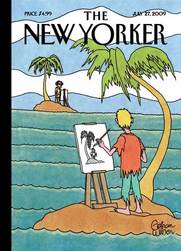
And now it appears on the cover of the July 27, 2009 issue. “Gahan Wilson’s”:http://en.wikipedia.org/wiki/Gahan_Wilson cover is of course a comment also on the desert island as a frequent location in one panel gags and cartoons. Last year, Mike Lynch’s cartoon blog “voted”:http://mikelynchcartoons.blogspot.com/2008/05/favorite-gag-cartoon-cliche.html for the desert island number one for gag cartoon clichés (second place was the Psychiatrist’s Couch, while third was The Grim Reaper).
Wilson’s cover, called “Cartoon Island,” of course features two cartoon islands, occupied by two artists drawing inspiration from one another across the treacherous-looking channel that separates them. The canvas we are allowed to see features a third island, occupied by a smiling castaway.
The castaway featured in the canvas is not a portrait of the bespectacled artist farthest away from us. The bespectacled artist simply provided the initial inspiration. The blond artist whose back is to us sees inspiration across the channel but not an opportunity for exact portraiture.
He is of course a castaway himself, but neither artist may realize this. So they paint and draw, sustaining themselves on Art and the off-chance that 7.5 oz cans of beans and franks and some desalinization equipment will wash up on their picayune shores.
Wilson has thus turned the desert island device on its own head. As Wilson has “remarked”:http://www.lowbrowartworld.com/gahan_wilson.html, “the creative artist is automatically an outsider, because he sees through the world that everybody else takes as the final reality, and he’s a very scary kind of guy.” Instead of a subject of art the island has become a place for producing art. The cartoon desert island is producing art about cartoon desert islands.
These cartoon desert islands usually look the same: they’re about the size of a Smart Car, usually sustaining a single palm tree and a single inhabitant, who is usually male. He wears the costume of a comic castaway: frayed slacks and shirt. He is sometimes unshaven, and always uninjured, and mysteriously does not look very undernourished. This is a humorous cartoon after all.
These desert islands are usually covered by a soft carpet of sand instead of unfriendly coral as sharp as an X-acto knife. Their very stripped-down quality makes desert islands a good location for humor. All you have is a man, an island, and the possiblity of a punchline. The cartoonist introduces some element that disrupts this minimalist world, and makes a comment on the world at large. The island is a laboratory for exploring ourselves.
The islands are ridiculously small, but their size allows us to see an entire world at once, a society in miniature, and of course, a small island is better than the dangers of the sea. As Gonzalo, the honest old counselor in Shakespeare’s “The Tempest,” declares, “Now would I give a thousand furlongs of sea for an acre / of barren ground–long heath, brown furze, anything.”
Wilson’s art, produced over the course of half a century, is sometimes described as scary or creepy, but here acquires a certain satirical tinge that is not particularly disturbing or sinister. His “Cartoon Island” is considerably less sinister than “another”:http://www.gahanwilson.com/orginalart.htm of his cartoon islands, which is not an island at all but a large sea monster -which is itself an old literary theme.
Wilson’s Cartoon Archipelago, composed of ink and watercolors, is a place of industry and stimulation. “I began to conclude in my mind,” Robinson Crusoe realizes on his deserted island, “that it was possible for me to be more happy in this forsaken, solitary condition than it was probable I should ever have been in any other particular state in the world.”
On Wilson’s “Cartoon Island,” we find two artists finding inspiration in the bleakest of circumstances, and thus finding a form of happiness through their art despite the fact that only the smallest of patches of earth separates them from a deep and hazardous ocean. The ocean is Neptune’s domain; skillful cartooning is Wilson’s.