
Jonathan Taylor writes:
Outside, 1980-something: “Why We Camp: Fran Lebowitz Wants to Know.” (So we can procrastinate on our novels.)

Monthly Archives: August 2009
The Wavy Rule, a Daily Comic by Pollux: The Secret of My Succe$s
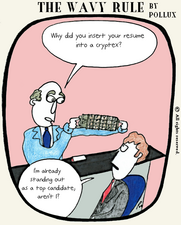
Click on the cartoon to enlarge it!
Read “The Wavy Rule” archive, and “order your Wavy Rule 2008 Anthology today!”:http://emdashes.com/2009/03/the-wavy-rule-anthology-now-fo.php
The Wavy Rule, a Daily Comic by Pollux: The Sealand Murders
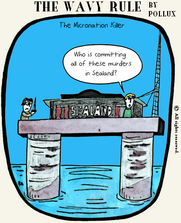
Has _The New Yorker_ ever done a report, profile, or story on the “Principality of Sealand”:http://en.wikipedia.org/wiki/Principality_of_Sealand? If not, it really should.
Click on the cartoon to enlarge it!
Read “The Wavy Rule” archive, and “order your Wavy Rule 2008 Anthology today!”:http://emdashes.com/2009/03/the-wavy-rule-anthology-now-fo.php
Infinite Summer: Location 3590
Martin Schneider writes:
Note: I’m participating in Infinite Summer, the widespread Internet book project dedicated to reading David Foster Wallace’s Infinite Jest. For more information, consult my introduction. My strategy has been to avoid lengthy commentary but instead list quintessentially Wallacean vocabulary and note other oddities, including Kindle typos.
I’m quite a bit farther than this, but I thought it’s preferable to present these lists in shorter form. Expect another update this week.
location 3154: Worcester, correct spelling seems off in this section
location 3229: addict/ alcoholic, errant extra space in Kindle
location 3240: galoots
location 3244: mythopoeia
location 3246: feldspar
location 3295: 
location 3323: tripodic
location 3390: PRECIPITANT
location 3391: FREDDIE-MAC FUND, very prescient!
location 3412: arational
location 3424: Good old aural, narrative voice here is distractingly close to DFW’s nonfiction voice
location 3435: usnlikable, Kindle error
location 3436: 60% of respondents, I love the wit and insight of the “videophony” section, but the bit about the self-consciousness over appearance is wrong, isn’t it? People simply adjust their expectations of visual attractiveness to the situation, right?
location 3440: Dysphoria(or, Kindle typo
location 3470: Masking(or, Kindle typo
location 3487: 149, Kindle error (page number included in text)
location 3512: and c.
location 3513: Tableauxdioramas, Kindle typo (hyphen missing)
location 3516: panagoraphobia
location 3523: agnate
location 3548: naïver
location 3558: 70° driveways. Very, very strange. There’s no such thing as a 70° driveway, right? 45° would be crazy steep.
location 3581: spronging
location 3585: truly what is it to pünch the volley, hilarious
location 3590: Stanford-Bïnet, why is DFW adding a diaeresis to Binet?
The Wavy Rule, a Daily Comic by Pollux: Cuba Dances
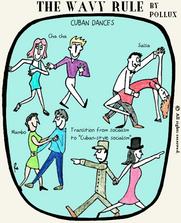
Click on the cartoon to enlarge it!
Read “The Wavy Rule” archive, and “order your Wavy Rule 2008 Anthology today!”:http://emdashes.com/2009/03/the-wavy-rule-anthology-now-fo.php
Raided Museum Was a ’30s ‘Culture Center’
Jonathan Taylor writes:
The Upper West Side’s Nicholas Roerich Museum, City Room reports, was recently the victim of its first art thefts. The museum was the topic of “Culture Center,” a Talk of the Town piece in 1934. (The museum was founded well before 1949, when the Times says it was). At the time, the museum was still located in the notable Art Deco building originally constructed to house both it, with its collection of a thousand Roerich paintings, and apartments for members of the theosophic Roerich Society: the Master Apartments on 103rd and Riverside. (The museum is now in a townhouse at 107th and Riverside.)
Talk called the 29-story building “the only building in town, so far as we know, that shades from deep purple at the base to white at the pinnacle. This symbolizes the idea of growth,” and, judging by the museum’s site, the colors retain their power. The piece continues archly about Roerich’s, and the Roerich Society’s, assiduous deployment of symbols.
The upper 25 stories of the building were “small kitchenette apartments for resident members of the Roerich Society.” Some became members just by virtue of signing a lease for a (nonprofit) apartment. A lease conferred an instant intellectual and social life: nightly talks on such topics as “What is Happening in the World and Why,” and birthday parties staged for folks like Goethe, Bolivar and Buddha—celebrated on the full moon of May. (The museum’s current event listings haven’t been updated lately.)
A Paris Roerich Museum is mentioned—can’t quite tell if that’s still around, but there are others in Mongolia, in a house he resided in, and in Moscow, which delightfully preserves in translation the Russian genitive form imeni, “by the name of,” for things named after people.
Sempé Fi (On Covers): Into the Wild
_Pollux writes_:
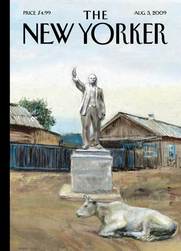
“Alex Melamid’s”:http://en.wikipedia.org/wiki/Alexander_Melamid cover for the August 3, 2009 issue of _The New Yorker_ is called, simply, “Siberia.” Melamid’s painting is not one of _The New Yorker_’s humorous or political covers. The meaning of his landscape cover only becomes apparent when one reads the issue’s Reporter at Large piece–and reads it in full.
Inside the covers of the August 3, 2009 issue is Part One of “Ian Frazier’s”:http://en.wikipedia.org/wiki/Ian_Frazier “Siberian journey.”:http://www.newyorker.com/reporting/2009/08/03/090803fa_fact_frazier In many ways, Frazier is plunging into the unknown. It truly is, as _The New Yorker_ describes it, the “ultimate road trip.” Starting in St. Petersburg, Frazier crosses the Urals to Tobolsk and beyond, in a lurching Renault step van with his guide Sergei Mikhailovich Lunev.
Melamid’s cover thus introduces an element of mystery that refers to the mystery of Siberia itself. Despite the increasing smallness, or flatness, of the world, Siberia remains a land of mystery to Westerners, a _terra incognita_ of taiga and tundra.
The very name “Siberia” conjures up images of remoteness, of nuclear tests, of gulag archipelagoes, of distant, cold cities with names like Omsk and Tomsk, and, as Frazier comments, of strategic places on the _Risk_ gameboard. “The Kamchatka Peninsula controlled the only crossing of the game board’s narrow sea between Asia and North America, so gaining Kamchatka was key.”
Siberia is a vast region marked here and there with the relics of the past and the realities of the present. On the start of his journey, in Vologda, in Western Russia, Frazier comes across “the only life-size statue of Lenin in the world. It looks painful as if the powerful Bolshevik had simply stood on a pedestal and been bronzed alive.”
In Melamid’s cover, Lenin stands before a nondescript, tumbledown house. There are no worshiping crowds or bouquets at Lenin’s feet, only an indifferent cow. “The main four-legged animal I encountered in Siberia was the cow,” Frazier writes. “Siberian cows are skinnier than the ones in America, and longer-legged, often with muddy shins, and ribs showing.”
Melamid’s brushstrokes capture the riddle that Russia still represents. Should we feel threatened by this land of life-sized statues and skinny cows?
Melamid, born in Moscow in 1945, was a co-founder, with “Vitaly Komar”:http://en.wikipedia.org/wiki/Vitaly_Komar, of the Sots Art movement, a Russian parallel to Pop Art and a satirical rendering of Socialist realism. Instead of paintings of admiring schoolchildren giving roses to Stalin, Melamid and Komar “inserted themselves, for example,”:http://www.komarandmelamid.org/chronology/1972/index.htm and their families into the forms and images of the state-approved Socialist realism.
Sots Art adopted, as explained in “this piece”:http://www.ivyparisnews.com/2007/11/sots-art-politi.html, “the aesthetic methods of state-approved art to express non-conformist sentiments”, utilizing the vibrant Soviet symbols (the hammer and sickle, the military uniforms, the star, the color red) for purposes of pop art rather than propaganda. Practitioners of this form of deconstruction included not only Komar and Melamid, but also Erik Bulatov, Il’ya Kabakov, Dmitry Prigov, Aleksey Kosolapov, and Leonid Sokov.
Melamid and Komar were arrested in 1974 during an art performance. Soviet authorities destroyed some of their works, and the two artists were working in the United States by the late 1970s. The two artists stopped working together in 2003. Recently, Melamid’s “_Holy Hip-Hop!_ solo exhibition”:http://www.mocadetroit.org/exhibitions/melamid.html attempted to capture the essence of hip-hop artists like Snoop Dogg, 50 Cent, Kanye West, and Reverend Run.
Melamid has been described as a revolutionary, a rebel, and a “cynical social realist.” However, I find his cover for _The New Yorker_ to be less satirical and irreverent and more nostalgic, almost sentimental.
Naturally, with the fall of the Soviet regime, creators of Sots Art no longer had a power structure and its accompanying symbols to lampoon and subvert. Melamid has thus turned to new power-brokers such as Snoop Dogg and away from those such as Leonid Brezhnev.
Nostalgia for the Soviet era emerged as soon as the Soviet era had ended. Lenin and Stalin were no longer objects of fear but representatives of a bygone era of superpower status. Today, affluent young Muscovites “buy”:http://www.nytimes.com/2007/11/27/world/europe/27designer.html?_r=1&bl&ex=1196830800&en=891f7f26514c44ff&ei=5087%0A overcoats bearing hammer-and-sickle buttons, retro USSR Olympic tracksuits, and jewelry minted to look like Soviet kopecks.
In the same way, Melamid’s cover has not been created, as Sots Art has been “described”:http://www.komarandmelamid.org/chronology.html, in “a unique version of Soviet Pop and Conceptual Art, which combines the principles of Dadaism and Socialist Realism” but instead is simply a literal imagining of Frazier’s words on Siberia, tinged with nostalgia for the Soviet past.
Frazier’s cows and Lenin statue are not described as being in the same town. Melamid has instead created a vision that combines Frazier’s reporting into one single canvas.
Melamid’s cover is thus not an attack on a repressive Soviet regime but an interpretation of the Russia of 2009: an intriguing combination of great strength and size and also a place of strong nostalgia, of ecological desolation, of empty steel barrels and scuttled ambitions.
The Wavy Rule, a Daily Comic by Pollux: A G-Force in the Bride Wars
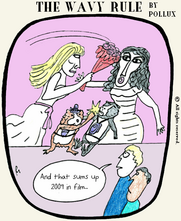
I think I’ll do one of these “every year.”:http://emdashes.com/2008/07/the-wavy-rule-a-daily-comic-by-1.php
Click on the cartoon to enlarge it!
Read “The Wavy Rule” archive, and “order your Wavy Rule 2008 Anthology today!”:http://emdashes.com/2009/03/the-wavy-rule-anthology-now-fo.php
R.I.P., David Marc Fischer, Devoted New Yorker Blogger and Extraordinary Friend
Emily Gordon writes:
There are no words to describe the sadness we feel at the death of David, the man behind (among many other projects and passions) Blog About Town, who was a friend of The New Yorker, particularly its cartoons and cartoonists; an unwavering friend of Emdashes who always encouraged us to do our odd but heartfelt job more creatively and uncompromisingly; and a friend of mine. I could never match his generosity or his ingenuity in getting fellow New Yorkers to ditch their work-crazed ruts and get together, out to dinner, out to a play. His list of loyalists was the loyalest.
The last time we emailed, he invited me to see Twelfth Night. I couldn’t go. Here’s a short post he wrote about the play and its famous riddle about the initials M.O.A.I. In the comments (he was an active and conscientious commenter, including on his own posts), he wrote:
Methinks that M. O. A. I. could very well be a red herring, meant to torture Malvolio with its unsolvability. However: Now that I’ve (just) read about it containing the outer letters of Malvolio’s name, I also realize that continuing the progression would produce L. L. O. V., which is something close to love. That’s also plausible to me.
It’s a shocking loss, not least because it was so unexpected. He’ll keep his place of honor in the Emdashes Rossosphere for all time. Maybe someone else will take up the project of faithfully chronicling the New Yorker‘s Cartoon Caption Contest, mapping the winners, and tracking Daniel Radosh’s always hysterically anarchic Anti-Caption Contest. But no one will do it with so much L.L.O.V.
Later: Here’s a nice post about David from Radosh.net.
And later: Yesterday’s memorial service was one of the most touching occasions I’ve ever witnessed. I’ve been to three funerals in recent months for people far too young to die: Andrew Johnston, Michal Kunz, and David. It’s disquieting to hear eulogies by and for one’s peers (of course, one must also get used to this). But there’s an energetic, offbeat quality to such tributes that I can only describe as youthful, and that can be cathartic and apropos, too.
The first person to speak was the photographer Matt Mendelsohn, who knew David for almost all of their 46 years, and, with Matt’s permission, I wanted to share this part of his tribute with you. The caption contest line, you’ll be glad to know, got an enormous laugh. Everyone knew how passionate David was about the contest, but I didn’t realized he’d entered it so many times. And I didn’t know till yesterday that the huge group of passions and communities David either formed or enthusiastically promoted was just the tip of the iceberg. You wouldn’t believe how many people he was connected to, and how many people he connected. As another friend observed, “He was a giver.”
David was the smartest, brainiest, most loyal, most culturally aware friend I’ve ever had. He was interested in everything and he was interesting about everything. That is to say, there was no topic off bounds or out-of-reach for David. No subject, highbrow or lowbrow, he was unable to add a cogent, witty, insightful comment on. As a child, that could have been a topic of mild importance, say, the assumption to the presidency of Gerald Ford in 1974; of moderate importance, like the jazz trombone stylings of his idol, Bill Watrous; or, one of dire, absolute importance, like the groundbreaking 1968 Patrick McGoohan television series The Prisoner.
As an adult, that could mean a topic of mild importance, like the election of Barack Obama; of moderate importance, like discussing his one hundred and seventy-nine consecutive non-winning entries in the New Yorker Cartoon Caption Contest; or, finally, a topic of dire, absolute importance, like the groundbreaking 1968 Patrick McGoohan television series The Prisoner.
David, young or old, was a collector of culture, a guardian of civility. You never so much as argued with David as debated him cordially. It’s no surprise that in the 1980’s, when Life magazine still published monthly, David was the Letters to the Editor editor. In an age now, when anonymous and vicious comments on the internet are run amok, the notion of David vetting every published letter for accuracy and intelligence seems downright quaint. But that’s just what he excelled at. He was a lifeline to a more literate and worldly world. The last postings on Blog About Town, the New York diary he kept up for years, include, quite randomly, tips for securing Shakespeare in the Park tickets, a word-for-word handicapping of the National Spelling Bee (“Kavya Shavashankar gets a huge Monty Python word, “Blancmange,” and swallows it whole; Kyle Mou gets lucky, I think, by drawing avoirdupois–and he takes full advantage of the situation”), and, finally, an old clip of the French songwriter Charles Trenet singing his 1946 classic “La Mer,” in his native tongue, long before Bobby Darrin re-wrote it into a hit song in 1959. Not knowing anything about Charles Trenet, I watched the clip, read the translation and thought to myself, “Wow, the original is so much more poetic.”
Will I someday use this morsel of knowledge David just gave me? I’m not sure. Like all of his wisdom, I’ve filed it in my brain, and someday it will find its way back out and into a conversation. These are the little gifts David loved to give.
The Wavy Rule, a Daily Comic by Pollux: Business Park
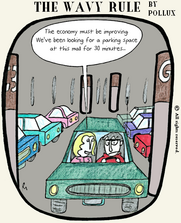
Click on the cartoon to enlarge it!
Read “The Wavy Rule” archive, and “order your Wavy Rule 2008 Anthology today!”:http://emdashes.com/2009/03/the-wavy-rule-anthology-now-fo.php