Monthly Archives: August 2009

Meditations in a Newsmergency

Michael Nielsen writes in “Is Scientific Publishing About to Be Disrupted?”, which is worth reading through to the sound advice at the end:

Some people explain the slow death of newspapers by saying that blogs and other online sources [1 (see note)] are news parasites, feeding off the original reporting done by the newspapers. That’s false. While it’s true that many blogs don’t do original reporting, it’s equally true that many of the top blogs do excellent original reporting…. Five years ago, most newspaper editors would have laughed at the idea that blogs might one day offer serious competition. The minicomputer companies laughed at the early personal computers. New technologies often don’t look very good in their early stages, and that means a straightup comparison of new to old is little help in recognizing impending dispruption. That’s a problem, though, because the best time to recognize disruption is in its early stages.

Although much of my own reporting for Emdashes is in the somewhat less world-changing realm of bagel inquiries and Shouts & Murmurs phone number calling, I heartily agree.

Important economic and media-future questions aside, this preoccupation with what a “blogger” does and doesn’t do–and can and can’t do–continues to be fascinating but frustrating to me. (This is why I’m looking forward to reading Say Everything: How Blogging Began, What It’s Becoming, and Why It Matters, by Scott Rosenberg, who, on his book’s site, answers the question “Aren’t there just too many blogs?” with a brief and hilarious “No.”) As Sewell Chan said not long ago: “The whole blogger versus journalist debate that might have existed around 2004 is dead. Over. Stale. Uninteresting. I couldn’t care less — it’s a meaningless debate to have. What’s more interesting to me is what a blog means now.”

Yes indeed, a blog means something–that’s very clear–but what about a “blogger”? If you don’t mind the self-quoting (I so rarely indulge!), I’ll repeat, Pete:

Like “radio host” or “airplane skywriter,” the term “blogger” refers only to a medium of communication, a method of delivery. The first two descriptions might indicate something about a person’s source of income; they say a little more about his or her temperament and skills (the ability to get to a radio studio, win the slot, speak into a microphone, and work the dials, at minimum; the agility and daring to fly a plane in signifying loops).

But “blogger,” like “caller from Schenectady” or “chronicler of skywriting,” reveals next to nothing about that person’s training, philosophy, background, intelligence, education, politics, reporting or research skills, social life, ethics, age, poise, lucidity, conventionality, effectiveness, impulsiveness, discretion, or relationship to (or experience in) traditional media, whether “mainstream” or not. Only watching what the skywriter spells, and listening to what Schenectady has to say, will begin to make them known.

In any case, writers who pride themselves on their sensitivity to language should avoid lumping their fellows into mass categories of either variety, don’t you think?

New ‘n’ related: Scott Rosenberg asks, Time to retire the term “blogger”?

A Look Back: Pauline Kael, and David Denby’s Snark

Martin Schneider writes:
My Facebook friend Michal Oleszczyk, who once reminded us about Pauline Kael’s former apartment on the Upper West Side, yesterday pointed us in the direction of an unflinching reminiscence written by a fledgling film critic to whom Kael once showed unusual kindness. This is exactly the way I like to think of Kael, imperious but benevolent, possibly eccentric but supremely confident of her abilities and importance (check that closing line).
I really admire Ed Champion’s willingness to grapple with the fundamental questions surrounding writing, and his defense of David Denby’s Snark from several months ago certainly doesn’t detract from that admiration. Back in the day, I was a FameTracker devotee of long standing (username: DerKommissar), so I respect the uses of snark while also harboring concern over its excesses. Either way, Denby’s argument was almost certainly dismissed too quickly, and Champion’s article is a useful corrective. Note that Choire Sicha and Adam Sternbergh took the time to respond to Champion in the comments.

What’s in This Week’s New Yorker: 08.24.09

Martin Schneider writes:
A new issue of The New Yorker comes out tomorrow. A preview of its contents, adapted from the magazine’s press release:
In “The Untouchable,” Ben McGrath examines Michael Bloomberg’s campaign for a third term as Mayor of New York. “After seven and a half years in office, Bloomberg, who is now sixty-seven, has amassed so much power and respect that he seems more a Medici than a mayor,” McGrath writes.
In “Plugged In,” Tad Friend examines the state of the electric-car industry, by profiling Elon Musk, the colorful chairman, C.E.O., and product architect of Tesla Motors.
In Comment, Hendrik Hertzberg takes note of our foundering state governments, and asks if one of our largest states, California, has become ungovernable.
Alec Wilkinson explores the world of competitive free diving.
In Shouts & Murmurs, Amy Ozols offers a cure for hangovers.
David Sedaris reflects on his childhood and a trip to Australia.
Alex Ross examines depictions of fictional composers in literature.
Sasha Frere-Jones looks back at Leonard Cohen’s career in music.
Peter Schjeldahl visits the exhibit “Augustus Saint-Gaudens in the Metropolitan Museum of Art.”
David Denby reviews Inglourious Basterds and Julie & Julia.
There is also an excerpt from The Wild Things, Dave Eggers’s new adult novel based on the storybook by Maurice Sendak.

Kevin Fitzpatrick’s “Algonquin” Book Tour Starts Sunday!

Martin Schneider writes:
Via the mysterious conduit known as “Facebook” arrives news that the new book about the Algonquin Round Table by our dear friend and colleague Kevin Fitzpatrick is commencing his book tour!
I’ve not had the pleasure of meeting Kevin, but Emily knows him well and assures me that he is a capital fellow and an unimpeachable resource on the subject of Dorothy Parker and her acerbic friends. Really, I see no way that buying his book could ever constitute a poor decision.
Emdashes readers will remember that we presented exclusive coverage of the book a little while back.
Good luck, Kevin!
I’ve pasted his press release below, complete with events, each of which is a delightful occasion to marinate in all things Dorothy Parker, The New Yorker, and wit in general—and to buy the book!

* * *

Hi friends and family,
I am happy to announce that my second book is out now. I am the editor of “The Lost Algonquin Round Table” and I hope you will feel compelled to want a copy. It is a collection of writing by the members of the group, 16 writers such as Dorothy Parker, Robert Benchley, Robert E. Sherwood, Edna Ferber, George S. Kaufman, Heywood Broun and many others. It has fiction, essays, humor, poems and reviews. It was a lot of fun to work on with my co-editor, Nat Benchley. To promote the book I launched my own publishing imprint, Donald Books, which you can find out more about on
www.donaldbooks.com.
So how can you get a copy? Easy! If you live in NYC, my “tour” schedule is below. For those outside of the city, you can go to any decent bookstore and they can order the book for you. Just tell them the title and they should be able to locate it to order; ISBN (hardcover): 9781440151521, ISBN (paperback): 97181440151514; it takes about a week to get it in. The book is also on all the major online booksellers, such as Amazon, Barnes and Noble, Powell’s, etc. You can also order it direct from iUniverse.com (see link on donaldbooks.com).
From my web site, here is the info on where I will be starting this weekend and running through September:
Sunday, Aug. 16, 11 AM, Long Branch Free Public Library, 328 Broadway Long Branch, NJ 07740 732.222.3900. As part of the annual Dorothy Parker Day, Kevin C. Fitzpatrick will give a talk, reading and book signing. Free. Open to the public.
Wednesday, Aug. 19, 6 PM, The Corner Bookstore, 1313 Madison Avenue, at E. 93rd Street, New York, NY 10128. (212) 831-3554. Official book launch and reception party. Editors Nat Benchley & Kevin C. Fitzpatrick will be on hand with special guests. Books will be available for purchase and signing. Free. Open to the public.
Thursday, Aug. 20, 8 PM, Don’t Tell Mama, 343 W. 46th Street, New York, NY 10036. Big Night Out presents the “1930s Idol” cabaret competition. Kevin C. Fitzpatrick will be signing/selling copies of the book plus is a judge in the show. $12 and two drink minimum. Open to the public. Reservations encouraged: 212-757-0788.
Saturday, Aug. 22, 12 PM, Algonquin Hotel, 59 W. 44th Street, New York, NY, 10036. Algonquin Round Table Walking Tour. Editor Kevin C. Fitzpatrick has led this literary walking tour for ten years. Walk in the footsteps of the Vicious Circle and see the locations they visited, from speakeasies to old haunts. Cost is $20 ea. At 3 p.m. in the lobby will be a book signing, followed by a small celebration to mark Dorothy Parker’s birthday today. Reservations encouraged: 212-222-7239.
Wednesday, Aug. 26, 6-9 PM, Museum of the City of New York, 1220 Fifth Avenue, there is a special Wednesday evening “speakeasy” on the roof, with live music and Prohibition era cocktails. $12 admission gets you into the museum’s first floor and it’s Prohibition exhibition (and a free drink). Kevin will give a talk and sign copies of the book.
Sunday, Sept. 27, 12 PM, Governors Island (Colonel’s Row). The Jazz Age Lawn Party and Roaring Twenties Party. Live music by Michael Arenella and the Dreamland Orchestra. Book signing 12-3 PM. $5 admission. Open to the public.
Thanks for the support, I really appreciate it.
Sincerely,
Kevin C. Fitzpatrick
kfitz@bway.net

Bob Mankoff on David Marc Fischer, the Winningest Non-Winner We Knew

Emily Gordon writes:
Recently, everyone at Emdashes was saddened by the death of David Marc Fischer, a dear friend of our site and of The New Yorker‘s cartoon caption contest. The following tribute is by The New Yorker‘s Bob Mankoff, and we think David would have loved it (click to enlarge the image):

In his “Blog About Town,” David Marc Fischer meticulously catalogued The New Yorker‘s Cartoon Caption Contest, including his 179 consecutive non-winning entries. Upon learning of this lovely man’s untimely passing, I went back and meticulously reviewed all of his entries, looking for the one that would best honor him and his devotion to the contest. I think this one, from contest 150, fits the bill.

–Bob Mankoff, Cartoon Editor, The New Yorker magazine

captiondmf.jpg

The Wavy Rule, a Daily Comic by Pollux: The E-Book of Deuteronomy (Location Range 1:6-4:49)

ebookindle4.PNG
Read Nicholson’s Baker “report”:http://www.newyorker.com/reporting/2009/08/03/090803fa_fact_baker on the Kindle–does the e-book make the book obsolete or is it a new source of annoyance and eye-strain in America?
Click on the cartoon to enlarge it!
Read “The Wavy Rule” archive, and “order your Wavy Rule 2008 Anthology today!”:http://emdashes.com/2009/03/the-wavy-rule-anthology-now-fo.php

I’m Not Hanging Noodles On Your Ears: Jag Bhalla’s Book on Idioms, Illustrated by New Yorker Cartoonist Julia Suits

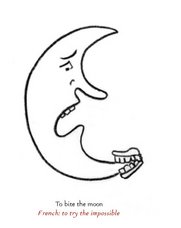
moon_bite_Julia Suits.jpg
**Illustrations by Julia Suits**
(click to enlarge)
_Pollux writes_:
Enjoying “Jag Bhalla’s”:http://www.hangingnoodles.com/ new book on idioms comes as easily as a river imp’s fart. _I’m Not Hanging Noodles On Your Ears_, published by the National Geographic Society, is a collection of “intriguing idioms from around the world.”
_Hanging Noodles_, which also features the work of _New Yorker_ cartoonist “Julia Suits'”:http://www.cartoonbank.com/search_results.asp?sitetype=1&advanced=1&section=all&artist=Julia+Suits visualizations of the idioms, collects wonderful and diverse idioms from various languages, including Chinese, Russian, French, Yiddish, and Spanish.
Our brains, as Bhalla explains, enjoy novelty in language and word play, and idioms are perhaps the best example of our collective love for linguistic playfulness. Bhalla calls idioms “frozen metaphors” and the definition is both pithy and apt.
The origins of some idioms have been lost in time. Idioms are living relics that see life everyday despite their hazy origins. They are frozen baby mammoths that we resurrect from the ice on a daily basis.
Idioms are figures of speech that are usually unintelligible to someone who hears them for the first time. If a Russian lets you know, perhaps while you are “journeying”:http://www.newyorker.com/reporting/2009/08/03/090803fa_fact_frazier across the wastes and wonders of Siberia, that he’s not hanging noodles on your ears, he means he is not pulling your leg.
But Bhalla’s _Hanging Noodles_ isn’t a soulless compendium of idioms, but a look at language and its formation. Bhalla prefaces each chapter with a short linguistic study that examines, for example, the capacity for babies and animals to learn languages, the role of facial expressions in language, the role of culture in language, the role of numbers and counting in language, semantic shifts, and what he calls the “woo-woo theory,” in which language may have gained complexity as a result of man’s efforts to woo the opposite sex, with idioms, for example, serving as a sort of linguistic peacock tail.
frogs_armpit_Julia Suits.jpg
Bhalla also includes trivia on words and word origins. For example, he mentions a neologism based on the Spanish word _tapas_ (literally “lids”, but referring to the little dishes of appetizers served before the main course), which is _crapas_ -a new coinage used to describe the terrible finger food served at public events. In addition, Bhalla not only discusses the origins of words, but also his own origins, and his own tastes and background regarding language.
Let me mention some of the actual idioms in Bhalla’s book. As the Germans say, _here the donkey falls_ (“that’s the important part”). Some of my personal favorites include “to vomit the sound of weakness” (Japanese, “to whine”), “to show your lamp to the sun” (Hindi, “to waste time”), and “to stick one’s nose in every sour curd cheese” (German, “be nosy”).
Julia Suits’ drawings illustrate the bizarreness of some of these idioms, making _Hanging Noodles_ not only a compendium of idioms, a collection of trivia, an autobiography, and a scholarly look at the history of language, but also a book of cartoons.
Suits’ simple lines are effective in a second translation of these idioms. Idioms such as “to stand like a watered poodle” are translated not only into English, but also into the visual language of cartooning. The result is a series of funny and surreal drawings that demonstrate the great complexity and strangeness of language.
Adding to the bizarreness of these idioms is the fact that Bhalla provides us his frozen metaphors only in their translated, English form. As Bhalla explains, the book is not intended to be a language reference book, but instead his purpose is for you to connect as a reader with the lists of idioms and “make your own sweet, beautiful meaning together.”
Bhalla includes a quote by _New Yorker_ cartoon editor Bob Mankoff that defines humor as the “counterweight to the hegemony of reason,” and _Hanging Noodles_ helps in the good fight against dispassionate logic. “Our minds,” Bhalla writes, “are not as reason-able as we like to think.”
But instead of lumping them in terms of their language of origin, Bhalla groups idioms according to theme or category. Thus, we get chapters such as _The Language of Love: Swallowed like a postman’s sock_, _Colors: Sighing with blue breath_, and _Time: When dogs were tied with sausages_.
This makes the book not only informative but funny. For example, a selection of romance-related idioms includes:
* _To live like an old farm rifle_ (Spanish, Nicaragua): to always be pregnant
* _Reheated cabbage_ (Italian): an attempt to revive an old love affair
* _Aunt seducer_ (German): a young man whose manners are much too good
Idioms enliven and brighten the languages of the Earth. Jag Bhalla’s book, adorned with amusing drawings by Julia Suits, is a welcome addition to the library of anyone who loves words.
Reading _I’m Not Hanging Noodles On Your Ears_ put the butter back in my spinach. I hope it does for you too, and may an onion not grow out of your navel.
tea_navel_Julia Suits.jpg