
Martin Schneider writes:
As of yesterday, you can follow The New Yorker at the Twitter feed @newyorker. It seems that they are no longer using @NewYorkerDotCom (as we reported long ago).
Monthly Archives: September 2009
The Wavy Rule, a Daily Comic by Pollux: Afghaniplan
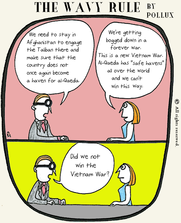
Click on the cartoon to enlarge it!
Read “The Wavy Rule” archive.
The “Mad Men” Files: Lenox Lounge
Martin Schneider writes:
The setting for the arresting first scene of the entire series, in which the as yet unidentified Don Draper quizzes a black restaurant peon about his brand of cigarettes, is the Lenox Lounge, according to Matthew Weiner in the DVD commentary to the series opener. Still in operation today, the Harlem landmark is located at 288 Lenox Avenue, just off Malcolm X Boulevard at 125th St., although that stretch of Sixth Avenue obviously didn’t bear that name in 1960—just another sign of how things change, a central theme of the show.
It seems a bit implausible that Don Draper would spend that evening alone in Harlem, perhaps 75 blocks north of his office and at least 110 blocks north of Midge’s apartment, his eventual destination. Then again, as we later learn, Don is a devotee of Ingmar Bergman’s movies and Frank O’Hara’s poetry, so he does have the capacity to surprise in this regard; the Lenox Lounge is a legendary jazz club, so he might be there to catch Lady Day deliver a memorable rendition of “I Cover the Waterfront.” (By the by, it is just me or have they blunted this side of Don in Season 3?)
I’ve been to the Lenox Lounge before, and I’m a little confused as to how seriously we’re meant to take Weiner’s information—it’s one thing for Draper himself to want to go there, quite another for it to be crammed with white office workers as a matter of course. Does anyone know the general demographic characteristics of the place during that period? It didn’t look like that (demographically speaking) in 2000 or so, when I was there.
I was hoping for a little insight on this question from The New Yorker, but no such luck: the references to the Lenox Lounge are all recent, the finest among them being an interesting photograph of the club’s interior, in a Portfolio by Robert Polidori, text by Kurt Andersen.
The Wavy Rule, a Daily Comic by Pollux: Audax Minor
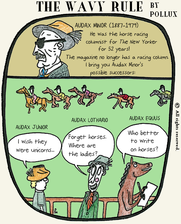
In honor of “Audax Minor”:http://en.wikipedia.org/wiki/Audax_Minor, whose column for _The New Yorker_, called “The Race Track,” ran from 1926 to 1978 -quite an accomplishment.
Reg Lansberry wrote a great “piece”:http://marylandthoroughbred.com/midatlantic/current_issue_archive/index.htm on Audax Minor (real name George Ryall) for _Mid-Atlantic Thoroughbred_, and James Wolcott has “commented”:http://www.vanityfair.com/online/wolcott/2006/11/in_the_most_rec.html that Lansberry’s piece may “spur publishing interest in having Audax Minor’s best work handily anthologized instead of remaining scattered through the digital volumes of the Complete New Yorker.”
Click on the cartoon to enlarge it!
Read “The Wavy Rule” archive.
The Wavy Rule, a Daily Comic by Pollux: TV Land
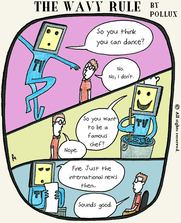
Click on the cartoon to enlarge it!
Read “The Wavy Rule” archive.
Beyond the New Yorker Festival II: ‘The Art of Reportage’ at NYU
Jonathan Taylor writes:
In my last post, I mentioned attractive anniversary readings being put on by New York Review Books Classics. I also want to note another upcoming event at NYU on “literary reportage,” which inescapably includes a lot of New Yorker contributors: Alastair Reid, Adrian Nicole LeBlanc, Lawrence Weschler, Philip Gourevitch, Robert S. Boynton, Eliza Griswold and Elizabeth Rubin. And in addition, Suketu Mehta, author of the awesome Maximum City: Bombay Lost and Found.
The October 6–7 symposium takes as its point of departure the renowned, and debated, work of Ryszard KapuÅ›ciÅ„ski, some of which itself appeared in the magazine. This 2007 memoir of his first trip abroad—to India as a reporter for Poland’s Sztandar Mlodych (The Banner of Youth) in 1955— is freely readable online.
Full release after the jump:
AFTER KAPUŚCIŃSKI: THE ART OF REPORTAGE IN THE 21ST CENTURY
A 2-DAY SYMPOSIUM
October 6-7, 2009
NYU’s Hemmerdinger Hall
100 Washington Square East
Subway: West 4th: B,C,D,E,F,V; 8th St: R,W; Astor Place: 6.
Free and open to the public on a first come, first-in basis.
This two-day symposium offers an exciting public conversation about
the state of the art of reportage amid a rapidly changing media
landscape, various approaches to and practices of long-form and
literary journalism, and the ongoing legacy of renowned practitioners
like Polish journalist Ryszard Kapuściński. At a time when categorical
differences between fiction and nonfiction are increasingly ambiguous,
and the gap between their respective segments of the publishing market
increasingly small, a discussion of reportage as a literary art form
is paramount.
This free public program is being co-sponsored by the Polish Cultural
Institute in New York, the National Book Critics Circle, the New York
Institute for the Humanities at NYU, and the Literary Reportage
concentration of the Arthur L. Carter Journalism Institute at NYU, in
association with the Overseas Press Club of America and Words without
Borders.
More information: http://www.PolishCulture-NYC.org
AFTER KAPUŚCIŃSKI: THE ART OF REPORTAGE IN THE 21ST CENTURY
A 2-DAY SYMPOSIUM
October 6-7, 2009
NYU’s Hemmerdinger Hall
100 Washington Square East
PROGRAM & PARTICIPANTS
TUESDAY, OCTOBER 6TH
Panel I: The Art of Reportage: On the Ground and On the Page
5:00 PM-7:00 PM
How does narrative arise from reportage? What transformation occurs
during the writing process? Answers from journalists who combine
investigative skills and literary craft.
Jane Ciabattari, Moderator, is President of the National Book Critics
Circle and a member of the Executive Board of the Overseas Press Club.
Her reporting from abroad and cultural criticism have appeared in the
New York Times, The Guardian online, npr.org, Bookforum, the
Washington Post, Los Angeles Times, and Columbia Journalism Review.
Joshua Clark is author of Heart Like Water: Surviving Katrina and Life
in Its Disaster Zone (2007 National Book Critics Circle award
finalist). He has worked as a correspondent for NPR and Salon.com.
Eliza Griswold is author of The Tenth Parallel: Dispatches from the
Fault Line Between Christianity and Islam (FSG, forthcoming 2010), a
New America Fellow, and a 2010 Rome Fellow at the American Academy in
Rome. Her reportage has appeared in the New Yorker, Harper’s and the
New Republic.
Arif Jamal is author of The Shadow War: The Untold Story of Jihad in
Kashmir (Melville House, 2009). Former contributing writer to the New
York Times, he is a fellow at the Center on International Cooperation
at New York University.
Elizabeth Rubin, a recent Edward R. Murrow press fellow at the Council
on Foreign Relations, is a contributing writer for the New York Times
Magazine. Her award-winning reportage from Iraq, Iran, Afghanistan,
Saudia Arabia, Russia, the Caucasus, the Middle East, Africa, and the
Balkans has appeared in the Atlantic Monthly, the New Republic,
Harper’s, and the New Yorker.
Paweł Smoleński is author of 7 books in Polish, including Burial of a
Butcher, on tensions between Poles and Ukrainians, and Hell in
Paradise, on post-Saddam Iraq. He received a 2005 Kurt Schork Award in
International Journalism from Columbia University’s Journalism School.
TUESDAY, OCTOBER 6TH
Panel II: Literary Reportage Between Self and Other, Fact and Fiction
7:30 PM-9:00 PM
If a strictly objective take is self-evidently impossible, what sort
of warrant as to strict veracity ought the reader expect from the
creator of long-form narrative nonfiction? To what extent, if any,
ought that writer’s vantage be grounded in a personal “I” voice, and
to what extent does even that commitment shade into a sort of
fiction?
Lawrence Weschler, Moderator, is concurrently Director of the New York
Institute for the Humanities at NYU and Artistic Director of the
Chicago Humanities Festival, and the author of over a dozen books,
including The Passion of Poland, Calamities of Exile, and Everything
That Rises: A Book of Convergences (2007 National Book Critics Circle
Award winner).
Wojciech Jagielski is the author of 4 books in Polish, including Night
Wanderers (2009), about child soldiers in Uganda, and, in English
translation, Towers of Stone: The Battle of Wills in Chechnya (Seven
Stories, October 2009).
Adrian Nicole LeBlanc is author of Random Family: Love, Drugs, Trouble
and Coming of Age in the Bronx (2003, NBCC finalist), a 2006 MacArthur
Fellow, and a visiting scholar at the Arthur L. Carter Journalism
Institute.
Suketu Mehta is author of Maximum City: Bombay Lost and Found (2004),
a 2007 Guggenheim Fellow, and Associate Professor in the Literary
Reportage concentration of the Arthur L. Carter Journalism Institute
at NYU.
Alastair Reid is an eminent poet, longtime New Yorker correspondent
from Spain, Scotland, and Latin America, one of the foremost
translators of the work of both Pablo Neruda and Jorge Luis Borges,
and a fellow of the New York Institute for the Humanities.
WEDNESDAY, OCTOBER 7TH
Panel III: KapuÅ›ciÅ„ski’s Legacy in the 21st Century
6:30 PM-8:30 PM
Ryszard Kapuściński was one of the most celebrated, albeit
controversial journalists of the last fifty years, a gorgeous stylist
and a rhapsodic, if at times not strictly reliable, witness. To what
extent is the kind of reportage he engaged in even possible today?
What lessons can the next generation of writers draw from his
example?
Robert S. Boynton, Moderator, is Director of NYU’s new Literary
Reportage concentration, former Senior Editor at Harper’s, and author
of The New New Journalism (2005).
Anna Bikont is a senior writer and co-founder of Poland’s leading
daily newspaper Gazeta Wyborcza, author of We, People from Jedwabne
(2004; English translation forthcoming from Yale Univ. Press), and a
2008-09 Cullman Center fellow at the NYPL, where she was researching a
biography of Ryszard Kapuściński.
Ted Conover is the author of Newjack: Guarding Sing Sing (2001
National Book Critics Circle Award winner), a 2003 Guggenheim Fellow,
and Distinguished Writer in Residence at NYU’s Arthur L. Carter
Journalism Institute.
Klara Glowczewska is Editor in Chief of Condé Nast Traveler, the only
travel publication to win a National Magazine Award, translator of
three of Ryszard KapuÅ›ciÅ„ski’s books, including Travels With Herodotus
(2007). She is a member of the Executive Board of the Overseas Press
Club.
Philip Gourevitch is Editor in Chief of The Paris Review, a longtime
staff writer at the New Yorker, and author of We Wish to Inform You
That Tomorrow We Will Be Killed With Our Families (1998 National Book
Critics Circle Award and Overseas Press Club Award) and, with Errol
Morris, of The Ballad of Abu Ghraib (2008).
Sempé Fi (On Covers): The Forest for the Knees
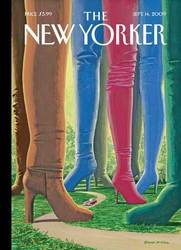
_Pollux writes_:
A puny, 1950s-style automobile navigates through a towering forest of stiletto heels and leather vamps. Ahead of the car there is a tunnel formed by the arch between heel and sole.
This strange passageway evokes the famous tunneled sequoia tree of Yosemite National Park, the Wawona Tree, through which cars could drive through until 1969, when it fell over.
The cover’s artist, “Bruce McCall”:http://www.brucemccall.com/bio/, doesn’t show us the forest canopy. Does it end at the shaft of the boots or extend all the way up the body of a beautiful but enormously tall woman?
My head reels with Freudian interpretations of McCall’s strange cover. A man putters down a road in a shrunken symbol of masculinity: an American car. He drives through woodland where women, or at least the symbols of women, tower above him, completely dominating him and the landscape.
The Mittyesque driver maneuvers slowly through the strange terrain. There are no confident clouds of dust emanating from the car. Caution! Knee High Boots ahead. Thurber’s intimidating women have put aside frumpy flower dresses and pulled on their Lumiani Novas or Michael Antonio Mckenzie Boots.
But my thoughts can travel down less psychosexual paths: I have ecological explanations for McCall’s cover as well. Is McCall pointing out that the leather boots, made from the skin of slaughtered carcasses, have replaced beautiful growing trees?
Where did the trees go? Have the Brobdingnagian boots simply kicked the pines aside or sprung fully manufactured from the ground? Has the earth been watered with buckles and sole stitchings? The cover conjures up surrealist spirits such as Magritte and De Chirico.
Perhaps, but this September 14, 2009 issue of _The New Yorker_ was “The Style Issue,” and McCall’s cover is aptly called “Step Into Style.” Shoe expert Desiree Stimpert “writes”:http://shoes.about.com/od/boots/a/knee_high_boots.htm about the “flattering ways of knee high boots”: “One of the best things about cooler weather is the appearance of knee high boots. With a multitude of attributes, knee high boots can make chunky calves appear slimmer and cover lower leg flaws; keep your legs warm; and look incredibly chic. In short, they’re extremely flattering, very practical, and incredibly stylish.”
This issue of _The New Yorker_ included profiles on Burberry, by Lauren Collins, and the internet shoe company Zappos.com, by Alexandra Jacobs. In Jacobs’ profile for the Annals of Retail, she writes that “owning a large collection of shoes in various styles and colors has, in the past decade, gone from being considered a sign of ultimate imperial excess (Imelda Marcos) to a constitutional right of the average American woman…”
McCall uses fall colors to adorn his boots. His boots are burnt orange, gold, twilight blue, aurora red, shady glade green. These are not colors I am privileged to see in Los Angeles, where Autumn is only the name of the Starbucks barista shoving over tepid cups of shady glade green tea over the counter.
Knee high boots, and the sexual power with which they are associated, are now for the average American woman, and no longer belong exclusively in the closets of a Pretty Woman, or La Femme Nikita, or your local dominatrix.
Ordinary women can actually collect shoes of all shapes and sizes. Consider Carrie Bradshaw or the Heineken “commercial”:http://www.youtube.com/watch?v=B1l_R7mE7Zk in which an ordinary woman shows off her group of friends an impressive walk-in closet lined with shoes. Her husband meanwhile reveals his walk-in fridge lined with bottles of Heineken while his friends shriek with delight.
McCall, whose work has appeared frequently this year, combines elegance with sheer mystery. I have the feeling that he can’t resist including a car somehow -he loves painting cars.
Whether the cover can be explained in Freudian, surrealist, or ecological theories, the boots are strongly and firmly planted in the ground. They move aside for no man, no car, and no tree.
New York Review Books: Then the Backlash Came
Jonathan Taylor writes:
Just kidding! Everyone loves New York Review Books Classics, and for good reason. Few things are as unreservedly worth celebrating as the 10th anniversary of this publishing project, which is single-handedly reshaping the understanding of the world’s recent literary past. By the way, their cover design scheme has become so well-known, does anyone remember that, a whole decade ago, it was rather different? Here’s my edition of J.R. Ackerley’s My Father and Myself, alongside the current one:
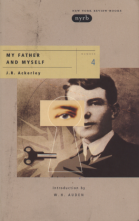
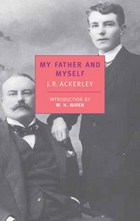
Anyway, Martin’s got the New Yorker Festival covered, but NYR Books are having their own anniversary festivities through November—in New York, London and both Cambridges—listed here, including:
- Monday, September 21, 7 pm
Idlewild Books hosts a reading by Tete-Michel Kpomassie, author of An African in Greenland - Tuesday, October 6, 7 pm
Idlewild Books, launch party for the first graphic novel published by NYRB, Poem Strip by Dino Buzzati, featuring translator Marina Harss - Tuesday, October 13, 7 pm
London Review Bookshop, John Banville and John Gray discuss the work of Georges Simenon - Thursday, October 29
NY Institute of the Humanities, New School Tishman Auditorium with Fred Wiseman, Walter Murch, Timothy Snyder, Ruth Ben-Ghiat, Chris Hedges discusssing the war writings of Curzio Malaparte and Vasily Grossman
Incidentally, Timothy Snyder is the author of a recent eye-opening article in The New York Review of Books about where, and how, the greater part of the Holocaust took place, that should be a must-read for all humans.
And the mention of Malaparte reminds me the great work of another series, a little lower-profile, but whose distinctive jackets are equally signals of worthy reading you might not otherwise know about: Northwestern University’s European Classics. They brought Malaparte’s Kaputt to my bookshelf before New York Review Books yet existed, as well as another eventual NYRB title, Stefan Zweig’s Beware of Pity.
Sen. Atul Gawande (D, N.Y.-er)?
Jonathan Taylor writes:
Matthew Yglesias passes on a suggestion to appoint a “heavy hitter” health care specialist to Ted Kennedy’s seat, such as Dr. Atul Gawande.
Would he be the first person to be both a New Yorker staff writer and U.S. senator?
The Wavy Rule, a Daily Comic by Pollux: Fashion Context
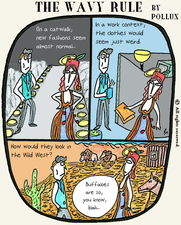
In honor of the last issue of _The New Yorker_, which was The Style Issue.
Click on the cartoon to enlarge it!
Read “The Wavy Rule” archive.