
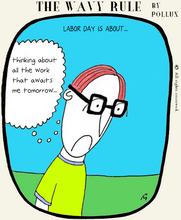
Read “The Wavy Rule” archive.
Monthly Archives: September 2009
NYC Straphangers Suspiciously Well Read, If They Do Say So
Martin Schneider writes:
I found delicious the results of the recent New York Times poll asking, “What Are You Reading on the Subway?”
Let’s have a look!
Magazines:
The New Yorker (1,405 readers)
New York magazine (403 readers)
The Economist (371 readers)
Time Out New York (193 readers)
Time (171 readers)
The New York Times Magazine (109 readers)
Newsweek (91 readers)
Harper’s (89 readers)
The Atlantic (83 readers)
People (60 readers)
These results are fascinating. So, to summarize: more people are reading The New Yorker than are reading finishers 2 through 7 combined. Wow. Wow.
I think of Nielsen, the ratings company, which used to ask its subjects to record their weekly TV watching habits in a journal—they found they had to jettison that system in favor of an automated one, because people were rarely truthful about what they watched. They tended to underreport their hours per week, and they also tended to “forget” about the trashier side of their TV diet.
I think something similar may be at work here too. (Where’s Entertainment Weekly? At least People made the list—barely.)
The books list is similarly (improbably) high-minded, with David Foster Wallace’s Infinite Jest, Robert Bolaño’s 2666 (!?), and Anna Karenina all finishing well. I half-expected to see Finnegans Wake in there. (Rowling doesn’t make the list.)
I’m being cheeky, but maybe my skepticism is misplaced. I honestly do see people reading The New Yorker on the subway with great regularity, and hell, even if these lists are a touch … aspirational, it’s a fine thing to see such dandy aspirations!
What’s in This Week’s New Yorker: 09.14.09
Martin Schneider writes:
The style issue of The New Yorker comes out tomorrow. A preview of its contents, adapted from the magazine’s press release:
In “Check Mate,” Lauren Collins profiles Christopher Bailey, the creative director of Burberry, the British fashion company. Founded in 1856 by Thomas Burberry, who “dedicated himself to devising superior ways of protecting his clientele from the elements,” the company outfitted famed explorers and outdoorsmen including Roald Amundsen and Robert Scott, and created the “trench coat” for British officers to wear in the First World War.
In “Happy Feet,” Alexandra Jacobs goes inside the headquarters of Zappos, the online shoe retailer. Zappos’s thirty-ï¬ve-year-old C.E.O., Tony Hsieh, “has earned a zealous following by imposing an ethos of live human connection on the chilly, anonymous bazaar of the Internet,” Jacobs writes. “He talks about being the architect of a movement to spread happiness, or ‘Zappiness,’ via three ‘C’s: clothing, customer service, and company culture.”
In “Lady of the House,” Dana Goodyear profiles Kelly Wearstler, the “presiding grande dame of West Coast interior design,” who is perhaps best known nationally for her turn as the eccentrically dressed judge on Bravo’s Top Design (“Most people, including her fellow-judge Jonathan Adler, say they watched just for Wearstler’s getups,” Goodyear notes).
In Comment, Lauren Collins compares local reactions to two recently completed New York City public spaces: the plaza in Times Square and the High Line.
In The Financial Page, James Surowiecki asks why some people are afraid that inflation is about to get out of control.
Patricia Marx shops Chicago.
In Shouts & Murmurs, Ian Frazier offers “Easy Cocktails from the Cursing Mommy.”
Photographs of the flamenco women of Spain, by Ruven Afanador.
Anthony Lane traces the journey behind the photographer Robert Frank’s The Americans.
Judith Thurman examines Amelia Earhart’s legend and legacy.
Nancy Franklin watches the CW’s new Melrose Place remake.
Sasha Frere-Jones writes about the Nine Inch Nails front man Trent Reznor’s latest album, farewell tour, and thoughts on the music business.
Anthony Lane reviews 9 and District 9.
There is a short story by Paul Theroux.
The “Mad Men” Files: It’s Different Inside
Martin Schneider writes:
I introduced a feature last year called “The Mad Men Files” (1 2), and I recently discovered a good occasion to try to spark it again.
For those who are completely up to date, I recommend a perusal of the Talk of the Town of August 3, 1963, which happens to contain two items that seem to relate to Season 3.
First, in Susan Black and Brendan Gill’s item about Radio City Music Hall, they note that “‘Bye Bye Birdie,’ the movie that played [the Hall] during Easter this year, holds the record for the week’s biggest gross—$233,825, with an attendance of 165,255.”
On the next page is a brief and rather lyrical item by Geoffrey T. Hellman, which is worth quoting in full:
Has Mr. Conrad Hilton, who is the chief of Hilton Hotels International (as well as domestic) and, in a way, a one-man Peace Corps, been bearing tall tales south of the Rio Grande? We are moved to this question by receipt of a multicolored postcard from vacationing friends in Acapulco (“The scenery from our patio is more beautiful than even Capri”) which bears a photograph of an irregularly shaped swimming pool and the legend “Las Brisas Hilton. Pink cottages and cocktail-sized pools surrounded by Acapulco Blossoms.” The pool, we should judge, is some eighteen feet long and about half as wide, or a good deal bigger than even a Yale Club Martini, said to be Manhattan’s most ample. What must the Mexicans think of us and our gringo guzzles? Let poetic justice prevail. It remains for Mr. Cesar Balse, of Acapulco and Mexico City, the lessor of the St. Regis, to launch in the King Cole Room a pool-sized Bloody Mary, properly celebrated on a postcard bordered by Orange Blossoms as big as the Ritz.
Why the sudden interest in Conrad Hilton and his irregularly shaped swimming pools? Well, there appears to be good reason to believe that the elderly reprobate Don befriends at the abandoned country club bar is none other than Conrad Hilton. (Given the notoriety of his great-granddaughter, a delicious commentary on the present day, if so.)
Given that Season 3 is set in 1963, it’s a resonant piece of prose, to say the least.
Sempé Fi (On Covers): Don’t Forgive Us Our Trespasses
_Pollux writes_:
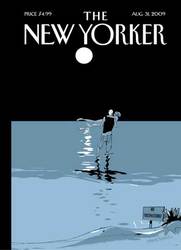
“No Trespassing!” a sign warns, as a couple wades into the surf at nighttime. It is a forbidden tryst, involving the romance of a midnight hour and a private beach to which they are not allowed access. The sign is small and ineffective; the power of love and lust is not.
It is a _New Yorker_ cover in which the cool grays, whites, and blacks of the coloring are working against the hot passion of a couple who may be about to make love in the surf. There is a touch of danger in the air, and as is usually the case with _New Yorker_ covers, a touch of mystery as well.
Danger lurks in the air. I can’t help thinking that, yes, the couple may be intent on a sexual thrill, but the moonlit pathway to the sea seems also to lead to death -either by murder or by suicide.
As one blogger has “written”:http://stevereads.blogspot.com/2009/08/in-penny-press-new-yorker-31-august.html, Banyai’s cover “manages to be romantically touching despite the fact that it automatically summons to mind the open scene of _Jaws_.”
The cover of the August 31, 2009 issue of _The New Yorker_, called “No Trespassing,” seems to be a parody of a romantic moonlit scene. A full moon is a commonplace symbol of romance and romantic trysts. Don’t lovers ever fall in love beneath the glow of a waxing gibbous or third quarter moon?
The cover’s artist is “Istvan Banyai”:http://www.istvanbanyai.com/, a Hungarian-born artist who now lives and works in New York and Connecticut. As Banyai has “remarked”:http://www.chroniclebooks.com/Chronicle/excerpt/0811846083-e0.html, “I like visual, I think visual.” His children’s book “_Zoom_”:http://www.hemmy.net/2008/05/02/zoom-picture-book-by-istvan-banyai/ is all about visuals: the book is composed of a slow and steady zooming out over the course of many pages.
Body language is everything. The legs of the woman are not draped gracefully and seductively across her man’s arms. She seems to flail rather gracelessly in the night air. Her knees are pointed against one another. Her pose is ungainly.
Nevertheless, her face is turned towards him, her eyes closed, her lips ready. She seems to be entirely naked. Her partner is clothed. Instead of a white tux or _From Here to Eternity_ swimming trunks, however, the man wears a tank top and shorts that sag unattractively down his buttocks.
Banyai’s May 6, 2002 “cover”:http://www.cartoonbank.com/product_details.asp?mscssid=N75BLQT1QCKS9NR183NUWJWU397MBJ28&sitetype=1&did=5&sid=51407&pid=&keyword=Istvan+Banyai§ion=all&title=undefined&whichpage=1&sortBy=popular also depicted a couple who made up for any lack of elegance with sexual passion: the boy wears an ill-fitting tank top that reveals skinny arms and a belly button.
The girl wears a summer dress, a bandanna, and no bra. She extends a long arm around him; his arm simply hangs across her shoulders. They kiss in a city street infused with a creamy yellow and with people bustling off to work. The commuters are boring and bored, and their nipples aren’t showing.
Banyai’s drawings of intertwined couples place the focus on their bodies, on their physicality. His couples are not perfect physical specimens, just regular couples who have managed to find a moment of passion and sexuality.
Where are they? Are they, perhaps, on one of Martha’s Vineyard’s coveted “key beaches”? These are beaches that require a key to get in, but according to this “article”:http://www.bostonphoenix.com/archive/features/99/07/29/VINEYARD_BEACHES.html, people still manage to sneak in. Gates are scaled, keys are duplicated and hidden under rocks, and visitors “accidentally” wander onto association beaches.
The rules regarding beach trespassing seem to be a little hazy, although most authorities consider public property everything seaward of the mean high water line–the mean high water line being the average level of the high tide line over the last 19 years.
There is no political or social message on the cover, and Banyai’s cover is not about beach property rights at all. (In any case, even an advocacy group like “C.R.A.B.”:http://www.crabnj.org/2.html, the Citizens’ Right to Access Beaches, declares very categorically the following: “We respect the rights of private property owners and do not advocate trespassing.”)
The cover’s intent is to evoke a scene of romance, of sex and danger. It is about the thrill of public nudity. It is about the thrill of wearing any old thing, or nothing at all, and still having someone who wants you.
Banyai’s couple does not seem to be worrying about high tide levels and property rights. They are trespassing and transgressing. Love, or at least lust, is in the air.
The Wavy Rule, a Daily Comic by Pollux: Un chien andalou et le flop cinématique

Click on the cartoon to enlarge it!
Read “The Wavy Rule” archive.
The Wavy Rule, a Daily Comic by Pollux: The Public Option

Click on the cartoon to enlarge it!
Read “The Wavy Rule” archive.
New Yorker Festival: First Glimpse of the Lineup!
Martin Schneider writes:
The New Yorker sent out its first lengthy announcement regarding the attendees of the New Yorker Festival today. Below are the lightly trimmed highlights from the press release.
* * *
The 2009 New Yorker Festival
Date: October 16-18
The full program guide will be included in the September 21, 2009, issue of the magazine, on newsstands September 14, and will be available at newyorker.com/festival.
Among this year’s highlights:
Interviews with the filmmaker Tyler Perry; the news anchor Rachel Maddow; the actor James Franco; the actress Tilda Swinton; the actor Jason Schwartzman; the playwright and actor Wallace Shawn; the author Annie Proulx; and the sleight-of-hand artist Ricky Jay.
The character actors Joan Cusack, Christine Baranski, Luis Guzmán, Richard Kind, and John Turturro will discuss how they create such memorable supporting characters.
Shouts & Murmurs Live will feature some of the funniest men and women from our pages Jenny Allen, Woody Allen, Noah Baumbach, Yoni Brenner, Ian Frazier, Patricia Marx, David Owen, Amy Ozols, Simon Rich, Paul Rudnick, George Saunders, Paul Simms, and Calvin Trillin–and will be hosted by David Remnick.
New Yorker writers Roger Angell, Adam Gopnik, Ariel Levy, Mark Singer, and Judith Thurman will gather for an evening of stories about life at the magazine, presented in conjunction with the Moth performance series and hosted by Andy Borowitz.
Pop-music offerings will include interviews with and performances by Neko Case, Bon Iver, Steve Earle, and Loudon Wainwright III; a pub-rock reunion with Ian Hunter, of Mott the Hoople, and Graham Parker, of Graham Parker and the Rumour; and a panel discussion about the music industry with Jace Clayton, Josh Deutsch, Melvin Gibbs, Danny Goldberg, and Livia Tortella. In addition, a special Brooklyn Playlist concert at Brooklyn’s Bell House, curated by Sasha Frere-Jones and Kelefa Sanneh, will feature Dirty Projectors, House of Ladosha, Jubilee, and Liturgy.
In a series of New Yorker Talks, Atul Gawande will relate a story of risk, medicine, and skyscrapers; Malcolm Gladwell will examine the curious case of Michael Vick; Simon Schama will explore Obama’s role in history; and James Surowiecki will look at why we procrastinate.
New Yorker film critics will screen and discuss overlooked masterpieces: David Denby will present Alfred Hitchock’s 1943 thriller, “Shadow of a Doubt”; Anthony Lane will explore the 1947 French film “Quai des Orfèvres”; and Richard Brody will discuss Jean-Luc Godard’s 1987 version of “King Lear.”
After a sneak-preview screening of “Precious: Based on the Novel ‘Push’ by Sapphire,” Kelefa Sanneh will talk about the film with Sapphire and the film’s director, Lee Daniels.
A panel, Radical Opera, will explore innovations in the genre, with participants Nico Muhly, Peter Sellars, Rufus Wainwright, and Lisa Bielwa discussing their recent work. This event will feature a special performance by the string quartet Brooklyn Rider.
About Town excursions throughout the city will include Calvin Trillin‘s ninth gastronomic walking tour of Chinatown and Little Italy, with stops at some of his favorite eateries; a tour of the Frick Collection before public hours begin, conducted by Peter Schjeldahl; a look into Chuck Close‘s studio, with drinks and conversation with Adam Gopnik; a studio tour with Basil Twist, who will discuss over drinks the art of puppeteering with Joan Acocella; and a beer-brewing demonstration and tasting with Sam Calagione, of Dogfish Head Brewery, in conversation with Burkhard Bilger.
Friday Night Fiction events will feature paired readings by New Yorker fiction writers: Mary Gaitskill and T. Coraghessan Boyle; Edwidge Danticat and Junot DÃaz; David Bezmozgis and Jonathan Franzen; George Saunders and Gary Shteyngart; Daniyal Mueenuddin and Salman Rushdie; Jonathan Lethem and Colson Whitehead; Yiyun Li and Chimamanda Ngozi Adichie; and Joshua Ferris and Aleksandar Hemon.
A panel on the world of advertising, moderated by Ken Auletta, will feature Matthew Weiner, the creator of AMC’s “Mad Men”; Lee Clow of TBTA Worldwide and Chiat/Day; and Steve Stoute of Translation Consultation + Brand Imaging, who will look at the reality behind Madison Avenue, today and in the past.
The interactive game Tailing Tilley game will send teams of participants off with New Yorker-inspired clues that will point the way to iconic locations around the city. Eustace Tilley himself will be hopping from one location to another, and the team with the most sightings will get a prize.
A live version of The New Yorker‘s popular weekly podcast on politics, the Political Scene, will feature Hendrik Hertzberg, Ryan Lizza, Jane Mayer, and Dorothy Wickenden discussing President Obama’s first year in office.
A New Math panel will feature people who crunch numbers in interesting ways, to fascinating ends: Bill James, the baseball theorist; Nate Silver, the political analyst and creator of FiveThirtyEight.com; Sudhir Venkatesh, the urban ethnographer; and Nancy Flournoy, the biostatistician. [Note: I really hope I get to go to this!—MCS]
In a new series called Kaffeeklatsch, New Yorker writers and artists will come together for discussions in an intimate setting. The writers Donald Antrim, A. M. Homes, George Saunders, and Gary Shteyngart will explore the themes of heroes and anti-heroes in their work; David Owen will interview the cartoonist George Booth about his decades of work for The New Yorker; and the correspondents David Grann, Ian Parker, and Elizabeth Kolbert will tell of their far-flung travels to report stories for the magazine.
A set of Master Classes will feature Platon on photography, Bob Mankoff on cartooning, and Ann Goldstein and others on copy editing at The New Yorker.
Tickets will go on sale on Friday, September 18, at 12 noon, and may be purchased at newyorker.com/festival or by calling 800-440-6974. Ten percent of tickets to all events will be available at Ticket HQ, at Cedar Lake Theatre, 547 West 26th Street (between Tenth and Eleventh Avenues). These tickets will be sold on Friday, October 16, from 12 noon to 4 P.M. A limited number of tickets will be sold at the door to each event one hour before start time (including Tailing Tilley, but excluding all other About Town events). Updated Festival information will be available online at newyorker.com/festival.
Book Giveaway: Jag Bhalla’s “I’m Not Hanging Noodles On Your Ears”
_Martin Schneider writes_:

Emdashes is delighted to be giving away a copy of _I’m Not Hanging Noodles On Your Ears_, a book on idioms by “Jag Bhalla”:http://www.hangingnoodles.com/, illustrated by _New Yorker_ cartoonist Julia Suits (who drew the funny picture above).
We recently “reviewed”:http://emdashes.com/2009/08/hanging-noodles.php Bhalla’s delightful book, which amuses and educates. The book is a great addition to lovers of both language and cartoons, and we guarantee that you’ll love _Hanging Noodles_. We know that you crave this book, or as the Chinese say, have _spittle that’s three feet long_ for this book.
Here are the rules: There are two ways you can enter. One is to drop us an “e-mail”:mailto:martin@emdashes.com, with the subject line “**My favorite idiom**”; include your favorite idiom, your full name, and your mailing address in the body of the e-mail.
The other way is to retweet our message about this contest on Twitter; our username is @emdashes, if you’re not already following us.
Please mention your favorite idiom in the tweet, too.
We’ll accept all entries until 8:00 p.m., Eastern Standard Time, on Friday, **September 30**, and then the Random Number Generator will deliver its negative verdict to every entrant save one.
Good luck to all of you! As the Russians say, _each vegetable has its own time_ (“every dog has its day”).
The Wavy Rule, a Daily Comic by Pollux: Mom’s Flyers

Click on the cartoon to enlarge it!
Read “The Wavy Rule” archive.