Monthly Archives: September 2009

Unoccasioned Link Roundup: Dimanche Apres Midi Edition

Jonathan Taylor writes:
I’ve bought the New York Film Festival ticket I want, I’m listening to “Bal de Dimanche Apres Midi” streaming from KRVS in Lafayette, La. (the French-speaker next to me on the sofa “can’t understand a word”), on the day after Emily’s birthday—here are some New Yorker–related links:

Sempé Fi (On Covers): FWIW

Brunetti_RequiredTexts_9-7-09.jpg
_Pollux writes_:
It’s September and school is back in session. Welcome to Professor Pipsqueak’s Computer Literacy 101 class. The instructor is about ten to eleven years old; he has to stand on a stack of books just to be seen. None of the students, who are many decades older than their teacher, dare to ask Professor Pipsqueak just exactly how old he is for fear that he will give them low marks. The instructor is ruthless like that.
The pace of technology is also ruthless, leaving behind in the digital dust generations who were just getting used to the concept of e-mail. Now they have to learn a whole new language, an electronic Esperanto that serves as a pseudo-linguistic bridge between the older and younger generations. Everything is acronyms and shortcuts these days, ranging from NSFW (“Not Safe for Work”) to FWIW (“For What It’s Worth”).
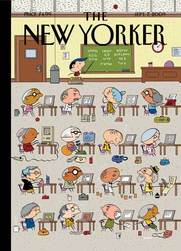
“Ivan Brunetti’s”:http://en.wikipedia.org/wiki/Ivan_Brunetti September 7, 2009 cover for _The New Yorker_, called “Required Texts,” captures the confusion and puzzlement that greets some of the older generations when confronted by Internet Slang or tools like YouTube or iPods. It satirizes the need for someone who is not a part of Generation Y to catch up to their sons and grandsons.
As Brunetti did with his March 1, 2009 “cover”:http://emdashes.com/2009/03/sempe-fi-the-office.php, called “Ecosystem,” each of his egg-headed little figures offers us an individual anecdote. As with any class, there are those who are learning more quickly than others.
In the bottom row, a roguish elder gentleman passes a note to a prospective sweetheart. His screen reads “IMHO <3" ("In My Honest Opinion... Love), while hers reads "NSFW BFF" ("Not Safe for Work--Best Friends Forever). One of his neighbors is less proficient; his screen is a swirl of angry lines. A woman plays a game of Solitaire, perhaps for the first time; another uses an iPod. In the second row from the top, a determined, white-haired lady seems well-equipped for the Digital Age: she uses anti-carpal tunnel syndrome wrist supports, an ergonomic foot rest, and a glare-guard. Another elderly woman, wearing a sweater depicting a cat (she knitted it herself), logs onto YouTube, perhaps to watch the video of President Obama reacting to the yelps of ill-bred Congressman Wilson. There is another gentleman using the Internet to his advantage: by visiting a Viagra site and buying its products. Some of the students just don't get it: one student uses a typewriter, another a quill and parchment. One student has simply given up and fallen asleep. Perhaps some of the students are in class for a good reason: to keep an eye on, and to understand, what their children are up to. As one site "warns":http://www.noslang.com/parents.php, "There's a new trend popular among teenage chatters, and your filters won't pick up any of it. It's called l33tspeak, netspeak or just plain internet slang (leet speak from the word elite). You know what I'm talking about. Acronyms like lol wtf bbiab and nm... If you're concerned about your kids, it's absolutely crucial you learn to understand their language." Adam Gopnik, in his book _Through the Children's Gate_, captures the confusion caused by the communication barriers that existed between him and his son. As he records, Gopnik believed for a time that "LOL" stood for "Lots of Love." "I could tell," Gopnik writes, "because it occurred at the end of so many of his instant messages. So I sent it right back to him: LOL, Dad. LOL, Luke. I felt delighted. Whatever inevitable conflicts we might have, at the end of every one of these exchanges, we could still tell each other that we loved each other, and lots." When any new technology and its accompanying culture arrive, its adoption is piecemeal and gradual, or at least should be based on need rather than trends. We should not use an iPod just because everyone else is using one. Is it necessary for older generations to learn the nuances of writing Twitter updates that are less than 140 words? Or to read about the once mighty empire of Friendster? Do we really need to all be on the same (internet) page? The knowledge of new technologies cannot always be divided neatly along generational lines. I am thirty years old, but I've never used an iPod or an iPhone. I don't text regularly but know what IMHO and ROFLMAO stand for. I am on "Facebook":http://www.facebook.com/paulmorrispollux and sometimes I "tweet.":http://twitter.com/TheWavyRuler My brother, also thirty years old, rarely uses e-mail (I must have received perhaps six e-mails from him over the course of my lifetime, each of them no more than a sentence long), has used YouTube once, but uses an iPod Shuffle. My parents, on the other hand, use e-mail, but selectively and only when truly necessary. They write elegant electronic epistles with the same thought and labor that go into novel-writing. It would not do them any good to know the meaning of "LOL" because they have no real need to know its meaning. In any case, its meaning seems to transmute constantly. As Bonnie Ruberg "writes":http://terranova.blogs.com/terra_nova/2006/06/naked_in_a_lawn.html, "'Lol' has come to mean: I'm being playful; I'm just kidding; I'm flirty; I'm friendly. It tints everything around it with a certain joviality... Meaning is no longer meaningful. The pragmatics of the internet have shifted language use beyond real-life recognition." Sadness tints Brunetti's image. It is about the perhaps pointless and hopeless struggle of generations to learn a new language. They are immigrants in a bewildering Digital Land. Sites warning parents to learn the language may not realize that Internet Slang changes from day to day. If a parent finally learned the meaning of GNOC (Get Naked on Cam), it may be too late--kids may have started using an entirely different term within weeks. The sad thing is that many kids are not rushing to learn what the older generations know -namely, correct spelling. This flow of one-way traffic leads to illiteracy and term papers littered with acronyms. What is the percentage, I wonder, of students requiring remedial English classes in high school and at college? The exchange of knowledge has become a one-sided affair. And there is nothing to LOL about that.

The “Mad Men” Files: Spoiler Alert

Martin Schneider writes:
In the most recent episode, “Ho Ho,” the wealthy scion of a shipping magnate (himself a friend of Bertram Cooper) hires Sterling Cooper to ensconce jai alai and el rey de la pelota—identified as “Patchy”—in the lucrative embrace of the American mass.
Somewhat improbably, Don is opposed to the account, as it will take advantage of a well-connected dupe. Upon hearing Don’s well-meant advice to drop the project, the scion intones, “If Jai alai fails, it’s your fault.” (James Wolcott cracks, “A heavy burden to lay on Don, or any man.”)
Considering that eleven years later, Herbert Warren Wind would be taking up the quixotic project to introduce Basque pelote sports to New Yorker readers, it’s safe to assume that jai alai never takes off.
Sorry for spoiling future episodes!
Relatedly, if you look at page 24 of the October 12, 1963, issue, there’s an advertisement for Florida that mentions jai alai. While far from a masterpiece, it does look considerably more modern than the stuff we see Sterling Cooper putting out. Time to step it up, boys (and Peggy).

Coyness Does Not Become You, New Yorker

Martin Schneider writes:
In the 1980s, John Allen Paulos invented the word innumeracy to describe people, on the analogy of illiteracy, who are not adept at thinking in numbers. I propose an addition: “iffashionacy,” the state of not understanding fashion very intuitively.
I’d like to make a confession: I’m an iffashionate. I don’t “get” fashion topics too much. It’s always an effort for me. It used to be that the Style Issue was simply “one to skip,” but today I look at it more like a safari in a strange and interesting foreign country.
I enjoyed Lauren Collins’s excellent article about Burberry, which is run by its creative and interesting leader, Christopher Bailey.
But something towards the end bugged me a little bit. There’s a paragraph that goes like this:

In 2005, Bailey’s partner, Geert Cloet, who worked as the brand director for Miu Miu, died, of a brain tumor. “Work was, absolutely . . . I buried myself in work,” Bailey told me. “I just kind of threw myself into things, because, you know, I think sometimes there’s a sense of failing.”

Hm. There’s something very subtle, and delicate, and incomplete about this handling of Bailey’s lost lover. Most obviously, the paragraph does not disclose the gender of Geert Cloet. Collins does not mention Cloet anywhere else in the article, and she also does not discuss Bailey’s love life in any other context that I could see. So readers, this is all we’re going to get. Time to play Sherlock Holmes.
To emulate Wimsatt and Brooks, we have to begin with a close reading of the text.
Key points: “Geert” is not a common first name in America, it does not obviously disclose gender, there are no personal pronouns to assist the reader, and the word partner, technically, also does not disclose gender.
(I shall do what Collins does not do, and assert that Geert Cloet was a man. But I should not have to rely on Google for that information.)
Partner, partner. Of course the word is a signal for homosexuality in our culture, and I’d lose credibility if I didn’t concede that it’s a pretty major clue.
The coding of “partner” here is pretty tricky. Anyone under the age of 40 (I barely qualify) probably takes the word to mean, effectively, “same-gendered lover,” and perhaps I’m showing my stodginess by making a fuss over it. But The New Yorker‘s readers are highly heterogeneous. How many older readers read the paragraph, assumed without undue reflection that Cloet was a woman, and kept reading? I would guess, more than you might think. For their lack of hipness, they paid in incomprehension.
The politics and rhetoric of homosexuality have gone through some major upheavals since the late 1960s, but right now it’s considered de trop to call attention to the fact of an article subject’s homosexuality, on the theory that overemphasizing makes it seem like a perversion or a physical deformity, when it should be treated on a much more matter-of-fact basis. So far, so good.
And in Collins’s defense, I also wouldn’t relish writing that “who is gay” clause either, and I can see why she opted not to write it. But there should have been some cleaner way of confronting the subject. You know, either bring it up, or don’t. But avoid this in-between.
One reason it bothers me is that the process of deducing that Cloet is a man also rubs up against a cliche about homosexuality. In my mind it takes shape like this: “Of course he’s gay, Bailey is a fashion designer—what did you expect?” Uhh, treatment of an individual as such? Not that spelling it out is all that much better, in a way I sympathize with Collins about that. But the act of deduction actually involves recourse to that stereotype.
In a lot of contexts, I’d argue that Bailey has a right to his privacy. The problem for Collins is, a big New Yorker feature article is not one of the contexts where Bailey can be accorded that privacy. One of the purposes of a feature is to bring the reader “closer” to an otherwise undisclosed subject, and tip-toeing around the question of his or her romantic life is iffy at best.
The real problem here is that the paragraph isn’t connected to anything else in the article. It’s dropped in before the finale to supply a bit of cheap emotion and depth. (A shame, because the rest of the article earns that depth properly. Bailey is an interesting guy.)
I use that word “cheap” advisedly, but I mean it quite straightforwardly—the reader is being asked to partake in Bailey’s grieving process while also being given next to no information about his beloved, aside from his/her occupation and Dutch name. It’s tricky—how much can we be expected to care, really, on a single mention like this?
The best-case scenario, for the reader, is to take in that grieving process, such as it is, and then look up from the magazine for a moment, stare into the middle distance a bit, re-read the paragraph, and conclude that Cloet is a man and that Bailey is gay. And that is a sub-optimal outcome.
Why not discuss it openly? It’s probably as interesting as anything else in Bailey’s life, which is, as already stated, plenty interesting.

Book Giveaway Reminder: Jag Bhalla’s “I’m Not Hanging Noodles On Your Ears”

tea_navel_Julia Suits.jpg
_Martin Schneider writes_:
If you happened to miss last week’s “announcement”:http://emdashes.com/2009/09/book-giveaway-jag-bhallas-im-n.php of our giveaway of Jag Bhalla’s new book, you have extra time -we have extended the contest time to _September 30_!
Send us an “e-mail”:mailto:martin@emdashes.com, subject line “My favorite idiom,” and include your name and full mailing address. We won’t accept anything after 8:00 pm EST on Friday, September 30, so don’t _do the leek_ (“hang around waiting”)… That’s a French idiom.
Good luck!

2009 New Yorker Festival Schedule Is Here!

Martin Schneider writes:
The 2009 New Yorker Festival schedule has been released!
I think it’s a very strong lineup, so appropriate for the 10th anniversay festival. I mentioned in the previous update that I’m very excited to see Bill James and Nate Silver, particularly. Pity that the Matthew Weiner event is at the same time, but such problems are the very stuff of outstanding New Yorker Festivals!
Tickets for The New Yorker Festival will go on sale at 12 noon ET on Friday, September 18. We wish you luck in grabbing tix for your most feverishly desired events!

Friday | October 16
Fiction Night | Paired Readings by New Yorker Writers
Chimamanda Ngozi Adichie and Yiyun Li
7 P.M. (Le) Poisson Rouge ($25)
David Bezmozgis and Jonathan Franzen
7 P.M. Cedar Lake Theatre ($25)
T. Coraghessan Boyle and Mary Gaitskill
7 P.M. Angel Orensanz Foundation ($25)
Daniyal Mueenuddin and Salman Rushdie
7 P.M. Directors Guild Theatre ($25)
Edwidge Danticat and Junot Diaz
9:30 P.M. Angel Orensanz Foundation ($25)
Joshua Ferris and Aleksander Hemon
9:30 P.M. (Le) Poisson Rouge ($25)
Jonathan Lethem and Colson Whitehead
9:30 P.M. Directors Guild Theatre ($25)
George Saunders and Gary Shteyngart
9:30 P.M. Cedar Lake Theatre ($25)
Brooklyn Playlist | A Special Concert Featuring Bands from the County of Kings
With Dirty Projectors, House of Ladosha, Jubilee, and Liturgy.
Curated by the New Yorker staff writers Sasha Frere-Jones and Kelefa Sanneh.
8 P.M. The Bell House ($25)
Take Out of School | New Yorker Writers on The New Yorker
The Moth and The New Yorker present an evening of stories about life at the magazine.
With Roger Angell, Adam Gopnik, Ariel Levy, Mark Singer, and Judith Thurman.
Hosted by Andy Borowitz.
8 P.M. City Winery ($40)
Saturday | October 17
Writers and Their Subjects
Ricky Jay and Mark Singer
1 P.M. City Winery ($27)
In Conversation With
Annie Proulx interviewed by Deborah Treisman
10 A.M. Florence Gould Hall ($27)
Rachel Maddow interviewed by Ariel Levy
10 A.M. Acura at Stage37 ($27)
Tyler Perry interviewed by Henry Finder
4 P.M. Cedar Lake Theatre ($27)
New Yorker Talks
Malcolm Gladwell | The Curious Case of Michael Vick
1 P.M. Florence Gould Hall ($27)
Simon Schama | Obama and History
4 P.M. Florence Gould Hall ($27)
Screen Gems | New Yorker Film Critics Present Overlooked Masterpieces
Alfred Hitchcock’s “Shadow of a Doubt”
With David Denby.
10 A.M. Directors Guild Theatre ($20)
Henri-Georges Clouzot’s “Quai des Orfevres”
With Anthony Lane.
1:30 P.M. Directors Guild Theatre ($20)
Jean-Luc Godard’s “King Lear”
With Richard Brody.
5 P.M. Directors Guild Theatre ($20)
Panels
New Math
With Nancy Flournoy, Bill James, Nate Silver, and Sudhir Venkatesh.
Moderated by Ben McGrath.
10 A.M. Cedar Lake Theatre ($27)
Mad Men
With Lee Clow, Steve Stoute, and Matthew Weiner. Moderated by Ken Auletta.
10 A.M. City Winery ($27)
The Music Biz
With Jace Clayton, Josh Deutsch, Melvin Gibbs, Danny Goldberg, and Livia Tortella.
Moderated by Sasha Frere-Jones.
1 P.M. Cedar Lake Theatre ($27)
The Political Scene
With Hendrik Hertzberg, Ryan Lizza, and Jane Mayer. Moderated by Dorothy Wickenden.
4 P.M. City Winery ($27)
Character Actors
With Christine Baranski, Joan Cusack, Luis Guzman, Richard Kind, and John Turturro.
Moderated by Nancy Franklin.
4 P.M. Acura at Stage37 ($27)
Early Shift
Loudon Wainwright III talks with Susan Morrison | A Conversation with Music
7:30 P.M. The Bell House ($35)
Wallace Shawn talks with John Lahr
7:30 P.M. City Winery ($35)
Ian Hunter and Graham Parker talk with Ben Greenman | A Conversation with Music
7:30 P.M. (Le) Poisson Rouge ($35)
Neko Case talks with Sasha Frere-Jones | A Conversation with Music
7:30 P.M. Acura at Stage37 ($25)
Saturday Night Sneak Preview
“Precious: Based on the Novel ‘Push’ by Sapphire”
After the screening, Kelefa Sanneh will talk with Sapphire and the film’s director, Lee Daniels.
8 P.M. Directors Guild Theatre ($27)
Late Shift
Jason Schwartzman talks with Richard Brody
10 P.M. The Bell House ($35)
James Franco talks with Lauren Collins
10 P.M. Cedar Lake Theatre ($35)
Tilda Swinton talks with Hilton Als
10 P.M. City Winery ($35)
Steve Earle talks with John Seabrook | A Conversation with Music
10 P.M. (Le) Poisson Rouge ($35)
Justin Vernon of Bon Iver talks with Sasha-Frere Jones | A Conversation with Music
10 P.M. Acura at Stage37 ($25)
Sunday | October 18
About Town
Tailing Tilley
A live, interactive game drawing on eighty-four years of New Yorker history.
11 A.M. Galway Hooker ($15)
Morning at the Frick
Peter Schjeldahl will lead a tour of the museum before public hours begin, followed by coffee and conversation.
11 A.M. Frick Collection ($60)
Come Hungry
Calvin Trillin will lead a tasting walk from Greenwich Village to Chinatown, concluding with a dim-sum feast.
11 A.M. Ticket buyers will be contacted concerning the starting point. ($100)
Strings Attached
Basil Twist will lead a tour of his studio and talk about the puppeteer’s art with Joan Acocella. Drinks will be served.
12 noon. Ticket buyers will be contacted concerning the location. ($60)
Inside the Artist’s Studio
Chuck Close will show his work and talk with Adam Gopnik at his studio. Drinks will be served.
12 noon. Ticket buyers will be contacted concerning the location. ($60)
Bottoms Up
Sam Calagione will demonstrate the beer-brewing process and discuss his work with Burkhard Bilger. Tastings, paired with meats and cheeses, will be served.
12 noon. The Gate ($50)
New Yorker Talks
James Surowiecki | Tomorrow Never Comes: Why We Procrastinate and How It Matters
11 A.M. City Winery ($27)
Atul Gawande | The Death of the Master Builder: A Story of Risk, Medicine, and Skyscrapers
1 P.M. Directors Guild Theatre ($27)
Kaffeeklatsch | New Yorker Writers and Artists Up Close
Heroes and Antiheroes
With Donald Antrim, A. M. Homes, George Saunders, and Gary Shteyngart.
Moderated by Cressida Leyshon.
10 A.M. Conde Nast Executive Dining Room ($15)
George Booth interviewed by David Owen
12 noon. Conde Nast Executive Dining Room ($15)
Our Far-Flung Correspondents
With David Grann, Elizabeth Kolbert, and Ian Parker. Moderated by Daniel Zalewski.
2 P.M. Conde Nast Executive Dining Room ($15)
Master Classes
Master Class: Cartooning
With Robert Mankoff.
10 A.M. Conde Nast Auditorium ($35)
Master Class: Photography
With Platon.
12 noon. Conde Nast Auditorium ($35)
Master Class: Copy Editing
With Ann Goldstein, Mary Norris, and Elizabeth Pearson-Griffiths.
2 P.M. Conde Nast Auditorium ($35)
Panels
Radical Opera
With Lisa Bielawa, Nico Muhly, Peter Sellars, and Rufus Wainwright. Moderated by Alex Ross.
3 P.M. City Winery ($35)
A Humor Revue
Shouts & Murmurs Live
With Jenny Allen, Woody Allen, Noah Baumbach, Yoni Brenner, Ian Frazier, Patricia Marx, David Owen, Amy Ozols, Simon Rich, Paul Rudnick, George Saunders, Paul Simms, and Calvin Trillin. Hosted by David Remnick.
4 P.M. Directors Guild Theatre ($35)
How to Purchase Tickets
Tickets for The New Yorker Festival will go on sale at 12 noon E.T. on Friday, September 18th. There are several ways to purchase tickets:
Online: Get tickets at newyorker.com/festival.
By phone: Call 800-440-6974.
At Ticket HQ: Ten per cent of tickets to all events will be available at Cedar Lake Theatre, at 547 West 26th Street (between Tenth and Eleventh Avenues).
Tickets will be sold on Friday, October 16th, from 12 noon to 4 P.M. First come, first served.
At the door: A limited number of tickets will be sold at the door to each event one hour before start time, with the exception of Morning at the Frick, Come Hungry, Strings Attached, Inside the Artist’s Studio, and Bottoms Up. First come, first served. Cash only.
Book Signings at McNally Jackson Books
SATURDAY | OCTOBER 17
12 noon
T. Coraghessan Boyle – “The Women”
Aleksandar Hemon – “Love and Obstacles”
1 P.M.
Junot Diaz – “The Brief Wondrous Life of Oscar Wao”
Mary Gaitskill – “Don’t Cry”
2 P.M.
Annie Proulx – “Fine Just the Way It Is: Wyoming Stories 3″
3 P.M.
Malcolm Gladwell – “Outliers: The Story of Success”
Bill James – “The Bill James Gold Mine 2009″
4 P.M.
Paul Rudnick – “I Shudder: And Other Reactions to Life, Death, and New Jersey”
Wallace Shawn – “Essays”
5 P.M.
Robert Mankoff – “On the Money: The Economy in Cartoons, 1925-2009″
SUNDAY | OCTOBER 18
12 noon
Tad Friend – “Cheerful Money: Me, My Family, and the Last Days of Wasp Splendor”
David Grann – “The Lost City of Z: A Tale of Deadly Obsession in the Amazon”
1 P.M.
John Cassidy – “How Markets Fail: The Economics of Rational Irrationality”
Paul Goldberger – “Why Architecture Matters” and “Building Up and Tearing Down: Reflections on the Age of Architecture”
2 P.M.
Daniyal Mueenuddin – “In Other Rooms, Other Wonders”
Colson Whitehead – “Sag Harbor”
3 P.M.
Adam Gopnik – “Angels and Ages: A Short Book about Darwin, Lincoln, and Modern Life”
Hendrik Hertzberg – “One Million”
4 P.M.
George Booth – “About Dogs”
Art Spiegelman and Francoise Mouly – “The TOON Treasury of Classic Children’s Comics”
The 2009 program schedule will appear in the September 21st issue of The New Yorker, on newsstands September 14th. The Festival schedule will also be posted on the same date on newyorker.com/festival.