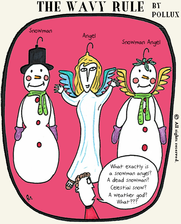
Click on the image for a detailed view!
Monthly Archives: December 2009
The Wavy Rule, a Daily Comic by Pollux: Megacerops!
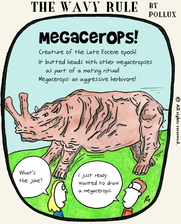
Click on the image for a detailed view!
Sempé Fi: Bows of Holly

_Pollux writes_:
When President Obama bent his body in a 90 degree angle before the Japanese emperor on November 14, 2009, he unleashed, perhaps predictably, a storm of controversy over his bow.
“President Obama has bowed to two Monarchs,” a right-wing commentator angrily “wrote.”:http://politicalpistachio.blogspot.com/2009/11/obamas-bow-to-emperor-akihito-ignorant.html “First, earlier this year, Obama bowed to a Saudi Prince. Last week he bowed to the Japanese Emperor. Note that Akihito did not bow back. The argument by leftists is that Barack Obama was being culturally sensitive. Bowing to Monarchs is a sign of subservience.”
Dick Cheney once shook hands with Akihito, as this _LA Times_ “piece”:http://latimesblogs.latimes.com/washington/2009/11/obama-emperor-akihito-japan.html points out, while Bill Clinton came close to bowing “once.”:http://www.nytimes.com/1994/06/19/weekinreview/the-world-the-president-s-inclination-no-it-wasn-t-a-bow-bow.html “He inclined his head and shoulders forward, he pressed his hands together.” President Nixon performed a slight bow before Emperor Hirohito in 1971.
Once “again”:http://www.huffingtonpost.com/2008/07/13/barry-blitt-addresses-his_n_112432.html, Barry Blitt tackles criticism and controversy surrounding Obama by taking the object of criticism (e.g. Obama bowing to a foreign head of state) to its most absurd extreme (e.g. Obama bowing to Santa Claus). Santa Claus, after all, is a foreign potentate of a sort, the leader of an autonomous community in the North Pole inhabited by elves, reindeer, and Mrs. Claus.
Blitt’s cover for the December 14, 2009 issue of _The New Yorker_, called “Season’s Greetings,” depicts Obama bowing and shaking hands with a jolly St. Nick who gingerly steps forward as he emerges from a chimney.
And why shouldn’t Obama welcome Santa Claus? The Christmas figure represents traditions and the joy of the holidays, but also represents the possibility of increased consumer spending during the holiday season. We need to turn this economy around. Santa’s toys and electronics may do the trick.
But of course the source of anger and controversy was the manner in which the Japanese emperor was greeted.
Blitt is currently the most politically minded of _New Yorker_ cover artists. His artistic niche involves poking fun at right-wing fears by exaggerating them. That the Obama Administration has been prone to gaffes and fumbles is undeniable. That Obama’s bow is considered “evidence” of his alleged hate for America is ridiculous.
In any case, both sides may be wrong, as this “piece”:http://blogs.abcnews.com/politicalpunch/2009/11/on-president-obamas-bow-to-the-japanese-emperor-an-academic-friend-writes-that-both-the-left-and-the-right-are-wrong.htmlpoints out, which concludes that Obama’s bow displayed the incorrect “physical tone.”
Blitt’s artistic-political strategy is a little awkward, generating more confusion and misinterpretation than laughter.
A dose of laughter, however, can be supplemented by other sources. The blog Ambiance ran a “caption contest”:http://amba12.wordpress.com/2009/12/13/caption-contest/ for Blitt’s cover. My favorite: “Obamas say they’ll leave milk/cookies out for Santa Claus. Glenn Beck accuses president of trying to bribe a foreign dignitary.”
Challenge: Connect Random Stuff in My Head to the Magazine
Martin Schneider writes:
Oh boy, my favorite parlor game…. also called “How Emdashes generates posts.”
1. Last night I saw Jason Reitman’s movie Up in the Air, and I enjoyed it very much. It certainly did seem like a movie that teed up its subject perfectly and then whacked it, which I’m not sure is quite the same thing as being a great movie, but … I’m quibbling, it was very good. I’ve spent a lot of time in airports recently, so I had to see it before all that useless knowledge wore off.
Connection: The movie was based on a book by Walter Kirn, who had a story published in The New Yorker in 1997.
2. Lou Reed and Ben Syverson designed and programmed an iPhone app called Lou Zoom. I installed it on my iPod Touch. What does it do, you ask? Why, it takes your Contacts list and renders it in much larger type. This accomplishment does rank below revolutionizing American avant-garde rock and roll, but not many things are as monumental as that. Plus it has to be the coolest way ever to tell the world, “I’m OLD! I can’t read this small type anymore!” (And you know, I think the app is very good. I do prefer looking at it to the default Contacts app.)
Connection: The New Yorker published excerpts from Lou Reed’s tour diary in 1996.
3. Oh man, is this picture great:

Connection: The New Yorker hardly ever misuses apostrophes, making this sign the anti-New Yorker.
The Wavy Rule, a Daily Comic by Pollux: Doctoral Snow Days

Click on the image for a detailed view!
The Wavy Rule, a Daily Comic by Pollux: Relationship Troubles of a Linguist
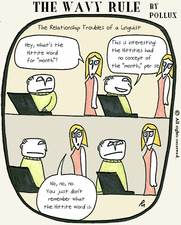
Click on the image for a detailed view!
The Wavy Rule, a Daily Comic by Pollux: Meatballs
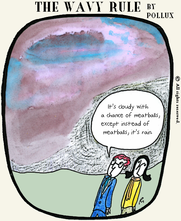
Click on the image for a detailed view!
The Wavy Rule, a Daily Comic by Pollux: Tree Leaves

Click on the image for a detailed view!
Platon Shoots Netanyahu, Qaddafi, Obama — and Many Other Potentates
Martin Schneider writes:
It was quite a spree.
My involvement with Emdashes recently has been minimal, but purely for logistical reasons. I’ve been traveling a tremendous amount and also was not getting the physical magazine shipped to me, and under such circumstances it becomes increasingly difficult to stay engaged with the magazine and feel as if one has anything worthwhile to say. Fortunately, the first problem (constant movement) is now solved, and the second (delivery of magazine) is being remedied even as I write this. I expect to be more engaged in the near future.
I did, however, want to take a moment to lavish praise on Platon’s recent gallery of world leaders. I saw it linked at Jason Kottke’s glorious weblog, and—well, I was really blown away by it. I can’t say that I’ve seen any work of Platon’s that struck me as anything less than excellent, but I don’t think I realized just how good the man is until I clicked on all forty-nine snapshots and listened to all forty-nine of his individual comments. If you haven’t done so, I urge you to spend a quarter-hour looking at the pictures with some care. The results are fairly astonishing.
The comments are about what you would expect—he generally praises everyone and then makes an observation about each subject’s personality and/or physiognomy and sometimes reflects on the circumstances of the meeting or the technical approach he chose for the subject. Most of the pictures are black-and-white facial portraits, but some are in color and some feature the subject’s body to some degree. I must say I found it quite impossible to question his judgment in almost any of the cases. They all seemed rather remarkably well done to me.
If Platon is the new Richard Avedon—am I the last person to figure this out?—then I must say The New Yorker made an excellent choice. I have made the transition from sympathetic observer to fan.
The Wavy Rule, a Daily Comic by Pollux: If on a winter’s night a traveler
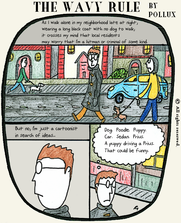
Click on the image for a detailed view!