
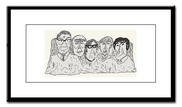
to tell you that we think “The Editors of The New Yorker,” Pollux’s drawing of Harold Ross, William Shawn, Robert Gottlieb, Tina Brown, and David Remnick, is so suitable for framing that it’s already framed, and available from those clever ducks at CafePress. Buy one for your favorite New Yorker lover and hang one in your office to remind yourself that you won’t let your standards slip, economy be damned. These five wouldn’t stand for it, and, with them keeping watch, neither will you! –E.G.
Author Archives: Emdashes
As We Dash and Listen and Tweet and Sketch, Follow the Festival Blog…
Emily Gordon writes:
We’re in full Festival mode, Paul went back to his hotel just to draw about the Mary Gaitskill and T. C. Boyle event, and we’re tweeting like the mid-flight rockin’ robins we are, but in between bites of our hors d’oeuvres, you’re going to want some equally tasty tapas, and that you can find at the official Festival blog. Sneak preview: Jon Michaud, co-author of our soon-to-be-upgraded-to-first-class column Ask the Librarians, reports, to my pleased wonderment, that at last night’s event “Tales Out of School,” “Throughout the evening, the deputy books editor, Leo Carey, provided musical interludes on his cello.”
More reports from Martin and me tomorrow, and while Paul is going to do most of his rounding up and reflecting back home in Los Angeles, we’re already sure his posts are going to rock our world, since that’s what he does in Sempé Fi every week. We’ve been told that the title of that column is perhaps the most meta of our admittedly very meta activities here, and we smile shyly and say, “That’s just what we were going for.”
I’d like to add, gratuitously but happily, that I’ve always been glad I asked Cartoon Caption Contest winner #29 and Park City, Utah, resident T. C. Doyle how he felt about the work of T. C. Boyle, who had a story published in The New Yorker the very same week as the announcement of Doyle’s winning caption. Those Caption Contest winners are funny folks, the lot of them. (Also, smart; read what he says about Bruce Eric Kaplan.) And persistent, too!
Review: “A Gate at the Stairs” (Newsday)
Lorrie Moore unlocks ‘A Gate at the Stairs’
By EMILY GORDON
A GATE AT THE STAIRS, by Lorrie Moore. Alfred A. Knopf, 322 pp., $25.
Lorrie Moore inspires fierce loyalty, for good reason: She’s the sheriff of a wild and lonely territory, in which empathetic people fight despair with charming words. Her language — its puns, musical refrains and catchphrases — only partly hides the sadness behind it. The result is that kind of silliness that peaks just seconds before bursting into tears.
The crises Moore addresses with high-spirited clowning have included romantic confusion, isolation, illness, death and even loss on a mass scale. Moore’s new novel, “A Gate at the Stairs,” artfully blends all these themes into a tale that’s as much a shifting of emotional seasons as it is a narrative.
Tassie Keltjin, a student in a college town much like Madison, Wisc. (where Moore lives and teaches fiction), takes a job as a nanny for a dynamic but scattered restaurateur, Sarah, who’s unable to conceive with her husband, Edward. The daughter Sarah adopts, a biracial little girl named Mary-Emma, brings out everyone’s desire to nurture, but the question of how best to love remains foggy. The parents who attend Sarah’s weekly rap sessions for parents of biracial children, preoccupied by origins and identity, can’t seem to get beyond talking in excitable circles. At the same time, Tassie falls in love with a friendly Brazilian in her Sufism class. But something is clearly not right, with either him or Sarah and Edward.
Why is the past so incongruous and confusing? These are persistent questions for everyone, but particularly so for Tassie, who was raised by moderately successful organic farmers in the country outside this liberal town. Tassie, who’s adjusting to work, love and living on her own, is continually stunned by newness, even as it amuses her. She can be the competent one on her volatile travels with the strong-willed Sarah and the vulnerable Mary-Emma, and with her slightly loopy roommate, but her dealings with the Brazilian are harder: she doesn’t heed the drastic signs of trouble until it’s far too late.
Moore never says so explicitly, but civic life after 9/11 is a backdrop throughout: governments, employers, boyfriends, teachers and parents engage in doublespeak, only to deny it moments later. Perhaps the most uncomplicated voice here come in the e-mails from Tassie’s younger brother, Robert, who is keenly seeking her guidance, but she’s too distracted to oblige.
Unlike the parents’ meetings, which sound like jumbled bumper stickers, Tassie’s interior monologue is sharp and specific and, needless to say, extremely funny — all a familiar balm to Moore fans. Similarly, Tassie’s conversations with her roommate are hilarious and true to life.
In the second half of the book, a terrible death enters the narrative. And Tassie’s linguistic playfulness, which transforms ugly facts and incoherent action into logic and wit, becomes far darker — but also much more lyrical. She returns home, city to country, down to earth. This is a new country: a pastoral Lorrie Moore novel. Tassie grows up, yes, but this is no mere coming-of-age novel. She embraces the death that is part of life. In the process, she, and Moore the novelist, enter a new realm of maturity and understanding.
(September 17, 2009)
A Feast of Friendly Links: R. Crumb, Lorrie Moore, Mad Men, W. H. Auden
Emily Gordon writes:
I haven’t done any link roundups in a while, but here are a few I think you’ll dig as we all gear up, from near and from far, for The New Yorker Festival. This post is also a celebration of some writer friends whose preoccupations often collide with mine:
My friend and Print contributing editor Bill Kartalopoulos comments on R. Crumb’s new Biblical epic.
My friend and thug-thumping Wisconsin labor advocate Dustin Beilke interviews the great Lorrie Moore for The Onion‘s AV Club. I reviewed her terrific new book, A Gate at the Stairs, for Newsday.
I can’t get enough of posts about the typography in Mad Men. These are already classics: my friend and content-strategist-about-town Andrew Hearst on the “jarring anachronism” of using Arial in the end credits; and Mark Simonson, designer and type designer, on–well, just read it. Featuring a cameo by our beloved Gill Sans.
And this isn’t exactly New Yorker-related, but Sophie Pollitt-Cohen, my favorite former babysat child (we need to coin a word for this) and frighteningly bright daughter of Katha “Learning to Drive” Pollitt and Randy “The Ethicist” Cohen (who are contributors), has a very funny new Huffington Post piece up about “comic books inspired by verse.” Speaking of being inspired by verse, happy birthday, Katha, far away in Berlin but always close to my thoughts!
It’s New Yorker Festival Week! October 16-18: Will You Be There?
Emily Gordon writes:
It’s the best week of the year at Emdashes HQ (a many-sided residence featuring pristine Austrian mountains, the tearoom at the La Brea Tar Pits, a deck in leafy Brooklyn, a Windy City aerie, and a desk in an undisclosed location). This year it’s the New Yorker Festival‘s tenth anniversary, which makes us wish we had been at all ten Festivals. Alas, though our allegiance is long, our blog is but five, so we look up to the Festival with all due awe and continue to paddle along after it like quick and fuzzy ducklings.
As we’ve mentioned, for the fourth year running, Emdashes will be there, and this year, for the first time, we’re proud to be importing our Los Angeles wunderkind of word and picture, Pollux, whose voice will join Martin’s and mine in Festival-mad reportage. We’ll be providing satisfying commentary, photos, reviews, thrilling glimpses of we don’t even know what yet, observations on audience reactions, and Zeitgeisty sight-bites from a man who actually speaks German (Martin; Paul speaks the mainly-on-the-plain kind of Spanish). Forgive the internal rhymes; this week always gives us dizzy spells.
Quick links: The New Yorker‘s in-house Festival blog, the @newyorkerfest Twitter feed you should already be following (I have it on good authority that it’s going to be hopping this year), and, of course, the main Festival page.
Having just come from Memphis, where I was live-tweeting for @printmag as quickly as my little TweetDeck for iPhone could muster, I feel secure in saying that where there’s wi-fi, there will be @Emdashes updates. So follow us too, won’t you? And whether you’re attending the Festival or watching from elsewhere, check back here many times daily later this week by clicking on the shiny red banner to your right, or, if you prefer, the lovely Festival portrait of me by Carolita Johnson.
If you write a real-time or post-game Festival report that you long to see in pixelated print, e-mail it to us straightaway, and you may become one of this year’s guest contributors. And if you see us–possibly wearing t-shirts from our humble store–please identify yourselves! We’re even nicer in person.
Ready Set Go: New Yorker Festival Tickets Go on Sale at Noon Today
Emily Gordon writes:
That’s now! Go get ’em! Can’t remember what’s playing this year? Here’s the list. (And there are always late-addition new events, listed here.) There’s also a Festival Twitter feed, @NewYorkerFest, so you’ll want to jump onto that.
We’re now in our fourth year of covering the Festival. Look for more Emdashes staff previews, reports, reviews, and postscripts throughout the next month and beyond.
Why Keep Blogging? With Your Help, We’ll Have the Answer in March!
Emily Gordon writes:
This is the panel proposal I submitted for potential inclusion in next March’s South by Southwest Interactive festival. If you click on the PanelPicker, sign up in a flash, and click on the little thumbs-up button, you’ll be helping me get there! Voting ends Friday, so if you do it now while you’re thinking about it, you’ll be helping out a lot. Thanks so much!
Here are all the details:
**Why Keep Blogging? Real Answers for Smart Tweeple**
**Organizer:**
Emily Gordon, Founder, Emdashes.com; Editor-in-Chief, Print magazine
**Description:**
Now that we think in 140-character strings and live through Facebook, it’s tempting to throw out the blog baby with the bathwater. These seasoned bloggers explain the vitality of this still-revolutionary medium–the resources, community, continuity, and space for real ideas that only blogs can provide–and its infinite future potential.
**Questions Answered:**
1. Why blog when there are newer, shorter, quicker mediums to express myself in?
2. If there’s no barrier to blogging, what makes any blog special?
3. Which blogs are going to be worth reading in 2, 5, 10, and 50 years?
4. What can blogging do for my life–creatively, socially, professionally, and intellectually?
5. What techniques do the bloggers with the most staying power use to keep their readers–and themselves–informed and inspired?
6. Why blogging during a recession is the smartest thing you can be doing with your time
7. What works as a blog post and what works better as a tweet or status update, and why?
8. How do veteran bloggers avoid the 10 blog traps that rookies always fall into?
9. Why is it so important to keep commenters happy and engaged–and how do I do it?
10. Is it worth it to revive a dead blog–and should I kill the one I don’t love anymore?
So far, the people I’ve asked to be on the panel if we make it to the show are:
• Daniel Radosh, blogger, radosh.net; contributing editor, The Week; author, Rapture Ready! Adventures In The Parallel Universe of Christian Pop Culture
• Book-writer and blog-writer Lizzie Skurnick, who writes the blockbuster Fine Lines column at Jezebel, which turned into her new book, Shelf Discovery: The Teen Classics We Never Stopped Reading; her book blog, The Old Hag; and, of course, www.lizzieskurnick.com.
• Scott Rosenberg, author, Say Everything: How Blogging Began, What It’s Becoming, and Why It Matters; blogger, www.wordyard.com
• Heather Cocks and Jessica Morgan; bloggers, Go Fug Yourself; authors, Go Fug Yourself: The Fug Awards
• Ron Hogan, blogger, Beatrice and GalleyCat; book critic; author, The Stewardess Is Flying the Plane! American Films of the 1970s
• Paddy Johnson, blogger, Art Fag City
• Josh Fruhlinger, blogger, The Comics Curmudgeon
And if we do make it–and you’ll be in Austin for the festival–come on by and I’ll thank you in person!
Emdashes Fall Interns: We Want You!
The Emdashes team is looking for bright, New Yorker-phile, syntax-and-punctuation-consumed, creative, and cheerful interns for the fall season. The internship will span from mid-September through December and will be supervised by various members of the staff, all of whom have been interns and will be friendly and supportive mentors in literary-media-political-illustration-design-niche blogging.
It will involve whatever you are best at doing from this list: editing, writing, idea-generating, organizing, tagging, coding, linking, doing multimedia tasks to be determined, reporting local events (not just in New York but wherever you happen to be), reading, reviewing, collecting, scanning, sleuthing, event planning, and/or obsessing. Actually, obsessing is the only absolute requirement. Attention to detail and horror at factual, typographical, and orthographical errors are key.
Benefits include free stuff (books, tickets to events, and the like), plenty of positive reinforcement and honest advice from professional editors and writers, web publication experience, writing clips, and a ticket to the hottest party in town: the Emdashes 5th Anniversary Extravaganza, near New Year’s of this year.
Please send a short email explaining why you are the perfect Emdashes intern to emily at emdashes dot com, and attach your CV and a writing sample or two. We’re looking forward to meeting you!
Best Single Line of Mad Men Commentary I’ve Read So Far
…and I’ve read a lot of it! This made me laugh, given that I’ve been describing the show to those who don’t get the appeal as hat-and-typewriter porn:
James Wolcott writes:
(Note to self: Focus on foreground.)
Read the rest. Could he liveblog everything? That would make my life instantly better.
Meditations in a Newsmergency
Michael Nielsen writes in “Is Scientific Publishing About to Be Disrupted?”, which is worth reading through to the sound advice at the end:
Some people explain the slow death of newspapers by saying that blogs and other online sources [1 (see note)] are news parasites, feeding off the original reporting done by the newspapers. That’s false. While it’s true that many blogs don’t do original reporting, it’s equally true that many of the top blogs do excellent original reporting…. Five years ago, most newspaper editors would have laughed at the idea that blogs might one day offer serious competition. The minicomputer companies laughed at the early personal computers. New technologies often don’t look very good in their early stages, and that means a straightup comparison of new to old is little help in recognizing impending dispruption. That’s a problem, though, because the best time to recognize disruption is in its early stages.
Although much of my own reporting for Emdashes is in the somewhat less world-changing realm of bagel inquiries and Shouts & Murmurs phone number calling, I heartily agree.
Important economic and media-future questions aside, this preoccupation with what a “blogger” does and doesn’t do–and can and can’t do–continues to be fascinating but frustrating to me. (This is why I’m looking forward to reading Say Everything: How Blogging Began, What It’s Becoming, and Why It Matters, by Scott Rosenberg, who, on his book’s site, answers the question “Aren’t there just too many blogs?” with a brief and hilarious “No.”) As Sewell Chan said not long ago: “The whole blogger versus journalist debate that might have existed around 2004 is dead. Over. Stale. Uninteresting. I couldn’t care less — it’s a meaningless debate to have. What’s more interesting to me is what a blog means now.”
Yes indeed, a blog means something–that’s very clear–but what about a “blogger”? If you don’t mind the self-quoting (I so rarely indulge!), I’ll repeat, Pete:
Like “radio host” or “airplane skywriter,” the term “blogger” refers only to a medium of communication, a method of delivery. The first two descriptions might indicate something about a person’s source of income; they say a little more about his or her temperament and skills (the ability to get to a radio studio, win the slot, speak into a microphone, and work the dials, at minimum; the agility and daring to fly a plane in signifying loops).
But “blogger,” like “caller from Schenectady” or “chronicler of skywriting,” reveals next to nothing about that person’s training, philosophy, background, intelligence, education, politics, reporting or research skills, social life, ethics, age, poise, lucidity, conventionality, effectiveness, impulsiveness, discretion, or relationship to (or experience in) traditional media, whether “mainstream” or not. Only watching what the skywriter spells, and listening to what Schenectady has to say, will begin to make them known.
In any case, writers who pride themselves on their sensitivity to language should avoid lumping their fellows into mass categories of either variety, don’t you think?
New ‘n’ related: Scott Rosenberg asks, Time to retire the term “blogger”?