
Author Archives: Emdashes

New Yorker Stories That Haunt My Dreams

Emily Gordon momentarily surfaces to write:
The briefest list, representing a much longer longer one spanning roughly 1981 to the present. I’ll add links later when I’m not hiring an art director for Print. Yes, you may still send your resume if you get it to me in the next couple of days.
Anyway, the beginning of that list of free-floating-anxiety-provoking, lingering-question-leaving, and dream-haunting stories (“the universe is expanding!”):

  • An elderly lady in a nursing home in, possibly, Florida, was starving to death because of the bureaucracy of Medicare, or something like that. Is she being nourished properly now, if she’s still with us?
  • The dangerous case of the dissolving pterapods. Has Obama appointed a Pterapod Czar?
  • The mothers, the nurses, and the kids in Katherine Boo’s piece about Louisiana programs that pair nurses and teenage mothers. Is it still being funded? How are the mothers? How are the kids? Are they still reeling crayfish from the back yard for dinner? I’ve eaten crayfish; is there really enough meat on them for dinner, or are they bigger in Louisiana?
  • The bees—about which Elizabeth Kolbert wrote (and gestured) so compellingly. I know they’re still not doing well as a group, because I keep hearing distressed British beekeepers on the BBC talking about the apian health crisis and the perilous honey business. I am a friend of the bee and a honey appreciator. How can I help?
  • Pretty much everyone from Adrian Nicole LeBlanc’s series on the South Bronx, which later became Random Family, which I finished reading a few months ago and am still reeling from. How are you, Adrian Nicole LeBlanc? What are you writing about and when can we read it, preferably in The New Yorker? Are you still in touch with your friends and subjects from the various neighborhoods you covered so intensely well? Has anyone broken out of the cycle of poverty and pregnancy and gone to college or gotten a decent job? Is the economy eroding any gains they’ve made? Although it may be voyeuristic or simply none of my business to ask, I literally can’t stop thinking about them.
  • Not to mention Florence, Crystal, and Daquan, part of whose stories Susan Sheehan told in the series that became Life for Me Ain’t Been No Crystal Stair.
  • Roger Angell and Lillian Ross. I know they’re getting on. But I hope they’re all right.

To be continued as long as I read The New Yorker and worry, that is, as long as I live. And you? What’s haunting you from the past 1 to 84 years of The New Yorker?
The Heretofore Unknown Mad Men-New Yorker Connection

Emily Gordon writes:
Just as when I read a magazine, I read a magazine, when I watch a show, I watch a show. That usually means (since I don’t have cable) that I watch a whole season of something I’ve become interested in, old or new, and then watch the entirety of the special features and commentaries. If it’s good enough to watch the whole season, it’s good enough to see what its creators, set and costume designers, writers, and (sometimes) actors have to say about the process of making it.
Anyway, I’ve been glutting myself on season one of Mad Men lately, and partly as a way to stave off the inevitability of what I hear is a less sublime season two, I’ve been in full-time commentary and documentary mode; fortunately, the DVDs perfectly reflect the creators’ already obvious obsession with detail, and provide as much of it as anyone could want. (I haven’t even scratched the surface of the show’s online fan base, but it’s clear that they’re at least as consumed with historical perfection.)
One conclusion that I’ve drawn from season one’s commentaries is that many of the people involved in Mad Men, from Matthew Weiner to the set’s hairdressers to writer’s assistant/writer Robin Veith (she moved up, since Weiner seems to promote an apprentice system–I wonder how common that is?), would make terrific New Yorker fact checkers. Etch-a-Sketch wasn’t invented for a few more months? Can’t put it in the episode. Hydroponic apples? We didn’t have them yet–take them out of the supermarket scene. Character a little broke or dowdy and unlikely to wear the latest season in fashion? Put her in something from 1958. Nice touches, and the show is full of them–they’re what makes the show, and the actors say (and repeat many times through the commentaries) that the clothes, corsets, and hair creations do half the acting for them.
Part of the research the team does for every episode involves literature–magazines, books, ephemera, period flotsam–collected not just year by year, but month by month for the time the show’s covering. It’s impressive, and one gets the impression it’s blowing the cast’s minds to read Sex and the Single Girl and similar guides to being alive in the time of Helen Gurley Brown. And here’s Robin Veith on doing some of that research: “I read a lot of the New Yorkers from the period.”
So there you are: the DNA of Mad Men has The New Yorker as its cytosine. In honor of the show and of the recently departed John Updike, here’s a link to one of his Talk pieces (November 17, 1962), on “faces in Manhattan,” that some of the junior admen in the show–the ones obsessed with getting published in The Atlantic Monthly (as they quaintly refer to it)–would rush to read and sigh over. From the abstract: “Perhaps 15% of the faces–invariably male–bear some more or less purposefully shaped ornament of hair, & not more than 5% are marked by duelling scars, shaving nicks, or deeply dimpled chins. One out of three faces wears twin framed panes of glass in front of its eyes, and in one out of three of these the panes are tinted dark…”

Wouldn’t You Like to See New Yorker Festival Videos on JetBlue?

Emily Gordon writes:
I flew JetBlue to Burlington, Vermont, this past weekend, and was pleased to get a chance to see for myself the airline’s much-discussed new Terminal 5, which was as clean, bright, and waggish (e.g. “OVERSIZE” in massive letters along a wall above the oversize luggage conveyor) as I’d hoped. As usual on JetBlue, I was as comfortable and amused as it’s possible to be in coach.
Although I was committed to reading printouts of Daniel Bergner’s riveting sexology investigation “What Do Women Want?”, Laura Miller’s review of Henry Alford’s How to Live: A Search for Wisdom From Old People and Diana “Stet” Athill’s Somewhere Towards the End, and a Harvard Business Review story about the curious assessment of women managers, I looked up at the little TV screen on the seat back in front of me (I’ve always loved that phrase) from time to time. Immediately, I noticed the signature colors of the New York TimesTimesTalks.
Indeed, the airline, the e-newspaper, and American Express have collaborated to invent “Times on Air,” which, as the airline’s press release says, is “the airline’s new in-flight video magazine of unique content from the newspaper’s TimesTalks events — its signature discussion series featuring journalists in conversation with today’s newsmakers and cultural leaders — along with articles and multimedia from NYTimes.com.”
This makes sense, I thought; plenty of people who take JetBlue flights either go to the TimesTalks in person or would if they lived somewhere that held them. Plenty of them would probably also watch TED videos on the seat-back in front of them. And plenty of them would surely watch New Yorker videos–from the New Yorker Festival, the New Yorker Conference, or some of the other new talks, readings, magic shows, and other stimulating entertainments the magazine is hosting or developing as we speak.
Don’t you think?? Wouldn’t you?

Daily Show Blasts O’Reilly for Ambushing Hertzberg and Others

Martin Schneider writes:
Anyone who remembers last December’s dustup between Bill O’Reilly of FOX News and New Yorker political commentator Hendrik Hertzberg will really, really enjoy this segment from last night’s Daily Show:

The New Yorker on the Kindle: We Have Visuals

Martin Schneider writes:
One of the difficulties of writing about the Kindle is its scarcity: very few people have them, and the retailer that supplies them is virtual, so you can’t even try one in the store. (And they’re always sold out anyway.)
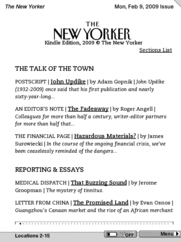
When we reported yesterday that The New Yorker had introduced its Kindle version, we were curious what it looks like. With a black-and-white display, you obviously wouldn’t get a pictorial reproduction of every page, as on The Complete New Yorker or The New Yorker Digital Edition, but what would you get?
Well, now we know. Click on the thumbnail to have a look at the first page of The New Yorker, as seen on a Kindle 1.
tny.gif

Starting Today, You Can Enjoy The New Yorker on Your Kindle

Martin Schneider writes:
Jeff Bezos of Amazon unveiled the Kindle 2 today; apparently it represents a significant upgrade.
Also released today is the Kindle version of The New Yorker. Starting now, for $2.99 a month, you will get your New Yorker subscription on your Kindle. How does it get there? “Free wireless delivery via Amazon Whispernet.” (Amazon Whispernet—doesn’t that sound like something Tarzan might have to free himself from?)
Amazon user “Dick Diver” approves: “I’ve been waiting for this now for over a year.” He’s hoping that more magazines are on the way.