
-thumb-182x136.jpg)
Farewell to a radiant human being, a breathtaking performer, a great teacher, a jazz innovator, and the inspiration to untold numbers of swing and other dancers around the world.
This remarkable photo of Frankie, taken (most likely) last year, is by Holly Van Voast and is used with permission.
Later: That weekend was a long and lindy-hopping celebration of Frankie’s life and exuberant self.
Author Archives: Emdashes
Garry Trudeau Twitters, Talks (About Town), Takes a Moment to Tweflect
Emily Gordon writes:
1. Garry “Doonesbury” “Awesome” “Of Whom I Am a Lifelong Fan” Trudeau started Twittering as his self-absorbed, intrepid newsman character Roland Hedley.
2. Trudeau writes (or excerpts, or compiles) a Talk of the Town with some choice tweets from Hedley’s mystic journey to the G-20 Summit.
3. Mediabistro’s TVNewser interviews Trudeau about the whole twemonenon.
4. Starting words with “tw” is still funny, and maybe, like saying “www dot” to start a funny word or phrase to ironically convey its currency, it always will be.
William Hamilton, Jack Russells, Mint Juleps, and Quality Road
Emily Gordon writes:
From the Andover homepage, courtesy of my alumni email newsletter (I went there for only a year, but it was an eventful year!), a nice horse story that also has a New Yorker cartoonist connection:
**Horse breeder Ned Evans ’60 has a Kentucky Derby contender**
April 15, 2009 – According to renowned New Yorker cartoonist and fellow PA alum **William Hamilton** ’58, Ned Evans would rather spend the day with his four Jack Russell terriers on his 3,000-acre farm in Casanova, Va., than sipping mint juleps at Churchill Downs on May 2. But Evans will just have to settle in and make do: his colt, Quality Road, posting 5 to 1 odds, will be competing in one of the biggest horse racing events of the year–the Kentucky Derby.
A top-ranked North American equestrian breeder, Evans has raised horses for 40 years on his sprawling Spring Hill Farm. And although he’s turned out some 70 stakes winners, three-year-old Quality Road is his first Derby contender. Evans, however, declines to partake just yet in the sweet conjecture of what a Derby victory would mean to him.
“I’ll tell you afterward what it means,” he proffers. “I’m mainly concentrating on getting there and doing the best we can.”
After graduating from Andover, the Greenwich, Conn., native earned a BA degree from Yale in 1964 and an MBA degree from Harvard in 1967. Known to many in New York’s top business circles as a shrewd entrepreneur, Evans’s many successes culminated in 1979 when he became chief executive officer of publishing giant Macmillan, a position he held for more than a decade.
What some associates may not have known until recently is that starting in 1970, while climbing the ranks of New York’s business world, Evans, a self-proclaimed “weekend commuter,” was quietly creating and expanding a vast horse farm on the old Civil War grounds of Virginia’s rolling countryside. Today, Spring Hill is home to roughly 200 horses at any one time, all handpicked and paired for breeding by Evans himself.
“I arrange all the matings and 15 months later a foal is born,” says Evans. “They don’t go into training until they’re 2, and all kinds of things happen along the way, not enough of them good.”
But it wasn’t until this past November that Evans knew he had bred a special one. Quality Road had burst onto the scene for his maiden race at Aqueduct and “caught everyone’s eye,” says Evans. According to reports, the proud owner turned down a $2.5 million offer for the galloping wonder and decided he would take Quality Road to the Derby himself, thank you very much.
As for what Evans would do if Quality Road were to take the Derby title, his fond friend Hamilton may know best. “A Derby win would leave him at least briefly ecstatic. He would probably give his terriers a treat and smile a moment at the sky.”
To which Evans replies, “He seems to know the situation.”
Hunting and Deciding: NYC Event Today With Jonah Lehrer
From the press release:
Please join us today—Monday, April 20—at 6 p.m., on the 7th floor of 20 Cooper Square, for food, drinks and a conversation with one of the brightest lights in the journalism of ideas: Jonah Lehrer.
Jonah will be discussing a story he wrote last summer for The New Yorker entitled “The Eureka Hunt: Why Do Good Ideas Come To Us When They Do?” That story sprung from his research for his latest book, How We Decide, which was published in February by Houghton Mifflin. Jonah will also be talking about the nexus between his book research, his magazine pieces and his very active blog, called The Frontal Cortex, which focuses on neuroscience. And yes, he’ll also be fielding questions about his recent appearance on The Colbert Report.
You can download Jonah’s New Yorker story at http://tinyurl.com/66qqhw. You can read his blog at http://scienceblogs.com/cortex.
The editor at large for Seed magazine, Jonah Lehrer is the author of Proust was a Neuroscientist (Houghton Mifflin, 2007) as well as How We Decide. In addition to The New Yorker and Seed, he has written for Nature, Wired, The Washington Post and The Boston Globe. He is also a contributing editor at Scientific American Mind and National Public Radio’s Radio Lab. A Columbia graduate, he also studied at Oxford as a Rhodes Scholar. The New York Times called Proust was a Neuroscientist “a precocious and engaging book that tries to mend the century-old tear between the literary and scientific cultures.” Publishers Weekly called How We Decide “a fascinating book . . . that will help everyone better understand themselves and their decision making.”
This event is part of the four-year-old “Inside Out” speaker series sponsored by the Science, Health and Reporting Program (SHERP) at NYU’s Carter Institute of Journalism. Leading the conversation, as usual, will be Robert Lee Hotz, distinguished writer in residence at the Carter Institute and the science columnist for The Wall Street Journal.
For logistical details, see: http://journalism.nyu.edu/events/?ev=2008-jonahlehrer
Because We Are Not Immune to Cute Animal Pictures
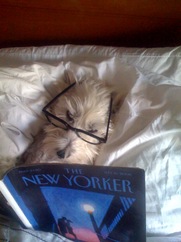
Emily Gordon writes: Thank you, C.S., for sending in this photo of a well-read dog named George.
All You Need Is Love
Emily Gordon writes:
Don’t miss Nancy Frankin’s Talk this week about a transporting encounter with Paul McCartney–a ticket to ride, as it were. N.F. is no joke: she’s getting better all the time.
Lest You Worry About My Larceny…
Emily Gordon writes:
My “discovery” of an uncatalogued James Thurber drawing, reported in nonsensical detail on Wednesday, was, of course, an April Fool’s caper. The affectionate homage is Pollux‘s, the NYPL remains unviolated by our staff, Ohio is spared the dubious delight of its non-specialty Toledo Butterscotch Flan, and our affections for Thurber are eternal.
New Yorker Nominated for a Bunch of National Magazine Awards!
Emily Gordon writes:
Quoting from the American Society of Magazine Editors website, the most relevant and, for Emdashes writers and readers, exciting bits (OK, I’m also very happy for my own magazine, Print):
• The New Yorker leads the list of finalists with a total of 10 nominations, including General Excellence, Reporting and Feature Writing. The New Yorker is the most honored magazine in the history of the awards, having received 187 nominations and 47 Ellies.
GENERAL EXCELLENCE: Recognizes overall excellence in magazines in six circulation categories. The award honors the effectiveness with which writing, reporting, editing and design work together to command readers attention and fulfill the magazine’s unique editorial mission.
Circulation 1,000,000 – 2,000,000
Bon Appétit; Field & Stream; The New Yorker; Popular Science; Vogue
[The New Yorker was nominated for the issues of February 11 & 18, 2008; May 26, 2008; and November 17, 2008.]
REPORTING: This category recognizes excellence in reporting. It honors the enterprise, exclusive reporting and intelligent analysis that a magazine exhibits in covering an event, a situation or a problem of contemporary interest and significance.
Fast Company; GQ (2 nominations); The New York Times Magazine; The New Yorker
[Ryan Lizza on how Chicago shaped Barack Obama: “Making It,” July 21, 2008]
FEATURE WRITING: This category recognizes excellence in feature writing. The award honors the stylishness, flair and originality with which the author treats his or her subject.
The Atlantic; Esquire; GQ; Harper’s Magazine; The New Yorker
[Nick Paumgarten on the lives of elevators: “Up and Then Down,” April 21, 2008]
ESSAYS: This category recognizes excellence in essay writing on topics ranging from the personal to the political. Whatever the subject, the award honors the author’s eloquence, perspective, fresh thinking and unique voice.
The Antioch Review; Backpacker; Glamour; Harper’s Magazine; The New Yorker
[Roger Rosenblatt on death and family: “Making Toast,” December 15, 2008]
COLUMNS and COMMENTARY: This category recognizes excellence in short-form political, social, economic or humorous commentary. The award honors the eloquence, force of argument and succinctness with which the writer presents his or her views.
Automobile; The Nation; The New Republic; The New Yorker; Sports Illustrated
[Hendrik Hertzberg, Comments on Barack Obama’s visit abroad (“Foreigners,” August 4, 2008), on McCain supporters calling Obama a socialist (“Like, Socialism,” November 3, 2008), and on the passing of Proposition 8 in California (“Eight is Enough,” December 1, 2008)]
REVIEWS and CRITICISM: This category recognizes excellence in criticism of art, books, movies, television, theater, music, dance, food, dining, fashion, products and the like. The award honors the knowledge, persuasiveness and original voice that the critic brings to his or her reviews.
The Atlantic; The Nation; New York (2 nominations); The New Yorker
[James Wood, Books, on Richard Price and the art of dialogue (“Say What?,” April 7, 2008), on Marilynne Robinson and religion (“The Homecoming,” September 8, 2008), and on the life of V.S. Naipaul (“Wounder and Wounded,” December 1, 2008)]
FICTION: This category recognizes excellence in magazine fiction writing. The award honors the quality of a publication’s literary selections.
The American Scholar; The New Yorker (2 nominations); The Paris Review; The Virginia Quarterly Review
[Annie Proulx, “Them Old Cowboy Songs,” May 5, 2008; Aleksandar Hemon, “The Noble Truths of Suffering,” September 22, 2008; Roberto Bolaño, “Clara,” August 4, 2008; Joshua Ferris, “The Dinner Party,” August 11, 2008]
LEISURE INTERESTS: This category recognizes excellent service journalism about leisure-time pursuits. The practical advice or instruction presented should help readers enjoy hobbies or other recreational interests.
Esquire (2 nominations); Field & Stream; The New Yorker; Texas Monthly
[Patricia Marx, On and Off the Avenue, on shopping in China (“Buy Shanghai!” July 21, 2008), on buying shoes in New York (“Sole Sisters,” September 1, 2008), and on going discount (“The Price is Right,” December 8, 2008)]
PHOTO PORTFOLIO: This category honors creative photography and photo illustration (including portraiture or specially produced layouts on fashion, food, decorating, travel, design, the arts, etc.).
Bon Appétit; GQ; Gourmet; The New Yorker; W
[Platon, photographs of the men and women who volunteered to serve in Iraq and Afghanistan, and their families: “Service,” September 29, 2008]
Letters From Home: Steve Martin’s Stand, Emily Gould’s Address
Emily Gordon writes:
Notable in the news (as we say at Emdashes HQ, “old news is good news”):
Steve Martin Play Stirs School Controversy, reports the Times, and Martin is getting involved personally to defend the honor of his play, which is, of course, entirely honorable and replete with the exact sort of “adult content” to which teenagers should be exposed. On the other hand, the night that I saw Picasso at the Lapin Agile (in 1993 or so), the cabbie who was getting me to the show by curtain time–and we were rushing–got in a controversy of his own with another cabbie, and one of them (I can’t remember which now) leapt out at a red light, got a tire iron from his trunk, and started pounding on the other one’s car. Normally, I find cabbies to be extremely peaceful people, so it was memorable.
I hadn’t seen this Designing Magazines post about New Yorker DNA-sharing noble magazine Wigwag, which was edited by Lex Kaplen, art directed by Paul Davis, and contributed to by (for instance, and what a for instance) Nancy Franklin, but it’s really worth delving into the post and its ache-inducing images.
Emily Gould writes that the March 2, 2009, issue of The New Yorker (“Ryan Lizza’s Rahm Emanuel profile. Ariel Levy on Van Lesbians. Rebecca Mead making some opera lady interesting”) is “the best New Yorker of all time, pretty much,” and, being aware of the self-googling nature of us all these days, addresses Adam Gopnik directly.
National Book Critics Circle: Winners, Honors, New Yorker-ers
Emily Gordon writes:
I’m SXSW-bound in a few hours, but I wanted to send a brief report from a stirring and satisfying National Book Critics Circle awards ceremony and reception. The 2008 finalists for NBCC awards included a good group of New Yorker-related people: the late Roberto Bolaño for 2666, Pierre Martory for The Landscapist, which was translated by John Ashbery; Richard Brody for Everything Is Cinema: The Working Life Of Jean-Luc Godard; Steve Coll for The Bin Ladens: An Arabian Family in an American Century; and Honor Moore for The Bishop’s Daughter (an excerpt of which ran in the magazine)–and it’s true, there are other people in the list you can certainly call New Yorker-related as well. After the ceremony, I spoke with Richard Brody, whose blog and Twitter presence we’ve noted recently with pleasure; he’s a lovely fellow, and I’m glad to have met him.
Bolaño’s book got the fiction prize, and after seeing the multiple-cover design, I want to own it. The rest of the prizes came home with Ron Charles, who won the Nona Balakian Citation for Excellence in Reviewing; my former employer the PEN American Center, which got the Ivan Sandrof Lifetime Achievement Award; August Kleinzahler and Juan Felipe Herrera in a surprise poetry tie that had the brainy audience whispering in delight; Seth Lerer for criticism; Patrick French for biography (James Wood reviewed the book, The World Is What It Is: The Authorized Biography of V. S. Naipaul, in December) Ariel Sabar for autobiography; and Dexter Filkins for nonfiction. I’m sure the NBCC website will be full of details tomorrow, so look there then!