Read all about it. Isn’t this great news? —E.G.
Author Archives: Emdashes
Say We’re Not Sanguine, Joe!
Emily writes:
You can’t always get what you want, as this extra-chilly December is teaching us so ruthlessly. Sometimes, though, you can still post on your nearly four-year-old blog. Yes, four this very month! Happy birthday month to us!
Five things I admired today:
1. From Inquirer.net (“the official news website of the Philippine Daily Inquirer, the Philippine’s most widely circulated broadsheet”), a reminiscence by Corazon P. Ong whose headline says it well: “I wrote E.B. White and he wrote back.”
2. David Remnick quoted in the Observer, answering the New York Times‘s Joe Nocera (who, as the Observer puts it, “asked how each of the them could be so sanguine about the future”) at a panel held by the Newhouse School of Communication:
“Joe, no!” he said. “(A), we’re not sanguine. Or blithe. We think about it all the time. There are meetings about it all the time. We’re each thinking about this. Constantly. The quesiton that Ken asked was ‘Do your magazines have a future and are they in any way different than newspapers? I think magazines that mean something are going to find a way to have a future. … Sanguine or blithe about it? That’s not the way to describe it, Joe.”
God bless you, David Remnick. That is exactly what it is like. And magazines will find a future. We won’t go down so easy!
4. Speaking of people with a sense of humor and diverse musical tastes, here’s LP Cover Lover.
5. Hillary Chute—whose Art Spiegelman interview we’re featuring all week on Print‘s website—interviewed the radiant and irrepressible Lynda Barry for the current issue of The Believer. Buy the issue; get a taste of the interview here. I was so happy, amidst the doldrums of fall, to witness Barry and Matt Groening being delirious together during the most recent New Yorker Festival. The magic of some occasions really does make up for the bad times.
The Sound of One Graf Clapping: William Steig and “Disquiet, Please!”
Emily writes (see note below):
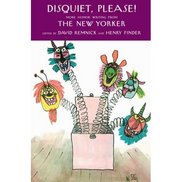
I have and am reading Disquiet, Please!: More Humor from The New Yorker, and I expect to post about it again. For now, won’t you join me in admiring this William Steig drawing on the cover? I think it’s glorious and deranged. Actually, it reminds me of a current New Yorker artist’s less well-known work: cartoonist Eric Lewis‘s found-sculpture Garbage Flowers. If I were you, I’d gather some of the inexpensive flowers before they’re all sold (several already seem to be), add the humor anthology, and there’s the formula for your whole Christmas list.
This has been an uncompensated endorsement of unqualified enthusiasm from phantom publisher and fond founder Emily Gordon, whose evanescent presence you will see around here from time to time. In case you’re stopping by for the first time in a while, current editor Martin Schneider is the author of all unsigned posts, so he should get the compliments!
We Already Knew Hendrik Hertzberg Was a Winner
…but the Columbia Journalism Review just reconfirmed it, with a “Winner” laurel for Hertzberg’s recent Comment on the hateful Proposition 8. CJR‘s Charles Kaiser writes, “His opening paragraph is worth the price of the magazine.”
It seems unlikely that you, the Emdashes reader, haven’t seen Keith Olbermann’s Special Comment on this Californian embarrassment and on the essential comfort of love in a hard world, but just in case, here it is. —E.G.
_Update_: Ta-Nehisi Coates “agrees”:http://ta-nehisicoates.theatlantic.com/archives/2008/11/i_show_you_how_to_do_this_son_1.php, saying that this Comment demonstrates why Hertzberg is the “king” of the weekly column. It’s endearing how much Coates loves the column, and I admire how he gets the post to end on a laugh. —Martin Schneider
What We Should Have Said Was “Author!”
Emdashes favorite Mike Birbiglia, whose one-man tale of the drowsily unchaperoned, Sleepwalk With Me, has made it to Broadway, gets a swell review in the New York Times. We’ve seen it and we laughed at the funny parts, laughed at the sad parts (because Mike makes them so funny), and laughed at the parts in between. We suggest you bring your family in town for the holidays. It’ll be a heartwarming conversation-starter, and even though we’re not phrasing that very freshly, we’re not being ironic in the least. —E.G.
Look Forward to a New Nonfiction Book by Jeffrey Frank
Frank is a New Yorker senior editor whose most recent book is the novel Trudy Hopedale; you’ll want to read his winsomely annotated playlist of songs Frank’s two narrators would find “music they’d think was meant just for them.” (My friend Lilit at Save the Assistants interviewed him when it was published, and wrote: “I’m happy to report that, fancy credentials nonwithstanding, Jeffrey Frank is a really cool guy. He’s also an incredible boss.”) The New York Observer reports that Frank is leaving The New Yorker at the end of this year in order to properly research and write it. (Via MediaBistro’s indispensable Daily Newsfeed.) —E.G.
Campaign-Trail Pain Painful, Though Even More Painful Had Palin Prevailed
Emily takes a break from a long issue close to write:
I was sorry to hear from the latest “Campaign Trail” podcast that most-having host Dorothy Wickenden has busted her ankle. President-elect Obama surmised that Chicago Sun-Times reporter Lynn Sweet’s cracked shoulder was the “only major incident” from the Grant Park party. Could this be the second media-related injury this election season? Either way, I hope both bones heal quickly and well.
Also, I was delighted to learn, at the end of this week’s podcast, that “The Campaign Trail” will continue to continue (as Simon & Garfunkel would say), as “The Transition,” which Wickenden describes as “a program about the new political scene in Washington and around the country as the shift in power gets underway.” I’m so glad: The show is too enlightening, and—particularly last week, when the crew became charmingly manic—too entertaining to end.
Obama Is My Flickr Friend
Perhaps even more remarkable than these moving photos of the Obamas and co. on election night is that the future president is now on my Flickr contacts list. He’s male and taken! —E.G.

John Leonard, 1939-2008
Emily writes:
Apart from my parents, there are two people most responsible for whatever success I’ve found in writing and journalism. One is Katha Pollitt. The other is John Leonard, who I’ve just learned has died. He was loquacious and brave, extravagant and rigorous, profound and mischievous, demanding and incredibly generous. He believed in older writers’ service to younger ones and put his money where his mouth was. He knew more than a football field of literati. His sentences were outrageous Cyclone rides, until later in his life and in his illness, when they settled down a little in syntax, if not in erudition and clarity.
I will miss him.
Later: Andrew Leonard, John’s son, read a “eulogy for my father’s words,” at John’s memorial service on March 2, 2009, and the eulogy is now on Salon. It was one of many moments that made up an evening worthy of John’s greatness of spirit and boundlessness of language.
Do read Scott McLemee (another believer in those overlapping categories, books and justice), Hillary Frey, and Jane Ciabattari at the National Book Critics Circle’s Critical Mass (which is collecting more remembrances as they appear) on the loss of John.
And in honor of his irresistible passion for juicy word combinations, here’s the title of a book he published in 1999, and a link so you can buy it (and I hope you do): When the Kissing Had to Stop: Cult Studs, Khmer Newts, Langley Spooks, Techno-Geeks, Video Drones, Author Gods, Serial Killers, Vampire Media, Alien Sperm-Suckers, Satanic Therapists, and Those of Us Who Hold a Left-Wing Grudge in the Post Toasties New World Hip-Hop. From the Times obituary: “The comma seemed to have been invented expressly for him.”
Tom Nissley at Omnivoracious has written a graceful tribute. This sentence from his post was hard to read but deeply good to know: “I know he managed to get to his polling place to vote in New York on Tuesday, and I hope he was able to appreciate the results of the night.” Laura Miller’s remembrance in Salon includes the doubly astute observation, “To say John Leonard was a reviewer at heart is to pay a great compliment to a profession that currently seems to be limping toward an undeserved obsolescence.” And: “Unlike most of his colleagues, he never burned out, never grew bitter or nasty about the books.”
Art Winslow, another force in my Nation years who gave me a leg up for which I’ll always be amazed and grateful, writes in the L.A. Times: “In a literary sense, he took it as his mission to drive the money-changers from the temple and to feed the multitudes, or at least try.”
At The New Yorker‘s Book Bench blog, Ligaya Mishan quotes John from his Harvard Crimson years, on “Ginsberg and his fellows”: “In a critical sense, we academicians know these men as psychopaths, and perhaps they are. They believe in sensuality, not sense; in thrill, not mere experience.”
Which made me think of a story John once told about leaving the Crimson office at near-dawn after a long closing night, with the snow falling on the Boston streets making his footsteps almost completely still, when suddenly he heard a voice singing so sweetly it couldn’t possibly be human. It was a very young Joan Baez, maybe at Club 47, where my mother also saw her perform around that time, and John went inside and listened till she stopped singing—it was that beautiful.
I also just remembered that it was John who told me about the scene in Renata Adler’s Speedboat in which a tour guide on a bus full of visitors to the city calls out, pointing at the protagonist, “Look, there’s one of them now!” And how he always identified with that sense of targeted mystery, wondering what the world makes of you, what they think you are. I hadn’t seen him in a while, just heard bulletins, read Meghan O’Rourke’s excellent profile in CJR, and was my usual optimistic, time-senseless self. The world of words is poorer, and so is mine.
Happy Birthday, David Remnick!
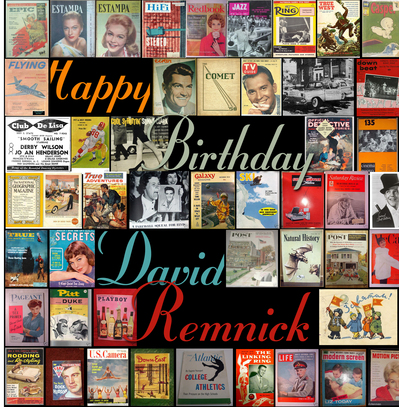
Remnick was born October 29, 1958. For this, we are thankful. And for those looking for a birthday present for him, may we suggest The Best of Bob Dylan’s Theme Time Radio Hour?
—E.G.