
Emily Gordon writes:
Lately I’ve been waging an inner war against millennial modifiers. Is it Gen Y’s fault (let’s blame them!), or the fault of us ad-sandblasted, dichotomy-spurning, latchkey-clutching Xers, that everything is “kinda” and “basically” now? I often used these qualifiers myself before I started noticing how hollow and cynical they sound. I’m objecting to this: “pretty awesome” and “kinda genius” and “sort of hilarious” and “basically the best thing ever.”
It takes character, and sometimes bravery–a Franzen-style commitment to loving rather then insta-liking–to declare a person or a thing actually good or smart or funny. What’s the point of declaring your devotion to something, or admiration for someone, if you can pre-take it back just in case someone else thinks your choice is lame? It’s simultaneously hyperbolic (which, as an enthusiast, I’m fine with), disingenuous (danger!), negating (hipster disaffection masking vague woundedness), and oxymoronic (and how is that a held belief?).
Although it’s already been replaced by Dicking Around, I’m still a proud adherent of the New Sincerity. Will you join me in putting on the sweet high lonesome sound of The Secret Sisters and wearing your heart on your (corduroy) sleeve instead of hiding it in an equivocating, halfhearted irony bucket?
Related: More banned words and phrases.
Author Archives: Emdashes
“The Patented Trump Palaver”: Time to Reread Singer!
Emily Gordon writes:
Anyone who’s surprised by reports about Donald Trump’s wiggly business sense–and anyone who’ll enjoy a little extra schadenfreude and outrage in this crazy-making political season–need only read Marc Singer’s classic 1997 Profile of the three-card-monte king. A sample:
Months earlier, I’d asked Trump whom he customarily confided in during moments of tribulation. “Nobody,” he said. “It’s just not my thing”–a reply that didn’t surprise me a bit. Salesmen, and Trump is nothing if not a brilliant salesman, specialize in simulated intimacy rather than the real thing. His modus operandi had a sharp focus: fly the flag, never budge from the premise that the universe revolves around you, and, above all, stay in character. The Trump tour de force–his evolution from rough-edged rich kid with Brooklyn and Queens political-clubhouse connections to an international name-brand commodity–remains, unmistakably, the most rewarding accomplishment of his ingenious career. The patented Trump palaver, a gaseous blather of “fantastic”s and “amazing”s and “terrific”s and “incredible”s and various synonyms for “biggest,” is an indispensable ingredient of the name brand. In addition to connoting a certain quality of construction, service, and security–perhaps only Trump can explicate the meaningful distinctions between “super luxury” and “super super luxury”–his eponym subliminally suggests that a building belongs to him even after it’s been sold off as condominiums.
Here’s the rest. Enjoy.
And related, in Salon today: “The biggest political lesson of the Trump ‘campaign.'” As Alex Pareene writes, “Trump realized that even though his ego was pushing him further and further into politics, he is much better at cashing checks from NBC for playing a billionaire than actually being a billionaire real estate mogul.”
What Not to Wear, Ogg
Ancient bones suggest cavemen wore boots
Neanderthal Shell Discovery Shows Cavemen Wore Makeup
Cavemen wore jewelry 19,000 years before Earth was created
“It is common knowledge that cavemen wore dreadlocks, not for spiritual reasons, not for fashion, just for the fact that the comb wasn’t invented yet.”
How To Make a Caveman or Cavewoman Costume (“To top the costume off, make sure to make your hair frizzy and messy much like how cavemen wore it back in the day. Finally, you can opt to carry a wooden club or crude stone axe. Don’t forget to act like a caveman by walking funny and by speaking gibberish.”)
“It is possible, the article opined, that cavemen wore mullets out of sheer practicality.”
Sexy Neanderthals Wore Feathers
Susan Sarandon Wears Teeth Bracelet!
–Emily Gordon
“The Most Trusted Man in America”: Know Your Jon Stewart
Emily Gordon writes:
While ambling around looking for photos of Jon Stewart and Laura Kightlinger together after hearing her be witty (and briefly mention having dated Stewart) on the Marc Maron podcast recently, I happened on this Moment magazine profile of Stewart by Jeremy Gillick and Nonna Gorilovskaya. Read it! It’s smart and thorough, and explores, among other things, Stewart’s Jewishness and relationship to Israel and Jewish history and politics. Here’s a graf I appreciated, followed by one that I know friend-of-Emdashes Ben Bass will either have already noted on his blog or soon will:
After waiting to hear some “constructive criticism” of Israeli policies that “may not be in the best interest of the world,” Stewart rolled clips of silence and went for the kill: “Oh! I forgot! You can’t say anything remotely critical of Israel and still get elected president! Which is funny, because you know where you can criticize Israel? Israel!”
Although the topic doesn’t come up often, it’s also evident where Stewart stands on intermarriage. In 2000, he married Tracey McShane, a veterinary technician and a Catholic. Stewart, who does The New York Times crossword puzzle daily, popped the question with a puzzle of his own. The paper’s “Puzzle Master,” Will Shortz, found Stewart a puzzle creator for the occasion.
I also liked this, toward the end:
Despite his effort to be a fair and balanced mocker, Stewart’s reputation as the “most trusted man in America” should be taken with a grain of salt. Such stature is not unusual for a comedian, says Nicholas Lemann, the dean of the Graduate School of Journalism at Columbia University. “Johnny Carson in his heyday, you could make that statement about.” Lemann warns against generalizing about how far that trust spreads beyond Stewart’s core audience. “I think that’s a kind of a blue-state perspective and youth perspective. To many of my cousins in Louisiana, Rush Limbaugh is the most trusted man in America.”
Anyway, as I said, read it all!
Literally, Extra: Newspaper Nail Art
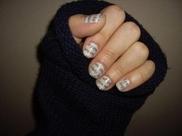 Emily Gordon writes: Thanks to Jennifer Hadley (who also created the original Emdashes logo!) for this: newspaper nail art, courtesy of old media, carefree youths unaware of their own impending obsolescence, rubbing alcohol (“or vodka”), and clear polish. Via, in turn, Je t’aime Morgan and Not Martha. Jennifer thoughtfully follows up with this YouTube video with better instructions. I see this not as a stomp on the corpse of newsprint but as a tribute to its beautiful ordinariness. It’s likely the twentysomethings posting these tips see it as beautifully retro or vintage. I guess that’s OK, too.
Paulette Forever: A Charles Taylor Interview
I was rereading some of Charles Taylor’s beautifully crafted, sometimes contentious reviews on Salon (I didn’t like Million Dollar Baby either), and the web wonderland led me to this 2006 interview with Taylor (or Charley, as I may call him because we’re friends) in Slant magazine. He talked about his career at Salon and elsewhere, the state of film criticism and media outlets (a phrase I already know will make him wince–sorry about that) generally, and more. Here’s a choice response, among many:
JK [Jeremiah Kipp]: You’ve frequently cited Pauline Kael as a major influence.
CT [Charles Taylor]: I got a paperback copy of “Deeper Into Movies” by Pauline Kael when I was in eighth grade. That was a major influence. I still think she’s the best film critic that is ever going to be. She was the best influence and the biggest influence. It was about trusting your instincts, which always the line about her. This is what I loved. This is why all of the “I Was a Former Paulette” articles I’ve read are all, to a one, simply wrong on the facts. I had countless disagreements with her, even arguments. I was never excommunicated. Some of the critics she liked were people she didn’t agree with. She wanted people to be honest. Art should be pleasure, not work. You have to bring your life experience to it, your experience of the other arts to it, you have to be well read, and no one should tell you what you have to like or what you should be interested in. The job of the critic is to help you formulate your own thoughts. Articulate them. Not to tell you what to think, but to get you to think. There was a freedom in her.
Without Mad Men We’d Go Mad, Men!
Emily Gordon writes:
My friend Meg (famed Short Fat Dictator blogger and recent transcendent vacation host) just alerted me to a distressing possibility: that Seaon 5 of Mad Men might be in danger. This isn’t new news, but it’s newly distressing to me. People are having tedious arguments about contracts and budgets in some Aeron-riddled, humorless rooms, and that means we might not get to see Don Draper wrestle ever more painfully with the sixties and his multiple superego-id hybrids. Worse, we might be deprived of all those jackets and ashtrays!
Hollywood, it’s time to reorder your mangled priorities and make it happen. Give the man what he wants, even if it’s more episodes featuring his son Marten’s peculiar character Glen. Although if Marten’s brother Arlo could appear on the show as a mysterious diminutive fashion maven, perhaps in a Sally Draper dream sequence, we might all get what we want.
Sam Gross: “I don’t do things for The New Yorker; I do things for me.”
Emily Gordon writes:
My friend Nathaniel Wice just pointed me to this stellar interview with New Yorker cartoonist Sam Gross at The Comics Journal, by the veteran music critic Richard Gehr. It looks as though this is the first in a series of “Know Your New Yorker Cartoonist” columns, which is great news for all of us who celebrate these hardworking and (literally!) marginalized artists. Here’s an excerpt I especially liked because Gross talks about Charles Addams and other strong influences, but read the whole thing:
GEHR: When did you become a New Yorker contract artist?
GROSS: I didn’t get a contract under William Shawn. I had a special rate under Robert Gottlieb. I got a flat fee but higher than their contract rate. The contract rate started below my special rate and went up incrementally for each five you sold until they would be way ahead of my rate. Then it would go back down again at the beginning of the year. And there was also a signature fee, a quantity bonus, and a pension. None of this do they have now.
GEHR: How has your work changed over the years? Do you get direction from your editors as the magazine’s editorial vision changes?
GROSS: My work hasn’t changed because of The New Yorker. I don’t do things for The New Yorker; I do things for me. I don’t do anything for The New Yorker because I operate on the premise that Bob Mankoff can be there today and gone tomorrow, and the same with David Remnick. Somebody else could come in and have a totally different outlook and I will either fit in or not fit in. If I’ve geared my work toward the people that were there before, I’m basically embedded with these older people and I’m screwed. But I am my own person. You either take me or leave me, simple as that.
GEHR: What cartoonists have influenced you?
GROSS: Charles Addams, Mischa Richter, Saul Steinberg. We all go through these things. Addams still influences me.
GEHR: What did you learn from Addams?
GROSS: I learned how to create a mood and get involved with the characters. I did a Puss in Boots gag some years ago. The cat is wearing these high leather boots with stiletto heels and has a whip. And a guy is looking at the cat and saying something like, “This is not the Puss in Boots I knew as a child.” I could tell there was something wrong with my sketch, however, and it finally dawned on me that the guy I drew never read a book in his life; he looked like he drove a truck or something. I had to draw somebody bookish. I know I have a poor eye. People like Sergio Aragonés, though, he can sit there and just fill up a page and there it is. I shared a studio with Dick Oldden, a penthouse on 78th Street. This guy didn’t own an eraser, Wite-Out, or even a pencil. He had trained himself to start on the upper left-hand corner, finish on the lower right-hand corner, and just sign his name. I thought everybody was like this. Sometimes I have to give a drawing a lot of thought afterward. I may look at it for two weeks if I’m trying to sell it to The New Yorker – or three weeks if it’s really bothering me. There’s no time element involved with most of my work. It can go on forever, and I have drawings that are still pumping money. “Son, your mother’s a remarkable woman,” that drawing with the cow jumping over the moon was done in 1982 and it’s going on and on. And the frogs’ legs cartoon was in the December 1970 issue of the Lampoon.
Where in the World Is Flat Stanley?
Emily Gordon writes:
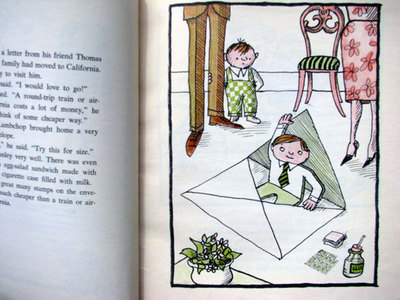
I just discovered The Apple and the Egg, a handsome blog about design and illustration for children’s books. The entry linked here is about one of the great heroic tales of our age (or, in my case, slightly before my age), Flat Stanley by Jeff Brown. Although I’m loath to denounce anyone these days, especially hardworking illustrators and anyone to do with children’s books, I can’t support the terrible decision to replace Tomi Ungerer’s bold, winning, exuberant drawings. You’ll have to turn to Powell’s and eBay to buy the original, and it’ll be yellowed and will possibly have been dropped in the bathtub once or twice. But it’s worth it! For now, The Apple and the Egg will give you the quick fix you need.
Unrelated, and entirely three-dimensional (or even four, since it’s about time): Colin Quinn’s advice for comics on Broadway.
Tips of the Top Hat: New Yorker Eustace Tilley Contest Winners & Nerd Cakes
Emily Gordon writes:
Via our friends at UnBeige:
With his moncole at the ready and a butterfly his constant companion, Eustace Tilley has been The New Yorker‘s dapper mascot since founding art director Rea Irvin sketched him into being in 1925. The magazine recently invited readers to put their own twist on the discerning dandy in its fourth Eustace Tilley design contest. And this year’s competition came with a bookish bonus: the grand-prize winner’s design printed on a Strand Bookstore tote bag (an icon for an icon!) and a $1,000 Strand shopping spree. After sifting through roughly 600 entries, New Yorker art editor Françoise Mouly has selected a dozen winners, now featured in a slideshow on the magazine’s web site. The victorious Eustaces range from Seattle-based Dave Hoerlein‘s cartographic version (“A Dandy Map of New York”) to a Facebook-ready Tilley created by Nick McDowell of Mamaroneck, New York. Savannah-dwelling William Joca‘s “Cubist Tilley” was inspired by the work of Picasso (with a sprinkling of Ben-Day dots for good measure), while Pixo Hammer of Toronto channeled Joan Miro. As for the big winner, keep guessing (Grecian Eustace? Symbolic Eustace? Eustace through the years?). The champion and the tote bag will be revealed this spring.
My favorite of the examples UnBeige selected is by San Francisco illustrator and comic and storyboard artist Gary Amaro, whose other beautiful and emotionally charged work (including some remarkably fine nudes and figure drawings) you should look at here.
In other, or you could even say similar, passionate-niche news, I really like these nerd cakes.
