
Emily Gordon writes:
A sausage chain of inky links:
Friend Laura Miller wrote about this at (on? for? I tried all three, and this has been driving me crazy for years, but I’m going to stick with “at,” I guess) Salon: Hideous fonts may boost reading comprehension.
At Slate, Jon Lackman asks the overdue question, “Why do Tea Partiers uppercase so many of their nouns?” Is it anyone else’s observation, especially those, like me, who have taught college English, that a lot of Americans capitalize a lot of nouns? I wonder if English is using the people who do this as a psychic medium to contact its former incarnations. Lackman alludes to this: “In the century prior to 1765, nouns were generally capitalized. (The reason for this is now obscure; Benjamin Franklin hypothesized that earlier writers ‘imitated our Mother Tongue, the German.’)”
Leila Cohan-Miccio wrote this at Splitsider, the site in the invincible trio of already extremely funny sites that’s specifically about the field/world/pathology of comedy: “In Defense of Judd Apatow’s Female Characters,” which reminds me of the rousing debate about contemporary “romantic” comedies we titled Are We Doomed, David Denby? But since I posted that in 2007, I found that repeated exposure to Seth Rogen eventually begat a fondness for Seth Rogen, which surprises me as much as anyone. I saw and liked Zack and Miri Make a Porno (I have cable now). He seems so happy to be engaged, and so humble about it. I saw him on the Today (or similar) show riding an exercise bicycle, gamely and humbly. I suddenly want him to be in more movies. And marriage will do a lot for him–maybe even make him all sensitive to the issue of trying to make better female characters, as Judd Apatow honestly is. I like a man who can admit he’s learning, and listens to the ladies.
Speaking of The Hairpin, which is referenced in one of the links above, I can’t say enough about Bonnie Downing’s column Outdated Beauty Advice, which is as timeless as, and is a visually rich and devastatingly deadpan complement to, the classic-internet classic (and, later, Broadway show, which I trust is also in Downing’s future) Miss Abigail’s Time Warp Advice. But it’s so late. I will return to this subject. TK. Just read every entry on both of these sites, laugh yourself thin, and follow 100% the advice therein at your own risk.
Author Archives: Emdashes
Two Oh One One Yippee-ki-yay
 My lord there are a lot of alternate spellings for that expression. Happy 2011 to you! We look forward to doing new things here in this space this year and continuing the evolution of our (Chicago-forged!) site design, while remaining the proud obsessives we’ve been–that is, in this public and sporadically prolific way–for six years (!) now. It’s freeing to no longer be New Yorker-centric, but that also means there’s a lot of world out there to cover. We’re going to keep chasing down our particular elusive favorites, quantumly. We believe in blogging. And we’re thankful you’re still here. Tell us what you like, and we’ll listen! We’re open to all the thoughts that are fit to think. –Emily Gordon
[Image credit.]
Late But Not Without Love: Our Punctuation Contest Winner!
Some time ago, we sponsored a contest–write a letter to a punctuation mark, and get a chance to win a signed copy of Ben Greenman’s book What He’s Poised to Do–whose results diverted and delighted us. They also distracted us, so much so that it’s taken us, collectively, quite a while to pick a winner. The Emdashes staff selected an absurdly long but heartfelt of finalists, and now Ben has picked his winner. Here is the glad announcement, and with it, our collective apology that we can be awfully slow. Punctuation makes us dizzy and loony. Sometimes blogging does, too. Thank you so much to all the clever writers and true punctuation lovers who entered the contest. And now: Ben Greenman! –Emily Gordon
To say that I agonized over this contest would be an understatement. I have spent weeks staring at these semifinalists, trying to decide how to elevate one and let the others fall away. Who should win? Who will win? When we started this competition months ago, we had no idea that so many people would write such passionate, funny, and insightful letters to pieces of punctuation. We should have guessed. The relationship between a reader and his or her punctuation starts early, and it doesn’t operate as a type of infatuation or opportunism, as the relationship between readers and words sometimes does. The love of (or love for) a piece of punctuation grows slowly, over time, until it is undeniable: a reader looks and wonders until there’s no option left but saying what is felt.
In the end, after weighing them all, I selected Letter #2, Nicole Rushin’s letter to the tilde, in part because she couldn’t remember its name (she’s flustered by love) and in part because she has perfectly identified the seam between passion and fashion. Ten years ago, no one cared about the tilde except for Spanish teachers. Ten years from now, it will have passed into oblivion again. But today, in the waning days of the strange http era, it is a kind of little king. The last four sentences of Nicole’s letter are especially poignant, and especially true. Congratulations to our winner and all our entrants.
–Ben Greenman
Nicole Rushin‘s winning entry, for which she will receive a signed and personally punctuated copy of Ben’s book:
Dear ~,
I am embarrassed to say that I have forgotten your name. You came into my life one torrid night while talking to the abrupt, but helpful customer service rep from Blue Host. I remember it clearly. I hope this letter reaches you. Is it too forward to say how I love the way you look after my name? Please write back. I am sending this out in a bottle, posting it in the classified ads. We would could be so happy together, crashing the shores of our meaning against each other, forever. I know nothing about you, I don’t know what you do? Why do you exist? I just want to know you.
Nicole ~
Roger Ebert Speaks Truth to Stupidity
Emily Gordon writes:
While recovering from sickness recently, I watched some execrable movies on cable. I love movie-watching so much I rarely suffer in the process of seeing almost any movie, and I saw this one all the way through. But at about the halfway mark I started reading the Rotten Tomatoes reviews as I half-viewed the images and half-listened to the dialogue from my horizontal pillow-state. You can click on the link below to see what movie this was, but it’s not important, I think. What’s important is how grand Roger Ebert is to have written this:
Why? I wanted to ask the filmmakers. Why? You have a terrific cast and the wit to start out well. Why surrender and sell out? Isn’t it a better bet, and even better for your careers, to make a whole movie that’s smart and funny, instead of showing off for 15 minutes and then descending into cynicism and stupidity? Why not make a movie you can show to the friends you admire, instead of to a test audience scraped from the bottom of the IQ barrel?
Let every person sitting in a Hollywood meeting ask himself (or, less likely, herself) these questions, and then answer them!
Here But Not Here–and Soon to Be Here Again
Emily Gordon writes:
We’ve (or, more properly, I’ve!) been posting fairly infrequently lately, but we wanted to let you know that after months of regrouping, regrouponing, and a productive amount of internal tumult, we’re planning to start posting regularly again soon. Keep those cards and letters coming and see you soon!
Department of Factual Verification Dept.
From Wikipedia, which, as Jesse Sheidlower could surely tell us, is also a verb, as in “Wiki that shit before you go around spouting nonsense!”:
Experience of the K-hole may include distortions in bodily awareness, such as the feeling that one’s body is being tugged, or is gliding on silk, flying, or has grown very large or distended.[citation needed] Users have reported the sensation of their soul leaving their human body.[citation needed] Users have also often reported feeling more skeletal or becoming more aware of their bones – the shape of their hands is also often of interest.[citation needed] Users may experience worlds or dimensions that are ineffable, all the while being completely unaware of their individual identities or the external world. Users have reported intense hallucinations including visual hallucinations, perceptions of falling, fast and gradual movement and flying, ‘seeing god’, feeling connected to other users, objects and the cosmos, experiencing psychic connections, and shared hallucinations and thoughts with adjacent users.[citation needed]
Yes, primary sources, people!
Leo Cullum, 1942-2010
Emily Gordon writes:
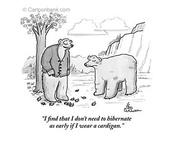
We were very sad to hear the news of the death of New Yorker cartoonist and veteran airline pilot Leo Cullum. (Click his name to see the full archive of his wonderful cartoons for the magazine.) From the New York Times obituary:
Mr. Cullum, a TWA pilot for more than 30 years, was a classic gag cartoonist whose visual absurdities were underlined, in most cases, by a caption reeled in from deep left field. “I love the convenience, but the roaming charges are killing me,” a buffalo says, holding a cellphone up to its ear. “Your red and white blood cells are normal,” a doctor tells his patient. “I’m worried about your rosé cells.”
Mr. Cullum seemed to have a particular affinity for the animal kingdom. His comic sympathies extended well beyond dogs, cats and mice to embrace birds — “When I first met your mother, she was bathed in moonlight,” a father owl tells his children — and even extended to the humbler representatives of the fish family. “Some will love you, son, and some will hate you,” an anchovy tells his child. “It’s always been that way with anchovies.”
“There are many ways for a cartoon to be great, not the least of which is to be funny, and Leo was one of the most consistently funny cartoonists we ever had,” said Robert Mankoff, the cartoon editor of The New Yorker. “He was certainly one of the most popular — some of his cartoons were reprinted thousands of times.”
Here’s the full obituary, and we’ll add other stories throughout the week.
Our condolences to Mr. Cullum’s family and friends, including the many New Yorker cartoonists who knew and loved him. Here’s the post reporting the news at the magazine’s own Cartoon Bank.
Later: Here’s the Comics Reporter on Cullum and his career.
Mad Men Recap Ritual Reading: This Week’s High Point
_Emily writes:_
Of the assorted Mad Men recaps I read every week, New York magazine’s are often my favorite. I interrupt myself to say, though, that the first one I read each week, and very nearly hyperventilate while waiting for, is Mark Lisanti’s matchless, dirty Mad Men Power Rankings, which are less recaps than they are manic fanfic, or meta-dystopias, or thought balloons kidnapped from the dank shadows of the writers’ room.
Then, throughout the week, I savor the Slate TV Club dialogues, which I love; letter-writing and -answering is still such a civilized form, and the correspondents’ sign-offs always make me laugh. Plus, the Slate trio (Michael Agger, John Swansburg, and Julia Turner) often cite reader comments and research, which is classy. You’d be a fool to miss James Wolcott’s (and others’) recaps at Vanity Fair, which include a playful plaint on the weary burden of recapping that is, as a friend of mine says, “the stuff of an S. J. Perelman Greatest Hits.” In the same column, Wolcott writes, elegiacally, of Sally:
I hate seeing Sally cry; there’s something so pure and defenseless about her plight. She’s either going to evolve into a saint forged in suffering or develop telekinetic powers and turn their next residence into a house of flying daggers, converting her mother into a lovely order of shish kabob. Either way, we’re pulling for you, Sally! Your tears shall not spill in vain!
I also enjoy the Lemondrop recaps, which have an appealing carefree zest but are sometimes a little sloppy. I can wait a few episodes to catch up with the Movieline recaps and Entertainment Weekly‘s “Mad Men Central,” though I relished EW‘s “‘Mad Men’: Unpacking ‘The Suitcase.'” Correct me if I’m wrong, but is EW a couple of episodes behind? Think of the people, like me and Duck Phillips, prone to the shakes!
Anyway, back to the always expertly composed and deeply considered writing on the show from New York. I thought this was an especially elegant, and relevant–see the Observer‘s recent instant classic “So Sorry To Do This! Flakiness Epidemic Sweeps Digital New York”–graf from Logan Hill this week:
This season, the show has become more critical of the actual conditions of Madison Avenue. Abe was the first character to really embody a hard-left critique of the ad world (only Midge’s bohemian critique came close) with his “Nuremberg on Madison Avenue” jeremiad. There are a whole lot of historians and sociologists, like David Montgomery (or Christopher Lasch, whose Haven in a Heartless World: The Family Besieged seems especially pertinent to this episode) who might be frustrated by the way a lot of the period arguments we fans have had about Mad Men — in terms of women in the office and work-life balance, and gender roles and so forth — tend to occlude the macro-level changes in the ways Americans work. We talk about how Betty’s a bad parent, and Don’s a bad parent, but rarely about how the way work — and, particularly, this kind of obsessive Manhattan work world — is eclipsing all other sorts of power and order, requiring and overtaking more and more of people’s values and lives. When, at a funeral, there’s more talk of money than religion, more talk of work trips than the journey to the afterlife, the show’s making a point.
Read the rest. This is rewarding, satisfying television criticism. That’s not an implied slight to anyone else’s (I hate the blog idiom sometimes–it’s so binary), but here’s to Logan Hill for doing this so well. Meanwhile, can someone pay Mark Lisanti to blog all day? I’m sure he has better things to do, but it would make a major contribution to my quality of life.
See also: 5 Other Necessary Mad Men Tumblrs, from Movieline.
For New Yorker Festival Reviews, Be Here Now
Emily Gordon writes: Martin and I will be here all weekend, writing leisurely and more-in-depth-than-ever-before reviews of the festival events we’re catching. If you’re still coming down from the high of The Social Network and want real-time bursts of us, you can get that by following us on Twitter. Angel investors: we’re still hearing offers. Devil investors: we’re flexible.
Happy Rea Irvin’s Birthday!
We always like to remember the high life, meticulous labors, and lasting legacy of Rea Irvin, The New Yorker‘s first and most influential art director, but especially on this day, his birthday. Hooray for Rea! Meanwhile, for those awaiting punctuation contest results, be patient–they’re coming! –Emily Gordon