Author Archives: Emdashes

Will Gary Coleman’s Death Affect the Gary Coleman Role in “Avenue Q”?

Emily Gordon writes:
The blog Instant Tea, part of the Dallas Voice, asks the same question, as does the Washington Post, in this live chat exchange (the questioner is not, I assume, anyone from the actual show):

Avenue Q: Do the producers retire its “Gary Coleman”?

Hank Stuever: Hmmm. Good question. Get me rewrite. There are so many living, washed-up tv stars to sub in.

Maybe our friend Ben Bass can provide some insight, since he knows the folks behind the musical. Having reported a rejected Talk of the Town piece back when Obama was elected, about whether the line “George Bush is only for now!” would be replaced (they decided to keep it), I have a hunch they may hold on to the Gary Coleman character, too.

Besides, how many leading parts for black women (Coleman is played by a woman; in New York, currently by Danielle K. Thomas) are there in high-profile, touring shows? Not that many. I vote to preserve Coleman’s memory in this highly affectionate, vibrant portrayal of what his life might have been if he’d taken another path. Till our dreams come true, we live on Avenue Q.

Is “Helvetica” an Aphrodisiac?

The movie and the typeface. I liked this account of seeing it in the theater by the designer Robert Gould, whose “I Came to Dance” Threadless t-shirt I just bought. (Thanks, Robert!) He writes in his comments section for the design:

It was very intriguing with exceptional interviews, perfect imagery and a lovely soundtrack to boot. I would NOT recommend this for a first date movie unless you are both design, type/ font nerds….. Hell, there was one part toward the end where they were showing a poster and the kerning was terrible (NAIL), you just heard ppl in the audience, including yourself, saying “KERNING!” ha, bliss, hahhaa.

Bliss is right. I’m glad I own the movie. If you haven’t seen Objectified yet, also by Gary Hustwit, do.

–Emily Gordon

Although We Are No Longer a Blog Exclusively About The New Yorker

…we continue to be admirers of the magazine and many of its contributors, naturally. We’ll still be posting about New Yorker-related stuff, just alongside a wider range of other subjects. Here’s the transcript of today’s Washington Post live Q&A with David Remnick about his new book, The Bridge: The Life and Rise of Barack Obama. Martin wrote up the recent New York Public Library conversation between Remnick and Ta-Nehisi Coates.
Here’s a snappy answer to a stupid (or maybe just absurdly vague) question:

Johannesburg, South Africa: Shortly after President Obama was inaugurated the U.S. media let slip that directly after law school President Obama encountered a dark cloud. The insinuation was that he had fallen into bad company. And then gone on to a meteorically successful private career in Law. Although I haven’t read your book, I would be interested to hear what you say about this.

David Remnick: It doesn’t sound like reality to me.

And a taste of Remnick’s reading life:

Delaware: Your book, Lenin’s Tomb, is one of my favorite books ever. I initially read it for a Russian history class in college. I’ve read it at least twice since then, each time more impressed with how prescient and cogently organized it is. I’m looking forward to picking up The Bridge this weekend. Wondering, what do you enjoy reading (besides The New Yorker)?

David Remnick: Thanks so much! I really appreciate that. I was delighted to see that my old friend, David Hoffman, at the Post just won a Pulitzer for his extraordinary book on secret Soviet weapons programs. The strangeness, the darkness, and the complexity of the world under Soviet rule remains a subject of great fascination for me, so that is one area where I try to keep up. And I try to read and re-read work by writers like Josef Brodsky, and Nadezhda Mandelstam, and Anna Akhmatova, as much as I can. I read, both for my work and my life (sometimes I wonder about the differene) pretty omnivorously. Not long ago I finished a slender, profound book about Jewish history called “Zakhor” by Yerushalmi and right now I am reading a couple of novels: one by David Grossman, called To the End of the Land, and a book of short stories by Denis Johnson. There is a huge new history of Christianity by MacDiarmid that just landed on my desk with a thud, but I am determined to read it.

–E.G.

Thirtysomething: Our Past, Our Future

Emily Gordon transcribes:
From season three, “Legacy,” which aired Oct. 31, 1989:
Lucy, Synergy magazine editor, to Hope, writer: It’s times like this that make me glad I’m in media. This is a remarkable piece, Hope.
**Kit, another editor:** Lucy and I were talking about it all morning.
**Hope:** I’m glad you liked the article.
**Lucy:** With a little work, we think it’ll make a powerful article.
**Hope**: Uh–it already is an article.
**Kit:** We mean an article for us, an article for the NEW Synergy.
**Lucy:** You see, one of the things we’re very anxious to do is to address the problem of–digestibility.
**Kit:** For a consumer magazine to succeed in reaching out to the public, it must be scannable. It has to present itself in a quick, visual, high-impact way that’s readily absorbable and instantly usable.
**Hope:** Are we talking about an article or an antiperspirant?
Later: Here’s a complementary passage from that excellent 2008 Atlantic essay “Is Google Making Us Stupid? What the Internet is doing to our brains.” Nicholas Carr writes:

The Net’s influence doesn’t end at the edges of a computer screen, either. As people’s minds become attuned to the crazy quilt of Internet media, traditional media have to adapt to the audience’s new expectations. Television programs add text crawls and pop-up ads, and magazines and newspapers shorten their articles, introduce capsule summaries, and crowd their pages with easy-to-browse info-snippets. When, in March of this year, The New York Times decided to devote the second and third pages of every edition to
article abstracts
, its design director, Tom Bodkin, explained that the “shortcuts” would give harried readers a quick “taste” of the day’s news, sparing them the “less efficient” method of actually turning the pages and reading the articles. Old media have little choice but to play by the new-media rules.

By the way, so that I could reread Carr’s relatively longish piece, I found myself doing the following to keep my brain on track: 1) magnifying the text to a gigantic size so that the ads and sidebars in the margins were forced off the screen; 2) hiding my OS X dock so I wasn’t distracted by the idea of all the other applications I could be jumping to, and 3) turning off NPR. I read in focused peace until…I reached the paragraph I quoted above to switch Safari tabs and amend this post. Curses!


Bluegrass, Matt Diffee, Mark Singer, Zachary Kanin: This Sunday in NYC!

steampowered.jpg
Emily Gordon writes:
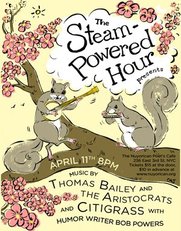
The Steam-Powered Hour is one of the best variety shows going in New York. The combination of high-quality bluegrass, New Yorker cartoonists like Drew Dernavich, Carolita Johnson (who drew the merrily sciurine poster above) and Emily Flake drawing live on stage, comedy, storytelling, and spontaneous mass acoustic jams make it a hootenanny-salon you have to experience, trust me.
It’s a monthly party, but it’s taking a break for the summer, so make sure to come to the next two! Especially this one, because Citigrass are some of the rousingest, rollickingest pickers I’ve ever had the pleasure of hearing.
From the Steamers’ latest email:
In April, The Steam Powered Hour welcomes back Citigrass, winners of this year’s Battle of the Hardly Strictly Bluegrass Bands. Also, more bluegrass goodness with Thomas Bailey and the Aristocrats, a story by The New Yorker staff writer Mark Singer and cartoonist Zachary Kanin. Plus, plenty more surprises. Hosted as usual by New Yorker cartoonist Matt Diffee.
April 11th, 8pm
Nuyorican Poet’s Cafe
236 East 3rd Street Between Ave B & C
New York City
Tickets are $15 at the door. Get ’em for $10 in advance at http://www.nuyorican.org.
You can follow The Steam Powered Hour on Twitter and on Facebook.