
Author Archives: Jonathan

Best of the 10.26.09 Issue: Peter Hessler, Finding the Center

Jonathan Taylor writes:
The world does not revolve around you: It’s the most basic experience of the traveler. Elaborating on the concrete ways this truth manifests itself is the most basic structure of travel narrative—but one that too often, paradoxically, cements the observer at the center of things. Peter Hessler’s dispatches from China are a lesson in overcoming this solipsism, and his “Letter from Lishui,” in the October 26 issue, takes points of view on “the outside world” as its topic of characteristically agile inquiry. (Subscribers only; free audio slide show here.)
Lishui is about 200 miles southwest of Shanghai, a bit inland from China’s Pacific coast. Its physical location is less important than its place in the global economy. It is a creature of the global economy because its factories produce components—”zippers, copper wiring, electric-outlet covers”—to be assembled by manufacturers elsewhere into finished goods. Yet it is at a firmly defined remove from the wider world. Representatives of foreign companies need not travel this far up China’s supply chain, and shrapnel of Western popular culture lands there in isolated bits: a gym called The Scent of a Woman, or a tattoo randomly reading Kent (the cigarette brand).
Hessler introduces “Little Long,” a dye factory technician who collects mangled self-help books like A Collection of the Classics, larded with dubious improving anecdotes about Western figures like Charles Darwin and John D. Rockefeller; and Wu Zengrong, who interacts with individuals a hemisphere away through an electronic veil, as a professional player of World of Warcraft.
Alongside Lishui’s fly-by-night pleather and bead factories, the government established something of a special district for the mass production of paintings, mostly kitschy old-world cityscapes. Any journalist could get a quick thrill out of describing a Chinese painting factory churning out thousands of scenes of Venice (known to the artists only a Shui Cheng, “Water City”), copying the details without a clue about what they are depicting. But Hessler cleverly uses these literal views of unknown places to illustrate the uses of information about the outside world in Lishui.

The degree of detail often impressed me. The outside world might be distant, but it wasn’t necessarily blurred; people caught discrete glimpses of things from overseas. In many cases, these images seemed slightly askew—they were focussed and refracted, like light bent around a corner. Probably it had something to do with all the specialization. Lishui residents learned to see the world in parts, and these parts had a strange clarity, even when they weren’t fully understood.

Hessler notes the distinctive way that residents of Lishui jump nimbly from one wave to the next in the senseless tides of the global economy, making do for themselves with little care why the world suddenly no longer wants pleather, but needs beaded shoes or hair bands instead. But when you consider those words by themselves, you can’t help but think that they apply, in their own way, to “us,” or any people planted any place on Earth.
Hessler loops back around to the U.S. to complete his point, which is not about China, or about art factories, but rather might be that the wider our global horizons, the more salient their limitations. A painting factory had received a commission from an unknown customer, via a middleman, to create art based on a series of photographs of what turned out to be Park City, Utah. Hessler shows pictures of the paintings, and the painters, to Park City folks. Mayor Dana Williams is excited that their local sites have gained global fame of a sort; others are suspicious or depressed by the subjection of their hometown to the low-cost foreign paintbrush. But Hessler’s plain tone, unchanged from when he’s in Lishui, allows Park City to take shape as another little place peering out at “the outside world” in curious fragments.
Mayor Williams knows a few words of Chinese and talks offhand about “the Tao”; his office is littered with calligraphic scrolls and a copy of Mao’s “Little Red Book” that he mines for “the useful stuff” (“Serve the people”). He is a mirror of Little Long, who knows just the English words for his nylon dyes (“Sellanyl Yellow N-5GL”) and learns from his A Collection of the Classics that Rockefeller wisely berated a waiter for complaining small-mindedly about a measly tip.
Everyone is the center of their own world, after all.
Best Book of All Time to be Discussed at Columbia

Jonathan Taylor writes:
Next Wednesday, October 28, the Center for Fiction is sponsoring a discussion of Proust’s À la recherche du temps perdu in English, at Columbia’s Maison Française, with Antoine Compagnon and The New Yorker‘s Adam Gopnik. (Full details below the jump—seating is limited, so RSVP to join this “little clan.”)
Warm up with a little combative reading on the newest translation into English, including Swann’s Way rendered by Lydia Davis, whose collected stories were discussed by James Wood in last week’s New Yorker.
I thought The New Yorker had carried a review of the Penguin translations, but I can’t find such a thing. It did do a Briefly Noted of a cunning book about the liberal use of English in the original. And Gopnik once wrote, in the abstract’s words, a “Comment about the similarities between Proust’s house in Illiers, and writer’s co-op on Broome Street.”
In other Proust news, a new Reader’s Guide to The Remembrance of Things Past, by Patrick Alexander, is recently out from Random House.
Marcel Proust: A Conversation
Antoine Compagnon and Adam Gopnik discuss
Á la recherche du temps perdu (In Search of Lost Time) In English
Wednesday, October 28th at 7pm
The Maison Francaise of Columbia University
East Gallery in Buell Hall (campus entrance at 116th and Broadway)
This event is cosponsored by The Proust Society of America, a program of The Center for Fiction; Maison Française at Columbia University; and The French-American Foundation.
Antoine Compagnon is the Blanche W. Knopf Professor of French and Comparative Literature at Columbia University. On Proust, after editing Du côté de chez Swann and Sodome et Gomorrhe, he published Proust entre deux siècles. Compagnon is also a professor at the Collège de France and a member of the American Academy of Arts and Sciences.
Acclaimed journalist, lecturer and author Adam Gopnik is a three-time National Magazine Award winner and recipient of the George Polk Award for Magazine Reporting. He has been a staff writer for The New Yorker since 1986.
Seating is very limited to this event so you must RSVP. Please e-mail the Center atevents@centerforfiction.org or call us at 212-755-6710 to reserve a spot.

Something Is Going On With That George Saunders Story

Jonathan Taylor writes:
I don’t read New Yorker fiction that regularly. I don’t bring up a New Yorker story and say, Did you read…? I did both with George Saunders’s “Victory Lap.” And then the person I say it to, who also doesn’t talk to me about New Yorker fiction, suddenly says she’s been thinking about it ever since she read it.
Emily recalls a similar flurry of people being struck and moved en masse when Lorrie Moore’s story “People Like That Are the Only People Here” came out in the magazine in 1997.
It’s true—you should read it on paper. On the subway, tonight.

Prescient Post Brings New Nobelist Müller Essay Today

Jonathan Taylor writes:
Not long after waking up and learning that Herta Müller had won the Literature Nobel, I noticed in my Google Reader that Signandsight.com, hours before the announcement, had published a translation of a recent piece by her about the lingering power of Romania’s former Securitate, from Germany’s Die Zeit.

Suddenly I found my file, too, under the name of Cristina. Three volumes, 914 pages. It was allegedly opened on 8 March, 1983 – although it contains documents from earlier years. The reason given for opening the file: “Tendentious distortions of realities in the country, particularly in the village environment” in my book “Nadirs”. Textual analysis by spies corroborate this. And the fact that I belong to a “circle of German-language poets”, which is “renowned for its hostile works”.

The Element of Doubt: The Art of Reportage at NYU

Jonathan Taylor writes:
At Tuesday night’s symposium on Ryszard KapuÅ›ciÅ„ski and “The Art of Reportage” at NYU, Alastair Reid read from an address he said William Shawn had given in 1979 to The New Yorker‘s “business side,” which Reid said might not previously have “seen light of day” outside the magazine. Describing what the magazine’s editors looked for in a writer, Shawn cited the presence of “style”—a “literary quality,” even amid the straightforwardness and simplicity demanded of factual reporting. “Writers who don’t sound like nobody, and don’t sound like anybody else” (or quite nearly those words); “honesty” and “soundness,” not just, or even principally, of factual accuracy, but of “character that shows up in the writing.”
Reid was one of three speakers on “Literary Reportage Between Self and Other, Fact and Fiction,” the second of the evening’s two panels, discussing the role of the first-person narrator, the “I,” in the credibility of long-form narratives. He made an elegant and muscular case for the primacy of the literary quality, of the journalists’s voice, over the pretense to “objectivity.” He quoted Claud Cockburn’s attacks on fellow reporters for purporting to gather “facts” as if they were “gold nuggets” on a “frozen ground,” and Borges (a frequent interlocutor) on the chasm between called “lived reality” and “word reality.” He brought a refreshing lack of hemming and hawing on the subject, given that his subject was, in fact, the element of doubt that should be at the bottom of the reporting enterprise.
Moderator Lawrence Weschler interposed with a complicated anecdote of an observation by Andrew O’Hagan, to the effect that only in fiction can everything be immune to doubt, and that in nonfiction there is always the question, Did it really happen like that? Weschler, upon once recounting this observation, was upbraided by Janet Malcolm, insisting that it was, in fact hers, in The Silent Woman :

In a work of nonfiction we almost never know the truth of what happened. The idea of unmediated reporting is regularly achieved only in fiction. When Henry James reports in The Golden Bowl that the Prince and Charlotte are sleeping together, we have no reason to doubt him, or to wonder whether Maggie is “overreacting” to what she sees”….We must always take the novelist’s and the playwright’s and the poet’s word, just as we are almost always free to doubt the biographer’s or the autobiographer’s or the historian’s or the journalist’s. In imaginative literature we are constrained from considering alternative scenarios—there are none. This is the way it is. Only in nonfiction does the question of what happened and how people thought and felt remain open. We can never know everything; there is always more.

Adrian Nicole LeBlanc was brimming over with the doubts posed by her reporter’s point of view in her current project, a book about stand-up comedians. In the Bronx of her astonishing Random Family, her status as a journalist was of little account apart from her writings’ potential to alert the law, or social services. That reportorial tour de force left her unprepared to manage her point of view amid the blandishments of a entertainment industry determined to control her reporting, and comedians determined to control her as an audience (mirroring her own performance for readers). Her remarks discreetly raised the question of not only the journalist’s “I” in reporting, but the journalist as “we” and “you”—the degree to which much journalism is preoccupied with itself (the event itself included).
LeBlanc appeared reluctant to welcome Reid’s liberation from the fact-gathering model, saying “I believe there is a world of comedy” and that it’s her job to delve in and bring out “the information.” But—citing Joseph Mitchell’s Joe Gould’s Secret as a model along the way—she demonstrated how much rests with her “I,” in explaining her doubts and struggles on how to present that information, and whether, or how much, to take the reader along her own path through the story. That path, she said, was made only possible by her own extreme depression at the time, a condition made the comedians genial company. But her emergence from it has created a new distance from her subjects.
Ultimatlely, LeBlanc said her goal in reporting is that the people she writes about will recognize themselves, and that readers, if they were able to discover the backstory of the writing and editing of the book, wouldn’t feel betrayed.
Drawing swift chuckles from Polish-speakers in the audience before the translator conveyed his remarks, Polish reportażysta Wojciech Jagielski referred to communist-era journalists’ habit of critiquing the regime indirectly through writing on seemingly innocuous topics, exemplified by KapuÅ›ciÅ„sk’s writing on Ethiopia or the Shah. Jagielski said the habit dies hard for him; even if it’s not a matter of covert doublespeak, it’s still vital that his journalism be about “something else” in addition to the local events being described, be they in Chechnya or Uganda. He said he found that “other” subject for his book on those countries and others, in the inscription on a gravestone in the Caucusus: He who thinks about the consequences will not become a hero.
An account of the evening’s previous panel, “On the Ground and On the Page,” will be in a future post.

Get Me Rewrite: Tolstoy IS Out of Copyright

Jonathan Taylor writes:
Some may try to slide by with “curating,” but others know the power of really editing. Henry Alford had a brilliant piece on the October 2 edition of the radio show “Studio 360,” asking writers about books they fantasize about being able to change—and how. I particularly like longtime New Yorker contributor Patricia Marx‘s idea for retitling Anna Karenina, and Sandra Tsing Loh has hilarious plans for The Bridges of Madison County:

Beyond the New Yorker Festival II: ‘The Art of Reportage’ at NYU

Jonathan Taylor writes:
In my last post, I mentioned attractive anniversary readings being put on by New York Review Books Classics. I also want to note another upcoming event at NYU on “literary reportage,” which inescapably includes a lot of New Yorker contributors: Alastair Reid, Adrian Nicole LeBlanc, Lawrence Weschler, Philip Gourevitch, Robert S. Boynton, Eliza Griswold and Elizabeth Rubin. And in addition, Suketu Mehta, author of the awesome Maximum City: Bombay Lost and Found.
The October 6–7 symposium takes as its point of departure the renowned, and debated, work of Ryszard KapuÅ›ciÅ„ski, some of which itself appeared in the magazine. This 2007 memoir of his first trip abroad—to India as a reporter for Poland’s Sztandar Mlodych (The Banner of Youth) in 1955— is freely readable online.
Full release after the jump:
AFTER KAPUŚCIŃSKI: THE ART OF REPORTAGE IN THE 21ST CENTURY
A 2-DAY SYMPOSIUM
October 6-7, 2009
NYU’s Hemmerdinger Hall
100 Washington Square East
Subway: West 4th: B,C,D,E,F,V; 8th St: R,W; Astor Place: 6.
Free and open to the public on a first come, first-in basis.
This two-day symposium offers an exciting public conversation about
the state of the art of reportage amid a rapidly changing media
landscape, various approaches to and practices of long-form and
literary journalism, and the ongoing legacy of renowned practitioners
like Polish journalist Ryszard Kapuściński. At a time when categorical
differences between fiction and nonfiction are increasingly ambiguous,
and the gap between their respective segments of the publishing market
increasingly small, a discussion of reportage as a literary art form
is paramount.
This free public program is being co-sponsored by the Polish Cultural
Institute in New York, the National Book Critics Circle, the New York
Institute for the Humanities at NYU, and the Literary Reportage
concentration of the Arthur L. Carter Journalism Institute at NYU, in
association with the Overseas Press Club of America and Words without
Borders.
More information: http://www.PolishCulture-NYC.org
AFTER KAPUŚCIŃSKI: THE ART OF REPORTAGE IN THE 21ST CENTURY
A 2-DAY SYMPOSIUM
October 6-7, 2009
NYU’s Hemmerdinger Hall
100 Washington Square East
PROGRAM & PARTICIPANTS
TUESDAY, OCTOBER 6TH
Panel I: The Art of Reportage: On the Ground and On the Page
5:00 PM-7:00 PM
How does narrative arise from reportage? What transformation occurs
during the writing process? Answers from journalists who combine
investigative skills and literary craft.
Jane Ciabattari, Moderator, is President of the National Book Critics
Circle and a member of the Executive Board of the Overseas Press Club.
Her reporting from abroad and cultural criticism have appeared in the
New York Times, The Guardian online, npr.org, Bookforum, the
Washington Post, Los Angeles Times, and Columbia Journalism Review.
Joshua Clark is author of Heart Like Water: Surviving Katrina and Life
in Its Disaster Zone (2007 National Book Critics Circle award
finalist). He has worked as a correspondent for NPR and Salon.com.
Eliza Griswold is author of The Tenth Parallel: Dispatches from the
Fault Line Between Christianity and Islam (FSG, forthcoming 2010), a
New America Fellow, and a 2010 Rome Fellow at the American Academy in
Rome. Her reportage has appeared in the New Yorker, Harper’s and the
New Republic.
Arif Jamal is author of The Shadow War: The Untold Story of Jihad in
Kashmir (Melville House, 2009). Former contributing writer to the New
York Times, he is a fellow at the Center on International Cooperation
at New York University.
Elizabeth Rubin, a recent Edward R. Murrow press fellow at the Council
on Foreign Relations, is a contributing writer for the New York Times
Magazine. Her award-winning reportage from Iraq, Iran, Afghanistan,
Saudia Arabia, Russia, the Caucasus, the Middle East, Africa, and the
Balkans has appeared in the Atlantic Monthly, the New Republic,
Harper’s, and the New Yorker.
Paweł Smoleński is author of 7 books in Polish, including Burial of a
Butcher, on tensions between Poles and Ukrainians, and Hell in
Paradise, on post-Saddam Iraq. He received a 2005 Kurt Schork Award in
International Journalism from Columbia University’s Journalism School.
TUESDAY, OCTOBER 6TH
Panel II: Literary Reportage Between Self and Other, Fact and Fiction
7:30 PM-9:00 PM
If a strictly objective take is self-evidently impossible, what sort
of warrant as to strict veracity ought the reader expect from the
creator of long-form narrative nonfiction? To what extent, if any,
ought that writer’s vantage be grounded in a personal “I” voice, and
to what extent does even that commitment shade into a sort of
fiction?
Lawrence Weschler, Moderator, is concurrently Director of the New York
Institute for the Humanities at NYU and Artistic Director of the
Chicago Humanities Festival, and the author of over a dozen books,
including The Passion of Poland, Calamities of Exile, and Everything
That Rises: A Book of Convergences (2007 National Book Critics Circle
Award winner).
Wojciech Jagielski is the author of 4 books in Polish, including Night
Wanderers (2009), about child soldiers in Uganda, and, in English
translation, Towers of Stone: The Battle of Wills in Chechnya (Seven
Stories, October 2009).
Adrian Nicole LeBlanc is author of Random Family: Love, Drugs, Trouble
and Coming of Age in the Bronx (2003, NBCC finalist), a 2006 MacArthur
Fellow, and a visiting scholar at the Arthur L. Carter Journalism
Institute.
Suketu Mehta is author of Maximum City: Bombay Lost and Found (2004),
a 2007 Guggenheim Fellow, and Associate Professor in the Literary
Reportage concentration of the Arthur L. Carter Journalism Institute
at NYU.
Alastair Reid is an eminent poet, longtime New Yorker correspondent
from Spain, Scotland, and Latin America, one of the foremost
translators of the work of both Pablo Neruda and Jorge Luis Borges,
and a fellow of the New York Institute for the Humanities.
WEDNESDAY, OCTOBER 7TH
Panel III: KapuÅ›ciÅ„ski’s Legacy in the 21st Century
6:30 PM-8:30 PM
Ryszard Kapuściński was one of the most celebrated, albeit
controversial journalists of the last fifty years, a gorgeous stylist
and a rhapsodic, if at times not strictly reliable, witness. To what
extent is the kind of reportage he engaged in even possible today?
What lessons can the next generation of writers draw from his
example?
Robert S. Boynton, Moderator, is Director of NYU’s new Literary
Reportage concentration, former Senior Editor at Harper’s, and author
of The New New Journalism (2005).
Anna Bikont is a senior writer and co-founder of Poland’s leading
daily newspaper Gazeta Wyborcza, author of We, People from Jedwabne
(2004; English translation forthcoming from Yale Univ. Press), and a
2008-09 Cullman Center fellow at the NYPL, where she was researching a
biography of Ryszard Kapuściński.
Ted Conover is the author of Newjack: Guarding Sing Sing (2001
National Book Critics Circle Award winner), a 2003 Guggenheim Fellow,
and Distinguished Writer in Residence at NYU’s Arthur L. Carter
Journalism Institute.
Klara Glowczewska is Editor in Chief of Condé Nast Traveler, the only
travel publication to win a National Magazine Award, translator of
three of Ryszard KapuÅ›ciÅ„ski’s books, including Travels With Herodotus
(2007). She is a member of the Executive Board of the Overseas Press
Club.
Philip Gourevitch is Editor in Chief of The Paris Review, a longtime
staff writer at the New Yorker, and author of We Wish to Inform You
That Tomorrow We Will Be Killed With Our Families (1998 National Book
Critics Circle Award and Overseas Press Club Award) and, with Errol
Morris, of The Ballad of Abu Ghraib (2008).

New York Review Books: Then the Backlash Came

Jonathan Taylor writes:
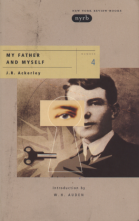
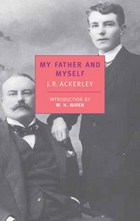
Just kidding! Everyone loves New York Review Books Classics, and for good reason. Few things are as unreservedly worth celebrating as the 10th anniversary of this publishing project, which is single-handedly reshaping the understanding of the world’s recent literary past. By the way, their cover design scheme has become so well-known, does anyone remember that, a whole decade ago, it was rather different? Here’s my edition of J.R. Ackerley’s My Father and Myself, alongside the current one:
AckerleyOld.pngAckerleyNew.jpg
Anyway, Martin’s got the New Yorker Festival covered, but NYR Books are having their own anniversary festivities through November—in New York, London and both Cambridges—listed here, including:

Incidentally, Timothy Snyder is the author of a recent eye-opening article in The New York Review of Books about where, and how, the greater part of the Holocaust took place, that should be a must-read for all humans.
And the mention of Malaparte reminds me the great work of another series, a little lower-profile, but whose distinctive jackets are equally signals of worthy reading you might not otherwise know about: Northwestern University’s European Classics. They brought Malaparte’s Kaputt to my bookshelf before New York Review Books yet existed, as well as another eventual NYRB title, Stefan Zweig’s Beware of Pity.