
Martin Schneider writes:
A couple of months ago, Anthony Lane’s dismissive review of Watchmen managed to alienate fans of the movie, fans of the comic book, and fans of all comic books.
In the upcoming issue, Lane directs comparable if not quite equal disapprobation at the new Star Trek movie and the rest of the franchise as well. It’s difficult to imagine a hypothetical Star Trek movie that Lane would want to bestow with a positive review, isn’t it? In any case, queue up a second annoyed sci-fi fan base.
The inventors of Beer Trek are friends of mine, and they report deep pessimism with respect to the new movie. Based on a single viewing of the preview, I’m inclined to agree, at least by the curious logic of the entire rest of the Star Trek franchise (the new swagger-y, foreordained-Hero depiction of Kirk violates the Star Trek ethos in a big way), even as the movie looks pretty good by ordinary standards.
But then again, I’m closer to Lane when it comes to Star Trek! I could only get interested in The Next Generation….
Author Archives: Martin
New Yorker Summit Comestibles Feted as “Yummy” by Gracious Attendee
Martin Schneider writes:
I couldn’t be at the New Yorker Summit yesterday, but through the magic of Twitter, I have iron-clad verbal/visual evidence that the food served during the lunch break was “quite good for being in a box.”
In an unprecedented (for Emdashes) follow-up “Twinterview” (wince), attendee Jed Cohen elaborated: “Steak sandwich + tortellini salad + cookies + apple = yummy. Thanks New Yorker/NYU catering!”
Cohen continued: “They also had a grilled vegetable wrap and some kind of chicken sandwich.” (Can Emily confirm?)
Never doubt that Emdashes will provide muckraking of the first order!
(Jed also posted in a more thoughtful way about the Summit. Why not go over and check it out?)

Adam Gopnik and Steven Pinker Debate Darwin, May 20
From the press release:
Adam Gopnik, author of Angels & Ages, A Short Book About Darwin, Lincoln and Modern Life and Steven Pinker, author of The Blank Slate and many other works, will debate a simple and deep subject: How far can Darwin take us as a guide to why we are the way we are? [I suspect neither side will be adopting the creationist position…. —Ed.]
Here are the details:
ADAM GOPNIK with STEVEN PINKER
Angels and Ages
Wednesday, May 20, 2009 at 7:00 PM
South Court Auditorium
The New York Public Library
Stephen A. Schwarzman Building
Fifth Avenue & 42nd Street / Enter at Fifth Avenue
Buy Tickets & SAVE $10 on every LIVE ticket!
Become a Friend of the Library for as little at $40 and you ticket
will be $15 instead of $25 plus you will pay NO service fees.
Adam Gopnik, author of Angels & Ages, A Short Book About Darwin, Lincoln and Modern Life and Steven Pinker, author of The Blank Slate and many other works, will debate a simple and deep subject: How far can Darwin take us as a guide to why we are the way we are?
Gopnik draws a line and suggests that Darwin can take us only to the edge of art and culture and not beyond; Pinker suggests that Darwin, and Darwinian thinking, in the form of evolutionary psychology, can take us deep into the seeming mysteries of why we like stories and pictures, and the kind of stories and pictures we like.
Both ardent Darwinians [See? Told you. —Ed.], Adam Gopnik and Steven Pinker will offer different—perhaps complementary, perhaps permanently contrasting—visions of what Darwin’s legacy is on the two hundredth anniversary of his birth.
About Adam Gopnik
Adam Gopnik has been a staff writer at The New Yorker since 1986. In 2000, he began writing New York Journal, about culture and daily life in New York City. He previously spent five years in Paris, writing Paris Journal, a similar column about the life of an expatriate in Paris. Gopnik is the author of Paris to the Moon, The King in the Window, and Through the Children’s Gate. In 1998, he received the George Polk Award for Magazine Reporting for his Paris Journal. Before he came to The New Yorker he was an editor at Alfred A. Knopf and a fiction editor at GQ. In 1990, Gopnik co-curated an exhibition entitled “High and Low: ModernArt and Popular Culture” at the Museum of Modern Art in New York, with the museum’s director, Kirk Varnedoe. He also co-authored the book under the same title.
About Steven Pinker
Steven Pinker is Harvard College Professor and Johnstone Family Professor of Psychology at Harvard University. His research on visual cognition and the psychology of language has won prizes from the National Academy of Sciences, the Royal Institution of Great Britain, and the American Psychological Association. He is the author of The
Language Instinct, How the Mind Works, and The Blank Slate, and writes frequently for The New Republic and The New York Times. He has been named Humanist of the Year, and is listed in Foreign Policy and
Prospect magazine’s “The World’s Top 100 Public Intellectuals” and in
Time magazine’s “The 100 Most Influential People in the World Today.” His latest book is The Stuff of Thought: Language as a Window into Human Nature.
Follow the New Yorker Summit on Their Blog, Twitter — and Ours
Martin Schneider writes:
The New Yorker is posting updates to their News Desk blog, here. (You can follow The New Yorker’s Twitter updates here or follow the #tnysummit hashtag.)
Emily is there, and we are hoping to have some tweets from her today as well.
New Yorker Summit: Happening Today
Martin Schneider writes:
The New Yorker Summit is taking place today at New York University. (A bit more convenient location than the Conference of previous years, which was held way over by the West Side Highway, in Chelsea.)
The lineup includes many luminaries, including Howard Dean, Geoffrey Canada, Nassim N. Taleb, Naomi Klein, and Elizabeth Edwards, along with familiar personages from the magazine like Seymour Hersh, Malcolm Gladwell, James Surowiecki, Ryan Lizza, and on and on. (Here’s the schedule.)
If I weren’t on the other side of the Atlantic, I would so be covering this. Failing that, we refer you to Jason Kottke, who has promised “some sort of live-ish coverage.”
More to come as the magazine posts reports, videos, and the like. Attendees, I wish you all intellectual, social, and culinary pleasure.
Update: The group NYU Students Organizing for America is covering the summit live via Twitter.
Milton Glaser, David Remnick, and An Unnamed Aide … Sing Together
Martin Schneider writes:
The indispensible Jason Kottke today posted a passage from Milton Glaser’s Ten Things I Have Learned, about how to detect when you are being nourished or sapped by a given person:
And the important thing that I can tell you is that there is a test to determine whether someone is toxic or nourishing in your relationship with them. Here is the test: You have spent some time with this person, either you have a drink or go for dinner or you go to a ball game. It doesn’t matter very much but at the end of that time you observe whether you are more energised or less energised. Whether you are tired or whether you are exhilarated. If you are more tired then you have been poisoned. If you have more energy you have been nourished. The test is almost infallible and I suggest that you use it for the rest of your life.
Shrewd words indeed. They reminded me of a passage from “The Wilderness Campaign,” a David Remnick Profile of Al Gore from 2004 (the bearded, liberated, post-2000 Al Gore), describing why, for all of Gore’s success in politics, it might have been an awkward fit for him. Here it is (emphasis mine; New Yorker don’t truck with no bold text):
Other aides were less harsh, saying that Gore was brusque and demanding but not unkind. Yet, once freed of the apparatus and the requirements of a political campaign, Gore really did savor his time alone, thinking, reading, writing speeches, surfing the Internet. “One thing about Gore personally is that he is an introvert,” another former aide said. “Politics was a horrible career choice for him. He should have been a college professor or a scientist or an engineer. He would have been happier. He finds dealing with other people draining. And so he has trouble keeping up his relations with people. The classical difference between an introvert and an extrovert is that if you send an introvert into a reception or an event with a hundred other people he will emerge with less energy than he had going in; an extrovert will come out of that event energized, with more energy than he had going in. Gore needs a rest after an event; Clinton would leave invigorated, because dealing with people came naturally to him.”
That’s all. It jogged a memory, and I couldn’t rest until I had posted it here.
Catch Gladwell and Borowitz at the Moth, May 21
Martin Schneider writes:
Talk about fortuitous timing—no sooner does a big Malcolm Gladwell article hit the newsstands than we receive word about an appearance he will be making in New York City this month, at the Moth Members’ Show at Symphony Space on May 21. Since a recent appearance at the Moth raised a few eyebrows, we’re glad to see that he’s diving in again.
Andy Borowitz, who appeared last week at the 92nd Street Y to celebrate/mock Obama’s 100th day in office, will host.
Here’s the press release:
Our Annual Moth Members’ Show
Thursday, May 21 at Symphony Space
Crack up: Stories about Comedies and Calamities
Storytellers include:
Malcolm Gladwell
Author of The Tipping Point, Blink and Outliers: The Story of Success
Sarah Jones
Tony award-winning playwright, performer, author and poet
Steve Osborne
Former lieutenant in NYPD detective bureau, Manhattan Gang Squad
Peter Zilahy
Essayist, playwright, and author of dictionary-novel, The Last Window-Giraffe
Hosted by:
Andy Borowitz
Comedian, actor and writer, featured regularly in The New Yorker, The
New York Times, and at borowitzreport.com
Become a Moth Member and receive 2 FREE tickets
With a $100 donation you will receive two tickets to the Members’ Show
($70 value) as well as our brand new double CD, with stories by
Richard Price, Sam Shepard, Mike Birbiglia, A.J. Jacobs ($15 value,
available only with membership), among other benefits.
When you join at a higher level of membership you get even more
benefits and perks. For a complete list of member levels and benefits
and to join go to www.themoth.org/membership.
We Need Your Support
Moth members are hugely important in helping us present unique voices
at our Mainstage and StorySLAM series, as well as our community
outreach program, MothShop, which brings storytelling workshops free
of charge to underserved communities. Moth Members also help us
produce our free–and commercial-free–podcast each week. Take a moment
to read about the importance of the membership program and what our
members have helped us to accomplish this year.
In these turbulent times, everyone needs a place to tell their stories
and hear the tales of our time. The Moth is that place. Please help
us offer more storytelling opportunities by becoming a Moth member.
How to Join:
Join online.
Call The Moth office at 212-507-9833 with your credit card information.
Mail a check, payable to Storyville Center for the Spoken Word, and
mail it with your name, mailing and email addresses to:
The Moth
330 West 38th Street, Suite 1403
New York, NY 10018
Storyville Center for the Spoken Word, d/b/a The Moth, is a 501 (c)
(3) not-for-profit organization. All donations are 100% tax deductible
and all donors receive a receipt for tax purposes.
Thank you for your support!
The Moth Board & Staff
P.S. Don’t Forget to RSVP to The Members’ Show when you join!
(to David Mutton at 212-507-9833 or rsvp@themoth.org)
Don’t wait for your donor receipt, call or email to RSVP as soon as
you have processed your online membership or mailed your check.
Show Information:
Crack up: Stories about Comedies and Calamities
at Symphony Space
2537 Broadway (at 95th St)
6:30pm Doors open
7:30pm Stories begin
Member tickets need to be reserved by calling 212-507-9833 or emailing
rsvp@themoth.org, and can be collected on the evening of the show from
Symphony Space box office.
A limited number of tickets are on sale at $35 from Symphony Space.
What’s in This Week’s New Yorker: 05.11.09
Martin Schneider writes:
The “Innovators” issue of The New Yorker comes out tomorrow. A preview of its contents, adapted from the magazine’s press release:
Malcolm Gladwell looks at the ability of underdogs to triumph over their stronger adversaries. “David can beat Goliath by substituting effort for ability—and substituting effort for ability turns out to be a winning formula for underdogs in all walks of life,” Gladwell writes.
Adam Gopnik ruminates on what spurs invention: necessity, or superfluity? Observing the abundance of razors in his medicine cabinet, all of which are about equally useful, Gopnik notes “a strange but basic truth of life and marketing alike: that it is after a problem has already been solved that ever more varied and splendid solutions to it start to appear.”
Douglas McGray writes about Green Dot Public Schools, a charter-school group that is California’s largest, by enrollment, and one of its most successful, sending nearly eighty percent of their kids to college.
Rebecca Mead observes the work of Christian Scheidemann, who “is among just a handful of private conservators who specialize in contemporary art,” and who “has become particularly admired for his skill in working with organic substances.”
John Colapinto profiles the behavioral neurologist V.S. Ramachandran, “one of a dozen or so scientists and doctors who, in the past thirty years, have revolutionized the ï¬eld of neurology by overturning a paradigm that dates back more than a hundred years: that of the brain as an organ with discrete modules (for vision, touch, pain, language, memory, etc.) that are ï¬xed early in life and immutable.”
Evan Osnos explores the life and career of Jia Zhangke, the Chinese filmmaker behind the award-winning film Still Life, about the social and physical demolition wrought by China’s Three Gorges Dam, and, more recently, 24 City, about a factory closing.
In Comment, Philip Gourevitch asks who should be held accountable for the torture memos.
In the Talk of the Town, Alma Guillermoprieto reports from Mexico City, under siege by swine flu.
In the Talk of the Town, Lauren Collins looks at the linguistic implications of the disease’s porcine name
In the Financial Page, James Surowiecki explains why the financial industry needs to shrink.
In Shouts & Murmurs, Amy Ozols makes friends on an airplane.
There is a comic strip by Chris Ware.
Judith Thurman writes Helen Gurley Brown and the Cosmo Girl.
Adam Kirsch explores the poetry of Gerard Manley Hopkins.
Hilton Als reviews Desire Under the Elms.
Sasha Frere-Jones listens to Grizzly Bear’s new album.
David Denby reviews X-Men Origins: Wolverine, Fighting, and Tyson.
There is a story by the recently departed writer J. G. Ballard.
Happy Day! The New Yorker and Print Take Home Ellies!
Martin Schneider writes:
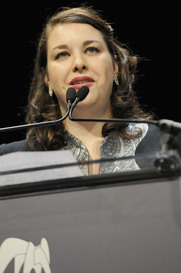
Last night, at the American Society of Magazine Editors awards ceremony (our coverage of the nomination announcement is here and here), The New Yorker took home awards for fiction by E. Annie Proulx and Aleksander Hemon, photography by Platon, and criticism by James Wood. Congratulations to all!
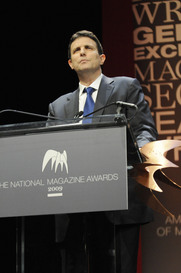
Judging from the reaction on Twitter, the victory of Field and Stream over The New Yorker and Vogue in the 1,000,000+ circulation category was a bit of a shocker.
Meanwhile, Print won the award for general excellence, under 100,000 circulation. Congratulations to Emily and everyone at that outstanding publication for the well-deserved recognition!
President Obama Throws Googly, Is Reading Joseph O’Neill’s “Netherland”
Martin Schneider writes:
At least according to David Leonhardt in the New York Times. A few quick reactions.
1. I’m reading it too! I’m almost done (bet that overachiever Obama beats me to the end, though—I’m savoring). I’m fairly certain it’s the first time that the president and I are reading the same novel at the same time. Did Clinton read Kurt Andersen’s Turn of the Century? I didn’t read any Zane Grey during the Bush years….
2. I admire Obama’s taste. I’ve run into a few people on Twitter and elsewhere calling Netherland overrated, but surely it’s a quality piece of work, even if one feels that it’s been overpraised. I’m not entirely sure how I feel about it yet, but then again, I’m not done yet. Leaning towards thumbs-up, though. What did you make of it?
3. I wonder how much Obama knows about cricket. I know next to nothing.