
In her “Shelf Life” column at the (Syracuse, NY) _Post-Standard,_ Laura T. Ryan wants to “know”:http://blog.syracuse.com/shelflife/2008/10/the_new_yorker_readers_whats_y.html what your favorite section of _The New Yorker_ is. Do indulge her, and tell her we sent you!
Author Archives: Martin
New Yorker Festival: Stephen Colbert is a Special Guy
The Colbert event on Saturday night was likely to be the high point of the Festival, and certainly nothing that happened in the NYC Cathedral contradicts that. It was pretty great. Colbert and Jon Stewart hold a special place in urbane consciousness right now, and I hope they are able to maintain that status in an Obama presidency (knock wood). Colbert’s chops as an entertainer and as a kind of public moral authority (albeit skewed) are tough to beat right now. The love flowing from the audience in that room was considerable.
Looking at my notes, there is hardly anything that isn’t covered in Rachel Sklar’s exemplary and exhaustive account at _The Huffington Post_ so I’m going to “link you”:http://www.huffingtonpost.com/2008/10/05/stephen-colbert-at-the-em_n_132019.html to that! I concur on all particulars.
I have only one additional point to make about Colbert, and it’s a rather esoteric one. Seeing him in person drives home the extent to which Colbert is not only a product of the Chicago improvisational method but quite possibly its apotheosis as well. If you’ve spent any time at the Upright Citizens Brigade Theater and witnessed the improvisational concepts of “raising the stakes,” “finding the game of the scene,” and “promoting a yes-and ethic,” just about everything Colbert says—whether in character or out of it—will seem familiar and vital, in the very best sense.
I’m not an expert on improv, merely a consumer of it, but I venture that that’s part of the reason why he can conduct interviews so well _in character,_ he’s just the best improviser out there, and he’s raised the stakes in the best possible way (by getting a TV show, interviewing important people, running for president etc.).
Somewhere “Del Close”:http://en.wikipedia.org/wiki/Del_Close is smiling.
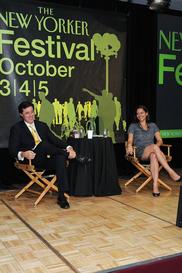
Stephen Colbert, Ariel Levy
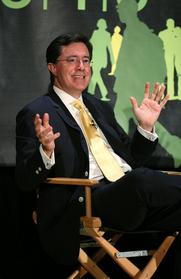
Stephen Colbert
(photo credit: Alex Oliveira/startraksphoto.com)
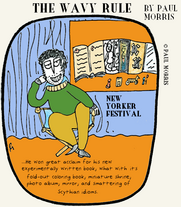
The Wavy Rule, a Daily Comic by Paul Morris: Book Value
_Observers did not disclose whether the item contained any words. Click to enlarge._
More by Paul Morris: “The Wavy Rule” archive; “Arnjuice,” a wistful, funny webcomic; a smorgasbord at Flickr; and beautifully off-kilter cartoon collections for sale (and free download) at Lulu.
New Yorker Festival: Art Spiegelman’s Life is Comics 101
Art Spiegelman, denied cigarettes at the Ailey Citigroup Theater, had a pipe in tow but did not noticeably resort to it. Spiegelman’s brief was “Comics 101,” but his way of doing that was to delve into autobiography. This was as true in 1978, when _Breakdowns_ came out, as it is in 2008, when the remix of same is being published. In much of his work, Spiegelman presents himself as an overeducated and “fretting” neurotic urbanite (complete with “plewds”:http://emdashes.com/2008/09/the-wavy-rule-a-daily-comic-by-48.php), an image belied by the assured and witty lecturer on the stage Saturday afternoon.
As with “Alex Ross”:http://emdashes.com/2007/10/festival-alex-ross-will-get-yo.php explaining twentieth-century music at last year’s festival, Spiegelman knows so much about his chosen subject that it is difficult to think of a more qualified person to explain it (even though the field famously attracts completists and pedants). Spiegelman’s presentation of the history of comics hewed mostly to the standard landmarks (Rodolphe Töpffer, Winsor McCay, George Herriman, Charles Schulz, and so on) but perked up noticeably when he discussed the mindbending FDR-era misfire “Stardust: The Super Wizard” and the loopy LBJ years of Chester Gould’s _Dick Tracy_.
Spiegelman really liked Barry Blitt’s famous “fist jab” cover. In his view, Blitt was able to present that highly charged image in a way that resulted in its “toxins” being “removed. . . . like a vaccine.” The brilliance of the satire can be seen in the fact that it took the entire country two media cycles to arrive at the unavoidable conclusion that . . . Obama is not a radical. “That Obama cover was a real “Thomas Nast”:http://en.wikipedia.org/wiki/Thomas_Nast moment,” he said.
Spiegelman also showed some amusing covers that got rejected, like Bill Clinton facing a firing squad during the Year of Lewinsky. The running theme here was Spiegelman’s uncompromising tendency to push the avant-garde envelope whatever the circumstances. Interestingly, what appealed to him about his stint at _The New Yorker_ was the opportunity to meld low culture (his purview) with the loftier domans more usually associated with the magazine. With Spiegelman, elevating his beloved mongrel art form is always on his mind. (I suppose he views a movie version of _Maus_ as the opposite. Apparently he has had many offers to turn it into a film, and understandably has no interest.)
Spiegelman showed a “tribute”:http://www.newyorker.com/archive/2000/02/14/2000_02_14_061_TNY_LIBRY_000020205 to _Peanuts_ that appeared in the February 14, 2000, issue of _The New Yorker_ on the occasion of Schulz’s retirement. On the day that he died, Schulz called Spiegelman to tell him how much he liked the cartoon.
For all of his surface hand-wringing, the impression Spiegelman leaves behind is one of confidence, perhaps even egotism, albeit in an endearing form. To an audience questioner, he was quick to relate the recent rise of the graphic novel as an outgrowth of his own achievements (with some justification, of course), later commenting that “I didn’t go to art school. I had to invent postmodernism without knowing what it was.” That’s high self-regard, but in a modest package, or maybe it’s the other way around. In any case I’d gladly hear the man talk twice as long on the subject.
Do Not Use a Number Two Pencil, Unless You Want To
_Martin Schneider writes:_
Take Paul Slansky’s 2008 “Campaign Quiz”:http://www.newyorker.com/humor/polls/slansky2008campaignquiz/01013sh_shouts_slansky, the “Shouts and Murmurs” from the new issue. You can submit your answers online and see how you did. (I got 17 out of 29 right. Surely someone can beat that!)
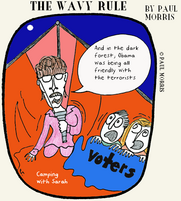
The Wavy Rule, a Daily Comic by Paul Morris: Campfire Campaign
_Yes, here comes the ugly season. Palin and McCain are invoking Rev. Jeremiah Wright and William Ayers (and Obama parries in kind with intimations of Charles Keating). Don’t you feel edified? Either way, click to enlarge!_
More by Paul Morris: “The Wavy Rule” archive; “Arnjuice,” a wistful, funny webcomic; a smorgasbord at Flickr; and beautifully off-kilter cartoon collections for sale (and free download) at Lulu.
New Yorker Festival: Ryan Lizza, Hendrik Hertzberg, George Packer, Dorothy Wickenden
On Saturday afternoon the primary participants of _The New Yorker_’s delightful and “addictive”:http://emdashes.com/2008/09/i-think-i-need-the-campaign-tr.php “Campaign Trail” “podcast”:http://www.newyorker.com/online/podcasts/campaigntrail collected for a live version of same, sort of like when Monty Python did _The Secret Policeman’s Other Ball._ Ably guided by moderator Dorothy Wickenden, Ryan Lizza, Hendrik Hertzberg, and George Packer engaged in a spirited and relatively unepigrammatic discussion about the state of the 2008 campaign.
The most startling line of the session may have been Hertzberg’s image of McCain being reduced to “seeds and stems.” Later on, Lizza compared Palin’s impact on the McCain campaign to a fire on the deck of a ship that already had a large hole in the hull. With her adequate debate performance on Thursday, the fire has finally been put out, but the hole has yet to be addressed and will probably do the campaign in. Observing that Palin supplied the appearance of coherence without actually being coherent, Hertzberg and Lizza collaborated to come up with the Colbertian term _coherentishness_ to describe her performance.
Noting that the Democratic coalition this year will likely consist of the educated class, minorities, and young voters, Packer noted that some have begun to call Obama “George McGovern’s Revenge.” Packer fretted about the Democrats’ problems securing white working-class voters, while Hertzberg pointed out that unions still play a big role in the Democratic Party.
I have mixed feelings about all of this: white working-class voters play a talismanic role in American politics quite apart from their actual electoral importance, which has been decreasing over the years. In principle, if Dems can build a larger coalition without them, they should do so. And yet, and yet.
Packer did point out that it was union canvassers, not Obama campaign staffers, who were bringing the realities of McCain’s health care plan to voters. Unions still are that rare group with the ability to supply political education to a wide swath of society and the incentives to do it well.
On Obama’s famous equanimity, Lizza told an enlightening story that reassured beat reporters, hungry for stories of blowups or breakdowns, that the candidate was human after all. In Denver, when Obama was rehearsing his big convention speech, when he reached the section in which he invoked Dr. Martin Luther King, he choked up, stopped the speech, and had to leave the room.
Noting that about 80% of new registered voters who pick a party are Democrats, Lizza said mildly, “George Bush has not made the Republican Party cool for young people”—then, noticing the understatement, added, “This is the killing fields.”
Packer made a great point about Palin’s somewhat maddening speaking style (and I don’t mean all the _you betchas_). I had noticed that she favors passive constructions, but Packer zeroed in on something more fundamental: “The key is her syntax. There are no verbs in it. There are gerunds, there are participles, but no verbs. Identity politics is nouns—hockey moms.”
Lizza perceptively noted that “Sarah Palin is a phenomenon of a party in decline, a phenomenon of decadence.” Asked by an audience questioner how big a disappointment “liberals like me” are in for, Lizza joked, “Massive,” and Packer followed up with the nub: “The question is, is he FDR or Bill Clinton?” Indeed.

George Packer, Ryan Lizza, Hendrik Hertzberg, Dorothy Wickenden
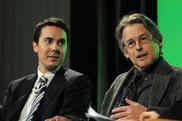
Ryan Lizza, Hendrik Hertzberg
(photo credit: Debra Rothenberg/startraksphoto.com)
New Yorker Festival: Gary Shteyngart, Peter Carey, Hari Kunzru
The head of the _New Yorker_ fact-checking department, Peter Canby, moderated the “Discussion Among Writers” with Hari Kunzru, Peter Carey, and Gary Shteyngart, on the subject of “Outlaws.” It was a less freewheeling session than the one in the same space “an hour earlier”:http://emdashes.com/2008/10/new-yorker-festival-klam-leona.php. Canby’s questions tended to be feature lengthy quotations from the writers’ works. And there was less crosstalk, the responses conforming more to the two-minute time limits imposed on the likes of Sarah Palin the night before.
Speaking of whom, about midway through Carey mischievously inquired what Ms. Palin would make of one of Canby’s hifalutin questions. It must be said, though, that Canby’s method worked, as all three writers supplied informative and engaging answers and Shteyngart supplied enough humor in an hour to power the next ten Festivals in the event that “angry Ted Stevens”:http://www.youtube.com/watch?v=VEXJV2P2ZIw takes the Festival over.
Indeed, I’ll succumb to a temptation to turn over the bulk of this post to his quips. Describing his homeland Russia as still in a “pre-therapeutic” phase, he plans to “airlift eight thousand Park Slope social workers” to the vast country to bring it up to speed. Musing on the domesticated status of American writers, hostage to 401(k) plans and health care fees, he contrasted his lot with that of the Lost Generation: If the Spanish Civil War reasserted itself, unlike Hemingway “I’d only go if Iberia had a good frequent flyer plan…. I’m not flying coach to a war.”
An audience question about each writer’s favorite book elicited groans from the panel–but also revealing answers (well done, questioner!). Kunzru stated that the last novel that made an impression on him was Joan Didion’s _Play It as It Lays,_ so he now wants to migrate to California and wear a dress. Carey expressed an admiration for droll and dyspeptic Austrian novelist Thomas Bernhard, and Shteyngart professed to read Vladimir Nabokov’s _Pnin_ once a month.
One thing about these panels–you do come away with a solid impression of the participants. The Friday author sessions remain the ideal way to kick off the Festival weekend.
New Yorker Festival: Matthew Klam, Elmore Leonard, and Joyce Carol Oates
A little bit to my surprise, the “Discussion Among Writers” dedicated to “The Devil Within,” featuring Elmore Leonard, Joyce Carol Oates, and Matthew Klam and moderated by Daniel Zalewski, was a light, lively, and amusing affair, quite in contrast to the stated subject. The taciturn Leonard, who would have looked entirely at home whittling a garter snake out of a twig, was flanked by the admiring Oates and Klam—yes, the admiration flowed freely on this night.
Without ever dwelling on it or even stating it explicitly, all three panelists acknowledged to the desirability of complexity as well as the enduring power of the thriller genre. All three either disavowed the reality of “evil” or described it as yet another mundane by-product of human existence. Of his famous baddies, Leonard mused that he’ll think of one he’s creating “as a kid. He’s a bully, he’s a cheater. He doesn’t get along with very many people. And then I let him grow up.”
Happiest when his readers squirm, Klam offered, by way of Shalom Auslander, that “Light and Dark are buddies, and they hang out after work.” For her part, Oates, astonished at Klam’s glowing words about her book _Do With Me What You Will,_ insisted that she is more accustomed to the critical reception of her cat, who has shown little interest in her works.
Leonard showed the same kind of word-stingy pith he does in his books, observing that he doesn’t like to know too much about his characters, “just enough to make them talk.” I don’t remember if this was before or after Klam demanded that Zalewski fess up to drop-kicking puppies.
It was a session so loose, you’d have thought alcohol had helped it along.

Matthew Klam, Elmore Leonard, Joyce Carol Oates and Daniel Zalewski
(photo credit: Alex Oliveira/startraksphoto.com)
Let Buck Henry Usher You into Democracy!
I had not noticed that _The New Yorker_ is using the Festival as a platform to perform an important civic duty. On Saturday and Sunday, a rotating slate of well-known people and _New Yorker_ luminaries will be on hand to register any eligible citizen to vote. If you are a recalcitrant politico-phobe or know one you suspect might respond to the extra inducement of meeting a famous person, it’s all at the Festival HQ at at Metropolitan Pavilion, 125 West 18th Street (between Sixth and Seventh Avenues). Here’s the schedule.
**Saturday, October 4**
10 a.m., Raúl Esparza
10:30 a.m., Judith Thurman
11 a.m., Edie Falco and Susan Sarandon
11:30 a.m., Wes Craven
12 noon, Sherman Alexie
12:30 p.m., Alex Castellanos
2:30 p.m., Alex Ross
3 p.m., Senator Chuck Hagel
3:30 p.m., Susan Orlean
4 p.m., Sasha Frere-Jones
**Sunday, October 5**
10:30 a.m., Nick Paumgarten
11 a.m., Reverend Al Sharpton
11:30 a.m., Mark Singer
12:30 p.m., Art Spiegelman
1 p.m., Larissa MacFarquhar
1:30 p.m., Michael Specter
2 p.m., Lynda Barry
2:30 p.m., Steve Brodner
3 p.m., Tad Friend
3:30 p.m., Buck Henry
4 p.m., Karen O
I confess I’m considering having the Rev. Sharpton register me even though I’m already registered. But I won’t, because it’s probably illegal.