
Well, she did fine, I thought. Biden was better. She won’t lose the race for McCain. Next subject.
Next subject? That’s the New Yorker Festival! Which is this weekend! Emily and I will gallivant (that verb wears the simple present tense oddly) to as many events as we are able, and we will be writing up our reports over the weekend and well into the week after.
In addition we’ll be twittering away from our cellphones as we move from event to event, so be sure to check out the Emdashes Twitter feed plus “twemes.com/nyfest”:www.twemes.com/nyfest. If you want to add your comments to the latter feed, send your “tweets” to **40404** and add **#nyfest** to the start of your message. The more the merrier!
Note that a limited number of tickets to ALL events will be on sale at the Festival Headquarters at Metropolitan Pavilion, 125 West 18th Street during the weekend. Here’s the “schedule”:http://www.festival.newyorker.com/schedule.cfm. If you have gotten shut out of your must-see event, be sure to try your luck there.
It should be a great weekend: Stephen Colbert, Clint Eastwood, Oliver Stone, Elmore Leonard, Barbara Ehrenreich, Mary-Louise Parker, Elizabeth Edwards, Joe Trippi, Martha Plimpton, Paul Rudd, Dawn Upshaw, Guillermo del Toro, and Chuck Hagel are a few of the featured guests, and _New Yorker_ stalwarts like Adam Gopnik, James Surowiecki, Rebecca Mead, Michael Specter, Ian Frazier, David Denby, Dorothy Wickenden, Jeffrey Toobin, Paul Muldoon, and the redoubtable David Remnick will collude to make it three days to cherish.
If you spot Emily or myself, be sure to say hello!
Author Archives: Martin
Fourth Annual Passport to the Arts: Tickets Go on Sale Tomorrow
Martin Schneider writes:
Always welcome, a press release from the Mother Ship, reproduced below:
The New Yorker’s Fourth Annual Passport to the Arts Event
A Benefit for Friends of the High Line
October 2, 2008–On Saturday, November 8, 2008, the New Yorker Promotion Department will host its fourth annual Passport to the Arts event, featuring a self-guided tour of twenty-eight leading Chelsea galleries, an evening cocktail reception, and a silent auction benefitting Friends of the High Line. Tickets are $45 and will go on sale, tomorrow, October 3, 2008, at www.ticketweb.com.
On Saturday, November 8th, participants will pick up a program guide, a map, and an official passport at la.venue at the Terminal Stores Building, West 28th Street between Eleventh and Twelfth Avenues, between 11 a.m. and 3 p.m. The self-guided tour of the twenty-eight participating galleries goes until 6 p.m. At each gallery, passports will be stamped with a replica of the featured work of art. From 6 p.m. to 8 p.m., participants are invited to a cocktail reception at la.venue, featuring a silent auction of works by Marina Adams, Julio Bittencourt, Geoffrey Chadsey, Matt Keegan, Joseph Kosuth, Keith Mayerson, BeatrÃz Milhazes, Aleksandra Mir, Santi Moix, Matthew Ritchie, Mia Westerlund Roosen, Joshua Smith, Mickalene Thomas, and other artists.
All funds raised by the silent auction and a portion of the proceeds of ticket sales will benefit Friends of the High Line. Friends of the High Line is a nonprofit organization dedicated to the preservation and reuse of the High Line, a 1.5-mile elevated railway that runs along the West Side of Manhattan. For more information on Friends of the High Line, please visit www.thehighline.org.
The New Yorker’s Passport to the Arts event is presented by Embassy Suites Hotels. It is sponsored by Barclays Capital, Land Rover, and MasterCard World Card, and supported by Kenneth Cole Awearness, LU Biscuits, and the Mexico Tourism Board.
For more information, including a full list of participating galleries and artists, visit www.PassporttotheArtsNYC.com. Tickets are $45 and will be available via TicketWeb at www.ticketweb.com or by phone at 866-468-7610 on October 3rd.
Say Goodbye to Chuck (and Bucks): Merrill Lynch in the New Yorker Archive
Jonathan Taylor, who previously revisited John McPhee on New York City’s greenmarkets and strongly suggested that the city install skybridges, writes:
If it’s really the end of an era for Wall Street, it will also be the end of a perennial New Yorker trope.
Recently subsumed brokerage Merrill Lynch, a metonym for Wall Street (itself a metonym!), was for decades an absurdly frequent subject of New Yorker Talk pieces and cartoons, which exhibited an inexhaustible fascination with the length and euphony of its name in its various iterations, particularly “Merrill Lynch, Pierce Fenner & Beane.”
Should that not be “Merrill, Lynch, Pierce….”? It should not, and an amusing December 27, 1947, Talk piece, “Fine Point,” settled it. The erroneous placement of a comma where it didn’t belong had led to a “warm discussion” among magazine proofreaders. (Most likely it was in a September 13, 1947, cartoon, in which a woman asks her investment counselor, “When you say Merrill, Lynch, Pierce, Fenner and Beane recommend a certain stock, do you mean it’s unanimous or just a simple majority?”)
“The situation set us to worrying,” wrote Talk, “and since, with us, to worry is to act, we sent a man downtown to investigate.” This man soon enough got co-founder (or “lead-off man,” as it was put) Charles Merrill on the horn. Merrill told him that when he and Edmund Lynch founded Merrill Lynch & Co. in 1914, they simply took after the ethereal example of J.P. Morgan affiliates (Morgan Grenfell, Drexel Morgan & Co.) that had no need for the workaday comma.
And in the discreet banking world, it seems that it can be wiser not to tip one’s hand punctuationally. “Fine Point” goes on to explain that when Merrill Lynch & Co. merged with another firm in 1940, there was a New York law forbidding a partnership from including a dead person in its name. This was initially thought to mean that the new company could not retain Lynch, who had died in 1938, in its name. But another law did permit the name of a firm to be a component of a name of a partnership; some syntactically wise lawyers surmised that, without a comma, “Merrill Lynch” could be construed as the name of a firm, rather than simply the names of two partners. “Otherwise, Merrill Lynch, Pierce, Fenner & Beane would be called something else today, maybe Chuck,” the mag quipped.
The next name change, to Merrill Lynch, Pierce, Fenner & Smith, prompted another investigation, in the February 15, 1958, issue. It was a small loss to the culture: “The explosive, easily rhymed climax provided by ‘Beane’ has long been a boon to writers of songs and gags.” A year later a 1959 piece titled “& Beane?” looked in on the departed partner, Alph Beane, who had co-founded a new firm, J.R. Williston & Beane Inc.
I wondered if Beane had perhaps shown superhuman prudence in bailing out of Merrill Lynch a whole half century before Merrill’s demise. But his 1994 Times obit notes, “In the fall of 1963, Williston & Beane began to have financial difficulties when it failed to meet capital requirements at the New York Stock Exchange and the American Stock Exchange after the bankruptcy of a client, the Allied Crude Vegetable Oil and Refining Company, which was unable to meet margin calls on soybean and cottonseed futures clients”; it was absorbed by another brokerage.
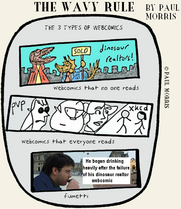
The Wavy Rule, a Daily Comic by Paul Morris: Frozen Movies
Would Will Eisner, who coined the phrase “sequential art” to describe comics, include fumetti? Paging Scott McCloud! (And click to enlarge!)
More by Paul Morris: “The Wavy Rule” archive; “Arnjuice,” a wistful, funny webcomic; a smorgasbord at Flickr; and beautifully off-kilter cartoon collections for sale (and free download) at Lulu.
The “Mad Men” Files: It’s Toasted
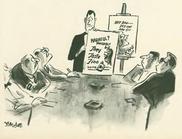
Today’s installment is courtesy of Frank Modell in the February 13, 1960, issue. Shades of the very first episode, in which Don Draper teaches the tobacco executives to reassure their addicted customers. “Smoke your cigarette,” he says. “You still have to get where you’re going.” That’s some evil stuff right there.
Score it Literary Magazine 1, Swedish Chauvinists 0
_Martin Schneider writes:_
As someone with deep roots in the country that produced “Elfriede Jelinek”:http://en.wikipedia.org/wiki/Elfriede_Jelinek, I’m pretty strongly on David Remnick’s side on “this one”:http://www.breitbart.com/article.php?id=D93H89QO0&show_article=1.
Forget Jet-Paks: We Demand More Skybridges for New York
Jonathan Taylor writes:
A few weeks ago, a friend and I were admiring a skyscraper in lower Manhattan, the American International Building at 70 Pine Street. Its tower—well described as an Art Deco hypodermic needle—is so thin and set back that it’s hard to look at from street level, but the almost parodically Deco style of its lobby can be seen despite the security guards posted to ward off idle venturers. A few weeks later, after the rescue of American International Group, I confirmed my guess that the building is the company’s headquarters (the Federal Reserve Bank of New York is conveniently nearby) but learned that it hasn’t always been. It was completed in 1932 as Sixty Wall Tower, known also as the Cities Service building, because it was the headquarters of oil company Cities Service Co. until the company moved to Tulsa, Oklahoma, in 1974. (I remember from growing up in Tulsa the ubiquity of the name “Cities Service,” probably as where a lot of kids’ dads worked. A relatively literal-minded child, I was perplexed by the company name’s stubborn failure to make clear to me what kind of company it was. Cities Service later became Citgo, now owned by the government of Venezuela.)
Frequently noted about the Cities Service building is the fact that it originally had eight “double-decker” elevators that served the floors above 28, two floors at a time, saving on elevator shafts and maximizing rentable floor space. In the April 30, 1932, issue of The New Yorker, E.B. White wrote a Talk piece about these new Otis elevators. White’s description of the system’s logic made it crystal clear, only after making it painfully clear that I should have been more confused by it than I thought I was:
People seem to think that to get into a double-decker, you have to walk either up a flight of stairs or down a flight. This isn’t so. The Cities Service building has two street entrance levels (on account of the way the land slopes off), and no matter whether you enter downstairs or upstairs, there will be four elevators that will make the even stops and four that will make the odd stops. No walking. In other words, when the double-deckers are at the starting position, their upper decks are being loaded with people coming in from one street, their lower decks with people coming from another street; four will stop ODD/EVEN and four EVEN/ODD.
The double-decker system was phased out in the building in the 1960s, according to this 1998 Times article. Among the buildings that today use double-deckers is the Citigroup Center in Midtown, itself the subject of a gripping May 29, 1995, New Yorker article by Joe Morgenstern (department: “City Perils”) about the discovery of a structural defect that might have caused it to collapse in a major hurricane, and the secret, after-hours work undertaken to correct it.
White ended his Talk piece on the elevators by noting, a bit sourly, that Sixty Wall Tower “isn’t in Wall Street, and can’t even be seen from Wall Street,” which is one block away. But the name stems from another of the building’s gewgaws, even more interesting from the point of view of that wonderful topic, the futurism of the past. The tower was joined to another belonging to Cities Service, at 60 Wall Street, by a connecting bridge on the 16th floor, allowing it to lay claim to that address. The bridge is now gone, but in that age, when the city was rapidly levitating upward in a skyscraper-building race, such bridges might well have seemed to be the logical wave of the future. In light of what seems to be the omnipotence of real estate values in the city’s economy, it’s still hard to believe that someone hasn’t found a way to profit from turning more corridors of air space into rights of way. That dream—and a hint of the obstacles to it—can be found in another Talk piece, of October 21, 1933, about the city’s taxation and regulation of such bridges (then numbering about 100, according to the article). They required the approval of the Board of Estimate, the Borough President, the Fire Department, and the Municipal Art Commission.
Somewhere in there (the piece is not clear) was the crucial say-so of “Edward Libaire, Assistant Engineer of the Division of Franchises” and “the city’s bridge expert for twenty-eight years.” Libaire rejected a proposal for another skybridge between the Cities Service tower and 60 Wall Street, on the second-story level, arguing that it would “hide too much of the sky.” But despite his stern standards for bridges that “won’t shut off too much light and that people will admire,” Libaire “pictures New York in 1983 with block-square skyscrapers connected with bridges that form great aerial highways.”
Now that New York City’s revenue base is being threatened by the financial crisis, perhaps Mayor Bloomberg would like to take a new look at skybridges. The Talk piece says that at that time—during the original Great Depression—”Nearly $400,000 of the yearly income of the city is from its tax on bridges between buildings.” (That’s $6.7 million in today’s dollars, according the federal government’s own “inflation calculator”:http://data.bls.gov/cgi-bin/cpicalc.pl.)
By the way, the Sun in January carried this update on the state of skybridges in the city today.
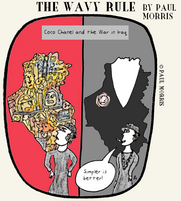
The Wavy Rule, a Daily Comic by Paul Morris: Intelligent Design
Today’s installment is reminiscent of an old Might magazine article about the importance of graphic designers in international affairs. The only thing I remember about it was that the solution for Northern Ireland involved use of Photoshop’s gradient feature on the embattled border. Click to enlarge!
More by Paul Morris: “The Wavy Rule” archive; “Arnjuice,” a wistful, funny webcomic; a smorgasbord at Flickr; and beautifully off-kilter cartoon collections for sale (and free download) at Lulu.
File Under Awesome: Caption Contest Now Searchable
Good news! The _New Yorker_ website now has a feature that lets you search on past “caption contests”:http://contest.newyorker.com/CaptionContest.aspx! Click on “Caption Archive” and there you are! You can access “every caption submitted to the contest, as well as see all of your captions.” (You will have to register to use the feature.) If you’re wondering what to search on, here are some “suggestions”:http://emdashes.com/mt/mt-search.cgi?IncludeBlogs=2&tag=Cartoon%20Caption%20Contest&limit=20.
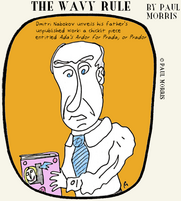
The Wavy Rule, a Daily Comic by Paul Morris: Sole Authorship
_Today’s entry puts me in the mind of John Hodgman’s failed palindromes: “Tow a what? Thaw!” Similarly, egret, neo tickle? Click to enlarge!_
More by Paul Morris: “The Wavy Rule” archive; “Arnjuice,” a wistful, funny webcomic; a smorgasbord at Flickr; and beautifully off-kilter cartoon collections for sale (and free download) at Lulu.