Author Archives: Martin

Mad Men, Season 4: Saarinen’s Curves

Martin Schneider writes:
Watching Mad Men the last two weeks (“Public Relations” and “Christmas Comes But Once a Year”), it’s been a shock to see how thoroughly its creators have used the plot point of a new office environment as an opportunity to pivot from what I’ve been calling the 1950s/”Sinatra” side of the 1960s to something closer to, say, Swinging London, not to mention Woodstock. I had once assumed that the show would find this transition difficult—at this point, I think this show can do anything.
The sight of the airy, sleek, symmetrical, somewhat plastic new SCDP office, with its Eero Saarinen furniture and Op Art wall decor, puts me in the mind of a possible key influence none of the smarties I read at Slate or Vanity Fair have mentioned—yet. I refer to Jacques Tati.
At the Awl’s “Footnotes of ‘Mad Men,'” Natasha Vargas-Cooper, excited about the new relevance of infidelity lyrics from “How to Succeed in Business Without Really Trying,” doesn’t seem to notice the fairly obvious Tati reference implied by a resonant screenshot of the show (I assume) she has posted. That is, this picture:

Myself, I can’t decide whether the Mad Men staff spent last summer screening Playtime or are barely conscious of the echo. I suspect it’s closer to the former option.

Bloggingheads-ganza: The Intentional Idiocy of Byron York

Martin Schneider writes:
A few days ago Timothy Noah of Slate and conservative writer Byron York engaged in a Bloggingheads.tv “diavlog,” as they are called.
What to do when you are an “intelligent” conservative confronted with the proposition that FOX News is essentially a bunch of partisan liars whose work cannot be taken seriously? I don’t know—that’s not my problem. Byron York doesn’t handle it a whole lot better:

Here’s my little recap:
York: The New York Times is afraid of the power of FOX News and conservative talk radio, so it compensates for that power by forcing inflammatory to remain in a “freak show” zone of non-mainstream stories.
Noah: Couldn’t it just be that FOX News sucks?
York: Oh, no, not at all! There are terrific stories that FOX is reporting all the time that the Times ignores. For example, some NASA official said something nice about Muslims—and Obama maybe sort of agreed with him! Why is this not a major story in the New York Times??
Noah: Uh, why is that a story? Wouldn’t it be a story if a NASA official said something mean about Muslims?
York: I don’t know, it seemed like a pretty smoking story to me.
What my little dramedy above cannot express is the sheer number of boring seconds York, in his slow-talking way, dedicates to this utter non-story. Anything better than actually own up to the mendacious ways of FOX News.
A few minutes later, York mentions a silly comment on JournoList by Spencer Ackerman to the effect that, in the wake of the Rev. Wright problems Obama was facing in early 2008, that liberals should just pick conservatives at random and accuse them of racism. Noah says, basically, “Well okay, but it’s not like he acted on it.” York’s response to this is priceless, right at the 34-minute mark: “Well, people on the right believe that they have been accused of racism, on a number of occasions!” Really! Conservatives feel that they have been accused of racism…. why is that, do you think?
To this, Noah says, rather deliciously, that you’ve got a few things going on there, the original question was whether Ackerman did anything—he didn’t—and anyway muddying the issue is that, basically, conservatives do a lot of racist things. So there’s that. See for yourself:

The obtuseness on display here is fairly staggering. The coalition that makes up the Republican Party is structured around reaction to the Civil Rights Movement. That’s just Politics 101. If York thinks that racism is distributed equally across the political spectrum, he’s not qualified to write about politics for a living, period. So my conclusion is that he is lying.
One last thing. Towards the end they’re discussing the unemployment benefits extension that the Republicans blocked last week. I think nothing can describe current conservative obtuseness with respect to important policy issues than York’s insistance, with the country facing serious unemployment problems and possibly a double dip recession, that there’s a serious risk in creating a “dole” and making unemployment a permanent condition for many Americans.
That’s right: You can talk to conservatives all you want about the miseries of unemployment and the benefits of softening those miseries—conservatives aren’t interested in that! It’s much too satisfying to wag a scolding finger and imply that some minor negative externalities outweigh that positive good. That’s as good as conservatives get—Byron York is probably a nice guy, and he’s not dumb. He’s about as good as it gets, quite seriously. And he cannot be made to care about treating unemployed people well.
Noah is terrific again in just not buying into any of York’s nonsense. Noah admits that some studies have shown a small effect of the type York has mentioned. York says, Well, shouldn’t that be taken into account? And Noah says, No, it shouldn’t!

James Sturm’s Online Hiatus: Essential Online Reading

Martin Schneider writes:
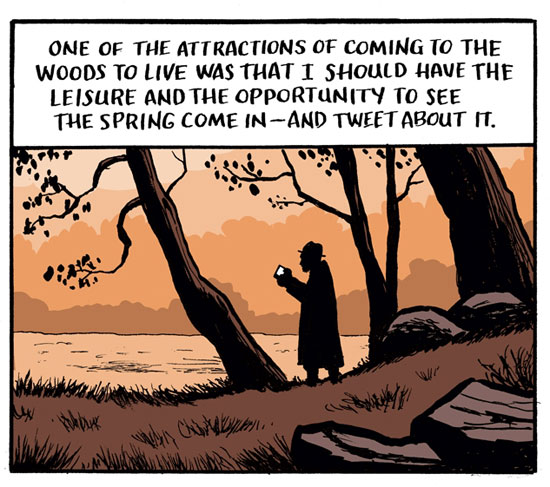
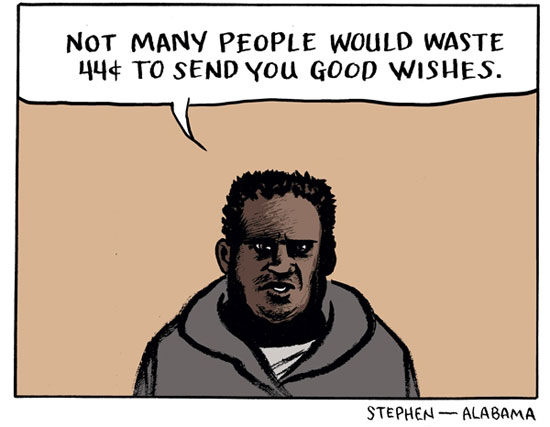
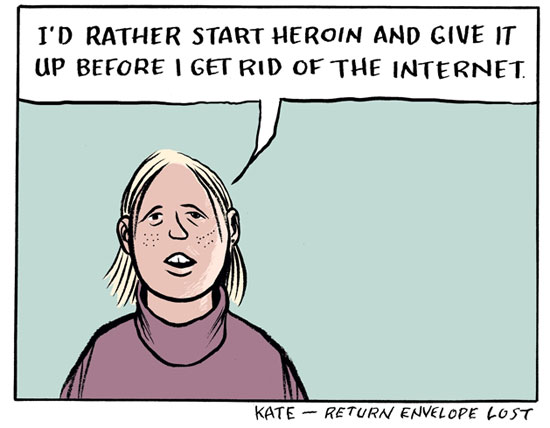
I just stumbled on James Sturm’s experiment on Slate involving staying off the Internet for a few weeks and seeing what happens.
The results have been marvelous, witty, wise, insightful, hilarious, and resonant—it’s one of the best things I’ve seen in weeks. I think just about everyone would find a point of access here; that’s one of the great things about it. I’m going to embed a few of my favorite panels and then leave you to read it.

There are eight installments; this is the first.

The New Republic: Web 2.0 Fail

Martin Schneider writes:
During the World Cup, The New Republic had a pretty cool blog dedicated to the tournament, as they had in 2006. It was a fun, eclectic blog, and I enjoyed it a lot. I even wrote a post about Luke Dempsey’s brilliant found poem.
There were a few times I wanted to chime in a comment or two, as I often do elsewhere in the blogosphere. Much to my surprise, the site demanded that I log in before posting—not with my www.tnr.com account username—which would be fine—but with my New Republic magazine subscription account username.
That’s right: if you want to write “first!” in a TNR blog comment thread, you’re going to have to buy 20 issues of the magazine. For the record, the page they send you to is here.
Does that business model remind you of anything? The year 2000, maybe?*
======
*I’m sorry if this is coming off as harsh, but it’s really meant as tough love. I know it’s a bad environment for magazines right now. But TNR pays really well-qualified people to blog for them, and those blogs are pretty awesome, and stuff like this just ensures that the money, time, and energy spent developing those blogs will not attract permanent users.**
** Could it be a browser issue? A cookie issue?

Katha Pollitt, Roman Polanski, George Orwell, and Saul Steinberg Updated

Martin Schneider writes:
POE (pal of Emdashes) Katha Pollitt skewers the misguided Roman Polanski apologists.
It’s funny: I suspect that at FOX News headquarters the defenses of Polanski are an instance of the moral relativism of the Left. I’m a liberal, and most of my friends are liberals, and I have never spoken to anyone who seriously entertained the notion that Polanski shouldn’t be incarcerated, and here is one of the leading figures on the Left, ridiculing the idea that Polanski’s masterpieces give him a free pass on rape. Last year I was at a dinner party with about ten Viennese journalists, the very picture of decadent “European” elite, and everyone present agreed that Polanski was guilty and should be sent to jail.
So I don’t know who, exactly, is really defending Polanski. I wouldn’t be surprised if the set of people who defend Polanski consists mostly of cultural elite types; the point is that it’s a small group and that most liberals don’t hold this view. Can someone generate a Venn diagram for me?
Pollitt’s essay reminded me of George Orwell’s “Benefit of Clergy: Some Notes on Salvador Dali,” I was a big Orwell addict in the early 1990s, and I’m still a big fan, but what’s striking about the essay is Orwell’s cultural conservatism. Then again, it was 1944, pre-John Waters, pre-camp, pre-Lots of Things.
On the subject of Polanski: I should stress that I don’t dismiss his post-exile works. I’m a big fan of Frantic, and I thought Bitter Moon was terrific, and I liked Death and the Maiden a good deal too. (I haven’t seen The Pianist.) Polanski’s an extremely talented fellow. And he should be sent to prison.
Unrelatedly: some wag has updated Saul Steinberg’s famous map “View of the World From Ninth Avenue” (actually, it’s possible that its creator has never heard of Steinberg). What I don’t get about the update: What, exactly, is inaccurate about it? It looks just like a standard U.S. map to me.
Oh, one last thing: hail the jumper colon! I’ve sprinkled a few in this very post!

The Whole LeBron James Situation: A Cleveland Point of View

Martin Schneider writes:
I’m living in Cleveland this summer. I spent the weekend in Chicago, and thus it was odd to be not in Cleveland on Thursday night, when LeBron James made his announcement to join the Miami Heat. My friends and compadres in Cleveland had to suffer that one alone—maybe it’s just as well, because my Cleveland identity is a little bit thin for that level of pathos and identification: it’s not my city, in that sense. Anyway, then I return to Cleveland this morning and find out that Harvey Pekar has died. A fun weekend in Chicago bookended by these oddly related events.
So much has been said about LeBron and Dan Gilbert’s angry letter. There were still a few points I thought could add to the discussion.
1. It doesn’t really matter either way. There’s been a lot of commentary about the sheer scale of LeBron’s ESPN announcement, which was, after all, merely an athlete’s announcement of a free agency decision, which happens all the time. It was a very hollow event, inflated by hype and potential and some shrewd PR machinations. I have a friend who is in the business of re-selling Nike sneakers, and he was telling me that LeBron’s decision would be a major deal for Nike, for him personally.
I don’t quite buy this. The NBA has a lot of incredible young players, the number of teams that will win titles in the next five years is still capped at five, and whether it’s LeBron and Wade or Dwight Howard in Orlando or Kevin Durant in Oklahoma City or Derrick Rose in Chicago who becomes the next major NBA star….. is pretty moot. True, LeBron already has a Jordanesque shoe deal and maybe only he could approach the Jordanesque heights of marketing, but I don’t quite buy that this makes any more difference than a butterfly’s fart. Cleveland’s odds of winning a title are down, Miami’s are up, the number of people who like the NBA or Nike sneakers is going to stay about the same.
2. LeBron James isn’t that good. I’ve been hearing about LeBron for years, watching some of the incredible highlights but basically paying no attention. This year, for the playoffs, knowing that I would soon be visiting Cleveland, I started watching the Cavaliers for the first time. I was shocked by what I saw. What I saw was a player who, because he is bad at free throws, declined to drive to the basket. LeBron James is a six-foot-eight shooting guard who is built like a small forward or even a small power forward and who fancies himself a point guard, in the sense that he usually “runs the offense.” LeBron’s is the type of player, against good teams in the playoffs, whose best weapon ended up being a decent, but not great, 18-foot jump shot. I’ll be honest with you, that’s quite a package, but I don’t know what the hell that player is. He’s not a power forward, he’s not a shooting forward, he doesn’t drive to the basket, he’s not a point guard but plays like one………….. I don’t know what that is. No matter how good or talented LeBron is, if he’s at the center of a team’s offense, I can’t see that team winning a title.
Secondarily, I’m not convinced that LeBron values hard work, self-improvement, or, by far most important, winning basketball games more than he values his brand, his popularity, or generally being liked. He’s still young and there’s room for development, but I’m unsure that he will ever get the competitive fire that Kobe Bryant or Michael Jordan have. He may get it once he reaches the age of 29 with no titles (if that happens) and has to retrench and eliminate all distractions.
3. Closely related to his … insufficient game is the fact that his entire profile is built on potential. When the Cavs won the rights to draft him in 2003, that was a huge story that had all of Ohio drooling over all the titles LeBron was going to bring to the area. Those titles never happened. Seven years later, it’s the same thing all over again. It’s all based on a speculative future, and in that sense LeBron is not much different from a speculative bubble in the financial world.
4. I had a realization a few days before the big ESPN announcement on Thursday. The wise move for LeBron would have been to quietly re-sign with the Cavs and go back to work. Given that his Miami announcement has been something of a PR disaster for LeBron (he was actually booed at Carmelo Anthony’s wedding the other day), I think I was right about this. LeBron got his hype, and he got his money, but LeBron isn’t about wisdom, he’s about his brand, so he made what I regard as an unwise choice here. Like a speculative bubble, it’s essential that LeBron cash in as quickly as he can, and that’s what he did. Showing some humility would have been a move nobody could have faulted. As it was, he pleased one city and annoyed everyone else.
5. LeBron is an athlete, and as such has every right to handle his career any way he sees fit and conduct his negotiations as he pleases. In that sense I fully endorse Mark Kleiman’s wise post, “What’s LeBron supposed to have done wrong?” Kleiman is right: People feel a deep need to judge wealthy athletes, and those judgments are inextricable from class and race issues. Read the whole thing.
6. Having said that, there is a difference. LeBron’s announcement circus did not exactly highlight LeBron’s finest features, and if it has put him in a bad light, that’s his own fault. It’s not so much about the size of the contract or that he was driving events that bothers me, but I have no problem with the idea that his treatment of his home region and his hankering for a shortcut to a title reflect poorly on him. It’s not much different from when Roger Clemens signed with the Yankees in 2007. There are valid reasons why sports fans don’t respect “title grabs,” and LeBron is right in line with that.
7. Also, there is the consideration of Cleveland itself. Cleveland is a working-class midwestern city, and the last few decades have not been an easy time in the Midwest. This is where the LeBron argument collides with serious national topics like the economy, urban renewal, retraining of laid-off workers, and so on, topics that LeBron could never solve by himself. But the fact is that Cleveland was perceived as depending on LeBron for economic reasons, in a way that will never be true of Miami. It’s not exactly fair to LeBron, but he contributed to a dynamic in which he was going to help revive Cleveland’s downtown area; now that that downtown area may experience some hard times, it’s not unjust to think poorly of LeBron for “abandoning” it, even if that word is way too strong and melodramatic. In short, the LeBron saga touches on issues of the American City. As a nation, we have to divert emphasis from diversions like sports, with its one-winner or oligopolistic logic (so few haves, so many have-nots), and towards pursuits like urban renewal. It ain’t his fault, but LeBron’s decision is relevant to that story.
8. So, to wrap up, I never found LeBron all that appealing, more Darryl Strawberry than Tony Gwynn, and now that he has chosen to indulge in a bath of hollow PR and scamper towards a “sure-thing” title (even if I think it’s not a sure thing at all), I feel justified in saying, he ain’t all that and he never was all that. I’ve got my doubts about his effectiveness on the basketball court, and I’ll be happy to see those doubts justified in the years to come. And off the court, he’s a big handsome PR creation—who cares?

‘The September Issue’: Ice Queen Reported Missing

Martin Schneider writes:
I just watched The September Issue, the documentary about Vogue and Anna Wintour. I must say it surprised me a lot. It’s very, very enjoyable, and anyone who likes fashion or magazines really ought to see it. (On the subject of magazines, I think I glimpsed an Ivan Brunetti cover from The New Yorker at one point, in the clutches of contributing editor André Leon Talley.)
I hope the movie serves as a corrective to The Devil Wears Prada (the movie anyway, can’t speak for the book). The portrait of imperious “Miranda Priestly” in that movie, ably embodied by Meryl Streep, did much to convince me that Wintour must be (while highly able herself) impossibly demanding, rude, and so on.
If that is true, I didn’t see any evidence of it in The September Issue. In the documentary she seemed extremely busy and capable, certain in her views, decisive (she calls this her most important trait), more than passably considerate. She didn’t seem demanding in petty ways; cheerful enough when engaging with people, quiet and composed when in observation mode (peering at the many catwalks, for instance).
Indeed, “grace under pressure” seems an apter slogan for Wintour than “ice queen.” It really makes you wonder about the way we view successful, nay powerful, women in our culture. I’ll take her over Jack Welch any day.
As far as I can tell, the movie is really about competence. Virtually everyone in the movie is a highly competent professional immersed in his or her work, thoroughly knowledgeable and fulfilled and accustomed to pressure and therefore calm and cheerful.
I appreciate this because it’s important to have on display arenas where excellence and talent and standards are valued—it’s so often not the case. Elsewhere we must put up with compromise and backsliding and shortcuts and limited budgets and on and on. It’s inspiring to see a place where excellence is valued as a matter of course, there’s no doubt that an imperfect photo shoot will be redone.
In the Wikipedia writeup for the movie it says that creative director Grace Coddington (who is awesome and steals the movie) is “the only person who dares to stand up to Anna Wintour.” What nonsense! Wintour is shown dealing with a lot of people, and I didn’t see too many frightened individuals in any of those meetings.
Wintour does make life difficult for Coddington by disagreeing about a couple of Coddington’s photo shoots, but if Wintour made any errors of judgment at any point during the movie, I must have missed them.
Finally, if you want to know what I think of the fashion industry, listen carefully to what Wintour’s daughter Bee Shaffer says about it. I’m with her.

Ben Greenman Reads in Brooklyn on Monday 6/21 and It Will be Awesome

Martin Schneider writes:
Get on over to Brooklyn’s Greenlight Bookstore at 686 Fulton Street (at S. Portland, in Fort Greene) this coming Monday, June 21, at 7:30 pm, when Ben Greenman will read from his new epistolatory story collection What He’s Poised To Do, published by Harper Perennial. It’s a Facebook event, too, which makes it even easier to remember to move it to the top of your queue. We’re just about to launch a fun giveaway for Greenman’s book later this afternoon, so watch for that!
From the Facebook description:
The author Ben Greenman celebrates the publication of his new collection of stories, “What He’s Poised To Do” (Harper Perennial) and its sister blog, Letters With Character. There will also be brief readings by Jonny Diamond (of The L Magazine); the actress and performance artist Okwui Okpokwasili (representing Significant Objects); Nicki Pombier Berger (representing Underwater New York); and Todd Zuniga (representing Opium Magazine, and appearing via Transatlantic technology).
I don’t know the witty New Yorker writer and editor personally, but I’ve had the pleasure of attending a few New Yorker Festival events that he moderated (one was with Ian Hunter and Graham Parker, another was with Yo La Tengo; there were others), and he always made an extremely positive impression on me—intelligent, funny, generous, self-deprecating, all the good things. Emily tells me that based on her having gotten to meet him in person at a recent Happy Ending event, my impressions are rock-solid.
I’m in the wrong city (Cleveland) at the moment to attend this event, but New Yorkers should get right on this.

Found Poetry at the World Cup

Martin Schneider writes:
The New Republic, as it did in 2006, is running an eclectic World Cup blog by a large group of admitted enthusiasts, non-experts. Most of the posts are personal, idiosyncratic, confessional. It’s been a fun read.
After today’s 2-1 defeat of North Korea by Brazil, Luke Dempsey posted a poem “written” by Martin Tyler and Ally McCoist, the commentators who called the game on ESPN, featuring exclusively phrases uttered during the broadcast, in chronological order.
I’m no expert in poetry, but I just adore this work of structured whimsy. My favorite line is “A voracious appetite for silverware,” a line that struck me at the time as being bizarre and kind of great (it was a reference to the Brazilians’ habit of winning a lot of trophies).
It also reminds me that I should pick up a used copy of O Holy Cow, a similar project involving the delirious ramblings of Phil Rizzuto, whose Yankee broadcasts I grew up on. My memory is hazy, but I believe Hart Seely and Tom Peyer’s project of curating Rizzuto’s “poems” started in The Village Voice about twenty years ago.

Irreplaceable Magazines, Irreplaceable Editors

Martin Schneider writes:
Jason Kottke today linked to some scanned pages of Sassy from the early 1990s. Jason observes, “Sassy seems to be one of those rare magazines that is dearly missed but doesn’t really have a modern day analogue. (See also Might and Spy.)”
True enough. What occurred to me, however, was that those three magazines have something in common: a very strong editorial hand. In all three cases the editors are pretty well-known people: Jane Pratt in the case of Sassy, Dave Eggers for Might, and Kurt Andersen/E. Graydon Carter for Spy. So the reason they either don’t exist or have not been replaced is that those specific people have elected to do other things.
But it feels like the “rule” of a strong, irreplaceable editor needs more to it. There are other magazines run by strong editors where it’s easy to imagine the magazine continuing in that editor’s absence. Anna Wintour at Vogue, for instance. David Remnick at The New Yorker. Carter at Vanity Fair.
So we can add a corollary. The irreplaceability of an editor is inversely related to the size of the operation, expressed in terms of circulation, revenue, ad pages, whatever.
Let’s stick with circulation for a moment. One way that a magazine becomes “a big deal” is when it expresses the hopes, dreams, fears, etc. of an impassioned, interested sliver of the population. That was true for Sassy and Spy, certainly; not so sure about Might but let’s say it’s true there too. As a counter-example, you could imagine that being true of Wired, say, but Wired got too big and important—that is to say, its readership combined an impassioned sliver and a larger group that was only mildly interested in the content. In other words, its readership had “graduated” to a general readership, making it possible for Wired to have multiple editors over time.
So I’d ask two questions: Are there any other magazines in Jason’s group? Do 2600, Raygun, SPIN, The Comics Journal, Adbusters count as potential members of that group (potential, since some of them still exist) or not? Who are the editors of those magazines? I can name three of them off the top of my head, but I won’t say which ones.
The other question is, Are there magazines that break my rules? One magazine that I had in mind for this category was Interview, which was founded by Andy Warhol and decidedly represented a “sliver” of the reading public, but it’s been chugging along for quite a while now. Is it an exception, or did its revenue or something pass some benchmark way back when? I don’t know the answer.