
Martin Schneider writes:
In the mid-1990s, an artist friend gave me his well-thumbed hardback copy of Negative Space. It was one of the better presents I’ve received. What a good critic. He will be missed.
Author Archives: Martin
Finally, a Literary Event Involving Pigeons!
Martin Schneider writes:
Longtime readers will know that this blog looks kindly on the noble rock dove, otherwise known as the pigeon.
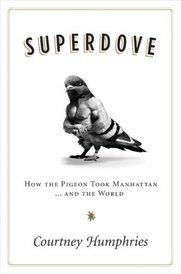
On Monday, August 18, at 7 pm, McNally Jackson Books hosts a reading by Courtney Humphries, author of Superdove: How the Pigeon Took Manhattan and the World.
The book has an amusing cover (click to enlarge):
McNally Jackson Books is located at 52 Prince Street.
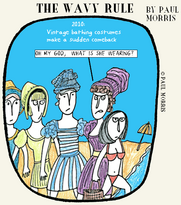
The Wavy Rule, a Daily Comic by Paul Morris: Billow Fight
Today, Paul contemplates the impending revival of damp pleats. On a related note, how big is steampunk really? Does anyone know? Tell us in comments! We’re a bit a skeptical here. As always, click to enlarge.
More by Paul Morris: Enter our exciting contest to name the upside-down question-mark! Entries accepted until August 25. Plus, “The Wavy Rule” archive; “Arnjuice,” a wistful, funny webcomic; a smorgasbord of multimedia at Flickr; and beautifully off-kilter cartoon collections for sale and free download at Lulu.
Man Loses Dog: A Metropolis Mourns
Chris Russo, known to many as “Mad Dog,” is leaving the tri-state-area sports behemoth WFAN, a move that brings the 19-year run of the afternoon sports radio talk show “Mike and the Mad Dog” to a sudden end. Right this minute, on the very last installment of the show, Mike (Francesa) is fielding a seemingly endless string of calls attesting to an importance that can only accrue in 330-minute installments five times a week over many years. I count myself as a fan.
Nick Paumgarten wrote about the curiously addictive duo in 2004; writing for ESPN.com’s “Page 2” in the spring of 2006, Bill Simmons also captured the singular appeal of the show.
Danza, Zogby, and Thom Yorke[r]: The Friday Intern Roundup
Each Friday, the Emdashes summer interns bring us the news from the ultimate Rossosphere: the blogs and podcasts at newyorker.com. Here’s this week’s report.
Sarah Arkebauer
The Cartoon Lounge was brimming with gems this week. Zachary Kanin continued his Sandwich Duel with a fourth installment, this one featuring Tony Danza. Chris Onstad fired back with his own endorsement—from Mick Jagger. I was delighted to see that Kanin interviewed Josh Fruhlinger, the man behind the Comics Curmudgeon, which is one of my favorite blogs. [You’re not alone! —Ed.] Since I read Mary Worth, Rex Morgan, M.D., and Apartment 3-G daily, I couldn’t have been happier to see Kanin post not just one but two of his own soap-opera strips. I can assure you that they’re fresher and funnier than the newspaper soaps.
The Book Bench this week included a thoughtful remembrance of Mahmoud Darwish. The post contains a hauntingly charming excerpt from his poem “Remainder of a Life,” which The New Yorker published in 2007. This week’s posts also included a scintillating “In the News” feature in which I discovered provocative tidbits about nursing home patrons, Guitar Hero, and Gordon Brown. I also enjoyed the treasure trove of fun facts in the post about pollster John Zogby’s new book.
Goings On posted eloquent memorials of Bernie Mac and Isaac Hayes. Both posts include thoughtful insights on their careers and characteristic video clips. The blog also put up two rather bizarre posts. One is an examination of the food it takes to fuel Super-Olympian (and my current personal hero) Michael Phelps; the sheer amount of food he eats every day is unbelievable (especially since he doesn’t cook). The second bizarre piece posted was a report on Pascal Henry, the man who disappeared while eating his way through every Michelin 3-star restaurant in Europe.
I got a surprise this week from The Rest is Noise: Alex Ross offered some insights on the Olympic opening ceremonies. I hope he permanently returns from summer hiatus soon!
I was excited to see a new Fiction Podcast up for August this week. The post is of Jeffrey Eugenides reading Harold Brodkey’s short story “Spring Fugue.” I wasn’t very familiar with Brodkey before listening to the podcast, but I liked what I heard. Even though spring is far away, Brodkey’s crackling descriptions of allergies and love and other springtime tropes felt close and familiar.
Adam Shoemaker
This week in “Notes on politics, mostly”, Hendrik Hertzberg takes umbrage at a respectable publishing house’s willingness to put forth a less than respectable attack on Barack Obama. He also shares the latest McCain attack ad and suggests that the Republican contender (as well as the other fogies of American politics) are in a snit because the junior senator from Illinois has made them seem, well, uncool. Two more McCain moves that have Hertzberg upset: drilling (he thinks it would merely be a drop in the bucket—but that we have to pay for the bucket) and a clever little move we might call the preemptive “not playing the race card” approach.
Sasha Frere-Jones considers the state of the bass guitar, and tallies up the possible causes of its recent marginalization; he also shares his observations on Thom Yorke’s “new rave moves.” This Radiohead fan was glad to hear that its lead singer has moved on from the neck bashing of a few years hence, which surely verged on vertebrate-snapping. Last Friday, Frere-Jones, in a list-making mood, offered readers a list of musical events organized by his predicted reception, from “Robust, Calm Happiness” to “Hiring People to Throw Themselves in Front of These Things So They Don’t Accidentally Brush Against Me.”
George Packer didn’t write anything this week in “Interesting Times.” A year ago, though, he wrote Karl Rove’s epitaph, an act that, despite the Bush advisor’s resignation that week, might have been a bit premature. Packer’s prediction was right, though, and now that the “Boy Genius” has been reduced to mere punditry, I wonder whether Packer would maintain that his statement then, that “the Rove approach to governing helped lose Iraq,” still applies, or if hope has sprung in the year since his demise—a development that might be described by Rove’s other nickname.
I also dug into the archives of New Yorker Out Loud this week to indulge myself in Matt Dellinger’s interview with Burkhard Bilger back in April, when the magazine published Bilger’s article on Art Rosenbaum and Lance Ledbetter’s quest to hunt down the last of Southern folk music. It was this piece that inspired me to purchase Goodbye Bablyon this summer, whose nailed wooden box—stuffed with raw cotton—and old-timey typography helps illustrate the strangely seductive power of the “authentic,” on which Bilger muses in the interview. He claims, and I believe it, that although few people pick up gems like Goodbye Babylon and The Art of Field Recording, those who do invariably want to start making music themselves. I’m thinking I’ll start with a banjo—or maybe an mbira.
Last but not least, The Borowitz Report manages to conjure up two of our potent Sino-fears: Chinese lead paint and allegations of the country’s duplicitous Olympic committee. The gold medals, Andy Borowitz reports, have been found to have high lead content. Normally I’d have no reason to doubt Mr. Borowitz. But, writing as I am from China, I can’t help but note the medal count. One would hope that this rising Olympic power might be a little more careful not to poison its own, especially considering the effects of lead on young children.
Previous intern roundups: the August 8 report; the August 1 report; the July 25 report; the July 18 report; the July 11 report.
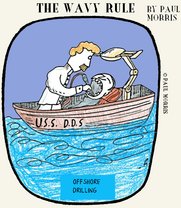
The Wavy Rule, a Daily Comic by Paul Morris: Wave of Irrigation
Today the artist cops to a flight of fancy, based on a term that’s much in the news lately. (“Irrigation” is the term for what you do when the dentist asks you to spit.) Click to enlarge!
More by Paul Morris: Enter our exciting contest to name the upside-down question-mark! Entries accepted until August 25. Plus, “The Wavy Rule” archive; “Arnjuice,” a wistful, funny webcomic; a smorgasbord of multimedia at Flickr; and beautifully off-kilter cartoon collections for sale and free download at Lulu.
The Wavy Rule, a Daily Comic by Paul Morris: Home of Phones
Today we commence a promising new series in which the artist undertakes to pitcher—er, picture—clever homophones. Click to enlarge!

More by Paul Morris: Enter our exciting contest to name the upside-down question-mark! Entries accepted until August 25. Plus, “The Wavy Rule” archive; “Arnjuice,” a wistful, funny webcomic; a smorgasbord of multimedia at Flickr; and beautifully off-kilter cartoon collections for sale and free download at Lulu.
The Wavy Rule, a Daily Comic by Paul Morris: Fighting Varietals
What’s all this about a global war on terroir? Righteous epaulets, dude! As always, click to enlarge!

More by Paul Morris: Enter our exciting contest to name the upside-down question-mark! Entries accepted until August 25. Plus, “The Wavy Rule” archive; “Arnjuice,” a wistful, funny webcomic; a smorgasbord of multimedia at Flickr; and beautifully off-kilter cartoon collections for sale and free download at Lulu.
The Wavy Rule, a Daily Comic by Paul Morris: Amusing Line Drawing
Who says you can’t be pretentious with simplicity, or simple with pretension? Not me—click to enlarge!

More by Paul Morris: Enter our exciting contest to name the upside-down question-mark! Entries accepted until August 25. Plus, “The Wavy Rule” archive; “Arnjuice,” a wistful, funny webcomic; a smorgasbord of multimedia at Flickr; and beautifully off-kilter cartoon collections for sale and free download at Lulu.
Klemperer, Barthelme, Borowitz, and Other Dactyls: It’s Intern Friday!
Each Friday, the Emdashes summer interns bring us the news from the ultimate Rossosphere: the blogs and podcasts at newyorker.com. (A dactyl is a metrical foot used in poetry. “Poetry” and “marmalade” are dactyls.) Here’s this week’s report.
Adam Shoemaker
George Packer writes in this week’s edition of Interesting Times about the diaries of Victor Klemperer, a Jewish scholar whose love of Germany, even amid the degradations of the 1930s, kept him from leaving his home. Packer is interested in Klemperer’s attack on nationalism, which stemmed from a tenaciously stubborn belief in the rationality of the Enlightenment. The Nazi Olympics are much on the mind these days, and while Packer refuses the easy comparison of that regime and Communist China, he is unable to resist hearing “a faint echo” from 1936 and feeling the broad, dangerous reverberations of nationalism. [Albert Speer’s son did design the Beijing Olympic complex, after all. –Ed.] Packer also offers his thoughts on the dialogue pinging around the media this week concerning Barack Obama’s alleged aloofness and his candidacy’s meaning in the larger sphere of black politics.
Hendrik Hertzberg takes time this week in “Notes on Politics, Mostly” to uncover the hidden racial undertones of John McCain’s new television advertisements, which include an almost subliminally short shot of Barack Obama playing basketball and, less subtly, juxtaposes the Illinois senator with those hardly chaste white women, Ms. Hilton and Ms. Spears. A reader also spurs him to ponder the phallic imagery of the spots. The obelisk as virility symbol is old hat for this art history major; if McCain’s ad makers are going to pin their hopes on hidden visual cues, they could at least take a few pointers from the master.
I was thrilled this week to see Sasha Frere-Jones report on one of my favorite bands, Bon Iver, a.k.a. Justin Vernon, and a performance he “would be celebrating more loudly if Vernon hadn’t wiped [his] mind clean.” These clips may help explain why sharing is often the only proper form of music recommendation: “hyperbole will somehow ruin things.” Frere-Jones also reports on Rock The Bells, where he saw Mos Def, Method Man, Redman, Nas, Jay-Z, and Q-Tip. Pithiest line: “Mr. Def makes his rhymes clear, enjoys moving around, and seems to accept that his job involves being entertaining. His pants were extremely bright.”
In this week’s New Yorker Out Loud, David Grann talks about his look into the bizarre story of Frédéric Bourdin, the shockingly successful French con man whose grandest and possibly last imposture involved a missing child come back from the dead. Just trying to imagine a thirty-year-old Frenchman passing as a Texan high schooler—or wanting to—makes the mind reel. Bourdin is no flesh-and-blood phisher or 419 boy; he dupes in the name of love. Both the article and interview are highly recommended.
Finally, Andy Borowitz uses The Borowitz Report to make a public service announcement to the nation’s “many jerks and douchebags” who are at increased risk of brain tumors due to their incessant cell phone usage. The eminent Dr. Logsdon offers his condolences: “All in all, this has been a tough summer for assholes.”
Sarah Arkebauer
The Cartoon Lounge continues its dueling-sandwich-shops saga with second and third installments. Even as I laughed at how ludicrous the cartoonists’ sandwich shops would be, I found myself wanting to visit them! It seems like everywhere I turn, I am greeted with the symbol of the Olympic games, so I was amused by the cartoon published earlier this week of the Olympic rings as a Venn Diagram.
Meanwhile, in an equally humorous post, the Book Bench linked to an imagining of Hamlet in the form of Facebook’s Newsfeed bursts, and I also enjoyed the photograph post of what are presumably the recent galleys at the New Yorker office. I was pleased, too, to see another update in the “Bookspotting” series; reading the “Bookspotting” posts reminds me to check out what the people I see in public are reading. On a more somber note, the Book Bench reported on a tragic barn fire in Bucks County, Pennsylvania, that destroyed thousands of valuable books, an unfortunate development with the International PEN Poem Relay, and an extensive remembrance of Aleksandr Solzhenitsyn.
Goings On also posted on Solzhenitsyn; the post is replete with links to articles written about him in the New Yorker over the years. Each profile brings to light a different facet of Solzhenitsyn’s life and times, and both long-time admirers and those new to his work will find much to enjoy and enlighten here. In other news, I’ve mentioned before how much I enjoy outrageous slang, and so I was thrilled to see the August 1 post on “Soda-Luncheonette Slang and Jargon” from America Eats!, Pat Willard’s new book on American culinary history. I’m afraid much of the slang is a little out of date, but it’s still wonderful to read about, and I’ve already picked out a couple of gems for my patois.
For my Fiction Podcast update this week, I went back into the archives and listened to Donald Antrim read Donald Barthelme’s 1974 short story “I Bought a Little City.” The story’s opening is punchy and delightful, and the rest of it—and the discussion thereafter—doesn’t disappoint. Indeed, I laughed out loud more than once. The story is short but potent, with an appeal that ensures I will revisit it in the years to come.
Previous intern roundups: the August 1 report; the July 25 report; the July 18 report; the July 11 report.