
Martin Schneider writes:
There’s more suggestive and principled oddness in this paragraph by Gothamist’s John Del Signore than in a number of novels I’ve read. I can’t decide which of the guys in this story I like more.
Author Archives: Martin
Two Months, Two Events: Mouly, Als, Spiegelman
Martin Schneider writes:
Who was it who said that comic books have recently become Hollywood’s R&D department? (It may have been “Everyone.”) The remarkable Françoise Mouly has decided—rightly—that the medium can also serve a similar function for children’s books, so (as Emily reported in PRINT) she has started an imprint called TOON Books, which puts out comix-inspired books for our youngest readers. (Her true aim may well be to propagate an entire generation of Los Bros Hernandez addicts.) She has enlisted the talents of Dean Haspiel, Jay Lynch, Eleanor Davis, and her husband, Art Spiegelman, to create the books, all of whom will be appearing twelve noon, Saturday, September 6, for a “Special Saturday Storytime” at McNally Jackson Books (note the new name) at 52 Prince Street. (Collectors: leave your Sharpies at home! Nobody present will be signing souvenirs. It’s for the kids, you know.)
And if we’ve now whetted your appetite for events without immediate opportunity for gratification, you can always check out the round table with New Yorker drama critic Hilton Als and Richard Foreman, guiding spirit of the Ontological-Hysteric Theater, at Solas (232 E. 9th St.) this Thursday night at 7:30pm. The event is free, as such affairs in summer ought to be.
Notorious Party Girls, Tippecanoe, and Lang Lang Too: Our Friday Intern Roundup
Each Friday, the Emdashes summer interns bring us the news from the ultimate Rossosphere: the blogs and podcasts at newyorker.com. Here’s this week’s report.
Adam Shoemaker:
This week in “Notes on Politics, Mostly,” Hendrik Hertzberg notices a few unexpected deviations in the news world. First, he applauds the Washington Post‘s decision to repudiate, unqualifiedly and unapologetically, John McCain’s accusation that Barack Obama demanded media cameras follow him into an Army medical center in Germany. Hertzberg also offers a modest suggestion for newsgatherers facing the newly breached promise by Chinese officials for uncensored internet access during the Olympic games. Finally, he puzzles over the recent off-road trek of a Republican “word technician” on Fox News who bravely veered away from Obama-bashing while host Sean Hannity desperately attempted to retrieve him. The post provided one of my favorite valedictions ever: “Thanks a load, toad.”
Sasha Frere-Jones spent the week at his blog considering free mixtapes and Czechoslovakian-infused rap. He also shares a music video from Richard McGuire, New Yorker illustrator and creator of “compact puzzles of funk.” I am converted. Still, the center of my heart remains dedicated to that burgeoning genre of sometimes atrocious, sometimes sublime hip-hop mashups, and one really can’t do better than this fusion of M.O.P. and “Sesame Street.”
In The New Yorker Out Loud, we hear from Kelefa Sanneh, who wrote in this week’s issue of The New Yorker about the early dissent of radio commentator Tavis Smiley from the “magical” promise of Barack Obama for the African-American community. Sanneh notes that for some black leaders, Obama’s position outside the traditional African-American political trajectory has raised concerns about his commitment to the historical imperatives of the Civil Rights movement. They wonder what it means to be “moving beyond the politics of grievance.” Together, Sanneh’s article and this interview provide a fascinating look at the decisions African-American leaders and voters are facing on the course from primary season to November’s general election.
Rounding out the roundup, Andy Borowitz writes in the Borowitz Report about the swift revenge of Britney Spears and Paris Hilton, who just released (we wish) their own attack ad on John McCain after the senator compared them to Senator Obama. While I’m not truly surprised that the “notorious party girls” support offshore drilling, I never really thought of McCain as “pasty white.”
Taylor House:
“Earthquake!” cried Postcard from Los Angeles. Dana Goodyear gives us the lowdown on the shakeup (which, admittedly, wasn’t very shaky). No serious injuries or building damage, just a lot of ponderous thoughts about preparing for “the big one” that in the event, will likely be every bit as unexpected. Yawn, maybe tomorrow.
More bad news for newspapers. The L.A. Times is now forcing cutbacks on its weekly book review section–downgrading it from a Sunday insert to space in the general arts section. How bad will it get, and is anyone brave (or stupid) enough to swim upstream?
Anyone recognize Senator Patrick Leahy as the gentleman telling off the Joker in The Dark Knight? Steve Brodner did, and illustrates the effect quite nicely over at Person of the Day.
David Remnick and Hendrik Hertzberg commend Obama’s speech in Germany but debate his shifting position on the war in this week’s The Campaign Trail podcast. And how does it look from McCain’s side of the street? Not great, but not without hope.
Sarah Arkebauer:
This week’s Cartoon Lounge contained some real gems.
Farley Katz penned a humorous Grover Cleveland-themed cartoon on July 29. The antiquated-cartoon theme continued with Matthew Diffee’s post on the 31st. Also worth noting is the delightfully bizarre email-duel by Achewood cartoonist Chris Onstad on July 31 about sandwich shops. The article is a continuation of an earlier interview between Onstad and CL contributor Zachary Kanin.
My favorite new series in the Book Bench is the “Bookspotting” segment. The July 28 edition contained an excellent sighting. I was also pleased to see that (the poetry of) Frank O’Hara made an appearance on the season two premiere of Mad Men. This might be just the impetus I need to start following the program. In other news, a new book of American slogans, Tippecanoe and Tyler Too, is forthcoming, and the people behind the Booker Prize have announced this year’s shortlist. Salman Rushdie is the favorite.
Meanwhile, Goings On posted two promising videos. One is an epic video of acclaimed pianist Lang Lang playing a Chopin etude, not with his fingers but with an orange. The second video of note is a “hilarious, surreal interview” that David Letterman did with Tom Waits (who, we learn, was born in a taxi). Both posts have provided me with valuable new anecdotes with which to astound my friends–always a worthwhile endeavor.
For this week’s New Yorker Fiction Podcast update, I turned to the May 3, 2007, recording in which Richard Ford reads John Cheever’s short story “Reunion.” The story is remarkable both for its brevity and for its richness, and the podcast is worth a listen even if you’ve already read the original.
Previous intern roundups: the July 25 report; the July 18 report; the July 11 report.
Holt’s New Book: Not About “Shy, Bald Buddhist”
Martin Schneider writes:
You can divide the world into people who understand that headline and people who don’t.
Yes, yet another book whose origins can be traced to the pages of The New Yorker. Jim Holt has expanded his April 19, 2004, book review into a laughable, if not risible (wait, those are pejorative), in any case highly amusing volume about the nature of the joke. It’s called Stop Me If You’ve Heard This, and Norton is the publisher (no, not Ed, nor Jim neither).
If Amazon had any wit, they’d pair it with James Wood’s How Fiction Works.

“The 405” and “the B.Q.E.” Both Mean “40-Minute Delay”
At the Washington Monthly website, Kevin Drum once raised the question of the (relatively) recent New York discovery of the taco (here is our contribution); now he is investigating a regional linguistic quirk: why is it that Angelenos are the only American city dwellers (save those living in Toronto/Buffalo, apparently) who habitually refer to local thoroughfares as “the 5,” “the 405,” “the 10”? Here in New York, you take “95” to get to Connecticut and “87” to get upstate and “287” to get across Westchester and so on.
(A friend of mine may have cracked the case, by the way. In Drum’s third post on the subject, he asks why the prevailing academic explanation—scale of traffic system—does not also obtain in New York City, which also has a high number of highways. Answer: in New York, if you say “the 1” or “the 3,” you’re probably referring to a subway.)
I called up my trusty Complete New Yorker, with the sneaky hope that some prescient gem about the “prepended the” would be contained therein. I found nothing about this definite article business. But I found gems nonetheless.
For some reason they are concentrated in the year 1966. That year, in the October 1 issue, the magazine ran “The Ultimate City,” a Profile on Los Angeles by Christopher Rand. Let’s start with that beguiling Steinberg art, a clear precursor to the famous “View of the World from Ninth Avenue” cover, only from the Los Angeles perspective—and ten years earlier. I zoom out to present the page layout (click to enlarge):

Dedicated as the Profile is to the futuricity of the city, many of the statements therein lend themselves to hindsight evaluation, and the recent spike in gas prices make 2008 an especially good year to excavate it. In dogged, unfussy, even mundane fashion, Rand hits on the main infrastructural features/challenges/problems of Los Angeles you would expect a typical educated representative from the east coast to notice: cars, water, earthquakes, brush fires, freeways, smog. He gets them all.
Rand mentions that the fashionable term for suburbs in the area is “slurbs” (60). Did this term stick? Does anyone say this? Does anyone remember people saying this? Much later (104), Rand writes two sentences that are suggestive from the vantage point of the energy-drained present day. “One wonders what would happen if gas and tire rationing struck L.A. now, as they did at the time of Pearl Harbor.” Indeed, one does wonder. And then: “As for mass transit, it is now talked of as if the city were serious about it.” Surely the skepticism in that sentence is built-in. But having never visited Los Angeles, I leave it to natives to debate whether 1966 was or was not the year the city finally got serious about the subway and bus system.
On page 109 the article mentions “sigalerts,” which term I had only first seen in one of the Washington Monthly posts. I had not realized that the term was so entrenched. In any case, it dates from no later than 1966. For anyone interested in the development of Los Angeles, Rand’s article is a fascinating and essential snapshot.
A few months earlier, in the June 11 issue, The New Yorker ran a cartoon, by Whitney Darrow Jr., with only glancing resonance to Drum’s “Highway Linguistics” series. Here it is (again, clicking makes big):

Staten Island Yankees Catch Irvin Fever
Martin Schneider writes:
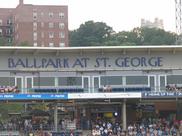
Yesterday I went to see the Staten Island Yankees host their crosstown rivals, the Brooklyn Cyclones, at beautiful Richmond County Bank Ballpark at St. George. (The Yankees won, 4-1.)
I couldn’t help but notice that all visitors are greeted with a big blue blast of Irvin type (or something close). I asked my friend Seth Davis to snap a few shots for evidence; they are presented below.



Ballyhoo at the Return of “The Campaign Trail” (For Me, Anyway)
Hooray, the Campaign Trail podcast is back! For some reason, the July 11 podcast never loaaed into my iTunes until yesterday, when I also downloaded the July 18 edition, which means that I’d been waiting since June 26 for more of Dorothy Wickenden and the gang. For my money, The Campaign Trail and the Washington Week audio feed are the only two weekly-ish political podcasts worth the trouble. The (belated) double dip was welcome indeed.
So after a week in which we heard way too much about the cover of the magazine, let us now praise The New Yorker‘s indefatigable, entertaining, and, at this stage, well-nigh overlooked political team, including but not limited to Hendrik Hertzberg, John Cassidy, George Packer, Jeffrey Toobin, Elizabeth Kolbert, and, of course, Ryan Lizza, who only wrote (in the very same issue!) that great article on Barack Obama that the whole political blogosphere recognized as outstanding.
I wrote way back in 2007 that “one of the rewards of election years is the certainty of … Lemann-esque articles” in The New Yorker, and Lizza’s was just the kind of thing I meant. (Nicholas Lemann wrote terrific articles on Al Gore and George W. Bush during the 2000 campaign.)
Which reminds me: I got to see Lizza interview Rahm Emanuel at the New Yorker Conference. I didn’t document it at the time, alas, but his reportorial chops were very in evidence that day. Lizza had the only interview of the conference that was newsworthy, and he knew it. He treated it as an opportunity to elicit new information, and he kept the pressure on Emanuel, and—what do you know, he committed news. By all means watch the video—you can see him trying to squeeze the most out of his allotted twenty minutes, doggedly refusing to let Emanuel off the hook. And remaining affable throughout.

The New Yorker Guide to Today’s China
I was intrigued by Emily’s observation a couple of weeks back that The New Yorker has been covering China so assiduously in recent months.
That got my devious little mind into gear. I looked into it, and she sure isn’t making it up. There have been a bunch of articles covering China since the start of the year, and the good news is, most of them are available online.
With only about three weeks until the start of the Beijing Olympics, we provide a handy list. (I’ll update this periodically.)
Evan Osnos, “The Boxing Rebellion,” February 4, 2008
Peter Schjeldahl, “Gunpowder Plots,” February 25, 2008
Peter Hessler, “The Wonder Years,” March 31, 2008
Jonathan Franzen, “The Way of the Puffin,” April 21, 2008
Paul Goldberger, “Situation Terminal,” April 21, 2008
Evan Osnos, “Crazy English,” April 28, 2008
Yiyun Li, “A Man Like Him,” May 12, 2008
Peter Hessler, “After the Earthquake,” May 19, 2008
James Surowiecki, “The Free-Trade Paradox,” May 26, 2008
Paul Goldberger, “Out of the Blocks,” June 2, 2008
Pankaj Mishra, “Tiananmen’s Wake,” June 30, 2008
Paul Goldberger, “Forbidden Cities,” June 30, 2008
Alex Ross, “Symphony of Millions,” July 7, 2008
Patricia Marx, “Buy Shanghai!,” July 21, 2008
Evan Osnos, “Angry Youth,” July 28, 2008
David Remnick, “The Olympian,” August 4, 2008
Did I miss any? Be sure to let us know!
Speedboat: Jen Fain Is the Written Thing
I read Renata Adler’s 1976 novel Speedboat last week. I found it a fascinating testament to…
…and right about there is where my difficulties began.
I had originally wanted to write that the book, while brilliant, is not a novel, at least not a novel with recognizable characters embroiled in a plot that’s resolved in some fashion, but after reading a bit of the critical commentary about it, I realized that this reaction is unoriginal and not so interesting. So what is there to say?
It’s not that Speedboat is simply dated. It is dated, very dated, but the book is also good, an unmitigated pleasure to read. Lots of books are dated in much more ordinary ways that make them difficult to read or enjoy today. Speedboat isn’t like that.
Perhaps this is the notion I’m groping for: A book like Speedboat couldn’t be published today in this form, much less receive the rapturous critical reaction it seems to have received in 1976. To use a medical metaphor, Speedboat is a diagnosis of the ’60s that cannot escape also being a symptom of the ’60s.
I don’t mean to offend. It’s a nifty book; it’s rare that one can say one has read a novel in which there is a pleasure to be found on virtually every page. But the techniques involved are so out of fashion that I’m not sure an editor would let it pass his or her desk in its published form. A novel consisting of a series of penetrating and thinly connected observations in which no plot point can be said to occur? It sounds like a hard sell, today.
Maybe we’re the poorer for it. Maybe their fashions were better than our fashions. Maybe I’m a terrible conservative when it comes to plot.
OK, that’s the meat of my reaction. A few odds and ends about the paperback edition I was reading, pictured below, found at the $0.48 bin at the Strand.
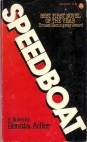
On the back is a picture of Adler by Richard Avedon, and underneath it says, in big red letters (hilariously, in my view): “JEN FAIN IS THE REAL THING.” Then underneath, in regular type, there are the words, “She is beautiful, hip, brilliant. She had been everywhere, done everything, known everyone.” And so on from there. It’s not that any of that is inaccurate, exactly, but it does create expectations the book isn’t designed to meet.
At the end of the book are a few pages of advertisement for other writers carried by the Popular Library imprint. One page touts Anne Tyler (spelled correctly), followed by a blurb from People: “To read a novel by Ann [sic] Tyler is to fall in love.” (Who’s that?) On the next page, we learn that a writer named Dorothy Dunnett “could teach Scheherazade a thing or two about suspense, pace, and invention.” And the page after that it says that “no other modern writer is more gifted a storyteller than Helen Van Slyke.”
Why is dated hype is so much funnier than other kinds?
Grant Achatz’s Alinea: Where Cobia, Tobacco, Radish Pod, Cedarwood Combine
Martin Schneider writes:
Anyone whose interest was piqued by D.T. Max’s Profile of Grant Achatz in the May 12 issue will want to check out the versatile Kathryn Yu’s Flickr group of the 27 Alinea courses she consumed last week. Molecular gastronomy seems designed to be ridiculed, but I for one am fascinated–and I’m not even a foodie.