
Martin Schneider writes:
I agree with the editors of America, the national Catholic weekly, that the most recent Fiction Issue may have represented a stealthy way of having a “Faith” issue in America’s most prestigious secular magazine. They note that “the magazine’s literary critic, James Wood, wrote a 4,000-word essay on the problem of theodicy, a term one does not often encounter in the pages of Eustace Tilley’s journal.”
America can cheer in recent hire Wood, then, because the guy has mentioned theodicy in five different articles so far! And, of course, the magazine does mention The Brothers Karamazov quite a lot, which is almost as good.
It will surely further cheer America that James Wolcott didn’t like all the wintry God stuff.
Myself, I have no objection to an emphasis on rabbinical or Jesuitical disquisition in the magazine. But June?
Author Archives: Martin
Flashback: Nancy Pelosi Channels Bob Mankoff
I’m glad to see Nancy Pelosi get her due. Her detractors, who have at times been legion, never seem to notice that the Democrats have had an unusual streak of good fortune since she assumed the leadership of the House. She’s the first woman to reach the second slot in the line of succession; a Wikipedia list of “women who have been in the United States presidential line of succession” makes for interesting and inspiring reading.
The New Republic article I’ve linked to above is a salutary reminder of a seminal moment in Pelosi’s tenure: the brilliant job she and Harry Reid (and Josh Marshall) did fending off George Bush’s attempts to reform/kill off Social Security. Atrios recalls a terrific anecdote, new to me, which occurred at a critical moment in that fight, when the Democrats refused to be bullied into offering up their own plan to reform/kill off Social Security in the name of appearing “reasonable.” Asked when the Democrats “were going to release a rival plan,” Pelosi responded, “Never. Is never good enough for you?”—which will surely remind many New Yorker readers of this Bob Mankoff classic.
“Campaign Trail” Podcasts Continue to Rock
For months now, Dorothy Wickenden has done a masterful job on the “Campaign Trail” podcasts engaging with the magazine’s talented political staff. They have been an undiluted source of pleasure in this exhilarating, maddening primary.
The latest installment, dated May 15, is one of the best yet. All three correspondents (George Packer, Ryan Lizza, and Hendrik Hertzberg) took part—I’d like to make known my desire that this happen as often as possible, as it worked so well this week. The three fellows grapple with McCain’s “2013” speech, with fascinating results. They don’t agree—indeed, they have wildly divergent reactions to McCain and his bid to recast himself as a moderate conservative. That may not sound very exciting, but I really liked how thoroughly undoctrinaire everyone’s contributions were, it made for a very lively discussion.
Plus Packer gave away the big surprise ending to the summer (spoiler alert—we attack Iran!). Wickenden seemed startled by that one, as was I!
Spondees and Anapests Fly at Union Square Cafe, YouTube
Martin Schneider writes:
“Word Feast” was that toothsome Talk of the Town by Lauren Collins in the May 12 issue about the versifying waitstaff of Union Square Cafe. (Seneca got beat up a bit.) It’s turning a certain Matt Gould into the kind of star that only New York can produce. Collins writes:
The biggest hit of last year’s series was a catchy rap poem written by a waiter named Matt Gould, which the bosses eventually got him to turn into a video holiday card. “Things never change or change later than sooner / Like the calamari, Billecart, filet mignon, and tuna!†Gould sings, while his co-workers shimmy on top of tables. (The Peppermill could be a new dance.)
Next, the good people of New York magazine’s blog Grub Street stated their intention to find a copy of the elusive Matt Gould holiday card. It took a mere quarter hour for a commenter to post a link to the video! (“Embedding disabled by request.”) Maybe they could combine their talents with a succulent Mark Strand special.
Remnick’s Jazz List: Let the Omission-Counterlisting Begin!
Martin Schneider writes:
In theory, I oppose lists of cultural distinction; in practice, I devour them greedily.
In conjunction with his Profile of legendary WKCR DJ Phil Schaap, David Remnick (with the help of Richard Brody) has compiled a fine, judicious, respectful, I daresay typically Remnickian list of the 100 most essential jazz recordings for the newcomer to jazz.
I can’t even hear the words “Phil Schaap” without thinking of my father, let alone “Django” or “Teagarden.” I would reckon he owned about two-thirds of these albums—or owned the material in other configurations (hint: bargain-bin compilations). A few of them, I’m certain, he bought as 78s. He was a child of the Depression, and his tastes ran to Benny and Louis and on through Thelonious and Billie Holiday. (Our first cat was called Billie.)
The whole first half is simply a list of the musicians my father loved the most. But even after the advents of free jazz and fusion and confusing, dissonant Ornette Coleman and Charles Mingus, none of which pleased him too much, he continued to find enough energy in contemporary jazz to visit the Village Vanguard with great gusto and regularity, even into this century.
I can say with complete confidence my dad would have approved of this list; that it emanates from the editor of The New Yorker, another lifelong passion of his, would have cheered him doubly.
New Yorker Conference Is Visual: Final Wrapup with Pictures
Martin Schneider writes:
The curious are invited to have a look at our Flickr set with photos from the New Yorker Conference:

I don’t have anything deep to say about the conference (although plenty of other people had deep thoughts to share). It was an exhilarating and exhausting experience, watching so much intelligent discourse in such a compressed manner. I salute the planners for enabling even a congenital wallflower such as myself to enter into the thrum of community over the two days.
I asked a fair number of people to assess this year’s event alongside its 2007 predecessor. There was some feeling that last year featured bigger names (Arianna Huffington, Barry Diller et al.) but that this year had more speakers. The duration allotted to each panelist decreased in the name of increasing the number of overall panelists. And, of course, the event was extended by a day. I definitely got the sense that the audience members were satisfied with the direction that The New Yorker had chosen to take the event. (Myself, I have no objection whatsoever to including speakers on the model of Paco Underhill or Jane McGonigal, highly esteemed experts in narrow, specialized fields.)
After the conference, I realized that the program exhorted participants not to take pictures. If anyone has a problem with these pictures being posted here, by all means write me and I will subject myself to the comfy pillow torture (and take the pictures down).
The New Yorker Conference Is Quotable: Day Two
Undeclared superdelegate Rahm Emanuel’s declarations at the New Yorker Conference proved newsworthy, and the magazine has posted the video of Emanuel’s interview with Ryan Lizza on its website. Now we can fact-check my scribbled quotations together! Yesterday I posted the finest lines from day one, and here are my favorites from the conference’s windup. —MCS
“You cannot get a healthy meal in a New York airport unless you bring it yourself and figure out how to get it through the security checkpoints.” —Paco Underhill
“I believe passionately in rubber-soled shoes.” —Paco Underhill
“Metal chairs should not be part of an airport’s lexicon.” —Paco Underhill
“The filthiest place in the first world is the bathroom in the economy section of a crowded airplane.” —Paco Underhill
“I think of the airport as a Berlin, with a Berlin Wall and a Checkpoint Charlie.” —Paco Underhill
“Has anyone had a pleasant experience at airport security? It’s a Stasi moment.” —Paco Underhill
“I think almost all of us agree that the airport experience is miserable.” —Paco Underhill
“World of Warcraft is the best-designed reality of all time.” —Jane McGonigal
“I have a dream of building an M.M.O. where your dog is your avatar.” —Jane McGonigal
“Miles per gallon is the new high score.” —Jane McGonigal
“I think there are people that know the Obamas better than Rahm does, there are probably people that know the Clintons better than Rahm does, but i don’t think there’s anyone in American politics that knows both the Clintons and the Obamas as well as Rahm does.” —Ryan Lizza
“At this point Barack is the presumptive nominee.” —Rahm Emanuel
“The reference point for change is George Bush.” —Rahm Emanuel
“Like in ’06, you’ve got to go take it from them. They don’t give up power easily.” —Rahm Emanuel
In the two recent special elections in Louisiana and Illinois, “The Republicans ran on taxes in Republican districts and their ace for the last thirty years came up joker.” —Rahm Emanuel
“When Hillary Clinton says, ‘I’m not a quitter, I’m a fighter,’ that is an accurate depiction of who she is.” —Rahm Emanuel
“The government has succeeded in universalizing health care for a population, not the population.” —Rahm Emanuel
“It’s not a coincidence that the big discussion in the Democratic Party is about trade and the big discussion in the Republican Party is about immigration.” —Rahm Emanuel
“Verizon is in the record business. Proctor and Gamble is in the record business.” —Steve Stoute
“The poster child for that ‘no sellout’ thing was Bob Dylan, and he ends up in a Victoria Secret ad.” —Steve Stoute
“We know that New York is the number-one terrorist target in the United States.” — Raymond W. Kelly
“You’d be hard-pressed to look at the high-end fashion industry and say they’re in trouble.” —James Surowiecki
“A copyright on the pinstripe would certainly be troubling.” —Scott Hemphill
“H&M is kind of like a gateway drug.” —Kal Raustiala
“I have a certain aversion to most famous people.” —Sheila Nevins
“The fictionalization of war seems better suited for after the war.” —Sheila Nevins
“Daytime is boring.” —Sheila Nevins
“Real Sex is our Sesame Street—people re-learn the alphabet every day.” —Sheila Nevins
“Opera fans are as fanatical about opera as sports fans are about sports.” —Peter Gelb
“One of the common errors that Americans make is to believe that all good things go together.” —Fareed Zakaria
“The real story is that the rest of the world is rising.” —Fareed Zakaria
“Over the last ten or fifteen years, China has opened up a lot more than people realize—but there are no political rights.” —Fareed Zakaria
“John McCain has drunk the neocon Kool-Aid.” —Fareed Zakaria
“It’s a good thing for there to be other centers of wealth.” —Fareed Zakaria
“In the Middle East, you had oil, you had failed dictatorships, and the two combined to form kind of an unholy alliance.” —Fareed Zakaria
“Being the 800-pound gorilla in the room is very different from being a small mouse in the room looking at the 800-pound gorilla.” —Fareed Zakaria
Note: Quotations are as accurate as I could make them; in a couple of instances I have replaced a pronoun with its antecedent.
The New Yorker Conference Is Quotable: Day One
Martin spent the day yesterday flying down the heady waterslide that is the New Yorker Conference, where inventors, scientists, politicians, filmmakers, programmers, musicians, and others with an eye on the daunting/thrilling place that is the future talk with New Yorker editors and writers about their work. Now in its second year (it’s timed to go with the apparently now annual Innovators Issue), it’s a brainy mini-marathon, punctuated by sweeping visual effects (thanks in great part to Frank Gehry’s floaty IAC Building) and fancy snacks.
All of which I was sorry to miss this year, along with the strong and welcome sense that I had become smarter in a single day. Luckily for us, Martin got back from Austria just in time to attend, and is even now being walloped with more visionary ideas, but in the meantime, he’s collected some of the most memorable lines from the first set of conference conversations. Kottke has been blogging the conference as well (and made the magazine’s new Twitter feed), and we can look forward to hearing more from Martin soon. Will some of the talks be available later on video? As a low-tech guru once said, signs point to yes. —EG
“Malcolm Gladwell has a new book coming out next year. It has already sold two and a half trillion copies.” —David Remnick
“Imagine this enormous room filled with incredibly sweaty teenagers with teeth missing.” —Malcolm Gladwell
“Scouting combines are, for lack of a better word, a disaster.” —Malcolm Gladwell
“I don’t think anyone could look at the President of the United States and not conclude that we have a massive mismatch problem.” —Malcolm Gladwell
“Ninety-nine percent of what policemen do is relational—resolving disputes and so on. So why are all cops big beefy guys?” —Malcolm Gladwell
“More politicians should screw up more often.” —Gavin Newsom
“I was trying to figure out why I am speaking third today. I think I was the top choice of all the sports combines.” —Andy Stern
“Change is inevitable; progress is optional.” —Andy Stern
“S.E.I.U. had to go from a lapdog of a political party to a watchdog for its members.” —Andy Stern
“Originally ‘Workers of the world unite’ was an ideological formulation; now it is a practical one.” —Andy Stern
“I am a very bad caffeine metabolizer.” —Michael Specter
“Rapidity in genetics is higher than Moore’s Law.” —Michael Specter
“For geeks like me, sexual data repositories are heaven.” —Michael Specter
“Drugs on average only work on 40 percent of the people who take them.” —Linda Avey
“Earwax is, you know, breathtaking.” —Anne Wojcicki
“We used to think, ‘We’ll figure out the gene for breast cancer, we’ll figure out the gene for Parkinson’s, we’ll figure out the gene for why I talk too much.'” —Michael Specter
“Anyone here seen those old James Bond films? Well, you’re looking at Q—actually, Q’s boss.” —Eric Haseltine
“Intellipedia is the single greatest advancement in the intelligence community since 9/11, and it cost zero dollars and took eighteen months.” —Eric Haseltine
“In the Cold War, the NSA came to mirror the Soviet Union.” —Eric Haseltine
“You cannot kill an idea with a bullet. You have to kill it with a better idea.” —Eric Haseltine
“Intelligence isn’t neat gadgets. Intelligence is computers and math.” —Eric Haseltine
“We developed a robotic hand but it developed arthritis.” —Yoky Matsuoka
“I have Duncan Sheik to thank that in my house, ‘Some Enchanted Evening’ now segues into a song called ‘Totally Fucked.'” —Susan Morrison
“Rock and roll in musicals—it’s like seeing your grandmother in a hula hoop.” —Duncan Sheik
“Of all the continents in the world, the one with the most hybridized conditions is Africa.” —David Adjaye
“These are like the three coolest chefs you will ever see in your life.” —Bill Buford
“Twenty-five years in Switzerland is maybe enough.” —Daniel Humm
“If you don’t go nuts in the kitchen at least once a day, it’s not worth it.” —Marc Taxiera
“I always think when a new season comes—this is my favorite season.” —Daniel Humm
“I think New York has more than four seasons. It has like twelve seasons.” —Daniel Humm
“Cooking is the only profession I know where you get to act like a buffoon all day with your friends.” —David Chang
“I can tell a California cook from a New York cook any day of the week—they’re slower…. I’m calling out all of California, pretty much.” —David Chang
“This is why I became a writer—my grandmother sucked in the kitchen.” —Bill Buford
“Ten years ago everyone wanted to have an omelet.” —Bill Buford
“The Berlin Wall fell in 1989. It’s probably the most important economic event in any of our lifetimes.” —Michael Novogratz
“Ramen noodles is everyone’s friend during two-dollar-a-day week.” —Amy Smith
“The truth is, there are ingenious people everywhere.” —Amy Smith
“I found out that most of these divas, whether Italian or American, were attached to needlework.” —Francesco Vezzoli
Note: Certain quotations altered very slightly to make comprehension more seamless. Not that short-term memory is flawless anyway.
Links of More Than Routine Interest: Benchley, Gawanke, Gladwell, &c.
Martin Schneider writes:
S.L. Harrison at Editor & Publisher digs Robert Benchley’s “The Wayward Press.”
Software engineers find Atul Gawande’s checklist useful.
Malcolm Gladwell is one of the five most influential “business gurus” in America, per WSJ. (Related: Where are the women?)
Forbes appreciates Calvin “Bud” Trillin’s London election coverage.
Ten talented cartoonists, essays and drawings, and Sex and Sensibility, a book Emily has celebrated.
And the headline source:
How Do You Say “Gently Sir” in Japanese?
Martin Schneider writes:
If this video doesn’t make you think of George Price, well, it certainly should.
As a reminder, a few classic cartoons from Price’s “crammed subway” period:
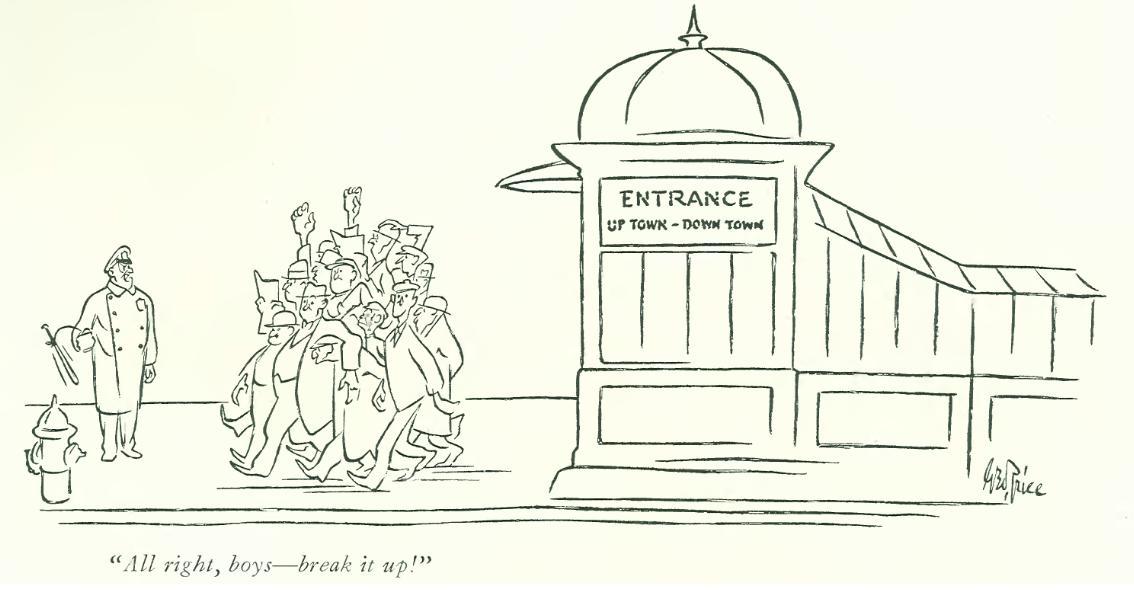
“All right, boys — break it up!” (February 25, 1939)
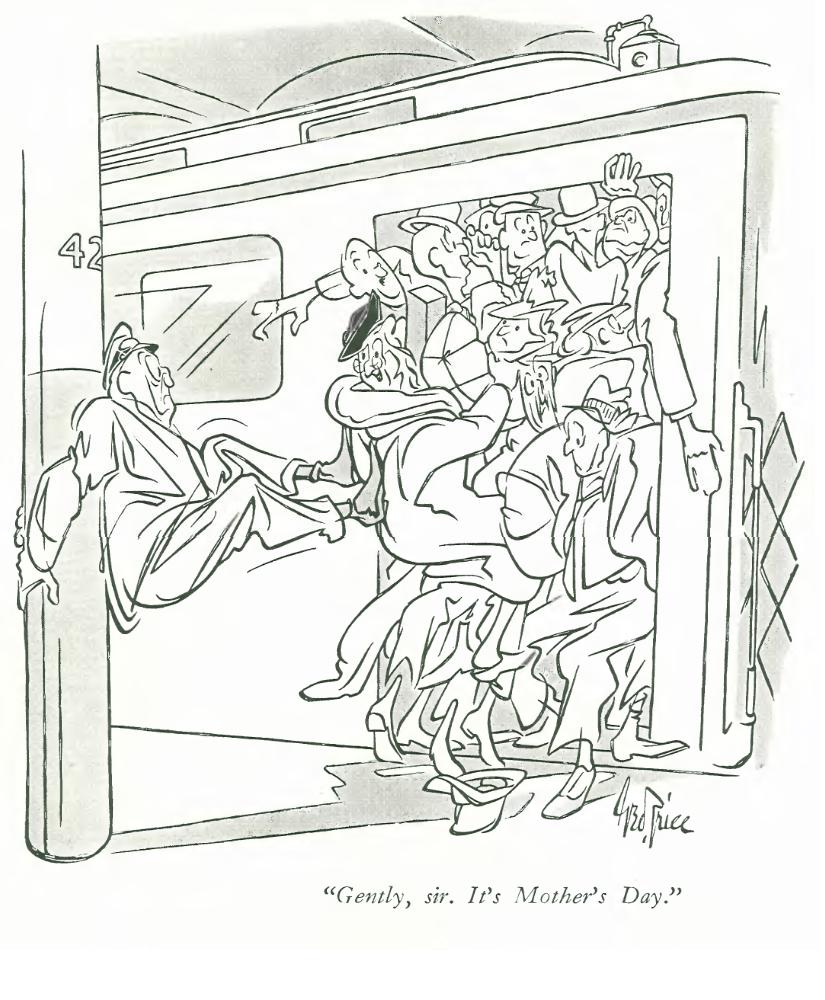
“Gently, sir. It’s Mother’s Day.” (May 11, 1940)
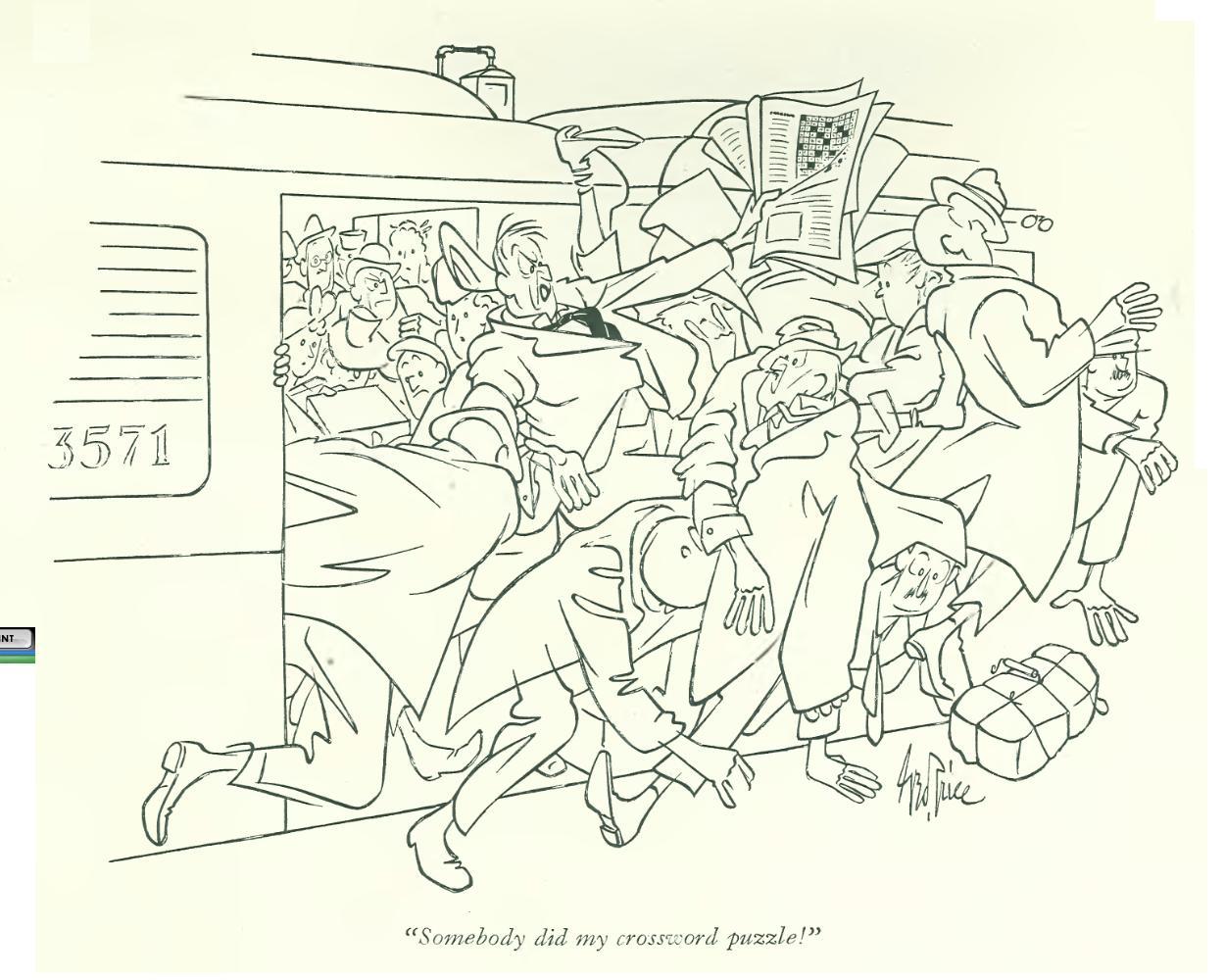
“Somebody did my crossword puzzle!” (December 11, 1943)
That first one is a favorite of Emily’s, the second a particular favorite of mine. (We’ve discussed all of this already, natch.)