
The Washington Post account of the Judd Apatow event.
An excellent Huffington Post review of the evening with Junot Díaz and Annie Proulx.
Nice tag-team coverage of several events by the Columbia Spectator, for which Emily once reviewed the debut issue of Allure, among other things.
The New York Observer calls two people conversing a “tiff.”
More sensible coverage of the Salman Rushdie and Orhan Pamuk event, plus a brief mention of George Saunders.
Enthusiast thinks the Voice‘s Rose Jacobs is mistaken (and presumably never saw our take.)
This writer notes much cursing at the Apatow event (she should have heard David Milch.)
An exhaustive and worthwhile account of the Mike Mignola, Jonathan Lethem, &c. comics event.
Is On Chesil Beach a novel? Not his problem, says Ian McEwan.
—Martin Schneider
Author Archives: Martin
Festival: The Art of Jumping on Concrete
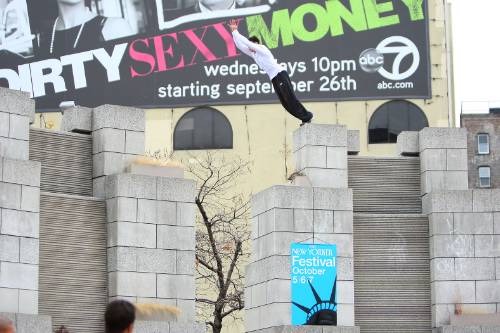
The “Parkour New York” event with David Belle happened at the same time as the Master Class on Profile Writing. I scurried over to Javits Plaza as soon as I could, hoping for a hyperactive last few minutes. By the time I got there, the event was more or less over. As the picture below demonstrates, the location was exceedingly well chosen.
I was due at the Joan Weill Center to see Alex Ross, but I took a few minutes to mill about (and dodge the occasional hurtling body). As it happened, some fellow was in the process of taking an arm’s-length self-portrait with Belle; I intervened and took a more standard posed shot from a few feet away.
Then Belle wordlessly (I think he does not speak English) called for a group photo to commemorate the event. If you ever see any such picture (I’ll be sure to post it if I do), I’m in there somewhere, certain to prompt in the other participants the pressing question, “Who the hell is that guy?”

Fortunately, Jason Kottke was there and therefore is able to provide a much fuller report than I can.
—Martin Schneider
Festival: The Art of Seducing Readers
Sunday’s Master Class on profile writing with Mark Singer and Susan Orlean was the best event I saw all weekend. The talk was structured basically as Singer grilling Orlean, in a friendly way, on the process of writing profiles, while Orlean would occasionally turn the tables. As the have been friends for decades, their shared references made it a powerfully informative, probing, and intimate session. The two writers were both so genuinely curious about the other’s process, it was as if the audience were not there at all. It was a truly remarkable session.
What follows is a more or less unstructured selection of observations and quotations.
It was fascinating to observe the many things Singer and Orlean have in common (curiosity, thoroughness, mad typing skills) while approaching very similar projects quite differently. Orlean is warm and seeks emotional connection with her subjects; Singer is more detached, calling his a “deadpan approach.”
Singer prefers to do exhaustive research before meeting the subject; Orlean prefers to learn about the subject in a more haphazard way. Singer made a great point about questions, saying that you should never ask a subject for information that you could acquire independently. In other words, don’t ask “Where were you born?”—ask what it felt like to grow up in Sheboygan. The former is publicly available; the latter is what you’re hired to find out. Orlean saw this differently; as she said, “I write a profile the same way I would go about making a friend,” and you would certainly ask a budding friend where she was born.
More than you would think, a lot of the process of writing these profiles occurs before it’s even agreed that there will be a profile at all. There’s a great deal of negotiating with the subject about access, and many profiles never end up happening at all. Some of Singer’s more interesting stories had to do with unwritten profiles. Since profiles at that stage are so amorphous, the process, later too, is necessarily infused with self-doubt—is this a subject? why would people read this? What am I doing here? And so on.
To counter this, a good profilist needs a compensating sense of worth: As Orlean said, “You have to have the confidence to say, as a writer, that somehow the choices you make are, in and of themselves, justifiable.” A simple and yet elusive point—as the example of a profile she did for Esquire about “the typical ten-year-old boy” demonstrates. She had to assume, on some level, that she was, of necessity, capable of “proving” to the reader that this material worth reading. “I love seducing readers,” she said, starting with a subject that seems of doubtful interest and then winning the skeptic over. She observed that Tina Brown, someone who would normally suggest very well-known people for profile subjects, could never really understand how Orlean achieved her effects (the two women have an abiding friendship nonetheless).
On the subject of editors, both writers were unabashed in their praise—indeed, awe—of David Remnick’s reportorial skills. As Singer said, “He is so good that he can spend a week in Israel and write a ten-thousand-word piece on the flight home,” a process for which the two panelists and most of their colleagues presumably would need far longer, on both the data collection and production sides. That had come up as a tangent on the subject of notes—both Singer and Orlean take copious notes, but Orlean insisted that the writer should be able to tell the story of the piece entirely out of her head, as it were. Until you’ve gotten immersed to that extent, you’re not ready to write. She compared the process to that of telling an anecdote at the dinner table. If you say, “I heard about this car that got stolen, but the owner’s dog was still inside,” your dinner-mates will likely not wrest the floor from you anytime soon. The same dynamic is in play with a successful profile. (That anecdote was the basis for an actual profile Orlean wrote, by the way.)
Orlean raised the question of tape recorders. Singer said that he has used them but hates them, “because then you have to listen to it.” As many people do, he detests transcribing as well as the sound of his own voice. Rather surprisingly, to me anyway, Singer likes to bring his laptop along as often as possible, and will often transcribe conversation with his subjects on the spot. Singer said the best course he ever took was typing, and Orlean laughingly bragged that she types exceedingly well, even better than the well-known Meryl Streep incarnation of her .
I did not know that Orlean did profiles for Rolling Stone for a long time. She explained that the material for a Rolling Stone profile is usually gathered an hour or less, in a hotel room with the subject, a process so truncated that the writer must, of necessity, invest random utterances and actions with absurd significance. (Singer: “The best approach in those situatons is just to shoot yourself before the interview.”) In addition, “nut grafs” are a Rolling Stone requirement: “The Fugees are important right now because …” At The New Yorker, unsurprisingly, things are different. Writers are encouraged to come up with a form and approach that fit the material, even if it means spending weeks with the subject. Singer said that the process is often so attenuated that subjects frequently question whether he is competent, wondering how on earth anyone could ever make a living this way. Orlean offered that she is always grateful that she can spend three weeks not apparently accomplishing much while she gets a sense of the subject at hand.
On the subject of form, Singer referred to his “cinematic” understanding of content, which leads him to use “scenes” to help him structure the material. As he said, “You have to have a really great reason to abandon chronology,” something that Orlean does more often than most. Singer observed that it is very difficult to write profiles about very funny people. There is a constant temptation to reproduce shtick, which never comes off nearly as good in print; such pieces are always threatened by a “you had to be there” quality that is death to a good profile.
Orlean once did a kind of mental tally of the geographical origins of New Yorker employees, concluding that the staff was “overwhelmingly midwestern” (I pass on the information in the interests of sociology). Singer and Orlean agreed that in a city like New York, many good profiles arise out of a kind of restless, pavement-pounding inquisitiveness. See an odd shop? (Orlean’s example was a shop specializing in ceiling fans.) Talk up the proprietor, you’ll likely discover a hidden expert in some arcane subject: “Everybody’s more intensely whoever they are in New York.”
I could easily go on for another ten paragraphs, but I won’t. Clearly, this material fascinates me in a big way. I’ve read a great many profiles in my time, and now I have at least an inkling of how they are put together. For that I am thankful. —Martin Schneider
Festival: Alex Ross Will Get You to Dig Arnold Schönberg
Alex Ross called his late-Sunday presentation, “The Rest Is Noise: A Multimedia Tour of Twentieth-century Music,” an “improvement” on his book, as he would be able to supplement the points in his narrative with musical excerpts, so that we could actually hear examples of composers’ work along the way.
Make no mistake about it: Ross’s presentation was fabulously successful by almost any set of criteria. Simply put, it’s difficult to imagine a human being better suited to the project of explaining the tortuous path of what we might call “serious” music in the years following 1900 to a lay audience. (I can already hear the objections to that word piling up.) If Ross has any plans to reproduce his presentation elsewhere, I highly recommend catching it; it is an experience sure to benefit any enthusiast of any kind of music. If you enjoy the intentional arrangement of aural tones to achieve an effect in the listener, you will probably enjoy this. Further, it is profoundly inspiring to see the high degrees of passion, engagement, expertise, and erudition that Ross brings to the subject.
I combine fairly low affinity for what is called contemporary music (or classical music for that matter) with a high degree of exposure. Staying in the twentieth century only, I’ve seen operas by Janáček, Korngold, Strauss, Glass, Prokofiev, Harbison, Berg, and Britten, and maybe a couple others I can’t think of right now. In all honesty, most of them had a kind of “Isn’t that impressive!” impact on me without really getting me where I live.
All of which either makes me Ross’s ideal audience member or the worst one imaginable—possibly both. For my part, I got a lot out of the presentation. Ross said that his goal was to “defeat any preconceptions” about twentieth-century music, and there’s no doubt he succeeded in that. To take two examples at random, he was able to present both the forbidding and supposedly melody-free clangor of atonal music and the barren-sounding prospect of minimalism in a way that both was memorable and piqued the interest.
Anyway, enough of my yakking. Whaddaya say? Let’s boogie! —Martin Schneider
Festival: Squeeze a Drop of Blood from a Sugarcube
If the New Yorker Festival Debate hadn’t ended so early (about 9:15), I might not have bothered hauling my sorry ass out to Gowanus to see Yo La Tengo. I’m lucky I did. Ben Greenman did a fine job ushering the band through an always potentially awkward blend of music and Q&A in a large darkened space. His suggestion of “Autumn Sweater” was particularly genius; that was the high point for me. I saw YLT do a proper rock gig at Irving Plaza years ago, and I must say I prefer the quasi-unplugged variant quite a bit more. YLT trades on its remarkable flexibility—every time you think they’re a step and a half away from becoming a folk band, they bust out a dose of skronk that would rouse even J. Mascis from slumber.
From the interview portions, my two favorite comments came from bassist James McNew (these are very close paraphrases): “An English teacher gave me a copy of White Light/White Heat, and it just broke my mind…. I was like, ‘I hope you realize this means I’ll be flunking your class….'” and, “A lot of the songs I write are messages to present-tense-me from just-slightly-future-tense-me telling me everything will be all right.”
Here’s what they played:
The Cone of Silence
Stockholm Syndrome
Story of Yo La Tango
Magnet (NRBQ)
Madeleine
Autumn Sweater
I Heard You Looking
Pass the Hatchet, I Think I’m Goodkind
This Man He Cries Tonight (The Kinks) (live debut)
Sugarcube [excellent choice for a closer]
(Accurate set list provided by Jesse Jarnow.) —Martin Schneider
Festival: Canuck Topples Hoser in Ivy Debate (or Possibly Vice Versa)
Well, the first annual (I hope!) New Yorker Festival Debate has come and gone, and to call it anything less than an unmitigated success would be a sham. I was seated up front at the Society for Ethical Culture, by chance nestled among some of The New Yorker‘s more elderly readers; the woman next to me, as an example, wore an expression of pure glee the few times I ventured a peek. If the Member from Gopnik and the Member from Gladwell (as the convention required they call each other) don’t collectively become a 100% Canadian staple of the Festival, then the world just doesn’t make sense. Attention programmers! I want to see these two debate a year from now! Got it? Good.
Gladwell, defending the proposition that we should disband Harvard, Yale, and Princeton (Gopnik frequently questioned this circumscribed definition of “the Ivy League”) and use their endowments to “purchase Canada,” had a difficult task insofar as he was defending an outlandish proposition for which there happens to be a great deal of supporting data. Gopnik, by contrast, could appeal to normalcy and reason without any data at all. However, the tone of high whimsy sustained by both Members was a joy to behold.

I prefer Gladwell’s rational moralism to Gopnik’s intuitive pragmatism, but I give Gopnik credit, though—he is quick. Hardly had Gladwell evoked the French Revolution than Gopnik took the opportunity to enlist the (already sympathetic) chair, Simon Schama, author of Citizens. Our very moderator wrote a freaking book on the Terror, Jack! (Short for Jacobin.)
My favorite bit was when Gladwell shamed the Ivy League’s rank naked elitism by quoting a federal investigation of Ivy League admission practices in the 1980s. (I’d like to see more of the fruits of that investigation—I assume Karabel has the goods.) According to notes found in applications, Harvard admission officials dismissed candidates for being “shy,” “frothy,” and “short with big ears”—and then pointedly implied that the Member from Gopnik must surely take some comfort in Gladwell’s implicit defense of those groups.
Schama took on his role as arbiter in the spirit of a mad uncle or possibly a court jester; he amusingly bristled at his employer Columbia’s exclusion from Gladwell’s “Ivy League First Division” of Crimson, Bulldog, and Tiger (Gopnik’s preferred satirical term was “Axis of Evil”). At one point Schama leapt up from his central table and, using the Member from Gopnik as a sort of meat puppet, contributed a point of fact and called the Member from Gladwell a “dunderhead.” Hardly the cool impartial magistrate such august proceedings demand.
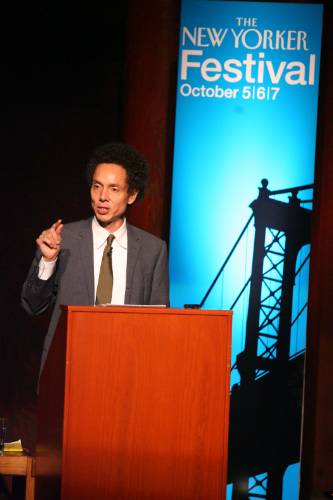
As Gladwell predicted, Gopnik was charming and almost dangerously persuasive—or, I should say, as persuasive as baldfaced appeals to emotion can be. Gopnik used a maximalist strategy wherein any agenda to disband Group X can be assumed to take its most extreme form at all times. Gopnik likened the Member from Gladwell to Pol Pot, a comparison Gladwell confessed he found “flattering.” Gopnik saved perhaps his shrewdest—indeed, possibly difference-making—move for his final statement, enlisting Bill Clinton for his cause and aligning George W. Bush himself with the Member from Gladwell. (Gladwell had to roll his eyes at that one; he might have sensed that defeat was nigh.)
In the end, Schama peered into the audience’s show of hands and pronounced the proposition defeated. Harvard, Yale, and Princeton can rest easy—for now.

—Martin Schneider
Festival: The Compelling Samantha Power
Wow. The Samantha Power presentation on Darfur was just phenomenal. It actually felt much more like a New York Conference event (at least judging from the online videos). It’s rare to see a speaker on a complex subject also speak, often ex tempore, very complexly and yet quite clearly and more than that, with rhetorical resonance.
Her talk had three parts — the situation in Darfur, solutions to the problem, and structural qualities that may hinder or help the efforts of well-intentioned people. I won’t try to reproduce the facts on the ground in Darfur — other sources can do that more accurately. I will attempt to summarize what I got out of the other parts of her presentation. None of this should be taken as quotation; I did take notes, and in some places will be attempting to reproduce her pithy wording. But my notes are imperfect, so just don’t take any of this as her exact words.
I gather that Power is now aligned with Barack Obama in ways that can’t relate to her job as a reporter. She sprinkled in a dozen stray references to the importance of electing Obama president. This is instructive for a few reasons, which I’ll get to. (As it happens, I agree with her on Obama.)
She has apparently been spending a lot of time in Obama’s Senate offices, and she found it illuminating to witness constituent influence on the actual activities of the office. Every day, according to her, someone would present a tally of the calls on a variety of subjects, and it was a given that any subject getting a large number of calls would have to be dealt with quickly. This was not limited to Obama’s office, which is presumably well run. Her point was that, difficult as it may seem to believe, when you call your local congressperson or Senator, it matters. They are listening, and if there are enough calls someone will go off and at least put out a statement. It may not sound like that much, but forcing them to get on the record is far from nothing. If something matters to you, call your elected representatives — they will be forced to take action.
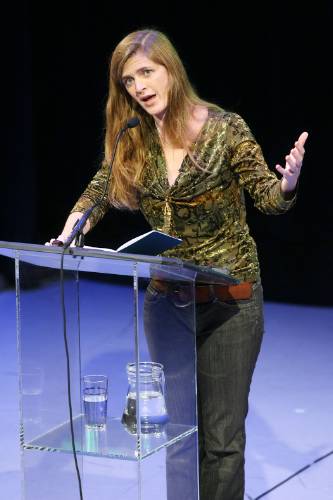
According to Power, this system of direct popular influence is almost unique to the United States (her actual point of contrast was Europe), and it is practically the only reason that the United States, even in its laggardly form, is one of the global leaders in the struggle to help Darfur. Power said that President Bush has mentioned Darfur far more in public than any other western leader, and that is purely a result of pressure bubbling up from citizens who want to see action. In addition, despite abiding GOP hostility toward to the International Criminal Court, there has been so much domestic pressure on Darfur that John Bolton was forced to give his kiss of approval to certain international actions intended to help Darfur.
In addition to nagging elected officials, there are also some interesting techniques that some younger activists are trying. One group is issuing “genocide grades” to congresspersons. (Missing big votes about genocide is a sure way to an F.) And it’s working. Some flunking representatives and senators have explicitly sought to raise their grade. If you have any kind of stock holdings, especially mutual funds, You can also call and ask to have Darfur-related stocks removed. “Divestment” is a big term in this field, and that’s also something you can pressure your elected official about.
In some ways the talk was “really” about the reduced prestige of the United States and the increased prestige of China. China is one of the major reasons that it is difficult to make progress in Darfur. China has major petroleum holdings in Sudan, so it is blocking efforts to stop the violence in Darfur. Basically this is just a fact of life we have to get used to (China is important), but we should also not forget that China can be shamed into action because it is very careful not to harm its prospects in the long term. It is possible to get even China to do things it doesn’t want.
It’s depressing to contemplate our reduced prestige, the primary effect of which is a palpable moral vacuum in the international arena. It’s sobering to realize how much damage the war in Iraq has done on this score, it is now simply a chip that countries with their own motives (let’s say, France, which has its own energy deals it is pursuing) can use any time they want to ignore U.S. exhortations on such subjects. The vacuum also extends to the UN Security Council, where a more influential China and a chastened United States mean continuing disarray in many parts of the world.
Back to Obama. All of this last stuff is the reason that Obama as president might be able to do so much good. Symbolically, he would send the right message to the rest of the world that we are ready to put the Bush presidency behind us, and Obama would doubtless take many concrete actions consistent with that. However, as Power pointed out, our problems are not limited to Bush; they extend to the domestic forces that put Bush in office. Similarly, while it is possible to imagine the United States taking a wide array of actions necessary to coexist in the world, it is difficult to imagine that happening without retwriting our national DNA. It will be interesting to see what kinds of actions have to happen on the international scene (I refer to proofs of our decreased prestige) in order for us to put our own chauvinism behind us and regain the good will of our erstwhile international allies. Power quoted someone (didn’t catch the name) to the effect that “the United States has to learn to become a team player even when it’s not the team captain.” Hear hear.

—Martin Schneider
Festival: The Medicine of the War in Iraq
It was an interesting thing, attending an event about the war in Iraq in which neither Bush’s policies nor the propriety of the war ever really took center stage. The subject was the medical side of the war. There was not a hint of “controversy” in the room, if anything the tone was deferential, quite properly—I’m sure there is unanimity on the question of whether our soldiers merit the best care we can possibly provide. Atul Gawande’s guests were Colonel John B. Holcomb, commander of the U.S. Army Institute of Surgical Research in Texas, flanked by Major L. Tammy Duckworth and Captain (Ret.) Dawn Halfaker, two veterans who lost limbs in separate incidents in 2004.
Tammy Duckworth’s name may be familiar, as she narrowly lost the race for Illinois’ 6th district in 2006. (From the sound of it, she hasn’t yet given up her ambitions for public office; she is now serving as director of the Illinois Veterans’ Affairs Department.) Having lost both of her legs, she appeared on stage with two prosthetic legs, only one of several options the VA has made available to her, including various types of wheelchairs. Dawn Halfaker was on a police patrol when a rocket-propelled grenade tore her Humvee in half. She lost an arm — were it not for her Kevlar armor, the injuries would have been far worse. She attended without her prosthetic arm, observing that wearing it can be a drag.
It’s important to note that both women displayed all sorts of traits common to all soldiers, wounded or unwounded, male or female, by which I mean wit, perceptiveness, pride, honor, and the like. Dawn made an acute point about the lot of female combat amputees: knowing that others are likely to interpret them accurately, a male veteran wears his scars with pride. Since fewer people immediately assume that a lost arm occurred in Iraq, a woman is more likely to cloak the amputation with a prosthesis. Tammy added, “I’m proud of my scars. I’m proud of my wounds. It’s not like it was a bar fight,” although she occasionally does jest in the latter vein: “You should see the other woman.” At one point Tammy displayed one of her “bar tricks,” swiveling her somewhat Terminator-like shin to a vertical position such that her foot could easily support her glass of water.
Not all audience members regularly encounter recent veterans (I am among that number). It was especially interesting to be reminded of the soldier’s quite proper ability to compartmentalize. Tammy has disagreed with the war all along, but as a service member, she was bound to follow the decision of the freely elected commander in chief, and was proud to do so. Tammy continued (paraphrasing), “If you disagree with the policy, it’s your duty to take it up with the politicians, and elect them out.” Dawn’s attitude was remarkably similar, if less inherently oppositional. Both described the bodily disfigurement as an “acceptable outcome” of battle—a seemingly strange position until you realize that a soldier lives with the daily possibility of instant death or capture by a sadistic enemy. This was a sobering and informative event, to say the least. —Martin Schneider
Festival: Matched sets, a Theme?
It’s funny: I assume photographic evidence is forthcoming, but Pamuk and Rushdie were similarly dressed — striped, light blue dress shirts and dark pants.
Saunders and Foer were likewise similarly dressed. Both had lavender- or lilac-dominated tops (in Saunders’s case, a tie) and jeans. Their clothes matched the backdrop.
Are these panels being costume-designed? Is “costume-designed” even a word?
Festival: Saunders and Foer Get Incredible
If the High Line Ballroom is an interesting venue, the Angel Orensanz Foundation is a gorgeous one. Not having ever been there before, I cannot divulge whether the blue and purple rear facade is a permanent feature or a creation of the lighting crew. Either way, the effect was jaw-dropping.
In these stately trappings, Saunders and Foer explored the concept of the Incredible. It was an interesting evening of chat. Unlike the earlier Pamuk/Rushdie event, Foer and Saunders genuinely didn’t see eye to eye on more than a few matters, and therefore something rather unexpected occurred — genuine hortatory verbal sparring, albeit respectful.
Both writers seemed honestly nonplussed to hear their work discussed in such fantastical terms. For Saunders, the emphasis is squarely on keeping the reader diverted; his craft manifests in getting the reader to keep reading — indeed, this is true of all writers in some measure: “Whatever effects you get, you only get them by being Groucho Marx.” Foer’s quick concurrence focused on the need to keep reader #1 entertained: “I have shut my own books, so many times….” Saunders later wished for temporary minor lobotomies, such that the author could approach each day’s work as if for the first time: “Paragraph three sucks. I ain’t readin’ any farther.” What others see as the outlandish in Foer’s work, he sees as a simple testing of the boundaries of the way things are. In his words, “nothing could be more real.”
Saunders is a natural cutup, as seen in his effort to explain the “baseline” narrative mode. If lion eats brother, the next day the discussion’s telling will be grounded in the reality of the lion. Once you’ve established the lion’s reality in story, then you can do something about it: “Let’s go get him; you go first.” On craft, Saunders often seemed the more insightful speaker, but that misses the point. Saunders got where he is through hard work, trial and error, and many false trails down Hemingway Lane. Not to dismiss the role of toil in Foer’s daily lot, but he’s clearly a natural. His description of seeking to induce “rigor mortis” in his readers was indelible, as was his heartfelt avowal of the importance of Kafka to his work. Never did they disagree more than when the subject turned to advertising, a staple of Saunders’s work and a subject he discussed with scarcely disguised glee (Foer’s take verged on horror). It was interesting to hear Saunders conjure a Tolstoy capable of describing both sides of the advertising transaction, the crone that advertising exploits and the advertising executive who exults in the artistry of it.
Foer explained his powerful ability to compartmentalize (when he’s not writing, he doesn’t think about it much) with a wonderful comparison. You may love swimming all the time, but when you’re not in the water, you’re not swimming. —Martin Schneider