Author Archives: Martin

Tina Brown: “Blondes Are More Interesting, It Seems”

They sure are when they come in the form of such accomplished women as Lesley Stahl and Tina Brown. Last night I ventured to the Union Square B&N to witness a “chat” between Stahl and the former New Yorker editor; the latter is, of course, promoting her incipient blockbuster, The Diana Chronicles (currently #7 on Amazon). This being Brown’s first book ever, not to mention her first book signing ever, it made for quite a heady event.
As the rain came down, in between wincing at the overamplified Pat Metheny music and pouncing on a slew of 48-cent Penguins at the Strand stall (I collect them), I had the good fortune to enjoy a solid hour of intelligent, delicious repartee about, like it or not, like her or not, one of the most fascinating figures of our time: Princess Diana.
I would not have been quick to grant Diana such a grand appellation, but Brown quite simply won me over. For her part, Stahl had clearly done her homework, found the subject matter riveting, and betrayed every sign of wanting to have a ball. “Should I keep dishing?” she kept asking the audience. “I should?” Normally I disavow the dishy, but her enthusiasm was infectious—dish on!

tina2.JPG

tina1.JPG


Stahl called Brown’s book “an autopsy of the monarchy under Queen Elizabeth,” and it’s easy to see why. Having worked at the Tatler during Diana’s formative first years as Princess, and having written one of the most important pieces of the Diana canon, “The Mouse That Roared,” for Vanity Fair in 1985, shortly after taking over the editorship there, Tina might well be the most qualified person in the world to discourse on the subject. If the book is half as engaging as last night’s chat, it’s going to be the best beach book in years.

During the Q. & A., someone asked Brown to draw out the parallels between Diana and Hillary Clinton. To her credit, Brown demurred—while acknowledging that both women contain compelling contradictions (“You know, blondes are more interesting, it seems,” she hazarded impishly), the chasm between the senator with the voracious intellect and the scarcely lettered socialite remains too gaping to ignore.

When Brown signed my copy of the book (see above), I told her what an effective advocate for the book she is. Apparently, she took my words to heart: When I got home and switched on the TV, what’s the first thing I see? Brown entertainingly explaining Diana to Anderson Cooper. [And last night, she was on Charlie Rose. —Ed.] You’re welcome!

—Martin Schneider
Lawrence Wright: “They Envy Us, But Even More, They Are Disappointed In Us”

Last Wednesday, Emily and I had the rare privilege of attending the second of two performances of Lawrence Wright’s My Trip to Al-Qaeda at Town Hall. I don’t know if any more performances are forthcoming, but I certainly hope so. Look out for it.
Directed by Gregory Mosher, My Trip to Al-Qaeda takes place in an approximation of Wright’s own office, complete with large, uncommented-upon Afghan rug. The few books whose covers we can glean from our seats seem well chosen, if the goal is not to project any particular “meaning.” Nicely played, Mosher. Wright, whose previous acting experience is (according to the program) limited to a high school production of Our Town, has a nice scholarly presence. He may have picked up a thing or two from Denzel Washington on the set of The Siege, a movie he wrote.
That’s right: Wright wrote the movie we all became intensely curious about after September 11, that movie that, according to Wright, became the top-rented movie after the hijacking attacks, giving him the grim distinction of becoming “the first profiteer in the war on terror.” Wright makes sure we understand the ways in which The Siege both was and was not prescient before beginning his narrative proper.
Over seven sections, Wright fills in his complex sketch of the Middle East as we now know it, as we now need to know it. The Middle East of Wright’s presentation is screwed up enough to elicit empathy, and if the United States doesn’t always come off looking so great either, does that make it an exercise in “root causes” or “blame America first”? To Wright’s credit, it never feels like the latter.
Difficult to summarize easily, My Trip to Al-Qaeda, which moves from Egypt to Saudi Arabia to Afghanistan, forces on the reviewer a strategy of revealing isolated points. Wright describes the formative experiences (torture) that turned Abu Musab al-Zarqawi “from a surgeon into a butcher”; the shockingly Pyongyang existence that is the everyday life of a woman or girl in the region; the importance of Naif in the story of Osama Bin Laden and his impressive uncle; the ego boost that destroying an empire (the U.S.S.R.) will provide to an angry band of Afghan guerrillas; and the charnel house that is the masculine side of the region’s psyche—although possibly for not all that much longer.
I won’t soon forget the minute or two of the Al-Qaeda training video that Wright shows.
No such story would be complete—not in 2007, anyway—without reference to witless harassment from the federal authorities soon after the author’s return, nor to chilling factoids emphasizing our current lack of preparedness. Since September 11, the number of Arabic speakers on staff at the CIA has decreased by two, to six.
This is effectively one of The New Yorker‘s finest reportorial pieces in recent years come to life. Parts of the performance are gut-wrenching, parts are hair-raising, but overall, “thought-provoking” is the most apt term.
Afterward, David Remnick came out and asked a few thoughtful questions and led a brief Q. & A., during which Wright indulged his hopeful side, noting that foreign-born Muslims are treated far better in the United States than in Europe and that the Palestinians clearly are ready for a peace treaty with Israel, which might reduce the all-consuming resentment in the region.
Note: For a taste of My Trip to Al-Qaeda, check out this brief clip, obligingly provided by The New Yorker. (By the way, Wright is now “off-book.”)
—Martin Schneider

McCain Said It

“The bridge to nowhere, with 233 miles—a $233 million bridge to an island in Alaska with 50 people on it was the tipping point.”
—John McCain, Republican presidential debate, last night
In related news, a search on whitehouse.gov, which contains a searchable archive of all presidential speeches, press conferences, news briefings, etc., yields 0 hits for “tipping point.”
—Martin Schneider

Sumnertime, and the Living Is Easy: Where Tilley’s Butterfly Must Be Flying

Sumner is a town in Oklahoma.
Do you know how many New Yorker covers incorporate some sort of reference to Sumner? Take a guess.
I’ll give you a hint. It’s more than 37. It’s a lot more than 37.
Don’t believe me? Do a search in the Complete New Yorker archive on the term “SumnerOK” (that’s right, no space).
It’ll return 1,133 hits, every last one of them a cover.
These are the known facts about Sumner, Oklahoma, at least according to the citizens of Wikipedia.
Sumner is in Noble County, Oklahoma, ten miles east of Perry and two miles north of US highway 64.
The town was named for Henry T. Sumner, a businessman from Perry (ten miles to the west).
At its peak, Sumner had a bank, post office, two churches, a school, a grain elevator, and a train stop, but those days are long past. Currently, the only significant buildings still in use are the two churches and the school. The post office opened on May 23, 1894—and closed on July 27, 1957.
In 1905, according to the Oklahoma Territorial Census, Sumner had sixty-four residents, but it now has a population of approximately fifty, a precipitous plunge of 21 percent (est.) over more than a century—an attrition rate of one person about every seven years and three months.
Now, you might think that truly outlandish figure means that Sumner is (somehow or other) represented in every single cover of The New Yorker. But that would be entirely preposterous. 1,133 represents the slenderest fraction of the full 4,109 issues, a mere 27.6 percent of the whole. A mere bagatelle.
It remains unclear what quality this town possesses that has led the hardy toilers on 43rd Street to such heights of monomania over the decades.

The New Yorker: The Hipster’s Choice…Or Is It?

Oh, irony, you scamp. In a recent post we identified “irony” as being, by some measures, a New Yorker kind of word, but today brings evidence that Time Out New York is the really ironic one. In this week’s cover story, “The Hipster Must Die!”, the weekly guide performs a “hipster detox” on a misguided (their assumption, not mine) hipster on staff named Drew Toal.

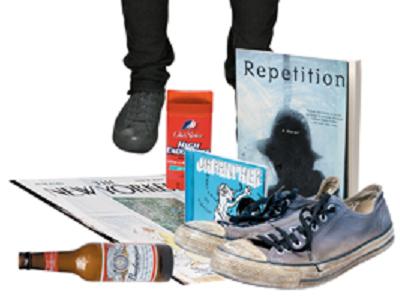
tony.JPG


The feature puts The New Yorker in an, ahem, interesting light. First, here The New Yorker is defined as a hipster journal. I beg to differ, but I can’t deny that its reach encompasses George Saunders as well as Seymour Hersh. So in the makeover, Toal (or should I say “Toal”? He may be a real person, but the makeover is clearly facetious) discards The New Yorker in favor of “a Star Wars novel and a copy of Maxim.” Ah, good to know what “regular” people read! So what does Toal think?

Truth be told, I found myself enjoying tales from a galaxy far, far away. Despite the fact that they were written on a third-grade level, the lack of existential conflict and postmodern window dressing was refreshing. And the lightsabers were cool too. Maxim, it should be noted, was less revelatory, although I did learn six important tips on how to make a successful sex tape. I will be going back to The New Yorker and Harper’s, but I’m also going to make time for nerding out in sci-fi land.

Is “hipster” so strongly coupled with “intelligent” that its opposite automatically denotes a “third-grade level”? I don’t think so, but let’s move on.
Clearly, this is a backhanded compliment to The New Yorker—it’s the opposite of third-grade fare. But wait! Doesn’t that make it also a backhanded compliment to hipsters, too? In a feature about the necessity to de-hipsterize Williamsburg? Color me confused.
And the confusion doesn’t end there. If we showed ten random local culture vultures a Star Wars novel and The New Yorker and asked them to pick the purer hipster artifact, how many of them would reflexively single out the one that frequently dedicates considerable space to poverty and genocide? Surely it’s the Star Wars novel that reeks of hipster slumming, no? Even Maxim can be read ironically, you know.
At this rate we’ll need Jesse Thorn, mastermind of the new sincerity, to sort it all out.
Note to TONY: Did you mean McSweeney’s? Or was that too obvious?
—Martin Schneider

A New Yorker Lexicon: What Hath Sanguinity Wrought?

Did you see the “100 Words Every High School Graduate Should Know” that the makers of The American Heritage Dictionary are touting? It’s a pretty good list, actually, although such an enterprise is always going to be a bit random. I confess there are more than a few terms (mostly science-related, e.g. “gamete“) that I would not be able to define to my own satisfaction.
I decided to run the words through The Complete New Yorker to see if The New Yorker “knew” them all. Sure, you’re thinking, it’s everything since 1925! They’ll all come up dozens of times, silly! But ah, I could counter, it’s only abstracts and keywords and hastily typed summaries we’re talking about here.
Anyway, it turns out that the CNY balked on seven words. I find it very suspicious that two of the words it didn’t “know” were “suffragist” and “enfranchise.”
Which of these words do you think would produce the most interesting set of results? The comments section awaits your opinion.
Here are the results. The winner, with yards to spare, was a surprise to me, as was the margin.
irony 435
totalitarian 59
infrastructure 52
wrought 48
metamorphosis 47
epiphany 39
hubris 32
lexicon 30
equinox 28
filibuster 27
kinetic 27
paradigm 25
nomenclature 22
euro 20
hegemony 20
impeach 20
obsequious 19
nihilism 18
soliloquy 18
vortex 17
gauche 16
incognito 16
reciprocal 16
facetious 15
vehement 13
bellicose 12
diffident 12
homogeneous 12
incontrovertible 12
precipitous 12
acumen 11
chromosome 11
feckless 11
lugubrious 11
tempestuous 11
auspicious 10
chicanery 10
fatuous 10
omnipotent 10
sanguine 10
tectonic 10
vacuous 10
fiduciary 9
respiration 9
abstemious 8
loquacious 8
plasma 8
taxonomy 8
antebellum 7
circumnavigate 7
deleterious 7
gerrymander 7
unctuous 7
yeoman 7
evanescent 6
kowtow 6
oligarchy 6
plagiarize 6
polymer 6
quotidian 6
supercilious 6
usurp 6
photosynthesis 5
reparation 5
belie 4
churlish 4
nanotechnology 4
nonsectarian 4
orthography 4
winnow 4
abjure 3
deciduous 3
hemoglobin 3
hypotenuse 3
parameter 3
ziggurat 3
laissez faire 2
recapitulate 2
tautology 2
thermodynamics 2
abrogate 1
bowdlerize 1
circumlocution 1
enervate 1
gamete 1
inculcate 1
jejune 1
mitosis 1
oxidize 1
parabola 1
pecuniary 1
quasar 1
subjugate 1
enfranchise 0
expurgate 0
interpolate 0
moiety 0
notarize 0
suffragist 0
xenophobe 0

Notes:
* A friend observes: “Jejune” is the month after “Mimay.”
* I don’t really see why anyone needs to know the words “yeoman” and “moeity” in 2007. [I’d argue for “yeoman,” used sparingly, but what would George Orwell say about some of these slovenly Latinate clunkers? —Ed.]
* “Quasar” has one hit—in which it is mentioned as a difficult word that nobody knows. It’s a cartoon from the 8/21/1965 issue by Alan Dunn. Mother to inquisitive son: “If you want to know what a quasar is, I’d say you’ve come to the wrong person.”
* A story in the current issue (June 4, 2007) explicitly refers to “sanguine” as a difficult word, the kind of word someone would look up in a dictionary. In fact, Karl Rove looks it up in a dictionary.
* For me, the big shockeroo is the total for “wrought.”
—Martin Schneider

Register: Titled Newsbreaks, 1Q74

Happy birthday, Martin!
ANSWERS TO HARD QUESTIONS 1/21 71; 2/18 91
ANTICLIMAX DEPARTMENT 2/4/46
CLEAR DAYS AT THE UNIVERSITY OF CHICAGO 3/4 94
CLEAR DAYS IN SACRAMENTO 1/14 94
DEPT. OF UNDERSTATEMENT 2/11 68
DEPT. OF UTTER CONFUSION 3/11 130
FULLER EXPLANATION DEPT. 2/25 108
HOW’S THAT AGAIN? DEPARTMENT 3/11 111
MOST FASCINATING NEWS STORY OF THE WEEK, WITH JUST A TOUCH OF PATHOS 3/25 132
OUR OWN BUSINESS DIRECTORY 2/25 99; 3/18 138
REMARKS WE DOUBT EVER GOT FIZZED, EXPLODED, GRUMPED, CROAKED, OR SPAT 3/4 70
SECRECY IN AMERICA 2/25 116
SOCIAL NOTES FROM ALL OVER 1/21 60; 3/11 105
THE BUREAUCRATIC MIND AT WORK 2/4 106
THE CLOUDED CRYSTAL BALL 3/4 79
THE GOOD OLD DAYS 1/7 62, 3/25 124
THE MYSTERIOUS MIDDLE WEST 1/7 51
THERE’LL ALWAYS BE AN ENGLAND 3/4 66
UH HUH DEPARTMENT 1/14 66
WORDS OF ONE SYLLABLE DEPT. 3/11 124; 3/25 76

Notes:
* Calvin Trillin article on Garrison, NY; my brother used to live there!
* Penelope Gilliatt profile of Woody Allen; definitely one of those “even more interesting in hindsight” pieces, wincha think?
* Roger Angell article about Super Bowl VIII presented in a sardonic way that would not be possible today; accompanied by a drab Steinberg of a football player with Mickey Mouse for a head; nice.
* Elizabeth Drew two-part report on Watergate actual diary entries rather than regular reporting; these were among her first dispatches; swell.
* Ellen Willis pops up a few times doing rock reviews; love that!
—Martin Schneider

The Margin of This Post Is Too Small to Contain a Gladwell Mystery

I’m making my way through the highly alluring videos from the inaugural New Yorker Conference a couple of weeks ago. In his lecture on “Genius: 2012,” Malcolm Gladwell discusses Fermat’s Last Theorem, which (according to Wikipedia) states that

if an integer n is greater than 2, then the equation an bn = cn has no solutions in non-zero integers a, b, and c.

After realizing this, Fermat famously wrote, “I have discovered a truly remarkable proof which this margin is too small to contain.” Which Gladwell explains, more or less, and then says this:

It leads to one of the greatest, ah, graffiti in the history of the New York subway system. I think it’s still there, on Washington Square. Someone has scribbled Fermat’s Theorem on the wall, and then below it they say, “I have the solution, but my train is coming.”

Question: Anyone seen this graffito? Where is it exactly?

Later on, Gladwell talks about the “10,000 hours rule” (fascinating!), which he identifies as a signal finding of the “expertise literature.”
My new favorite term is “expertise literature.”
—Martin Schneider

The Pigeon Files, Part the Second

Squib Report bureau chief Martin Schneider continues his investigation into the worthy subject of pigeons in The New Yorker.
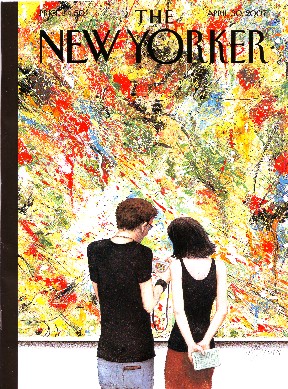
My new favorite New Yorker cover artist is Harry Bliss, and I have a feeling I’m not alone—Emily has already noted that his lovely, witty April 30 cover has drawn kudos from as far afield as New Zealand, since which time Jason Kottke has pointed out an interesting reaction to the cover, even leading to the discovery of a likely Norman Rockwell connection. Oh, that messy Jackson Pollock does attract satirists, does he not? (If I hadn’t temporarily misplaced my Complete New Yorker Disk 5, I could direct readers to Dana Fradon’s November 5, 1960, cartoon referencing Pollock in the full knowledge of its contents.)
That Bliss is poking fun at the YouTube generation does not seem in doubt. The interesting question is whether the young lady depicted partakes in the same technophilia as her companion or is, instead, nonplussed. The relevant data here seems to be the distance between the two, along with the subtle curvature of her shoulder away from him. Dissenters might point out that the gap is simply necessary for the reader to see the digicam.
Has Bliss weighed in? Or is he letting the picture speak for itself (without the help of digicams)? And while I’m asking questions, does anyone know the name of the Pollock painting in the image? Is it at MoMA?
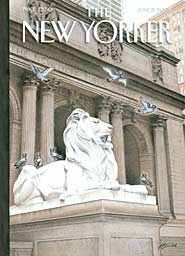
All this is preamble to a Bliss-related pigeon item. Turns out my concern about the lack of pigeons in recent New Yorker covers was utterly unfounded, as this typically fanciful Bliss cover of June 3, 2002, demonstrates. It’s just as witty as the Pollock/digicam one.

2002_06_03_v256.jpg

As many New Yorkers and tourists are aware, the famous lions are known as Patience and Fortitude—they were once known as Lady Astor and Lord Lenox!—with Patience occupying the left-hand slot. So that makes it Patience depicted in the cover. Waiting more than ninety years to munch on some primo Columba livia (Latin for “lives near Columbia University,” as you know)—now that is patience, to be sure.
—Martin Schneider

People of Cover

Martin Schneider writes:
I wanted to address reader Bruce’s comment to the last “Squib Report” post. Here’s what he wrote:

What is so interesting about the current cover is that this is the second time in the magazine’s history that they have shown people of colour in the drawing. Otherwise it is not a great cover.

When I first read this, I immediately thought of Tina Brown’s second-ever cover, which celebrated Malcolm X (and was timed to coincide with Spike Lee’s movie), and Art Spiegelman’s “controversial” 1993 Valentine’s Day cover.
A few minutes with The Complete New Yorker produced this list:
January 19, 1929
January 10, 1931
November 21, 1936
March 9, 1940
February 7, 1942
January 9, 1971
December 28, 1992
September 13, 1993
October 17, 1994
January 16, 1995
January 30, 1995 (sort of)
December 4, 1995
March 11, 1996
April 28, 1997
July 26, 1999
January 17, 2000
February 14, 2000
April 2, 2001
October 27, 2003
June 28, 2004
September 12, 2005
I am sure there are many other examples—and this list only counts Africans or African-Americans. If we broadened it to include Asians, Inuits, Native Americans, and so on, the list would be considerably longer.
I’m sure we can all take issue with The New Yorker‘s blind spots or paternalism over the years—it’s been a tumultuous eight decades!—and The New Yorker has certainly never been easily confused with Ebony. Still, Bruce—you’re going to have to make your case in some other way!