
You know things are getting interesting when top Department of Justice officials plead the Fifth, as Monica Goodling did Monday. It doesn’t seem clear at all that she actually can do this, since “avoiding perjury charges” is not a valid justification for using the Fifth.
My, this stuff is complicated. If only there were some magazine around that could do an exhaustive three-part article on the Fifth Amendment!
Naturally, Richard Harris (not, I expect, the actor) did precisely that for The New Yorker in April of 1976. You can tell that it’s written in a different era, though, because at that time, the FBI’s most pressing task was infiltrating nests of lesbians.
No, I’m not kidding.
—Martin Schneider
Author Archives: Martin
Nutella: A State of Superior Perception
Martin Schneider writes:
I was on chat with a friend when suddenly he typed at me,
SquibFriend [not his real handle]: I love Nutella
Sigh. Yet another subject where my best information is New Yorker-derived:
Squib [not my real handle]: LOL. in italy it’s a very big deal
SquibFriend: I should move there
SquibFriend: it’s brilliant!
Squib: they have like nutella political parties and stuff
One-minute pause.
Squib: did you just have some?
SquibFriend: in the process
SquibFriend: spooning it, baby
Squib: spooning it!
Squib: how naughty!
SquibFriend: don’t need no fucking bread
SquibFriend: just gimme the jar and the spoon!
SquibFriend: yargh!
According to The New Yorker, Nutella “is made to be spread on bread but more often ends up being eaten in hasty spoonfuls, straight from the jar.” So true, so true!
Squib: please don’t tell me you will consume a whole jar tonight
SquibFriend: 13 oz.
SquibFriend: is that bad?
Squib: mmmm, not recommended
SquibFriend: uh, then no…
SquibFriend: no I, uh, won’t
Squib: LOL
Squib: excellent liar
Five-minute pause.
SquibFriend: how’s 1/2 a jar?
My friend, fiend for hazelnut goo, would no doubt have been shocked to learn that in 1994, Silvio Berlusconi’s political party sponsored an “Il Primo Nutella Party,” where guests spread Nutella “over their partners and licked it off”! It’s difficult to imagine our political elite engaging publicly in such activities (except maybe at Bohemian Grove).
In 1993, a writer for Italy’s La Stampa got out the purple pen, calling Nutella’s more engaging properties “a devouring passion. Uncontrollable. It has struck heads of state, bewitched artists, seduced poets. The love for Nutella is inexplicable, it just is…. More than a food, it is a category of spirit, a state of superior perception.” (The charms of peanut butter are decidedly more mundane.)
All Nutella facts and quotations in this post are derived from a delightful and informative 3/6/95 TOTT (by Andrea Lee, who is, I now learn, the author of the 2006 novel Lost Hearts in Italy, which may or may not feature a diverting Nutella-related subplot).
Nabokov: So Glow Back, I Am Waiting
Martin Schneider follows up on my mention earlier this week of a ’30s animation goody starring Otto Soglow’s Little King.
Vladimir Nabokov really liked the work of Otto Soglow. We know this because in the 1967 foreword to his memoir Speak, Memory, he draws attention to a little wordplay he made involving the cartoonist’s name.
Let’s look at the passage:
Reviewers read the first version more carelessly than they will this new edition: only one of them noticed my “vicious snap†at Freud in the first paragraph of Chapter Eight, section 2 and none discovered the name of a great cartoonist and a tribute to him in the last sentence of section 2, Chapter Eleven. It is most embarrassing for a writer to have to point out such things himself.
No kidding! Is it me or does Nabokov come off a touch vainglorious and snippy here? Still, I daresay we can find some empathy for a great author in his twilight years uncertain of his legacy.
A USC student named Chuck Kinbote—just kidding, his name is actually Alexander Zholkovsky (A. Zh.)—supplies some helpful glosses:
Reviewers read the first version more carelessly than they will this new edition: only one of them noticed my “vicious snap†at Freud in the first paragraph of Chapter Eight, section 2 [i.e. the “Sigismond Lejoyeux†bilingual pun, p. 156, —A. Zh.] and none discovered the name of a great cartoonist and a tribute to him in the last sentence of section 2, Chapter Eleven [219; according to commentators, the reference is to Otto Soglow, 1900-1975; the rather desperate pun is in the words ”so glowing” —A. Zh.]. It is most embarrassing for a writer to have to point out such things himself†(15).
So the “rather desperate” pun here is limited to so glowing—it’s fascinating to me that he expected his readers (reviewers) to “solve” this puzzle based on such a mundane combination of words. If he’d contrived it to read “a grotto so glowing”—a Nabokovian turn of phrase, potentially—I would better understand his dismay.
So far I haven’t used The Complete New Yorker at all. I thought, wouldn’t it be fun to see if Soglow’s cartoons ever appeared embedded in Nabokov’s prose?
It turns out that it happened exactly once.
Nabokov’s first ever New Yorker item appeared in the 4/11/42 issue, an odd semi-cannibalistic poem called “Literary Dinner.” It appears on page 18; a Soglow appears on page 20.
Close.
In the 6/23/45 issue appears a highly Nabokovian TOTT about a doppelganger. (He wouldn’t write another TOTT for nearly 31 years! A record, surely? Perhaps the good librarians can tell us at a later date.) It is not the kind of piece that would ever appear as a TOTT today; Nabokovians may find in the piece some echo of his novel Despair (also about a doppelganger).
Bingo: The piece covers six pages, on the second of which is a Soglow.
Just the one time. Did the name strike him as potentially punny already in 1945?
The Hilarity of “The Wisdom of Children”
Boing Boing and Kottke, among others, have enthusiastically linked to Simon Rich’s marvelous expression of childish/childhood perception, “The Wisdom of Children.” It’s comforting to know that even though it’s not a humor magazine per se these days, from time to time The New Yorker can come up with a gem on the level of The Onion.
What’s the funniest thing you’ve ever read in The New Yorker? I nominate two very recent ones by Jack Handey, “This Is No Game” (1/9/06) and “What I’d Say to the Martians” (8/8/05).
—Martin Schneider
Yglesias: New York Has Good Bad Chinese Food
Political blogger Matthew Yglesias and some of his commenters confirm Jeffrey Goldberg‘s observation in his March 19 TOTT that Washington, D.C., has some pretty awful Chinese food. Anyone care to confirm? As he notes, “bad Chinese food” is a subset of Chinese food, and some of it can be quite good—New York has plenty. The problem is that D.C.’s bad Chinese food is Atrocious. According to Yglesias, this is an example of what makes The New Yorker so good. It’s the observational reporting, stupid.
(Any typos in this post should be considered my humble hommage to Ylgesias.)
—Martin Schneider
The Pigeon Files, Part the First
A recurring bulletin from Martin Schneider, Emdashes Squib Report bureau chief, in which urgent matters regarding The Complete New Yorker are speedily and elegantly investigated.
If I were to tell you that pigeons were on the verge of becoming extinct in New York, would that delight or depress you? I’m sure that the range of reactions would include both glee and gloom. Although given their inescapable ubiquity in New York, you might instead question my sanity (or, more prosaically, merely my powers of observation).
Their status as an endangered species is restricted to a very specific domain, and I’ll address what domain that is in just a moment.
Rebecca Mead’s March 5 TOTT about Kader Attia’s “Flying Rats” art exhibit sparked Emily to inquire about prior coverage of pigeons in The New Yorker‘s glorious past. It turns out she’s a pigeon fan! Or more properly, a stalwart defender of the charms of the pigeon (Spec. Columba livia, Latin for “lives near Columbia University”), inexplicably overlooked by so many.
There must be a term for the historiographical practice of using a smaller subject to track the development of an era or empire. As aqueducts work well for the Roman Empire and heresy for the Middle Ages, so do pigeons for The New Yorker. Pigeons appear in many guises and forms, sometimes as the butt of the joke, sometimes held up for contemplation, sometimes exalted (well, not too often). So we’ve decided to launch a limited series of pigeon-related posts from the CNY.
Pigeon fact no. 1: They appear in lots of cartoons; indeed, a survey of pigeons in New Yorker cartoons would tax the resources of this humble venture.
Our first pigeon piece may even fall under “exalted,” a lovely 2/21/01 TOTT called “Some Pigeon!” by Sheridan Prasso that well-nigh claims that a specific pigeon that used to demand (and receive) nocturnal entry to a Burmese restaurant on the Upper West Side (since closed) may have embodied the soul of a former denizen of the premises. It’s just the kind of piece we look to TOTTs for, a charming slice of life nowhere else covered.
Pigeon fact no. 2: Once a staple of New Yorker covers, pigeons have since been almost banished as a cover subject. This is the “extinction” to which I earlier referred. The demise dates approximately from the arrival of Tina Brown; there has been only one pigeon-related cover since 10/5/92—don’t need to tell you what made that issue special, do I? And even that cover, by Peter de Sève for the 9/5/94 issue, seems really to be about the Hamptons and not pigeons per se.
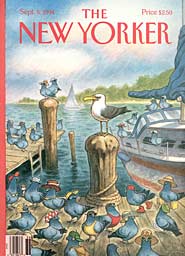
And I think therein lies a lesson: If you make a decision to increase topicality, to boost newsstand single-issue sales, to stretch the capacity of The New Yorker to cover the newsworthy and the trendy (as Tina Brown was no doubt right to do, don’t get me wrong), a price is nevertheless paid. New Yorker covers once regularly featured triste still lifes or plangent landscapes, a sometimes haven from the headlines rather than a cheeky “take” on them; they don’t really serve that purpose anymore, and that’s too bad.
But we’ll be visiting some of those in future installments of the Pigeon Files.
Investigation: Bruce McCall’s Wheel of Article Ideas
Happy 82nd birthday, New Yorker! (The magazine debuted on Feb. 17, 1925, with the Feb. 21 issue.) I asked Martin Schneider, Emdashes Squib Report bureau chief, to do a little sleuthing into a corner of Bruce McCall cartoon on pp. 168-69 of this week’s anniversary issue.
As Emdashes’s resident archival expert, I found McCall’s cartoon of the first-ever guided tour of The New Yorker‘s offices highly irresistible. My favorite invention is the “Wheel of Article Ideas,” which pokes fun at the identifiably New Yorker blend of subjects—often fascinating, often arcane, sometimes too trendy, sometimes too dusty, but never, ever straightforwardly or unselfconsciously au courant. (After all, any magazine can be merely up to date; only a special magazine asks what in going on in J.Lo.’s brain.)
Does there lurk in this inscrutable amalgam a hidden code, each item pointing to a different era or major leitmotif of The New Yorker? Were I better versed in New Yorker lore, would it be within my grasp to crack that code and watch the different shards of the enigma interlock into a grander pattern? (The other possibility is that it’s just a cartoon.)
Anyway, let’s get to it. Did McCall include any topics that The New Yorker has already handled? Armed with the bottomless Complete New Yorker, I decided to find out.
LOGS
In the 2/13/1984 issue, The New Yorker ran a poem by Karl Shapiro called “The Sawdust Logs.” Quoth Shapiro, “Why shouldn’t sawdust have its day?”
NAPS
In the 5/31/1941 issue is a cute little TOTT about two young women who are prepared for their suburban journey out of Grand Central. They produce an alarm clock and nap right up to one minute before their train arrives in Scarsdale. Then they scamper off the train.
OXEN
In the 8/24/1946 issue, Berton Roueche reports on a day in the company of Percy Peck Beardsley, breeder of Devon oxen, who plies his weary trade in the bleak and pitiless plains of…Connecticut. In my opinion, this is a dig at the Shawn era, what with its E.J. Kahn “Staff of Life” treatises on wheat and the like.
BALLET DESIGN
Joan Acocella’s 5/28/2001 review of a Jerome Robbins bio cites “Balanchine’s grand, unfolding design.” Arlene Croce’s 11/17/1997 showcase on Merrill Ashley refers to “the design of classical dancing.” I suppose any ballet production has set and costume designers, and the corps may have designs on the prima ballerina’s primo position, but I take “design” here to mean something closer to an engineering term. Essentially an absurd juxtaposition.
J.LO I.Q.
Astoundingly, The New Yorker has never devoted any significant space to the question of Ms. Lopez’s intellectual gifts. In the 10/2/2000 issue, however, Christopher Buckley did float the idea of someday replacing future VP Dick Cheney with J.Lo. So back off, hatas! If “Oxen” is the kind of profile Shawn would have run, here we surely hark back to the Tina Brown era.
MAMBO
This seems to be a dig at the uneasy fit that such a steamy, sultry subject would be in the pages of The New Yorker, and McCall certainly has a point: The New Yorker has never produced much copy on the subject. There’s a TOTT from 4/18/1988 about an uptick in dance-course enrollments in the wake of Dirty Dancing. There was also that 2000 Oscar Hijuelos book The Mambo Kings Play Songs of Love, which got some coverage too.
IRAN’S BILLBOARD CRISIS
No such thing. I take this somewhat absurd reference to be essentially a compliment. The implication is that The New Yorker has a knack for producing fresh coverage—perhaps at times perversely—even on hot spots that have already received plenty of exposure. Who can forget that 2002 look at trampoline fetishism in Karbala?
FERNANDO PÓO
What a marvelously supple reference. Fernando Póo, Fernando Pó, and Fernão do Pó refer to both a person and a place. He was a Portuguese explorer who in 1472 discovered an island off the west coast of Africa in the Gulf of Guinea that for centuries was named after him. In 1979 it assumed the name Bioko after some sort of revolution. His name was also applied to certain places in Cameroon, which he also explored, this fact leading to the only mention I could find in The New Yorker—a 2/18/1961 TOTT about “Cameroun.” Other Fernandos mentioned in The New Yorker include Meirelles, Luis Mattos da Matta, Scianna, Medina, Collor, Henrique, Ferrer, Ochoa, Valenzuela, and Nottebohm. The Fernandos created by ABBA and Billy Crystal have apparently escaped The New Yorker‘s notice.
JAM
Oh, could we get any more quaint and cozy? Why not just choose the tea cosy, for that matter? As it happens, jam figures prominently in the searing 9/10/1966 TOTT on the National Fancy Food and Confection Show. So there.
MILLARD FILLMORE
Ah, our most risible president. Does anyone even know whether he was any good or not? His amusingness seems a priori. Alas, the world awaits the definitive New Yorker treatment of the subject. In the meantime, Morton Hunt’s 11/3/1956 account of the presidential race of 1856 will have to do.
Can anybody read that last one? “Zoo”? I await further clarification (shout? murmur?) from Mr. McCall.