Martin Schneider writes:
I was tickled by Steve Johnson’s post at the Chicago Tribune‘s website on Larry Wood, who has now won the New Yorker Caption Contest for the third time.
Here are Wood’s previous two victories. (Hat tip to David Marc Fischer’s indispensable Blog About Town.)
Reading between the lines, it seems that economical wording is key to the Chicago attorney’s success. Johnson quotes Caption Contest honcho Robert Mankoff that “Wood’s was clearly the best worded of several submissions that went after the same basic joke.”
Also noteworthy is the news that every week, Farley Katz, who administers the contest, “culls through the submissions, catagorizes [sic] them by type of joke.” It hadn’t really occurred to me that so many people would coincide on their jokes every week, but it does make sense.
Even readers with exceptional eidetic memory will probably need reminding that Wood is an Emdashes reader. Congratulations, Lawrence—or may I call you Larry?
Category Archives: Headline Shooter
What’s in This Week’s New Yorker: 06.08.09
Martin Schneider writes:
The summer fiction issue of The New Yorker comes out tomorrow. A preview of its contents, adapted from the magazine’s press release:
In “Good Neighbors,” Jonathan Franzen’s first piece of fiction in four years, an upwardly mobile couple, Walter and Patty Berglund, deal with their recalcitrant son while their neighbors gossip and their blighted St. Paul block gentrifies in the nineteen-eighties and nineties.
The issue also features début fiction by Téa Obreht, a previously unpublished writer who graduated from Cornell University’s writing program in January, 2009. Obreht was born in Yugoslavia, grew up in Egypt and Cyprus, and moved to the United States in 1997.
In an excerpt from his upcoming book, The Book of Genesis Illustrated, due out this fall from W.W. Norton, R. Crumb illustrates the story of creation and of Adam and Eve’s expulsion from the Garden of Eden.
Louis Menand explores the rise of university creative-writing programs.
In “Old Wounds,” Edna O’Brien chronicles the difficulty that two cousins have in trying to reconnect after a long family feud.
David Grossman writes about the Jewish Polish writer Bruno Schulz, and investigates the circumstances of his death—ostensibly as a victim of a feud between two Nazi officers—in 1942.
In “A Soldier Home,” Yiyun Li remembers reading Hemingway and other writers in English as a way to escape from her life during and after her military service in China.
In “Two Emmas,” Roger Angell describes the bookshelves at his summer home in Maine and recalls fondly his experience reading The Garrick Year by Margaret Drabble.
In “The Magic Mountain,” Aleksandar Hemon reminisces about his long solo summer reading holidays in his family’s remote cabin on Jahorina, a mountain in Bosnia.
Jeffrey Toobin, in Comment, examines Sonia Sotomayor’s nomination and reflects on diversity on the Supreme Court.
In The Financial Page, James Surowiecki looks at the role that fear has played in the U.S. credit crunch and Buenos Aires’s recent coin shortage.
Nancy Franklin watches Nurse Jackie.
Sasha Frere-Jones listens to the Hypnotic Brass Ensemble.
Alex Ross attends a musical “marathon” of Gustav Mahler’s symphonies.
Hilton Als explores race and desire in Tennessee Williams’s Vieux Carré.
David Denby reviews Up, Night at the Museum: Battle of the Smithsonian, and Away We Go.
Roger Angell Beats Jeffrey Toobin to Sotomayor by Fourteen Years
Martin Schneider writes:
One of the few things we know about President Obama’s recently announced nominee for the Supreme Court, Yankees fan Sonia Sotomayor, is that she played an important role in the resolution of the baseball strike of 1994-1995 (glad I was living abroad for that stretch; I barely noticed it). She issued the injunction against the baseball owners after ruling that their actions against the players’ union had violated federal law. As Avil Zenilman noted, that happenstance bit of notoriety caused Roger Angell to mention her name in the magazine, twice, in 1995:
“Comment: Mind Game,” April 10, 1995, p. 5
“Called Strike” May 22, 1995, p. 46
Jeffrey Toobin, who mentioned Sotomayor back in February, is catching up fast, though:
“After Ginsburg”
“The Arc of Justice”
Amy Davidson has also written about Sotomayor several times since the announcement of Justice Souter’s retirement:
“Uncharitable Judgments”
“Insults and Impunity”
“A Deep Bench”
“Saving the Season”
What’s in This Week’s New Yorker: 06.01.09
Martin Schneider writes:
A new issue of The New Yorker comes out tomorrow. A preview of its contents, adapted from the magazine’s press release:
In “Slim’s Time,” Lawrence Wright profiles Carlos Slim Helú, the Mexican businessman who is sometimes ranked as the richest man in the world, and who agreed to extend a two-hundred-and-fifty-million-dollar loan to the New York Times Company earlier this year.
Atul Gawande explores how to contain the rising costs of health care by looking at McAllen, Texas, one of the most expensive health-care markets in the country, and at the Mayo Clinic, one of the country’s most effective, low-cost health systems.
Jill Lepore chronicles the parrot fever of 1930, a “medical mystery” that transfixed the nation with the possibility of a pandemic and set a precedent for the coverage of future outbreaks and epidemics.
On the cover, an image by Jorge Colombo, “Finger Painting,” drawn entirely on his iPhone—a first for the magazine.
Jeffrey Toobin, in Comment, reflects on President Obama’s and Dick Cheney’s recent speeches on national security.
In the Financial Page, James Surowiecki explores how corporate boards of directors could be reformed to protect shareholder value.
In Shouts & Murmurs, Andy Borowitz demonstrates how to make the most of your “quiet time.”
In a sketchbook, Roz Chast offers sea chanteys for the subway.
Calvin Tomkins examines the life and works of artist Bruce Nauman.
Peter Schjeldahl visits the Francis Bacon retrospective at the Met.
John Lanchester considers the role human nature played in the banking crisis.
John Lahr attends Wallace Shawn’s first play in more than a decade, Grasses of a Thousand Colors.
Anthony Lane reviews Terminator Salvation and Jerichow.
There is a short story by Craig Raine.
Summoning Clear-and-Bright-Plum! The Naming of an Ambassador
Jonathan Taylor writes:
Following the nomination of Utah Governor Jon Huntsman (R) as U.S. ambassador to China, two posts on Evan Osnos’s “Letter From China” blog have some great notes (with reader assists) on the conventions in China for rendering foreign ambassadors’ names, by mere transliteration and/or a devised “Chinese name.” (Chinese characters TK, apparently.) Osnos writes, “I’ve received questions about whether I have a Chinese name. Answer: Ou Yiwen, stamped on me by early Chinese teachers. Like a lot of foreigners’ names in Chinese, it sounds a bit fancy—roughly akin to meeting a Chinese journalist in the U.S. who has taken the name Aloysius Sunbonnet or something.”
What’s in This Week’s New Yorker: 05.18.09
Martin Schneider writes:
A new issue of The New Yorker comes out tomorrow. A preview of its contents, adapted from the magazine’s press release:
In “The Death of Kings,” Nick Paumgarten presents a wide-ranging exploration of the economic crisis and its impact. “Much abridged, a few familiar words will do” to tell the story of the economic crisis, Paumgarten writes: “debt, greed, hubris.”
In “Don’t!” Jonah Lehrer examines recent evidence that indicates that self-control, not intelligence, may be the most important variable when it comes to predicting success in life.
In “Drink Up,” Dana Goodyear profiles Fred Franzia, the man behind Charles Shaw, a wine that sells for $1.99 at Trader Joe’s and is affectionately known as Two Buck Chuck.
Hendrik Hertzberg, in Comment, discusses Obama’s upcoming commencement addresses.
There is a “strange, but true” sketchbook by Roz Chast.
Ian Frazier writes an ode to turning forty—again.
Arthur Krystal looks at the life and works of critic William Hazlitt.
Anthony Lane reviews J.J. Abrams’s Star Trek.
John Lahr reviews the new Broadway revival of Samuel Beckett’s Waiting for Godot.
There is a short story by Salman Rushdie.
Lane Pans New Star Trek Flick; Also, Dog Bites Man
Martin Schneider writes:
A couple of months ago, Anthony Lane’s dismissive review of Watchmen managed to alienate fans of the movie, fans of the comic book, and fans of all comic books.
In the upcoming issue, Lane directs comparable if not quite equal disapprobation at the new Star Trek movie and the rest of the franchise as well. It’s difficult to imagine a hypothetical Star Trek movie that Lane would want to bestow with a positive review, isn’t it? In any case, queue up a second annoyed sci-fi fan base.
The inventors of Beer Trek are friends of mine, and they report deep pessimism with respect to the new movie. Based on a single viewing of the preview, I’m inclined to agree, at least by the curious logic of the entire rest of the Star Trek franchise (the new swagger-y, foreordained-Hero depiction of Kirk violates the Star Trek ethos in a big way), even as the movie looks pretty good by ordinary standards.
But then again, I’m closer to Lane when it comes to Star Trek! I could only get interested in The Next Generation….
What’s in This Week’s New Yorker: 05.11.09
Martin Schneider writes:
The “Innovators” issue of The New Yorker comes out tomorrow. A preview of its contents, adapted from the magazine’s press release:
Malcolm Gladwell looks at the ability of underdogs to triumph over their stronger adversaries. “David can beat Goliath by substituting effort for ability—and substituting effort for ability turns out to be a winning formula for underdogs in all walks of life,” Gladwell writes.
Adam Gopnik ruminates on what spurs invention: necessity, or superfluity? Observing the abundance of razors in his medicine cabinet, all of which are about equally useful, Gopnik notes “a strange but basic truth of life and marketing alike: that it is after a problem has already been solved that ever more varied and splendid solutions to it start to appear.”
Douglas McGray writes about Green Dot Public Schools, a charter-school group that is California’s largest, by enrollment, and one of its most successful, sending nearly eighty percent of their kids to college.
Rebecca Mead observes the work of Christian Scheidemann, who “is among just a handful of private conservators who specialize in contemporary art,” and who “has become particularly admired for his skill in working with organic substances.”
John Colapinto profiles the behavioral neurologist V.S. Ramachandran, “one of a dozen or so scientists and doctors who, in the past thirty years, have revolutionized the ï¬eld of neurology by overturning a paradigm that dates back more than a hundred years: that of the brain as an organ with discrete modules (for vision, touch, pain, language, memory, etc.) that are ï¬xed early in life and immutable.”
Evan Osnos explores the life and career of Jia Zhangke, the Chinese filmmaker behind the award-winning film Still Life, about the social and physical demolition wrought by China’s Three Gorges Dam, and, more recently, 24 City, about a factory closing.
In Comment, Philip Gourevitch asks who should be held accountable for the torture memos.
In the Talk of the Town, Alma Guillermoprieto reports from Mexico City, under siege by swine flu.
In the Talk of the Town, Lauren Collins looks at the linguistic implications of the disease’s porcine name
In the Financial Page, James Surowiecki explains why the financial industry needs to shrink.
In Shouts & Murmurs, Amy Ozols makes friends on an airplane.
There is a comic strip by Chris Ware.
Judith Thurman writes Helen Gurley Brown and the Cosmo Girl.
Adam Kirsch explores the poetry of Gerard Manley Hopkins.
Hilton Als reviews Desire Under the Elms.
Sasha Frere-Jones listens to Grizzly Bear’s new album.
David Denby reviews X-Men Origins: Wolverine, Fighting, and Tyson.
There is a story by the recently departed writer J. G. Ballard.
Happy Day! The New Yorker and Print Take Home Ellies!
Martin Schneider writes:
Last night, at the American Society of Magazine Editors awards ceremony (our coverage of the nomination announcement is here and here), The New Yorker took home awards for fiction by E. Annie Proulx and Aleksander Hemon, photography by Platon, and criticism by James Wood. Congratulations to all!
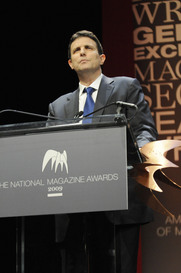
Judging from the reaction on Twitter, the victory of Field and Stream over The New Yorker and Vogue in the 1,000,000+ circulation category was a bit of a shocker.
Meanwhile, Print won the award for general excellence, under 100,000 circulation. Congratulations to Emily and everyone at that outstanding publication for the well-deserved recognition!

Fighting the Plague of Our Time: the Ban Comic Sans Movement

_Pollux writes_:
One reads alarming statistics sometimes. The “increase”:http://www.newyorker.com/reporting/2009/04/20/090420fa_fact_bilger in the number of gigantic Burmese pythons in Florida, the growing rate of sea-ice shrinkage, the country’s unemployment rate.
Here’s another statistic that will chill your blood: by approximately 2018, usage of the “Comic Sans font”:http://en.wikipedia.org/wiki/Comic_sans will have surpassed usage of the Helvetica and Times New Roman fonts. By 2030, Comic Sans will be the only remaining font. All other fonts will be extinct and will go the way of grunge and post-grunge lettering.
These are the statistics provided by the “Ban Comic Sans movement”:http://www.bancomicsans.com/about.html, which has sprung up in reaction to the Comic Sans typeface, originally designed by “Vincent Connare.”:http://www.connare.com Connare, as reported in this “_Wall Street Journal_ article”:http://online.wsj.com/article/SB123992364819927171.html by Emily Fleet, is not exactly against the movement against his typographic baby, and is certainly fonder of one of his other creations, the “Magpie font.”:http://www.connare.com/type.htm
Originally designed in 1994, Comic Sans has become the _bête noire_ of the typography world but “sometimes it has been a superhero, as seen in this humorous video,”:http://www.collegehumor.com/video:1823766 and sometimes a “dim-witted creature with a lisp.”:http://www.sheldoncomics.com/archive/070510.html
Holly Sliger and Dave Combs, the husband-and-wife team who started the Ban Comic Sans movement and man the typographic barricades, offer merchandise, font alternatives, and oratory on their website to inspire us all:
“By banding together to eradicate this font from the face of the earth we strive to ensure that future generations will be liberated from this epidemic and never suffer this scourge that is the plague of our time.”