Category Archives: Hit Parade

A storm is coming, Frank says…

I’m living in the future, the present, and the past all at once. It’s very Donnie Darko. What I mean is, you might want to revisit the Brandenn Bremmer and the Karl “I Could Eat a Knob at Night” Pilkington posts, which have been expanded and commented on quite a lot since they were first posted. They may be from the past, but they’re living in the moment. As they say somewhere else online, join the fray!

The Comic Critic's

The Comic Critic: Donnie Darko [Mark Monlux]

Eustace Google: The strange, sad case of Brandenn Bremmer

Emily Gordon writes:
I’m interested to see what people are saying about “Prairie Fire,” the Letter From Nebraska by Omaha native Eric Konigsberg in this week’s New Yorker. The piece is about the suicide, last March, of the 14-year-old homeschooled rural Nebraska prodigy Brandenn Bremmer and his heartbroken, perplexed parents, who gave nearly all their material and emotional resources to developing Brandenn’s interests and career. There’s not much talk about the piece yet, since it’s not online and it’ll take a few more days for most people to get the current issue, but just after Bremmer’s death there was plenty of press coverage and internet discussion. Here’s the Blog of Death obituary; I’ve omitted the many links (some expired).

Brandenn E. Bremmer, a 14-year-old musical prodigy from Nebraska, sustained a gunshot wound to the head on March 15. The boy died the following day at Children’s Hospital in Denver. Authorities suspect he committed suicide.

Bremmer taught himself to read when he was 18 months old. He began playing the piano at 3 and was home-schooled from kindergarten on. At 10, Bremmer became the youngest person to graduate through the Independent Study High School conducted by the University of Nebraska-Lincoln. Described by friends and family as a bright young man who smiled often, Bremmer dressed up like Harry Potter — one of his favorite literary characters — for his graduation picture.

Bremmer was only 11 when he began studying piano improvisation at Colorado State University at Fort Collins, Colo. Last year, he released his debut album, “Elements,” and gave concerts in Colorado and Nebraska. The day his body was found, Bremmer had just completed the artwork for the cover of his second CD, which features meditative, New Age piano music.

Like most kids, he loved watching cartoons, playing video games, riding his bike and catching fish. In January, Bremmer enrolled in a biology class at Mid-Plains Community College in North Platte, Neb. He planned to graduate from the University of Nebraska’s medical school by the time he was 21 and become an anesthesiologist.

His mother, mystery writer Patricia Bremmer, said he showed no signs of depression and didn’t leave a suicide note. Bremmer’s kidneys were donated to two people. His liver went to a 22-month-old and his heart to an 11-year-old boy.

The comments are worth reading, too, including one by a 13-year-old named Sydney Lee Smith, who appears to have been a friend of Bremmer’s. (Smith and her mother, Mary, are also quoted in this Lincoln Journal Star piece about the suicide.) More on this soon, and send in any links you find.

Also via Blog of Death: photos of an older Bremmer (he’s seven in the one The New Yorker used), and details about his piano-composition recording Elements, on the Windcall Enterprises page.

“He maybe just kind of ‘crashed’ like computers can,” and other spontaneous theories on the case from back in March, on Common Ground Common Sense.

There’s been a spirited, provocative debate on Wikipedia on the definition of “child prodigy” and which alleged prodigies (including Bremmer, Willie Nelson, and Michael Jackson) to include on the site. In a separate thread, Wikipediaers argue about whether to delete Bremmer’s page on the site, and whether Bremmer should really be considered “notable.” (The page was indeed deleted.) It’s a useful look inside the workings of Wikipedia, too. A user named Stan, a passionate and caustic advocate for deleting Bremmer’s entry, writes:

This is a very strange and sad story of child abuse, in which a boy’s parents tried to live vicariously through him by pushing him beyond his abilities, vanity-publishing his CDs and helping him with high-school homework to get him through at an accelerated pace. He cracked under the pressure and killed himself. Now that he’s dead, those close to him are still trying to live through him, this time by posting and reposting the same wikipedia article about him. I find the situation monstrous. If we have an article about how child prodigies are manipulated and exploited by their parents, we might merge this with that, as a further example, but I don’t know that such an article exists, or if such an article would meet wikipedia standards. It’s also true that many child prodigies go on to do no significant work as adults–many prodigies are simply experiencing an early spurt and turn out to be average-functioning adults. There’s nothing wrong with that, of course, but it highlights the fact that a prodigy is not necessarily notable just for being a prodigy. So I vote to delete this once again.

“Child abuse” is very strong language for what is surely a subtler moral question. The blogger Terrette posted critical comments about the Bremmer family just after Bremmer’s death and got an email from (it seems) the same friend of the family, Mary Smith, who was quoted in the Lincoln Journal Star piece. Terrette defends her position, point by point, and makes it clear that for her the central issue is gun control:

If I may address my displeased reader frankly: I know it must suck to feel that some long-winded East Coast liberal who probably doesn’t even have kids is trying to tell you right from wrong, but please know that I read the newspapers and see the incidents of juvenile suicide and homicide tallied month after month, and the whole thing has made me wonder: What’s going on in this country? However much you’d like to believe that Brandenn Bremmer took that gun in his hands in a quiet little corner of Nebraska — a place with its own rules and customs and that, as such, is radically exceptional to things that take place on the East Coast or in regions where liberals haven’t developed a proper fondness for weapons — the fact is that Brandenn killed himself in a nation where such incidents are common and where laws regulating minors’ unsupervised access to guns are uniformly lax. Moreover, these laws are lax not because of some Constitutional right that the framers of that document set down in law so that all the nation’s children could take up arms against a potential new wave of British Redcoats, or so that seasonal hunting traditions in the Midwest would go undisturbed, but because the National Rifle Association has long targeted our politicians in Washington with its powerful lobby and thereby assured its friends gun-sale profits at the expense of all social, regional, and safety-related considerations. If the NRA could facilitate the sale of semi-automatic rifles to all the teenagers of this nation, believe me, it would. And no amount of killing of and by our children would ever allay the NRA members’ passion for peddling and glorifying weapons. Their short-sighted and self-serving claim will always be: “it’s not the guns that kill, it’s the shooters.”

Update: Hey there, googlers! Don’t be shy; what do you think of what you’ve read about Bremmer’s life and the criticisms above?

Further update: There’s an interesting discussion of Konigsberg’s piece on Gifte
d Exchange
, “the blog about gifted children, schooling, parenting, education news and changing American education for the better.”

Additional note: In the introduction to this post, I’ve made a slight change to my description of Brandenn’s grieving parents. I think, on reflection, that my original tone had an unsympathetic tinge I didn’t intend. It’s often said that the death of a child is the worst pain a person can experience, and I believe it.

And: Well, everyone’s talking about it now, including John Derbyshire in National Review Online:

You know how once in a while you read something that leaves you feeling vaguely disturbed — suddenly unsettled and insecure, as after a minor earth tremor? Well, that’s my current state. The offending text was Eric Konigsberg’s piece “Prairie Fire” in the January 16 issue of The New Yorker.

Obviously he was a very nice kid, the sort you’d want your own kids to mix with. His suicide seems, from Konigsberg’s account, utterly inexplicable.

The suicide of a child is of course one of the major nightmares of parenting. That is one reason I, as a parent, find the Brandenn Bremmer story unsettling. If THIS kid could do it, who might not? Even aside from that, though, there is something about suicide that is deeply disconcerting to all of us. We have all known instances among our acquaintance, or, if we are unlucky, in our own families. An odd thing I have noticed is that a suicide, even of someone we are not strongly connected to, makes us angry…. I suppose this anger is just an acknowledgment of the fact that killing yourself is the most selfish thing you can do — a gross betrayal of your social responsibilities, the first and foremost of which is to exist, so you can carry out all the others. Surely the old dishonoring of a suicide’s corpse — in Christian countries, it could not be buried in consecrated ground — reflects something of this instinctual anger. Continued.

Discussion is ongoing at the New Yorker Forums. Don’t get me wrong—I think the human brain is just as wondrous as it is ridiculous and rigged—but there sure are a lot of people who use the word “gifted” to describe both their children and themselves as kids. I wonder how this plays out across the classes? Who gets to be called “gifted,” and when does the constant reminder of “giftedness” become a burden? It seems like a crude, loaded word that probably causes more problems than it solves. (I speak as a beneficiary of a groovy, ill-planned “talented and gifted” public high school track that rewarded the students who actually showed up to school with countless hours of unstructured hanging out. Fun! American history? We caught up on that later, or didn’t. True believer Mr. Ihle was the exception. Next track after TAG? “Academically Motivated.” God knows what they called the next down from that.) Feel free to argue.

Speaking of arguments, there are posters on the New Yorker Forums who say they’re close to the Bremmers and that Konigsberg misrepresented them, took quotes out of context, knew the story he was going to write before he wrote it, etc., etc. I’m sure people in that community are feeling exposed and sore, but these are familiar complaints; we all know the polls about how little people trust journalists.

[Updated:] As I remember it, Konigsberg expresses open skepticism only once, in a brief aside when listening to the afterlife theories of Hilton Silverman, who’s married to Linda Silverman of the Gifted Development Center. Antidisingenuousmentarianism typed in much of the passage (which I double-checked because I’m fanatical that way):

“Well, I can tell you what the spirits are saying,” [Hilton Silverman] said. “He was an angel.”

[Linda] Silverman turned to face me. “I’m not sure how much you know about my husband. Hilton is a psychic and a healer. He has cured people of cancer.”

“It kind of runs in my family: my grandfather was a kabbalistic rabbi in Brooklyn, and my father used to heal sick babies with kosher salt,” Hilton said. “Brandenn was an angel who came down to experience the physical realm for a short period of time.”

I asked Hilton how he knew this. He paused, and for a moment I wondered if he was pulling my leg and trying to think up something even more outlandish to say next. “I’m talking to him right now,” he said. “He’s become a teacher. He says right now he’s actually being taught how to help these people who experience suicides for much messier reasons. Before Brandenn was born, this was planned. And he did it the way he did so that others would have use for his body. Everything worked out in the end.”

I just started at that “much messier reasons” on rereading—as though the reasons are the tragedy, and the suicide is incidental. I haven’t reread “Prairie Fire,” but except for that “pulling my leg,” I don’t think Konigsberg reveals any feelings about the matter one way or the other.

In any case, all this just continues to demonstrate that the internet is—yes, Eyebeam panel, it is—a pretty effective forum for democratic free speech. I’m glad the rural, homeschooling, non-coastal subjects of New Yorker articles can respond in a widely distributed public place to what’s written about them, even if the integrity of the journalism ultimately prevails.

More discussion at Urban Semiotic.

New and interesting: A journalist tries to contact Linda Silverman about the New Yorker story for Colorado’s New West. Links are theirs.

This week’s New Yorker features a long, and wrenching, profile of Brandenn Bremmer, a prodigiously gifted 14-year-old from western Nebraska who killed himself in his bedroom at his parents’ farm last March. Figuring prominently in the story is Linda Silverman, who runs the Gifted Development Center, a “resource center for developmentally advanced children and their parents” in Denver.

Silverman, who lives in Golden, doesn’t come off particularly well in the story; writer Eric Konigsberg details her tendency to grade smart kids at IQ-levels well off the scale that most child-development experts consider valid, including a 2001 case in which she scored an 8-year-old boy’s IQ at “298-plus.” That boy was later found to have been coached on the exam by his mother. Interviewed after Brandenn Bremmer’s death, Silverman told Konigsberg that the teenager’s parents “had contacts with him after he left his body” and that Brandenn’s “mission to assist others in this lifetime may have been fulfilled by his death” (Bremmer’s organs were donated to several recipients).

Curious about Silverman’s reactions to the New Yorker article, I rang up the Gifted Development Center. Silverman wasn’t available, and a staffer named Lee Ann politely informed me that she would have no comment on the story “because of confidentiality requirements.”

“So,” I said, “I take it Linda is not talking to anyone with the press about this story.”

“We simply can’t,” Lee Ann replied.

I thanked her and hung up, refraining from pointing out that this makes no sense; any confidentiality restrictions between Silverman and Brandenn Brem
mer (who met Silverman as a young boy and attended several GDC events, according to the story) were violated by Silverman’s extensive interviews with Konigsberg, in which she discussed Bremmer at length.

The whole subject of gifted children has become a fraught one, with experts debating what constitutes “giftedness” and disagreeing how such way-above-average kids should be nurtured and taught. The example of Brandenn Bremmer is a cautionary one for all of us who suspect our kids might be brilliant. Unfortunately, Linda Silverman, at least in this instance, doesn’t seem to be shedding much light on the subject.

“I Could Eat a Knob at Night”: Ricky Gervais Dance Remixes

She gave me 20p for the hot chocolate machine

What’s going on here? First cue up the Ricky Gervais podcast, from the beginning, you can. Then read this quick summary of what was to become Pilkingtonmania, from Reuters:

It was during a discussion on the Gervais show about a reality TV show, where contestants were asked to eat an animal’s penis, that Pilkington made Internet history. First he said he could not eat an animal’s penis in the morning because he has a delicate stomach.

He then proclaimed, “I could eat a knob at night.”… After Gervais mused on the show that the soundbite could be used in a dance remix, it took just a few days for the Internet to be awash with songs using the soundbite as a hook.

The latest (at press time) big article, in the NY Times yet, is here. Earlier, there was a Reuters piece about the phenomenon of Karl, the podcast, the knob, and the mashups. Or remixes, as the case may be! I now understand the difference (thanks Nathan). They’re also talking Karl in Australia (an expanded version of the Reuters piece), Chile, and Sweden. Translators welcome. The new series: My first review of the non-free podcast was here, and there have been several more since.
Without further ado–Karl Pilkington dance remixes, the original list. Apologies for any broken links, and updates welcome!

  • The popular and oft-downloaded DJ Reacharound version, from episode six of the podcast. Quite possibly my favorite.
  • Newest! Nathan–“transforming the great into the quite good”–remixes his remix and comes up with something wildly original. Farther out than a chimponaut!
  • Second newest: Matt’s mix, and a good one too. He calls it “an electronica/nuskool version.”
  • Third newest: DJ Ropey’s. I should really set up a voting system.
  • Hop like a kangaroo: Nathan’s uptempo “trancey house mix,” which may be the hippest of them yet. This one deserves a video. Then listen to his truly excellent Gervais-related Free Love Freeway, featuring the vocal stylings of David Brent. Do you think knob cuisine has become popularized as a result of all this? Will Australian PETA need to get involved?
  • Also shiny and new: The band Love2B (“Electronica / Ambient / Experimental”) has a brief but complex version that, laudably, reintroduces the modifier “kangaroo.” Their other songs are funny too.
  • Danceable! Sweet stuff from Confusioning.
  • “Erectioneering”: Fintan Stack’s lyrical contribution, which owes a small debt to Radiohead. He explains himself thusly.
  • Last week’s star: Rohan Lilley, for his very funny take on the, um, knob philosophy. More of Rohan’s mixes and future Gervais riffs here.
  • One of the newest: Aidan O’Halloran calls his version “the ultimate Karl Pilkington ‘i could eat a knob at night’ song.”
  • Cool twist by Mr. Zystem.
  • DJ Frankie Pigeon does his tribute.
  • May be a repeat: a zippy, rhythmically adventurous track with horns.
  • Thanks, Wikipedia! This one’s from Cyn.
  • Andrew Brady, Tom Frost, and Andy (“its very good. Funky house beat”), your audio links hath expired, and that makes everyone sad.

Update: Since this is getting search-engine lovin’ (hello, U.K.!), if you’ve got links to other versions–Ricky said he got at least 70–let me know and I’ll post them here.
NEW: a great rock ‘n’ roll tribute to Karl’s timeless utterance. The newest remix is actually a re-remix by Nathan, who also just revamped his already inspired enhancement of David Brent’s earnestly soulful “Free Love Freeway.” Download it here and you’ll see what I mean. On his MySpace page, he adds modestly, “If you really really like FREE LOVE FREEWAY, theres a totally self indulgent overlong extended mix lasting nearly 9 minutes, here.” I’ve listened–entirely worth it!
knob_night.jpg
Update again: I’ll need to do some more googlistening, I see, since your desire for Pilkington Man is downright insatiable. Meanwhile, why not read Nancy Franklin on Ricky Gervais? Franklin interviewed Gervais at the New Yorker Festival last year, and it was a delightful event, in part since Franklin is one of the funniest critics around.
gervais_franklin.jpg
Also, via diligent commenter James on the Sydney Morning Herald blog, the trio’s old XFM show. James notes, “It is hilarious (though annoying because you have to download each 5 min file, about 12 per episode – but well worth it).”

Sowerby and Luff's Big Squeeze

Brand-new mashups/remixes added as people send ’em in to me–see below for the list.
LATEST (June ’06): Our favorite Birmingham-dwelling, Office-remixing DJ, Nathan Jay, writes: “I’ve got some new songs–one of ’em [“A Good Day”] might be interesting to you if you watch The Office (US version). I really love the show–as much as, if not more than, the UK version. I made a kind of ‘chilled’ house track, and spruced it up with loads of snippets from Pam the receptionist.” As always, it’s excellent and super-danceable.
Karl Pilkington news: There’s probably not much point in my keeping up with this anymore, since the entire bloggomedia (the gap is quickly closing) is now doing it for me. But in case you’re stopping here first, this is a very funny Karl, Ricky, and Steve animation and a trippy monkey news video, and there’s a forthcoming book by Karl, or something like that. In recent news, there’ve been Karl clocks, badges, shirts on eBay; the end of this post lists other sources for Pilkington paraphernalia.
Are there any British podcasts as funny as Ricky’s? Incredibly, yes! Comedy 365’s ridiculously addictive Big Squeeze with sexy Georgina Sowerby and Brian Luff, the brilliant Chris Skinner’s Simulacrum, and Killer Comedy (or anything else) with the King of Dry, John Dredge. See below for mouth-watering details. And they’re all free!
The only way to survive the long minutes until the next episode is to download as many Big Squeeze (starring Georgina Sowerby and Brian Luff, pictured above) and Simulacrum podcasts–do not miss the interviews with John F. Kennedy, Kate Moss, and Moby-Dick–as you can. Also, John Dredge’s Killer Comedy. See excerpt below for a snippet of Chris Skinner’s revealing interview with the pissed-off whale.

First of all, can I get some things clear about Herman Melville, because that man is a complete son of a bitch. I employed that man as my official biographer. He was set aside to write the great story of my life, exploring the seas, and the things I saw while I was there. And he sold out completely, and turned it into a–horror film. I was this lethal man-killing machine…. I’m quite placid. If you wrong me, I’m bigger than you, I’ll take you out, but not in a dinner way–more in a fighting mean-machine sort of way. I’m not going to do it now, because you’ve been generally quite pleasant.

But is he? Listen to the REST of this shocking Simulacrum show.

Fluffy TV


Have a shameful thing for naughty doctor-bunnies and saucy nursey-lambs? Who doesn’t? Fluffy TV will oodle your noodle. I would say it’ll tickle your fanny, but I know that has an entirely different meaning in the U.K., so that probably won’t do.

Simulacrum from Comedy 365


Wear the knob: Flipporium’s sexy “I Could Eat a Knob at Night” t-shirt (pictured below; “a percentage of Karl proceeds go to buying a goat!”). Link via Wax Elastic. Here are more knob shirts, including “I [Heart] Karl Pilkington.” Need more Pilkington paraphernalia? Get it here. New: a brand-new, stylishly designed t-shirt, and the inevitable Karl quote book.

So What Do You Do to Write a Winning Caption, T. C. Doyle?

82897035_ba18dc6ac2_o.jpg
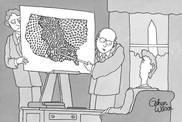
“And in this section it appears that you have not only alienated voters but actually infected them, too.”

Relaxed after a well-earned vacation and back in Park City, Utah, initialed editor and contest champ T. C. Doyle considers Chast, DeLay, hubris, Hemingway, canoes, the “crustacean-like, single-cell-looking objects” and curiously young leader in Gahan Wilson’s drawing, and Doyle’s non-doppelganger, T. C. Boyle, who has also been published in The New Yorker. In the very same issue, actually. Boyle once gave his readers a challenge to write concisely about the year 1970; Doyle dispenses with it in a handy haiku.

First things first: What do your friends and colleagues call you? Is there a nefarious T. Doyle you’d prefer not to be confused with?

It’s T. C. and always has been since day one. Conflicting stories as to why. One is that the TV cartoon show of the day, Top Cat, had a namesake character who was T. C. to his fellow alley cats. Supposedly that appealed to my father, but I wonder. He studied the classics at Princeton in the ’50s and there is nothing cartoonish about him save for occasional phone call from two thousand miles away asking me where “the big screwdriver is.” He does that because he recalls that I was “the last person who used it.” At the time, Reagan was probably running for re-election.

Are there a whole slew of parks in Park City?

Park City does indeed have parks. Officially we are known as the home of the U.S. Ski Team. We hosted several Olympic events in 2002 and have three major ski resorts out our back door. Parks? We got ’em. Including the one behind my house where you can ski jump, luge and bobsled all in the same day.

Is everyone there excited about your caption win?

One woman rang the other night and suggested a connection. Something about common interests and close proximity. Her voice was breathtakingly sexy. Friends have rang and been gracious and generous with praise.

When did you begin reading The New Yorker?

My parents always had a subscription, so I read cartoons as a kid. Later I would pick up the magazine at the airport when I traveled on business. A decade or so ago, my father-in-law gave me a subscription for birthday gift. He’s retired and reads every issue cover to cover. He shares his love of fine things generously. That’s why I will give to him whatever the magazine shares with me.

Who are your favorite New Yorker cartoonists?

I have several favorites, one from another era. That’s Thurber. “The Catbird Seat” is one of my all-time favorite short stories. It’s urban. It’s absurd. And it makes perfect sense to me, a kid from Indiana who once asked Santa for a filing cabinet. I did. When I was a kid, my parents had a cabin in Michigan, in Grayling on the Ausable River. Think pine trees as tall as goalposts, mosquitoes as hungry as stray cats. Supposedly a great place to catch rainbow trout. (I caught only poison ivy.) Inside was a ping-pong table and a record player accompanied by a Trini Lopez album and a Kingston Trio record. And there was Thurber. A whole book of him. I read it over and over while waiting for vacations there to come to an end.

Early in my career, I was introduced to Roz Chast by a co-worker. Actually she introduced me to the work of Chast’s husband, Bill Franzen. She gave me a gift that I have to this day: his book of short stories entitled Hearing From Wayne. Like Thurber’s, his stories are absurd, though more accessible. In one, a guy figures out how to make a buck creating phony “souvenirs” supposedly created by God himself in the aftermath of a tornado. It’s hilarious. When I learned that he was married to Chast, I started looking for her work in The New Yorker. I later bought a copy of one of her books from the 1980s, Mondo Boxo.

Finally, I have become a huge fan of Bruce Eric Kaplan’s work. Small, brutish figures lost in city life? Each with aggressive or callous or senseless points of view? I love that. I recall one often. It is of a man striding purposefully down the street. I think he wears a trench coat or suit jacket and clutches a briefcase in one hand. Outwardly, he appears in command of his world. But the balloon above his head belies his self-assured, confident ways: “Now what is it again I am always thinking?” I hope I got it right. The point is simply this: no matter the exterior, people are often lost, woeful or trapped in circumstances beyond their control, often without their knowledge. It’s just hubris, pocket change and non-striking transit workers that keeps them going.

Did you submit captions to any other contests before this one?

I did. Contest No. 29, the one I won, was my third or fourth attempt.

What’s your favorite non-winning caption so far, either by you or someone else?

My wife, Naomi, had one for Tom Cheney’s recent drawing that I laughed at. His drawing was of the monster truck that somehow found its way on stage and interrupted an orchestral performance. In that one, the lead violinist is addressing the audience. Her quip: “Please excuse me, I am going to have to cut this short. Apparently my date from eharmony.com has arrived.”

On to the strange coincidence of T. C. Doyle and T. C. Boyle appearing in the same issue of The New Yorker. Are you a fan of his writing? Any particular story or novel?

I have not read his work.

Boyle studied 19th-century British literature. Do you have a favorite 19th-century British novel? Or another highly recommended book for 2006?

How about Robert Louis Stevenson’s Treasure Island? One Michigan-free summer I ran afoul of my aforementioned father. Some sin of a broken window or a promise, no doubt—I cannot remember. But I do recall the punishment. He made me write a book report on Treasure Island. I typed it myself on the very manual Royal typewriter he used at Princeton. A few years later, I carried it to the University of Illinois where I banged out a few never-to-be-published short stories. That’s how I taught myself to type. Funny thing, though I write professionally, I still use only three fingers when banging away. And though I have been a journalist for two decades, I still look at the keys.

The same author once challenged readers to write “a story, a memory, a recollection, a re-imagination: 1970 in two-hundred [sic] words or less.” How would you sum up that year in a sentence? Or a haiku?

1970? Hmm… How about this:

Avoid Michigan.
Way too much poison ivy.
Must you? Take Thu
rber.

Boyle drew a comic called “I Dated Jane Austen.” Which author (living or not) would you most like to take a canoe trip with?

God, back to Michigan. Wait. Thinking Big Two-Hearted River. Nick Adams. A gun, I suppose. Surely there was a canoe. Someone in Michigan always has a canoe or at least access to one. So I would pick Hemingway? That’s the author to take on a canoe trip. Wouldn’t matter how well you paddled or how many fish you caught. Rivers there run fast and the currents are strong. After a few bottles of Spanish cava red, which we’d drink while slapping some rods and reels at the water, navigation would be left to chance. Even I’d go back to Michigan for that trip.

Your caption is a deliciously witty commentary on both pollsters and politicos that brings to mind many real-life elected officials. Boyle’s much-anthologized short story “Greasy Lake” begins, “There was a time when courtesy and winning ways went out of style…” Would you say that’s the case in Washington at the moment?

I’m sorry, I was just reading some fine things Tom DeLay had to say about bipartisan cooperation.

Speaking of which, the politician in Wilson’s caption seems awfully young. How do you think he got elected?

He is awfully young. And vulnerable. And that I believe is key to the cartoon. I honestly didn’t see the obvious caricature of the Cheney-like figure delivering the bad news to the shell-shocked President. In retrospect, it clearly is there. But the character is a bit too young and a bit too shocked for our current leader. No, I went with a young, perhaps ambitious, but certainly naive congressman hearing the worst, the absolute worst. So I asked myself, what is the most awful thing you could do to constituents, the thing for which even you, a man of ambition and unshakable belief and self-love would know in an instant would be too much to overcome? Lie to them? Nah. Cheat? Swindle? Nope, gotta be worse. My answer was there in the drawing, in the crustacean-like, single-cell-looking objects that conjured microscopes and test tubes and Petri dishes. And then it hit me: infect them. That would be bad. Way bad. You cannot do worse to voters than infect them. No apology could save you, no rationale could explain your way out of a mess like that. And the spinmeister behind the board in the left hand corner of the cartoon knows it. His certainty of pending doom was the inspiration for my quip.

How his client got elected in the first place, God only knows.

Do you think Alaska and Hawaii were covered in paisley or dots?

See, I didn’t see tie patterns at all. But I only buy a few a year and when I can, I go to Hermès. They do nice ties there. Not many in paisley or on sale.

Boyle writes on his website, “I seek winter this time of year…. I trudged through the woods, accompanied by my canine friend, kept the fire stoked, read, wrote, relaxed.” How about you? Do you prefer to seek winter or banish it?

I live at 7,000 feet next to a ski resort in the shadows an Olympic luge track covered in ice. As I write, part of my lawn is covered in four feet of snow. I won’t see grass until May. I, too, seek the woods this time of year. Only we call them “trees” and you sail through them on titanium boards strapped to your feet. Not exactly trudging. But hey, I’m sure his dog is nice.

I figure winter is best celebrated, not lamented. Better still when forgotten.

Do you think the Washington Monument is one of the more attractive buildings in our nation’s capital?

Is it a building? Really? Can you call a monument a building? I guess so. Buildings have Starbucks in lobbies now. Or tenants of some sort. It’s a nice obelisk. And not cluttered with paisleys or inexplicable symbols.

If you had to wear a tie in the pattern of the East and West coasts in Wilson’s drawing, or the paisley middle, which would you choose?

The costal risottos for sure.

Legal/philosophical note: James Thurber’s “The Catbird Seat” is actually available online, in a crude sort of format. Is it better for Thurber’s estate, and, more to the point, his literary legacy and future fan base, to link to the e-book purchase page above, or to the story itself? What do you think? —Ed.

Also, this is the brilliant Gahan Wilson’s second caption contest drawing. Is he enjoying this? Perhaps we’ll hear from him.

***

Other Emdashes caption-contest interviews:

  • Robert Gray, winner #106 (“Have you considered writing this story in the third monkey rather than the first monkey?”)
  • David Kempler, winner #100 (“Don’t tell Noah about the vasectomy.”)
  • David Wilkner, winner #99 (“I’d like to get your arrow count down.”)
  • Richard Hine, winner #98 (“When you’re finished here, Spencer, we’ll need you on the bridge-to-nowhere project.”)
  • Carl Gable, winner #40 (“Hmm. What rhymes with layoffs?”)
  • Adam Szymkowicz (“Shut up, Bob, everyone knows your parrot’s a clip-on”), winner #27, and cartoonist Drew Dernavich interview each other in three parts: One, Clip-On Parrots and Doppelgangers; Two, Adam and Drew, Pt. Two; Three, Clip-On Parrots’ Revenge
  • Evan Butterfield, winner #15 (“Well, it’s a lovely gesture, but I still think we should start seeing other people.”)
  • Jan Richardson, winner #8 (“He’s the cutest little thing, and when you get tired of him you just flush him down the toilet.”)
  • Roy Futterman, winner #1 (“More important, however, is what I learned about myself.”)

Drew and Adam, Pt. 3: Clip-on Parrots’ Revenge

When we last checked in with them early this morning, recent caption contest winner, snowboarder, and newly minted St. Lawrence University graduate Adam Szymkowicz (who at press time was still not a New York playwright) had replied to the pithy questions of New Yorker cartoonist Drew Dernavich. Now Dernavich gets his say. He’s in boldface, much like his boldly inked drawings (for example, in the cartoon now accompanied by Szymkowicz’s snappy caption).

[Adam Szymkowicz:] All right, my turn to ask questions:

So why parrots on businessmen’s shoulders, and what would you have had the parrot saying?

I think my original idea for the caption is best left to fade into the ether. It didn’t have anything to do with pirates or crackers, however. It’s safe to say that the clip-on idea took it in an unexpected direction.

Who is your favorite cartoonist, and in line with that, how did you decide you wanted to be a cartoonist?

As a youngin’, it was actually the political cartoonists in my local papers that first caught my attention—Jeff MacNelly, Doug Marlette, and the like. I loved their drawings. But of all the cartoons that I soon came to enjoy—”Shoe,” “Calvin & Hobbes,” “The Far Side,” “Zippy the Pinhead”—it was probably Matt Groening’s “Life in Hell” that most inspired me to start drawing cartoons myself. That strip showed me that you don’t have to be a master draftsman as long as you have a keen sense of humor. That’s what I like about the cartoonists in the magazine. There are some incredible artists who draw cartoons, but the art is, in many respects, irrelevant. They have sharp ideas, and that’s what counts.

On a deeper level, I was frustrated as an art student by what seemed to be a lack of criteria about what made a great work of art, and by the subjective and mercurial tastes of the art world. But with cartoons, you either “got it” or you didn’t, and I liked that. You could make an argument that that’s not necessarily true, but that was my experience.

What’s the most ridiculous thing you’ve ever engraved on a headstone?

What do you want engraved on yours?

I’ve engraved lots of things that, when you look at them, you wonder why somebody would choose to be remembered by them—lawnmowers, beer bottles, motorcycles riding off into the sunset with nobody operating them. But the weirdest thing was a grim reaper, and there was no funny caption to go along with it.

What do you prefer, boxers or briefs?

Are you asking because you are buying me a Christmas gift? I’m all set in the underwear department, but I could use a new turtleneck.

If you were given a shovel in a public place, by someone you didn’t know, what would your first instinct be?

To look around and try to find the hidden television camera.

You have ten words to describe yourself, they all must begin with the letter “T”…ready, get set, go!

Ten! That’s The Toughest Task To Try Today! Tomorrow, Too!

Finally, if you were given the choice, would you rather de-pants a bear (assuming bears wore pants) and immediately be mauled, or would you rather be mauled by a bear, knowing that in the future (after you healed) you would be able to de-pants it without injury? Why?

Is this the type of philosophical question that somehow went unanswered during your undergraduate days? I am appalled. My answer would be the same as Aristotle’s, which is on page CDXLVII of Metaphysics.

Good luck, keep up the awesome cartoons, and enjoy answering these questions.

Your friend and fan,
Adam Szymkowicz

Thanks Adam!

Final note: Here’s a cool little video of Dernavich drawing audience suggestions. Videographer Andy Carvin (from whom I stole the image above—thank you, Andy!) writes:

One aspiring cartoonist asked him some questions about the biz, but after that, Dernavich started taking requests. After drawing a picture of a man covered in grass cuttings from his neighbor’s lawn mower, Chewbacca-style, he made eye contact with me and paused to see if I had a drawing request. I drew a blank for a moment, but then asked him how he would portray Boston’s notorious problem with bad street signage. (If you want to get lost in Boston, follow the signs and it’s inevitable.) Dernavich smiled, paused another moment, and got to work, drawing a “Welcome to Massachusetts” sign almost completely obscured by a giant tree…

***

Other Emdashes caption-contest interviews:

  • Robert Gray, winner #106 (“Have you considered writing this story in the third monkey rather than the first monkey?”)
  • David Kempler, winner #100 (“Don’t tell Noah about the vasectomy.”)
  • David Wilkner, winner #99 (“I’d like to get your arrow count down.”)
  • Richard Hine, winner #98 (“When you’re finished here, Spencer, we’ll need you on the bridge-to-nowhere project.”)
  • Carl Gable, winner #40 (“Hmm. What rhymes with layoffs?”)
  • T.C. Boyle, winner #29 (“And in this section it appears that you have not only alienated voters but actually infected them, too.”)
  • Evan Butterfield, winner #15 (“Well, it’s a lovely gesture, but I still think we should start seeing other people.”)
  • Jan Richardson, winner #8 (“He’s the cutest little thing, and when you get tired of him you just flush him down the toilet.”)
  • Roy Futterman, winner #1 (“More important, however, is what I learned about myself.”)

Adam and Drew, Pt. 2: A Cartoon Caption Contest Interview

In which Cartoon Caption Contest champ Adam Szymkowicz answers the Derwent Drawing Pencil-sharp questions of master cartoonist (and professional carver of headstones) Drew Dernavich. Szymkowicz’s questions and Dernavich’s answers will follow in the next few days.

Adam:

Congratulations on winning The New Yorker‘s Cartoon Caption Contest. You’re now the proud owner of a unique collaborative piece of artwork, and you will of course need to protect it by buying the Extended Warranty from me. I’ll have my people contact your people. Until then, a few questions:

Have you ever been caught with a clip-on tie?

How long did it take you to come up with the caption?

If I had drawn the parrot speaking, what might it have been saying?

Who is your favorite cartoonist, New Yorker or otherwise (think carefully about this one, Adam…)?

Are you considering a career as a cartoonist, or is this a one-off for you?

I see that you’re involved with the visual arts. What other kind of art are you interested in? What kind of art inspires you?

As a fellow New Englander and a stone engraver, I have spent my share of time in Vermont. Tell me something that you find funny about Vermont.

Finally—what are your plans for the cartoon?

Congrats again and best wishes, Adam—

Drew Dernavich

Adam’s reply:

As far as I can see it, the clip-on tie is the most important safety device developed in the last thirty years. Did you know that since the introduction of the clip-on tie, accidental hanging-related deaths have dropped a remarkable 11% among regular tie wearers?

As for the caption, it was spawned out of the ether, in about twelve seconds. As long as it should feasibly take to envision a clip-on parrot.

If the parrot were to be speaking, the first thing I’d have to determine was whether the parrot was talking to another parrot, or to one of the businessmen. If the parrot were talking to another parrot I think he’d have to be saying “Well, where’d you get yours?” If it was speaking to the businessmen it would have to be saying “Awk! Don’t worry, it’s on the company card! Awk!” or something of that nature.

My favorite cartoonist is a toss-up between Bill Watterson and Gary Larson. I grew up on “Calvin and Hobbes” and “The Far Side”—I think it shows.

I’d love to be a cartoonist, except I can’t draw. I have the artistic talent of an Ikea coffee table. Maybe less. However, this does not mean that I can’t enjoy art. I really am driven by cartoons, from the old “Looney Tunes” and “Acme Hour” that I used to watch at my grandmother’s house. Something about the Coyote’s unattainable quest for the Roadrunner just gets me. I also have a deep love for all things literary, and am constantly inspired by the classics (Kerouac, Melville, Cheever, among billions of others), and by new writers that I hear about word-of-mouth or through some of the newer literary mags (McSweeney’s, Vestal Review, Black Warrior, etc.).

Something funny about Vermont…that’s tough. After you’ve lived somewhere long enough even the mundane becomes absurd. I’m not sure if this is all that funny, but it’s interesting to go walking through the fields near my house and see old foundations and ancient farming equipment. It really puts you in your place to see the land reclaiming that which was once used to cultivate it and bring it more into the sphere of man. Sorry, waxing mad philosophical. A slow place like Vermont gives you a lot of time for that sort of thing.

As for my plans for the cartoon…just you wait. It’s actually the first subtle step toward my eventual world takeover.

All right, my turn to ask questions:

So why parrots on businessmen’s shoulders, and what would you have had the parrot saying?

Who is your favorite cartoonist, and in line with that, how did you decide you wanted to be a cartoonist?

What’s the most ridiculous thing you’ve ever engraved on a headstone? What do you want engraved on yours?

What do you prefer, boxers or briefs?

If you were given a shovel in a public place, by someone you didn’t know, what would your first instinct be?

You have ten words to describe yourself, they all must begin with the letter “T”…ready, get set, go!

Finally, if you were given the choice, would you rather de-pants a bear (assuming bears wore pants) and immediately be mauled, or would you rather be mauled by a bear, knowing that in the future (after you healed) you would be able to de-pants it without injury? Why?

Good luck, keep up the awesome cartoons, and enjoy answering these questions.

Your friend and fan,

Adam Szymkowicz

P.S. Who are these “people” you’re talking about? Are there people watching me?! Are you in on it?!

Update: Dernavich replies.

***

Other Emdashes caption-contest interviews:

  • David Kempler, winner #100 (“Don’t tell Noah about the vasectomy.”)
  • David Wilkner, winner #99 (“I’d like to get your arrow count down.”)
  • Richard Hine, winner #98 (“When you’re finished here, Spencer, we’ll need you on the bridge-to-nowhere project.”)
  • Carl Gable, winner #40 (“Hmm. What rhymes with layoffs?”)
  • T.C. Boyle, winner #29 (“And in this section it appears that you have not only alienated voters but actually infected them, too.”)
  • Evan Butterfield, winner #15 (“Well, it’s a lovely gesture, but I still think we should start seeing other people.”)
  • Jan Richardson, winner #8 (“He’s the cutest little thing, and when you get tired of him you just flush him down the toilet.”)
  • Roy Futterman, winner #1 (“More important, however, is what I learned about myself.”)

Clip-On Parrots and Doppelgangers

I just spoke with the good-natured, self-deprecating Adam Szymkowicz, winner of the most recent caption contest. “I was psyched to win. I’m finally known for something!” he laughed. He’s out West snowboarding at the moment, but happily agreed to do an email interview with cartoonist Drew Dernavich (whose cartoons he likes a lot) in coming days. Look for that soon.

I warned Adam that other contest winners have reported getting cantankerous letters from readers. “Uh-oh, I hope they don’t have anything against clip-on parrots!” Yes, about that caption: He wasn’t sure if it “was necessarily in the vein of The New Yorker,” he says, so he was extra-pleased it was chosen.

Meanwhile, he’s already contending with one of the drawbacks of fame: being impersonated. Another Adam Szymkowicz, a New York playwright and screenwriter (Pretty Theft, Deflowering Waldo), keeps getting congratulated for winning the contest. As our Adam reports, “we’ve had this little email thing going on for a couple of days.” From his jesting letter:

So you don’t know me…

But you have something of mine. My name. yeah, my name. Adam Szymkowicz. When I took it, hell, I thought no one else would want that lackadaisical jumble of consonants and just two and a half vowels. Apparently I was wrong…. [W]e’re gonna have to have it out over this shit at some point. It’ll be a total literary style high-noon showdown. Totally. OK corral style; complete with dust, blood, shotguns and scantily-clad prostitutes watching furtively from behind grimy half veiled upstairs saloon windows.

I like that half a vowel—it reminds me of an improv bit my friend Scott Prendergast did in which the letter Y showed up to rehearsal for Vowels—The Musical!, although he’d been told to come in only “sometimes.” In any case, as Caption Adam notes, “He put it on his blog, so I guess he’s not mad.” Emily Fox Gordon and I know well that having a name clone can be inconvenient, but it does have a big plus—it makes you seem really, really prolific. Congratulations to the new Szymkowicz in town, and don’t touch that dial; look for his dialogue with Drew Dernavich here soon. (Update: Real soon—these guys are prompt!) Come join the youth and beauty brigade!

***

Other Emdashes caption-contest interviews:

  • David Kempler, winner #100 (“Don’t tell Noah about the vasectomy.”)
  • David Wilkner, winner #99 (“I’d like to get your arrow count down.”)
  • Richard Hine, winner #98 (“When you’re finished here, Spencer, we’ll need you on the bridge-to-nowhere project.”)
  • Carl Gable, winner #40 (“Hmm. What rhymes with layoffs?”)
  • T.C. Boyle, winner #29 (“And in this section it appears that you have not only alienated voters but actually infected them, too.”)
  • Evan Butterfield, winner #15 (“Well, it’s a lovely gesture, but I still think we should start seeing other people.”)
  • Jan Richardson, winner #8 (“He’s the cutest little thing, and when you get tired of him you just flush him down the toilet.”)
  • Roy Futterman, winner #1 (“More important, however, is what I learned about myself.”)

Girls Gone Wild: “Female Chauvinist Pigs”

Newsday logo

Girls Gone Wild

By Emily Gordon

Female Chauvinist Pigs: Women and the Rise of Raunch Culture
By Ariel Levy. Free Press, 224 pp., $25.

One afternoon last winter, I went by myself to see “Inside Deep Throat,” the explicit documentary about the making of the classic porn movie, and found it hilarious and informative. Still, it bothered me that the filmmakers seemed to endorse the line that star Linda Lovelace, a subsequent anti-porn spokeswoman, was a loon to say she was ever abused by either the industry or anyone in it.

Afterward, I talked to two young hipster guys who’d gotten a kick out of the movie and also mocked Lovelace’s change of heart. “But it’s very well-documented,” I began—and I could see the red alert in their eyes: Tiresome feminist harangue ahead! Pro-sexual expression crusader or uptight speechmaker? They were both roles I resented being shoehorned into.

This annoyingly familiar dilemma makes it somewhat difficult to address the theme of Ariel Levy’s “Female Chauvinist Pigs.” In a tone of deep disapproval, Levy outlines the ways in which women—by endorsing, imitating and producing the “raunch culture” of porn stars, strippers, exhibitionist celebrities like Paris Hilton, “Girls Gone Wild” flashers and other shameless hussies—are eroding the gains of the second-wave feminist movement under the banner of feminist choice-making, individuality and sexual freedom. Indeed, she argues briefly but persuasively, many young women have “relinquished any sense of themselves as a collective group with a linked fate.”

American women are indeed barraged with images of their counterparts acting like Jessica Rabbit. Levy argues that regardless of whether these women are drunk, peer-pressured spring-breakers or former women’s studies majors cheering on pole-dancing at New York’s exclusive Cake parties and flamboyantly smooching their female friends, they’re all making the opposite of an empowered statement.

She interviews both disapproving pioneer feminists and unsure-sounding younger women to prove the point. Levy’s polar universe leaves no room for more ambiguous figures, such as the triumphantly unionized strippers in San Francisco or retro-burlesque dancers all over the country whose art form is genre-bendingly new and old at once. There are no quotes from articulate young feminists about how, for instance, porn (including the non-mainstream, female-centered variety) could be in any way entertaining, sexy or edifying.

One of Levy’s major points is both vital and extremely well-illustrated. Adolescent girls are under tremendous pressure to adopt an image of sexual willingness and to prove it. Unlike women in their 20s or 30s, they’re unlikely to have a media-savvy filter for the messages they absorb. As a result, they’re in serious danger of being slandered at school and online, of sacrificing their youth to self-conscious nymphettishness, of getting pregnant and contracting STDs more often than girls in comparable countries, and of learning too late that sex is something they should actually enjoy. Her chapter on the confusing paradoxes of contemporary urban lesbian culture will also have relevance for younger lesbians unsure of where they fit in.

Unfortunately, “Female Chauvinist Pigs” as a whole lacks the requirements of really energizing feminist polemics—a smooth, engaging prose style; a bird’s-eye view of class, race and geography; and a rallying cry for concrete solutions or alternatives. Most distractingly, Levy provides readers almost no sense of her own background with or relationship to these subjects, except in a few tantalizing statements (inevitably in parentheses).

On the penultimate page of the conclusion, she writes, “Our national love of porn and pole dancing is not the byproduct of a free and easy society with an earthy acceptance of sex. It is a desperate stab at freewheeling eroticism in a time and place characterized by intense anxiety.” The complicated nature of that anxiety is worthy of a more focused look.

(Published in Newsday, November 6, 2005)

Secrets of New Yorker cartoons revealed!

At the cartoonists’ jamboree late Saturday night, state secrets were, unthinkably yet electrifyingly, slipped. Behold the scientific system—you’re familiar, I trust, with the classic Tartaglian intuitionist theorem “one from column A, one from column B, one from column C”—by which New Yorker cartoons are designed, built, and distributed to innocent Americans and not a few more or less innocent Canadians:

New Yorker cartoon formula exposed!

Click to enlarge. I’m not sure if Bob Mankoff would actually endorse this formula, but he didn’t yell fire in a crowded theater to stop it, so I think it’s OK to sell to the top Russian periodicals at this point.

So What Do You Do to Write a Winning Caption, Evan Butterfield?


evanpic
(c) Gahan Wilson and The New Yorker

It’s time for another caption contest interview! Meet the charming Evan Butterfield from the great city of Chicago, whose caption for this cheerfully off-kilter Gahan Wilson drawing—”Well, it’s a lovely gesture, but I still think we should start seeing other people”—is pitch-perfect and the rightful winner. We discussed head tattoos, their potential impact on burgeoning relationships, and other issues of the day.

What do you think the people in Gahan Wilson’s drawing are eating and drinking?

I think they’re in a perfectly acceptable, slightly overpriced and just barely overcrowded little restaurant that’s been there for as long as anyone can remember (and whose untouched historic décor, considered Elegant in the early ’50s, is sorely in need of a little touching). They are sort of enjoying a moderately priced wine that’s not going to astonish anyone, but that isn’t going to make anyone’s pancreas dissolve either. They are, however, thoroughly enjoying the soup, which is one of the reasons the place has lasted so long. It may be a hearty gazpacho, but I tend to think it’s more brothy, with little slivers of vegetables.

Who do you think did the man’s head tattoo? What drove him to it?

The head tattoo was drawn by one of the artists at Charming Stan’s Flaming Dragon Body Art & Part Piercing. It was very much unlike the otherwise quiet, mild-mannered man to go there, but once he had the idea it became an obsession, and he forced himself to go to an unfamiliar and vaguely scary neighborhood. He showed a picture of the woman to the first available artist, a young lady named Ja3leen who had had herself intricately tattooed into a zoetrope: when she spun around rapidly, a cowboy appeared to be riding a buffalo across her body. The man had, for some time, felt (with considerable panic) that the woman’s affection for him had started to cool. Desperate to salvage their two-month-old relationship, he felt that only a dramatic, romantic gesture that clearly declared his undying love would force her to understand the depths of his love, something that clearly and publicly showed that his intentions were true, deep, and permanent. Her name on his pale bicep (such as it was) would be pedestrian. Then he noticed the vast canvas of his head, and it all became clear. Ja3leen at Charming Stan’s was delighted to oblige, and more than sufficiently skilled.

Were you a fan of Wilson previously? Who are your favorite New Yorker artists? Writers?

Oh lord yes—I’ve always loved Wilson’s cartoons. There’s something about his wiggly, linear style that really appeals to me, and his odd world is the one I happen to live in. (He’s similar in some ways to Charles Addams, but more consciously ironic and without the sort of, oh, “domestic” quality Addams has—Addams is about weird people in the normal world; Wilson’s world is just slightly warped.) Did that make any sense at all? Bottom line, Wilson is my favorite New Yorker cartoonist, although Art Spiegelman appeals on a different level, and Roz Chast is a total hoot. What you need to understand about my relationship with The New Yorker is that I mostly don’t play favorites. The magazine has managed, over the twenty years or so I’ve been a subscriber (never mind how old I am, thank you. I’m sure I started subscribing as a tiny toddler), to publish very little that I didn’t find interesting, compelling, or at the very least readable. It’s a remarkable feat, that even an article on a subject that I immediately say “ick” to, will nonetheless turn out to be, if not fascinating, at least worthwhile. That said, I’ll read anything by Seymour Hersh or any of the other political writers; Dan Halpern’s profile of Kinky Friedman (another favorite writer) was wonderful. I think that Tina Brown made a slightly fading magazine more vibrant and relevant; that said, I’m also glad she’s moved on. And I think the single-advertiser Target issue was clever in a commercial sort of way and not an unforgiveable crime against humanity.

Is this the first caption contest you’ve entered? Your first contest of any kind?

This is the second caption contest I submitted to. (In the interests of airing my dismal failures as well as celebrating my momentary wonderfulness, I suggested “Go back to sleep, you’re always hearing things.” for #7, with the earth outside the couple’s window and the wife looking alarmed.) I think it’s a wonderful new feature, because New Yorker readers are a pretty creative bunch for the most part, and this is a good outlet. Also, it creates a sort of community by involving readers directly in a creative effort. (I’m also unutterably pleased that my fifteen words now permit me to casually announce to people that I have been published in The New Yorker.) I don’t generally enter contests, and I think this is the first one I’ve entered and won. It’s quite exciting, really. I have been e-mailed by people I don’t know, asking if I’m the Evan Butterfield whose caption is in the magazine, and have received a couple of late-night prank phone calls from some disappointing subscribers. I’d’ve expected better behavior from New Yorker readers. Anyway, I will continue to pester the editors at The New Yorker with captions, because it amuses me. Oh—here’s an interesting thing: I was called by a New Yorker staff person who told me my caption had been selected as one of the three finalists, but I was not called regarding my glorious victory—thanks and waves to all who voted for me. I have no idea when to expect my prize. It’s a very mysterious system, really.

What’s been your favorite caption, out of all the contenders, in the contest so far?

Well mine, obviously, because it’s just so brilliant on so many levels. However, I also especially liked numbers 14, 13, 10, 9, and 1. I voted for 14 and 13; the others predate my active involvement with the caption contest. I have no idea why it took so long for me to jump in.

How are things in Chicago?

I love Chicago. I encourage everyone to visit and be astonished. The lake is lovely, the skyline is breathtaking, and the weather just now is perfection itself. We have lovely beaches and parks, and excellent architecture (although we’re about
to have a Trump thing inflicted on us). We get to see the hot musicals before they’re any good (you New Yorkers totally missed out on some of the longest, dreariest, and most un-funny elements of The Producers and Spamalot, poor yous). Our city council just demanded an immediate withdrawal of troops from Iraq (that’ll do it) and is debating whether or not to ban pâté de foie gras because it’s mean to geese. Our mayor, Richard Daley, is having some corruption scandals, but we must all remember that it was he who had huge planters filled with prairie grasses and wildflowers plunked down the middle of the financial district and on top of City Hall, and who, having planted trees in the middle of Lake Shore Drive, has the speed limit lowered every winter so they don’t get salt splashed on them. Did I mention I love it here?

Where are you going to hang the framed print?

I hadn’t thought about that. Possibly at work, since I’ve pestered everyone there with the news of my great victory. On the other hand, there’s a bare spot in my hallway where it might feature nicely. I’m open to suggestions.

Did you base your caption on any personal breakup experiences?

Good heavens, no!

Do you know anyone who would consider this a nice gesture?

Absolutely not. In fact, everyone who’s seen it has had the same reaction: they would consider someone tattooing their face on his or her head to be a rather large-ish red flag and would run as quickly as their little legs could carry them.

Do you have any tattoos, and if so, are they of people who might recognize themselves? Would they be flattered or distressed?

Sadly, I have no tattoos, although I have been known to draw on myself with a pen sometimes. If I were to get a tattoo it would probably tend to be something a bit more abstract than a likeness: I have a tremendous fear of doing something permanent to myself that becomes suddenly outdated and unstylish. We can’t have that.

At your job, would they discourage head tattoos? How might one cover up if one had already gotten one as a tribute to one’s beloved?

Well, (a), yes, I believe that even my relatively tolerant publishing company would look askance at forehead art for fear it would frighten the occasional visiting author. Is that right? Probably not, but such is life in corporate America. As for (b), I suppose one could cover it with artfully arranged bangs—sort of a sweeping, ’70s-style forehead swoop à la John Davidson would do the trick, or a low-sitting hat of some sort. A Post-It note would also work, and you could put little messages on it like “Why are you looking at my forehead?” or “No head tattoos here!” Possibly an eye patch worn a bit high. There are many fashionable alternatives.

What’s your relationship to your name? For me, it conjures up a lush field full of pats of butter, which is my vision of the afterlife if all goes especially well.

I’m delighted to have brought you to the brink of death for a wee peek at the other side. You’re hardly the first. My relationship to my name goes back a number of years; I’ve had it almost all my life. When I was considerably younger I found it annoying, and for a time tried using my middle name instead, but I couldn’t take it seriously (it’s “Matthew”, in homage not to any biblical figures but to Matt Dillon—and not the actor, but the TV sheriff. Thanks, Dad). I suppose I’ve gotten used to it, now. In fact, when my children were born (to quote another New Yorker cartoon, “I have two children by a previous sexuality”), I desperately wanted to name them Robert and Elizabeth, so that they would be Bob Butterfield and Betty Butterfield (maybe Robert would turn out to be toughish, and then he could be “Bob ‘Buster’ Butterfield,” which would send me into fits of giggling). My then-wife was less alliteratively inclined, and that probably turned out for the best. I am not related to any jazz musicians or Watergate figures so far as I know. I am related to a Civil War general, Daniel Butterfield, who composed “Taps” and whose spurs lie in state at Arlington Cemetery’s visitor center. I believe my fame now rivals his, however.

Do you think that if our hero had gone ahead and had his girlfriend’s entire body tattooed on him instead, she would have stayed?

I think she was horrified enough by the face thing. On the other hand, if he’d had it done so that she appeared to dance when he raised his eyebrows, that might just be a classy enough gesture to have won her heart.

Evan Butterfield, encore!
Self-portrait.


***

Other Emdashes caption-contest interviews:

  • Robert Gray, winner #106 (“Have you considered writing this story in the third monkey rather than the first monkey?”)
  • David Kempler, winner #100 (“Don’t tell Noah about the vasectomy.”)
  • David Wilkner, winner #99 (“I’d like to get your arrow count down.”)
  • Richard Hine, winner #98 (“When you’re finished here, Spencer, we’ll need you on the bridge-to-nowhere project.”)
  • Carl Gable, winner #40 (“Hmm. What rhymes with layoffs?”)
  • T.C. Boyle, winner #29 (“And in this section it appears that you have not only alienated voters but actually infected them, too.”)
  • Adam Szymkowicz (“Shut up, Bob, everyone knows your parrot’s a clip-on”), winner #27, and cartoonist Drew Dernavich interview each other in three parts: One, Clip-On Parrots and Doppelgangers; Two, Adam and Drew, Pt. Two; Three, Clip-On Parrots’ Revenge
  • Jan Richardson, winner #8 (“He’s the cutest little thing, and when you get tired of him you just flush him down the toilet.”)
  • Roy Futterman, winner #1 (“More important, however, is what I learned about myself.”)