
Martin Schneider writes:
In lieu of the regular New Yorker Conference that has taken place in early May the last two years, The New Yorker will be hosting a somewhat more urgent event befitting our nervous times. Called “The Next 100 Days,” the New Yorker Summit evokes FDR’s first 100 days in office in 1933, an implicit nod to the daunting challenges we face in 2009.
Quoth the magazine: “The New Yorker convenes today’s most prominent thinkers and decision-makers to address the unprecedented challenges facing the new Administration, and to detail their visions for the future, in discussion with New Yorker writers.”
Information:
May 5, 2009
Skirball Center for the Performing Arts, New York University
Speakers: Robert Shiller, Malcolm Gladwell, Richard Holbrooke, Geoffrey Canada, Neera Tanden, Howard Dean, Nassim N. Taleb
Tickets: $350 (on sale March 23, 2009)
More information to come in the March 30 issue.
Category Archives: New Yorker Festival
To Mark Ten Years of the New Yorker Festival, a Mega-Festival
Martin Schneider writes:
Earlier today The New Yorker posted the following item on its Festival blog:
This year marks the tenth anniversary of the New Yorker Festival, and so, to celebrate, we’re expanding the programming to ten days: October 9-18.
The first seven days will feature an event a night, including:
* “Tales Out of School: New Yorker Writers on The New Yorker,” an evening of recollections by our contributors, presented with the storytelling group the Moth
* “Brooklyn Playlist,” a Festival concert featuring the bands of Brooklyn
* And “Tailing Tilley,” a live urban scavenger hunt drawing on New Yorker trivia.
Then, the weekend of October 16-18 will have the full Festival lineup—panels, interviews, excursions, et cetera. Find out more at the New Yorker Festival Web site. And sign up for Festival Wire to receive official announcements and updates.
As they say in California, this is the Big One!
Well, well! The Moth, Brooklyn bands, and a scavenger hunt. It looks like a lot of fun!
Click One, Click All: Festival Link Mega-Post!
The dust has settled, and the wide reach of another successful Festival has been registered in the only place that really matters, little differently colored words that you can click on.
“A Party of One”:http://katemalay.wordpress.com/2008/10/08/october-2008-new-yorker-festival/ on the whole weekend
“Places to Go, People to Meet”:http://placestogo-manomi.blogspot.com/2008/10/first-stop-nyc.html on the whole weekend
“I Love New York”:http://iheartmanhattan.blogspot.com/2008/10/supermom.html on the whole weekend, with SuperMom cameo (I love this post)
“Con C De Arte”:http://concdearte.blogspot.com/2008/10/new-yorker-festival.html on the whole weekend (in Spanish!)
“_The Oregonian_”:http://blog.oregonlive.com/books/2008/10/new_yorker_festival_is_highbro.html seems impressed with the Festival
“Eat the Press”:http://www.huffingtonpost.com/2008/10/09/emnew-yorkerem-fest-polit_n_133192.html on the political humor panel
“Eat the Press”:http://www.huffingtonpost.com/2008/10/09/the-campaign-trail-nouns_n_133190.html on the campaign trail
“Eat the Press”:http://www.huffingtonpost.com/2008/10/07/post_171_n_132602.html on the poltiical reporting panel
“Eat the Press”:http://www.huffingtonpost.com/2008/10/06/donna-brazile-dont-ever-p_n_132007.html on the political strategy panel
“Eat the Press”:http://www.huffingtonpost.com/2008/10/06/stephen-colbert-at-the-em_n_132019.html on Stephen Colbert
“Back of the Room”:http://backoftheroom.wordpress.com/2008/10/05/stephen-colbert-at-the-new-yorker-festival/ on Stephen Colbert
“Citizen Sugar”:http://www.citizensugar.com/2293686 on Stephen Colbert
“The Geek Prospectus”:http://geekprospectus.blogspot.com/2008/10/thoughts-on-new-yorker-festival-comics.html on Stephen Colbert and Art Spiegelman
“If Liz Were Queen”:http://iflizwerequeen.com/?p=808 on Donna Brazile (this event probably got the most “reaction”:http://blogsearch.google.com/blogsearch?q=%22donna%20brazile%22%20%22new%20yorker%20festival%22&ie=UTF-8&oe=utf-8&rls=org.mozilla:en-US:official&client=firefox-a&um=1&sa=N&tab=wb in the blogosphere)
“Jezebel”:http://jezebel.com/5059749/elizabeth-edwards-i-think-we-have-the-capacity-with-great-leadership-to-change-things on Elizabeth Edwards
“Benny’s World”:http://bennycat.blogspot.com/2008/10/elizabeth-edwards-refuge-is-passion-for.html on Elizabeth Edwards
“Irish Voice”:http://www.irishabroad.com/news/irish-voice/entertainment/Articles/new-york-festival101008.aspx on Roddy Doyle and Anne Enright
“_Paper Magazine_”:http://www.papermag.com/blogs/2008/10/the_new_yorker_festivals_next.php on the “Next Generation in Fashion” panel
“Stilettos on Cobblestone”:http://stilettosoncobblestone.blogspot.com/2008/10/new-yorker-festival-next-generation-of.html on the “Next Generation in Fashion” panel
Emdashes friend “Newyorkette”:http://newyorkette.com/2008/10/04/caj-at-the-new-yorker-festival-plus-before-and-after-pics/ at the Festival
“Joe Trippi”:http://joetrippi.com/blog/?p=2510 on the political strategy panel that he was on
“Ta-Nehisi Coates”:http://ta-nehisicoates.theatlantic.com/archives/2008/10/if_you_shoot_you_aint_the_real_pretty_tone.php on the political reporting panel that he was on (nice moment involving Remnick too)
“The Apiary”:http://www.theapiary.org/archives/2008/10/the_new_yorker.html on the political humor panel
“Francsesco Explains It All”:http://francescoexplainsitall.blogspot.com/2008/10/sarah-and-dina-hit-town.html on the political humor panel
“The Litter in Littérateur”:http://www.rickyopaterny.com/blog/2008/10/09/donna-brazile-from-the-new-yorker-festival/ on the political strategy panel
“Straight Chuter”:http://www.straightchuter.com/2008/10/trip-report-new-yorker-festival-nyc/ on Lynne Cox and Greg Child (and a few other events)
“Gawker”:http://gawker.com/5059425/peggy-noonan-at-the-new-yorker-festival-kind-of-embarrassing twits Peggy Noonan
“Dancing Perfectly Free”:http://dancingperfectlyfree.com/2008/10/05/ratmansky-at-the-new-yorker-festival/ on Alexei Ratmansky
“Elizabeth Reed”:http://www.aaaah.org/comment_on_alexei_ratmansky_at_the_new_yorker_festival_by_elizabeth_reed.html on Alexei Ratmansky
“The One Ring”:http://www.theonering.net/torwp/2008/10/16/30296-guillermo-del-toro-i%E2%80%99m-so-voracious-about-the-hobbit/, “obsessively”:http://www.theonering.net/torwp/2008/10/20/30314-del-toro-interview-part-2-this-is-the-hardest-movie-i%E2%80%99ll-probably-ever-do/, on Guillermo del Toro
“Newley Purnell”:http://newley.com/2008/10/05/elmore-leonard-on-writing-and-new-yorker-stories/ quotes a pithy Elmore Leonard nugget
“Matthew Klam’s sister”:http://julieklam.wordpress.com/2008/09/12/the-new-yorker-festival-with-matthew-klam-elmore-leonard-and-joyce-carol-oates/ is excited
“Politics and Prose”:http://politics-and-prose.blogspot.com/2008/10/new-yorker-festival-i-american-dream.html on Jeffrey Eugenides and Jhumpa Lahiri
“Ivy Gate”:http://www.ivygateblog.com/2008/10/the-american-dream-brought-to-you-by-the-new-yorker/ on the American Dream
“Blah Blog Blah”:http://mingum.blogspot.com/2008/10/new-yorker-festival-part-one.html on the American Dream
“Blah Blog Blah”:http://mingum.blogspot.com/2008/10/new-yorker-festival-parts-two-and-three.html on Ian Frazier and Mark Singer
“You: On My Blog”:http://youonmyblog.blogspot.com/2008/10/post-in-which-i-post-massive-amounts-of.html engages in a bit of namedropping
“BizBash”:http://www.bizbash.com/newyork/content/editorial/e12951.php disliked the corporate tone of the weekend
“Your Blog About Town”:http://thelmagazine.com/lmag_blog/blog/post__10070804.cfm on Alice Munro
“City Life and the Social Worker”:http://stevetm.com/2008/10/take-this-down-new-yorker-fest/ on the Town Hall
“D.B. Burroughs”:http://dbborroughs.livejournal.com/2458286.html on Clint Eastwood and the Young Shakespearians
“MegExpressions”:http://megexpressions.blogspot.com/2008/10/new-yorker-festival.html on the political strategy forum and the Young Shakespeareans
“Irish Stage in NYC”:http://irishstagenyc.blogspot.com/2008/10/liberal-media-elite-presents-unfiltered.html on Seamus Heaney
“Lodge Porch”:http://www.lodgeporch.com/2008/10/sen-chuck-hagel-at-new-yorker-festival.html on Chuck Hagel
“The Autograph News”:http://theautographnews.com/2008/10/20/matt-groening-gets-animated-while-sketching-the-simpsons/ has footage of Matt Groening … signing his name.
“The Village Voice”:http://blogs.villagevoice.com/music/archives/2008/10/pulp_fictions_l.php on Lynda Barry and Matt Groening
“Tim’s Family Journal”:http://timkau.blogspot.com/2008/10/grace-and-her-boyfriend-paul-rudd.html on Paul Rudd
“Carpathian Kitten Loss”:http://kittenloss.blogspot.com/2008/10/that-pig-has-some-powerful-friends.html on Paul Rudd (with excellent picture)
“Sequenza21”:http://www.sequenza21.com/2008/10/meet-press.html on Dawn Upshaw (with encouraging anecdote about Festival press tickets)
“Celebrity Baby Blog”:http://www.celebrity-babies.com/2008/10/for-mary-louise.html on Mary-Louise Parker (more interesting than you might expect)
“FOX News”:http://onthescene.blogs.foxnews.com/2008/10/21/an-evening-with-oliver-stone/ (yes) on Oliver Stone
“Rundagerously”:http://rundangerously.blogspot.com/2008/10/haruki-murakami-running-novelist-at-new.html on Murakami (with prominent Emdashes plug)
“_NY Times_”:http://www.nytimes.com/2008/10/06/nyregion/06trillin.html on Calvin Trillin, “Come Hungry”
New Yorker Festival: Oliver Stone’s Got Guts
“I’m a dramatist, not a journalist.” This is currently Oliver Stone’s favorite mantra, repeated at the Director’s Guild Theater with David Denby and, for instance, on Bill Maher’s HBO show last week. I take it as a sign that his aims have become more modest than in his _JFK_ days, if not an outright shield against the legions of fact-checking critics who, in _W.,_ will doubtless find much fault with Stone’s unique use of composites and rearranged chronology to drive home this or that emotional or political point.
“Nixon’s the grandfather of Bush, in a sense. Reagan’s the father,” said Stone. (I await the Reagan biopic that would complete the trilogy. Actually, that idea’s not half bad.) On the poor box office performance of Nixon, Stone said, “He evokes guilt and paranoia, and those qualities are not much in demand.”
Apparently refusing to absorb that maxim, Stone has produced a movie more than a decade later about George W. Bush. Three lengthy clips were shown, dating from 1978, 1988, and 2002. The first takes place at the barbecue party at which the erstwhile Laura Welch (embodied by Elizabeth Banks) and W. meet. Bush swigs throughout from a beer bottle and appears somewhat cowed by Laura’s identity as a librarian. It’s worth pointing out that Josh Brolin is pretty awesome as W. In the Crawford section his callowness doesn’t quite convince, but as W. ages, Brolin really finds his way to the heart of the character. We’ve all lived with the president for the last eight years, and Brolin’s impersonation won’t distance anyone in the slightest, I think.
The 1988 scene takes place in his father’s vice presidential office, Rove and W., clearly not among the veep’s core advisors, engage in a bit of crosstalk about the rise of the religious right (Poppy is not down with the program). After everyone else is ushered out, W. shows his father the as-yet-unaired Willie Horton ad, and then comes the sort of anachronistic dialogue for which the movie will surely become renowned. W. observes that what with this ad and “that picture of Dukakis in a tank,” Bush’s election is assured, an observation scarcely imaginable without heaps of hindsight, of course.
The 2002 scene demonstrates all of the weaknesses and strengths of Stone’s project. The setting is the Situation Room, and all of the familiar players (Cheney, Rumsfeld, Rice, Powell, Wolfowitz, Rove, Bush) discuss what to do about Iraq. (In person, Stone persistently calls the former secretary of defense “Rumsfield.”) In the scene, several different characters deliver extended speeches explaining this or that point of view. The showdown between Powell (Jeffrey Wright) and Cheney (a marvelously restrained Richard Dreyfuss) is the scene’s climax. As before, statements known to be made in other places and at other times are heard to be uttered here, including the terms slam dunk and misunderestimated.
To Denby, Stone defended these quirks by pointing out the utter opacity of the Bush administration’s decision-making process until quite recently; only in the last two or three years have journalists produced books shedding light on these meetings. (Of course, herein lies the case for waiting until a president is out of office for such attempts at retrospective assessment.)
For all of his excesses, at heart Stone remains almost touching in his idealism. If one asks, “does Stone engage in character studies or works fomenting political change?” The answer I think must be that Stone believes the former to lead to the latter. That is, there is a faith at work here that if audience members can only grasp the “real” person in question (mediated in whatever fashion, using whatever dramatic shortcuts are necessary), then political change will result. And the ascent of Obama is at least a partial proof that the true nature of the Bush administration _has_ penetrated the public at large.
Subtlety was never Stone’s strong suit; he’s the type who underlines words three times. Yet from all appearances this movie is not the hatchet job one might expect. And he’s not exactly fashionable right now, if that’s even the right term for Stone’s status during his peak in the late 1980s and early 1990s. His ability to impose his will on the national discourse is not what it once was. But despite it all, he puts himself on the line as much as in 1988; he has recently produced a documentary about Castro and has another project, since stalled, about My Lai, and mentioned Hugo Chavez and Ahmedinejad as potential future subjects. Somehow you’ve got to admire the old SOB.
Are You Funny? Tag-Team Caption Contest Throws Down the Wit Gauntlet
_Longtime friend of Emdashes “Ben Bass”:http://benbassandbeyond.blogspot.com/ contributed a terrific “report”:http://emdashes.com/2007/10/avenue-queue-a-new-yorker-fest.php from last year’s Festival about waiting on line for tickets; clearly Ben has a talent for making the best of a situation. This year he weighs in on the Cartoon Caption Contest event, held on the Festival’s opening night._
The 2008 New Yorker Festival kicked off Friday evening with a serious town hall meeting on race and class in America at which Thomas Frank, Cornel West, and David Remnick parsed those weighty issues. For those of us in the mood for something lighter, there was the Cartoon Caption Game, a friendly competition hosted by cartoon editor and bon vivant Bob Mankoff.
We entered to find a large open room dotted with nineteen round cocktail tables. At each table, presiding over four empty seats, sat a past New Yorker Cartoon Caption Contest winner or finalist, easily identifiable by a red baseball cap emblazoned with the New Yorker logo and “Team Captain.” Our captain was a friendly New York City psychiatrist named Richard. Displaying the discretion so crucial to his profession, he declined to share his last name upon learning that I would be writing about this evening. He did, however, recite his winning caption, in which a man seated at an office desk in an electric chair says into his telephone, “Cancel my twelve-oh-one.”
If “What’s your line?” was the icebreaker that launched a million midcentury conversations, on this night the de rigueur greeting was “What was your line?” In a room full of strangers, the one fact you knew about these smiling folks was that each had written a good joke and so had a tale to tell. That was all we needed to get things rolling. On the other hand, as attendees (sorry, “contestants”) drifted into the room looking for seats, the captains’ icebreaker was, “Are you funny?” My companion and I answered with a deflective optimism; a bright young couple filled the last two seats with an appealing “We’re kind of funny.”
Of course, most people who attend something called the Cartoon Caption Game think they’re funny, and many of them are right. The trouble is, at least where competitive cartoon captioning is concerned, delight at one’s own witticisms often accompanies a certain solipsism, an unwillingness to acknowledge that others might have thought of the same joke, or even improved upon it. Bob Mankoff calls this malady “idea rapture.”
Mankoff’s introductory remarks included an illustration of this particular type of narcissism. He displayed a recent Caption Contest cartoon of a courtroom scene in which a killer whale is seated at the defense table. Like everyone else in the room, my first reaction was to posit that the whale’s putative killer status was at issue. In fact, I couldn’t think of any other joke. Sure enough, the winning caption was “Objection, Your Honor! Alleged killer whale.”
Mankoff then read an angry letter he received from a contest entrant who had submitted the same joke. The letter writer, convinced that he alone had come up with this line, wrote that he’d scribbled it on a magazine he’d left on an airline flight and bitterly accused the contest winner of finding the magazine and submitting the line as his own work. Mankoff’s elegant response was to send the writer the other fifty or so nearly identical submissions of the same joke.
His amusing spiel (“A lot of you are winners of the contest. The others are losers”) also described the process of administering the caption contest. The New Yorker receives between five and seven thousand contest submissions per week, with over a million to date and counting. As the readership has embraced the contest, it has taken on a momentum of its own, even spawning a new book on the subject, conveniently on sale this very evening.
After Mankoff explained the format, the competition began in earnest. Various gag illustrations from New Yorker cartoonists were projected seriatim for five minutes each, during which time each table huddled and brainstormed its caption ideas. When the time elapsed, each table submitted its best line for consideration by the evening’s panel of judges, New Yorker cartoonists Mankoff, Jack Ziegler, Barbara Smaller, and Matt Diffee, who chose three finalists for each cartoon (sound familiar?).
As in the magazine, where online voting determines the winner, popular acclaim, in this case in the form of applause, awarded the points for first, second, and third place. The evening’s cumulative point leaders would take the first prize, prints of their best-captioned cartoon; the runner-up table would receive signed copies of the new Caption Contest book.
Our group, known for lack of a more creative name as Table 14, came out firing. The first illustration was of a five-story-tall rabbit chasing a throng of business-clad types down a city street, Godzilla-style. A fleeing man in a suit was doing the talking. Table 14’s submission: “I miss the bear market.” Good enough, as it turned out, for second place, but we were aced out by another solid one: “And yet it’s adorable.”
The second cartoon was a Matt Diffee drawing of a domestic scene in a cave that a caveman and cavewoman had improbably furnished with sleek, modern-looking furniture. The club-wielding husband was the speaker. We liked our “There’s a difference between gathering and shopping” but went with “Wait ’til you see the Cadillac I speared”; apparently we liked it more than the judges did.
As the evening wore on, the scarcity of really good jokes became apparent. Over and over, a line we had thought of but rejected as too obvious or hacky would pop up among the finalists as another table’s submission. Did this make us funnier than them, or just worse evaluators of which lines would go over big? We like to think that both are true.
Much like the actual NYer C.C.C., the exercise became a mind game in which we tried not just to think of funny lines but also to predict which of these would please the judges. As a recent Caption Contest winner wrote, “You are not trying to submit the funniest caption; you are trying to win The New Yorker‘s caption contest.”
In the event, the wiseacres at Table 7 ran away with the Cartoon Caption Game. I’m happy to report that they won it not with Table 14’s rejects but with a number of genuinely witty and surprising lines. I hope John McCain, a few weeks hence, will graciously echo our content resignation at having lost to a demonstrably superior opponent.
As for New Yorker Caption Contest idea rapture, not even your correspondent is immune. Last spring I submitted a line my friends and I thought was at least as good as the three somewhat humdrum finalists. After mine wasn’t chosen, I wrote about the small setback, but it was mere whistling in the wind; I still didn’t know whether my joke was considered and rejected, or not even read among the thousands of submissions.
Happily, I got a small measure of satisfaction from Farley Katz, the New Yorker cartoonist, former Mankoff assistant, and Caption Contest first line of defense to whom I’d emailed the above link hours earlier. He told me that he’d checked his records and found that a number of people had submitted the same joke I had and that he had declined to include it among that week’s thirty or so semifinalists. At least now I know I was in the game.
New Yorker Festival Videos Already Online
_The New Yorker_ has put up several videos from the New Yorker Festival:
“Elizabeth Edwards”:http://link.brightcove.com/services/link/bcpid1827871374/bctid1846655477, hosted by Atul Gawande
“Political Humor,”:http://link.brightcove.com/services/link/bcpid1827871374/bctid1845377876 with Samantha Bee, Andy Borowitz, James Downey, John Oliver, and Allison Silverman, hosted by Susan Morrison
“If I Were Running This Campaign,”:http://link.brightcove.com/services/link/bcpid1827871374/bctid1840665660 with Donna Brazile, Alex Castellanos, Edward J. Rollins, and Joe Trippi, hosted by Jeffrey Toobin
“Young Shakespeareans,”:http://link.brightcove.com/services/link/bcpid1827871374/bctid1846620038 with Lauren Ambrose, Ethan Hawke, Kristen Johnson, Martha Plimpton, and Liev Schreiber, moderated by Adam Gopnik
And the Campaign Trail “podcast”:http://www.newyorker.com/online/2008/10/13/081013on_audio_campaign is featuring the audio of the “Campaign Trail” “Festival event”:http://emdashes.com/2008/10/new-yorker-festival-wickenden.php, with Ryan Lizza, George Packer, and Hendrik Hertzberg, moderated by Dorothy Wickenden
New Yorker Festival: Stephen Colbert is a Special Guy
The Colbert event on Saturday night was likely to be the high point of the Festival, and certainly nothing that happened in the NYC Cathedral contradicts that. It was pretty great. Colbert and Jon Stewart hold a special place in urbane consciousness right now, and I hope they are able to maintain that status in an Obama presidency (knock wood). Colbert’s chops as an entertainer and as a kind of public moral authority (albeit skewed) are tough to beat right now. The love flowing from the audience in that room was considerable.
Looking at my notes, there is hardly anything that isn’t covered in Rachel Sklar’s exemplary and exhaustive account at _The Huffington Post_ so I’m going to “link you”:http://www.huffingtonpost.com/2008/10/05/stephen-colbert-at-the-em_n_132019.html to that! I concur on all particulars.
I have only one additional point to make about Colbert, and it’s a rather esoteric one. Seeing him in person drives home the extent to which Colbert is not only a product of the Chicago improvisational method but quite possibly its apotheosis as well. If you’ve spent any time at the Upright Citizens Brigade Theater and witnessed the improvisational concepts of “raising the stakes,” “finding the game of the scene,” and “promoting a yes-and ethic,” just about everything Colbert says—whether in character or out of it—will seem familiar and vital, in the very best sense.
I’m not an expert on improv, merely a consumer of it, but I venture that that’s part of the reason why he can conduct interviews so well _in character,_ he’s just the best improviser out there, and he’s raised the stakes in the best possible way (by getting a TV show, interviewing important people, running for president etc.).
Somewhere “Del Close”:http://en.wikipedia.org/wiki/Del_Close is smiling.
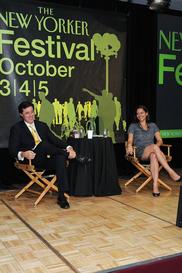
Stephen Colbert, Ariel Levy
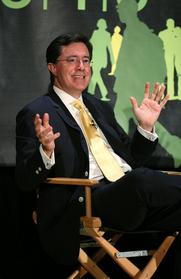
Stephen Colbert
(photo credit: Alex Oliveira/startraksphoto.com)
New Yorker Festival: Art Spiegelman’s Life is Comics 101
Art Spiegelman, denied cigarettes at the Ailey Citigroup Theater, had a pipe in tow but did not noticeably resort to it. Spiegelman’s brief was “Comics 101,” but his way of doing that was to delve into autobiography. This was as true in 1978, when _Breakdowns_ came out, as it is in 2008, when the remix of same is being published. In much of his work, Spiegelman presents himself as an overeducated and “fretting” neurotic urbanite (complete with “plewds”:http://emdashes.com/2008/09/the-wavy-rule-a-daily-comic-by-48.php), an image belied by the assured and witty lecturer on the stage Saturday afternoon.
As with “Alex Ross”:http://emdashes.com/2007/10/festival-alex-ross-will-get-yo.php explaining twentieth-century music at last year’s festival, Spiegelman knows so much about his chosen subject that it is difficult to think of a more qualified person to explain it (even though the field famously attracts completists and pedants). Spiegelman’s presentation of the history of comics hewed mostly to the standard landmarks (Rodolphe Töpffer, Winsor McCay, George Herriman, Charles Schulz, and so on) but perked up noticeably when he discussed the mindbending FDR-era misfire “Stardust: The Super Wizard” and the loopy LBJ years of Chester Gould’s _Dick Tracy_.
Spiegelman really liked Barry Blitt’s famous “fist jab” cover. In his view, Blitt was able to present that highly charged image in a way that resulted in its “toxins” being “removed. . . . like a vaccine.” The brilliance of the satire can be seen in the fact that it took the entire country two media cycles to arrive at the unavoidable conclusion that . . . Obama is not a radical. “That Obama cover was a real “Thomas Nast”:http://en.wikipedia.org/wiki/Thomas_Nast moment,” he said.
Spiegelman also showed some amusing covers that got rejected, like Bill Clinton facing a firing squad during the Year of Lewinsky. The running theme here was Spiegelman’s uncompromising tendency to push the avant-garde envelope whatever the circumstances. Interestingly, what appealed to him about his stint at _The New Yorker_ was the opportunity to meld low culture (his purview) with the loftier domans more usually associated with the magazine. With Spiegelman, elevating his beloved mongrel art form is always on his mind. (I suppose he views a movie version of _Maus_ as the opposite. Apparently he has had many offers to turn it into a film, and understandably has no interest.)
Spiegelman showed a “tribute”:http://www.newyorker.com/archive/2000/02/14/2000_02_14_061_TNY_LIBRY_000020205 to _Peanuts_ that appeared in the February 14, 2000, issue of _The New Yorker_ on the occasion of Schulz’s retirement. On the day that he died, Schulz called Spiegelman to tell him how much he liked the cartoon.
For all of his surface hand-wringing, the impression Spiegelman leaves behind is one of confidence, perhaps even egotism, albeit in an endearing form. To an audience questioner, he was quick to relate the recent rise of the graphic novel as an outgrowth of his own achievements (with some justification, of course), later commenting that “I didn’t go to art school. I had to invent postmodernism without knowing what it was.” That’s high self-regard, but in a modest package, or maybe it’s the other way around. In any case I’d gladly hear the man talk twice as long on the subject.
New Yorker Festival: Ryan Lizza, Hendrik Hertzberg, George Packer, Dorothy Wickenden
On Saturday afternoon the primary participants of _The New Yorker_’s delightful and “addictive”:http://emdashes.com/2008/09/i-think-i-need-the-campaign-tr.php “Campaign Trail” “podcast”:http://www.newyorker.com/online/podcasts/campaigntrail collected for a live version of same, sort of like when Monty Python did _The Secret Policeman’s Other Ball._ Ably guided by moderator Dorothy Wickenden, Ryan Lizza, Hendrik Hertzberg, and George Packer engaged in a spirited and relatively unepigrammatic discussion about the state of the 2008 campaign.
The most startling line of the session may have been Hertzberg’s image of McCain being reduced to “seeds and stems.” Later on, Lizza compared Palin’s impact on the McCain campaign to a fire on the deck of a ship that already had a large hole in the hull. With her adequate debate performance on Thursday, the fire has finally been put out, but the hole has yet to be addressed and will probably do the campaign in. Observing that Palin supplied the appearance of coherence without actually being coherent, Hertzberg and Lizza collaborated to come up with the Colbertian term _coherentishness_ to describe her performance.
Noting that the Democratic coalition this year will likely consist of the educated class, minorities, and young voters, Packer noted that some have begun to call Obama “George McGovern’s Revenge.” Packer fretted about the Democrats’ problems securing white working-class voters, while Hertzberg pointed out that unions still play a big role in the Democratic Party.
I have mixed feelings about all of this: white working-class voters play a talismanic role in American politics quite apart from their actual electoral importance, which has been decreasing over the years. In principle, if Dems can build a larger coalition without them, they should do so. And yet, and yet.
Packer did point out that it was union canvassers, not Obama campaign staffers, who were bringing the realities of McCain’s health care plan to voters. Unions still are that rare group with the ability to supply political education to a wide swath of society and the incentives to do it well.
On Obama’s famous equanimity, Lizza told an enlightening story that reassured beat reporters, hungry for stories of blowups or breakdowns, that the candidate was human after all. In Denver, when Obama was rehearsing his big convention speech, when he reached the section in which he invoked Dr. Martin Luther King, he choked up, stopped the speech, and had to leave the room.
Noting that about 80% of new registered voters who pick a party are Democrats, Lizza said mildly, “George Bush has not made the Republican Party cool for young people”—then, noticing the understatement, added, “This is the killing fields.”
Packer made a great point about Palin’s somewhat maddening speaking style (and I don’t mean all the _you betchas_). I had noticed that she favors passive constructions, but Packer zeroed in on something more fundamental: “The key is her syntax. There are no verbs in it. There are gerunds, there are participles, but no verbs. Identity politics is nouns—hockey moms.”
Lizza perceptively noted that “Sarah Palin is a phenomenon of a party in decline, a phenomenon of decadence.” Asked by an audience questioner how big a disappointment “liberals like me” are in for, Lizza joked, “Massive,” and Packer followed up with the nub: “The question is, is he FDR or Bill Clinton?” Indeed.

George Packer, Ryan Lizza, Hendrik Hertzberg, Dorothy Wickenden

Ryan Lizza, Hendrik Hertzberg
(photo credit: Debra Rothenberg/startraksphoto.com)
New Yorker Festival: Manil Suri, Yiyun Li, Sana Krasikov
Jonathan Taylor, who has written about Merrill Lynch, New York City’s greenmarkets, and skybridges for us, writes:
Friday’s “Writing About Home” fiction panel, with foreign-born, U.S.-based writers Manil Suri, Yiyun Li, and Sana Krasikov, was low-key and revelatory. I’ve been reading a lot of fine travel writing lately, and the topic appealed to me as a reversal of that activity: going somewhere else and writing about where you came from. Perhaps more important, it’s a reversal of the choices made: rather than going abroad for the purpose of writing, each of these writers were forced or decided to come to the United States for other reasons, and each in their way later turned, as adults here, to fiction writing. (Suri took writing up initially as a hobby; he is a mathematician, and his description of his writing life sounded distinctly methodical if not almost absurdly logical.)
Deputy fiction editor Cressida Leyshon’s questions gradually drew out the way each writer’s work, even though inevitably focused on this or that specific set of stories, skilfully engages the social “ripples” of historic cataclysms.
Suri’s The Death of Vishnu created a microcosm of Indian society within one apartment building. Li views China through what she described as the “villager-like” mentality Beijing’s residents still possess, in which “politics is like the weather.” And Krasikov noted her admiration for fiction in which the shadows of “what’s happening beyond the story” creates tension within it, such as Kazuo Ishiguro’s Remains of the Day or Isherwood’s Berlin Stories, where “we know now” the unspoken fates of their protagonists.
These historical earthquakes cause dislocations, not just geographical ones. In Krasikov’s stories, scientists and engineers from the former Soviet Union work as nannies or home health care aides—recalling a detail of Li’s “A Man Like Him,” in which a university professor disgraced in the Cultural Revolution is forced to become a school janitor. Each writer, interestingly, told with relish a story about being mistreated on returning to their home country. Suri humorously recounted the bureaucratic antics of an Indian bank teller. Krasikov described, with more outrage, being accused of shoplifting from a Moscow Sephora—and noted the blatant discrimination in Moscow against people of more obviously Caucasus origins. And Li observed that because she had two children, something forbidden to Chinese couples, she was universally assumed to be a nanny (and hence treated rudely).
The final audience questioner summed up the writers’ situation nicely—”to be both an insider and an outside observer”—and asked of each of them whether writing about his or her home country made them feel more “intimate” with it. The answers were appealingly direct and diverse: Krasikov said no, it “exacerbates distance.” For her, the process of digging deeper into former Soviet reality—which has of course changed unrecognizably since her family left in 1987—is a process of “discovering distance.” Suri’s experience was the opposite: he had long tried to leave India behind him, but when he took up writing, India forced itself on him as his subject, bringing him “closer” to it. And Li—who in response to an earlier question had said that she could no longer live with China, in the same way that, as an adult, she could no longer live with her mother—said that writing about China had not made her more “intimate” with it—just more “patient.”
In addition to Li’s “A Man Like Him,” two of Krasikov’s stories are available on the New Yorker website.