Martin Schneider writes:
A new issue of The New Yorker comes out tomorrow. Here is a description of its contents.
In “Syria Calling,” Seymour M. Hersh reports on the prospects for peace talks between Syria and Israel, and the opportunity that now exists for the Obama Administration to mediate them—”a role that could offer Barack Obama his first—and perhaps best—chance for engagement in the Middle East peace process.”
In “Cash for Keys,” Tad Friend looks at the housing crisis in Southern California and follows Leo Nordine, one of L.A.’s leading brokers specializing in selling foreclosed homes, who “has a knack for pricing houses aggressively, so they sell fast, a valuable skill in a county where values are declining two to three per cent a month.”
In “Message in a Bottle,” John Colapinto chronicles the development of Plastiki, a sixty-foot “bottle boat” which David de Rothschild, the environmentalist better known for his family’s banking fortune, and a crew hope to sail across the Pacific Ocean.
Nicholas Lemann comments on populist rage and the Geithner plan.
In Shouts & Murmurs, Bruce McCall launches a company to help executives escape their bad behavior.
Rebecca Mead profiles Matthew and Michael Dickman, twin brothers and poets.
There is a poem by A. S. Byatt.
Anthony Gottlieb explores the miserable history of the Wittgenstein family.
Peter Schjeldahl views paintings by European masters from the Norton Simon Museum at the Frick Collection.
Hilton Als reviews Exit the King, People Without History, and Rambo Solo.
Sasha Frere-Jones listens to U2’s new album.
Anthony Lane reviews Monsters vs. Aliens and Shall We Kiss?
There is a short story by Brad Watson.
Category Archives: New Yorker
Snopes: Recent Woody Allen “Shouts” Authored by Some Guy Named Konigsberg
Martin Schneider writes:
I’m glad that Snopes.com was able to crack the Case of the Utterly Unmysterious Woody Allen Article. Although to be fair, it is a little strange that every weekly magazine issue has what amounts to an incorrect date on the cover.
More information on Konigsberg.
Donnelly and Maslin: Story of a Marriage–And a Book
Martin Schneider writes:
I just saw this on The Daily Beast and wanted to post something about it as soon as I could. (It was posted to coincide with Valentine’s Day, but I missed it at the time.)
Liza Donnelly and Michael Maslin are both New Yorker cartoonists, and they are also married to each other. They have a new book out called Cartoon Marriage: Adventures in Love and Matrimony by The New Yorker’s Cartooning Couple, which I haven’t seen yet, but everything that I have seen and heard about it suggests that it will be full of wit, sensitivity, and insight.
This multi-panel cartoon, by Donnelly and Maslin both, is the story of how they met and fell in love. Not only does it succeed on its own terms, as story, as graphic art; it’s also great fun for anyone interested in The New Yorker, as it references several of Donnelly and Maslin’s cartoonist colleagues as well as the many New Yorker anniversary parties that served as occasions for their initial meets. Never has the title of this category been more apropos, since James Thurber played a major role in their intertwining.
The cartoon reminds me a little of the R. Crumb/Aline Kominsky joints that sometimes appear in The New Yorker, but without the internal stylistic clash that those always featured. Maybe the cartoon stylistically reflects their compatibility!
Here’s a brief feature that CBS Sunday Morning did on Donnelly and Maslin:
“How Much Can They Laugh? They’re Laughed Out.”
Martin Schneider writes:
Our friend Toby Gardner makes an astute observation: Having David Sedaris and Woody Allen in the same issue of The New Yorker is the precise magazine reenactment of the scene in Annie Hall in which Alvy Singer complains about having to follow a standup comedian at an Adlai Stevenson rally. And they even put Woody’s piece right after Sedaris’s.
It’s practically an homage.
New Yorker Blog Roundup: 03.25.09
Martin Schneider writes:
This batch seems somewhat “urgent” to me, in a good way. Have a look.
(This content is taken directly from the left nav bar on the magazine’s website.)
George Packer discovers George Orwell was a loving father.
Evan Osnos mourns the Chicago Tribune‘s foreign bureaus.
Steve Coll thinks the Treasury’s plan does what’s politically possible, not what’s necessary.
James Surowiecki challenges Joseph Stiglitz’s distortions of the Geithner plan.
Hendrik Hertzberg applauds another Bill O’Reilly target.
The Front Row responds to A. O. Scott.
News Desk: Signs of progress, the President and the Pope.
Sasha Frere-Jones hosts a roundtable about Haitian music.
The Book Bench: If Samuel Beckett used Twitter, Bulgaria’s favorite book.
The Cartoon Lounge: North by Northeast, reports of nose skirts from SXSW.
Goings On: The New York Dolls‘ “Cause I Sez So,” second-generation rock drummers.
From the 5¢ Token to the $103 Monthly Unlimited: ‘The Subway Fare Problem’ in The New Yorker
Jonathan Taylor writes:
Although the one voted today really is the most shocking in recent memory, subway fare hikes are perpetual grist for New Yorkers’ mills—as seen in The New Yorker‘s own archives: from the 1927 two-cent hike proposal that went all the way to the Supreme Court, to the introduction of the $2 fare, subject of a 2003 Talk piece.
True! Twitterers Tout, Twit “Tweedy” Weekly
Martin Schneider writes:
One of two things will happen: Either Twitter will gain sufficient acceptance that nobody will bother being annoyed it, or it’ll stop being used enough to warrant any attention at all. In the meantime, some messages:
mldrabenstott @genmarshall A weekly New Yorker equals 6-8 monthly mags. Quality, not quantity.
ljhliesl I just put a lot of staples through the New Yorker so Blake could take them out again. He is a staple-remover and a confetti-maker.
youngamerican Can anyone deny that for the last two or three months, this has been the best part of each and every New Yorker? http://bit.ly/ofuim
BananaEsq The New Yorker consistently misuses the word “insure.” Please stop.
splendid Weird: Marina showed 8-sec clip of artist performing by getting rifle shot in arm; get home, open New Yorker, see article about that artist
guttersniper Going to the John Updike tribute at the NYPL tonight. Expecting tweed.
MitMoi “Editing is the same as quarreling with writers – same thing exactly” Harold Ross: American Writer, New Yorker founder
LaurenProctor32 Lauren Collins’ article in this week’s New Yorker is wonderfully well written. She’ll always be a favorite. [I think this was referring to the article about Bill Cunningham.]
dbrauer The New Yorker’s partisan cover fetish has become boring.
mrcornie Reading short story in 3/23 New Yorker & it talks of Facebook & Wii. Fascinated when new-ish pop culture phenoms start showing up in my lit.
suzannegangi Asked w/utmost respect: How old is Mr. John McPhee, esteemed author & “New Yorker” contributor? He made la crosse(!) interesting (3/23 NYer) [I wrote back, informing her that McPhee had turned 78 about two weeks earlier.]
VelocityWong My fave part of the New Yorker’s Burris piece is how almost every mention of an IL pol has a parenthetical epilogue about their crimes.
What’s in This Week’s New Yorker: 03.30.09
Martin Schneider writes:
A new issue of The New Yorker comes out tomorrow. Here is a description of its contents.
Atul Gawande examines the use of prolonged solitary confinement in our nation’s prisons, and concludes that whether one is serving time at a supermax prison or being held in a cell in Beirut, Hanoi, or Guantánamo Bay, “all human beings experience isolation as torture.”
Evan Osnos profiles Cheung Yan, the head of Nine Dragons Paper, China’s largest paper manufacturer, and explores how the fortunes of the company that was once the largest exporter, by volume, of freight from the United States fell to the point “that the company’s market value was less than half the value of its own phalanx of paper machines.”
David Owen writes about how bad economic times can be good for the environment.
James Surowiecki responds to Europe’s conservative reaction to the economic crisis.
David Sedaris recounts stories from his latest book tour.
Woody Allen envisions revenge on Bernie Madoff.
Alec Wilkinson profiles Chris Ferguson, one of the most successful and strategic poker pros.
John Lahr reviews West Side Story and God of Carnage.
Hilton Als explores depictions of race and prejudice in Tracey Scott Wilson’s The Good Negro.
Anthony Lane examines the life and letters of Samuel Beckett.
James Wood considers paranoid schizophrenia in John Wray’s new novel Lowboy.
Alex Ross attends Il Trovatore and La Sonnambula at the Metropolitan Opera.
Paul Goldberger revisits the work of the architect Andrea Palladio.
Nancy Franklin reviews the new television drama Kings.
David Denby reviews Duplicity and Hunger.
There is a short story by Craig Raine.
New Yorker Blog Roundup: 03.21.09
Martin Schneider writes:
Last week, a reader named Sandra wrote in to praise Ben Greenman’s flight of fancy: “This fake American Idol roundup is one of the best things I have ever read. Stunning.” Thanks for the alert, Sandra—we can always use them!
(This content is taken directly from the left nav bar on the magazine’s website.)
Steve Coll feels bureaucracy nostalgia.
James Surowiecki watches a Domino’s commercial, quotes Lenin.
George Packer looks at the Florida real estate crash…of 1929.
The Front Row: Richard Brody explains why A. O. Scott is wrong about neo-neorealism.
Elizabeth Kolbert on who’s donating to climate-change deniers.
Evan Osnos on Ralph Macchio and the Beijing dance-fight scene.
News Desk: The White House kitchen garden.
Hendrik Hertzberg on why Paul Krugman is right about Europe’s economy.
Sasha Frere-Jones recommends turning back to bass this weekend.
The Book Bench: Ann Goldstein remembers John Updike, a Scottish Armada.
The Cartoon Lounge: Dispatches from SXSW.
Goings On: American Idol does Hair, a quarter-century of Atomic Records.
Ask the Author: Submit a question to Keith Gessen about the Politkovskaya murder trial.
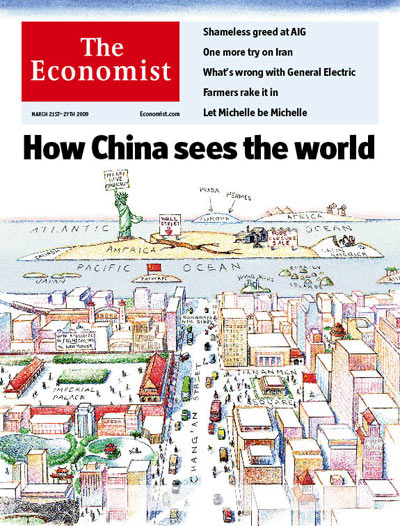
The Economist Presents “View of the World from … Chang’an Street”?
Martin Schneider writes:
Twitter user Michael Aphibal (michaelaphibal) makes an astute point about this week’s cover of The Economist:
Look at the cover of #TheEconomist (3/21-27/2009) The New Yorker sued Columbia Pic for imitating something similar http://tinyurl.com/2q2ybk
Good point, Michael! I’d forgotten all about Steinberg v. Columbia Pictures Industries, Inc. (Steinberg won the case.)
So many questions! Does a news organization have more latitude on copyright infringement than a movie studio? (I’d wager yes.) Does it matter that The Economist operates out of Great Britain? Can the Saul Steinberg estate sue a British entity? (Is it inclined to?) Anyone who has seen the issue, do they credit Steinberg anywhere?
And finally, what do you think of the cover? Do you think it’s clever?
Update: Strange Maps supplies a larger view, in which one can see (as the post points out) that the image contains a billboard on the Imperial Palace with the following text: “With Apologies to Steinberg and The New Yorker.” So Steinberg is credited. Thanks to Strange Maps for the informative post.