
_Pollux writes_:
I drew a “joke”:http://emdashes.com/2009/07/the-wavy-rule-a-daily-comic-by-251.php about desert island jokes a few weeks ago. It struck me, as I’m sure it has struck many observers, that the desert island features often as a comic device, especially “within the pages of _The New Yorker_.”:http://www.cartoonbank.com/directory/deserted-cartoons.html
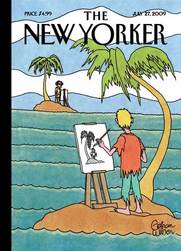
And now it appears on the cover of the July 27, 2009 issue. “Gahan Wilson’s”:http://en.wikipedia.org/wiki/Gahan_Wilson cover is of course a comment also on the desert island as a frequent location in one panel gags and cartoons. Last year, Mike Lynch’s cartoon blog “voted”:http://mikelynchcartoons.blogspot.com/2008/05/favorite-gag-cartoon-cliche.html for the desert island number one for gag cartoon clichés (second place was the Psychiatrist’s Couch, while third was The Grim Reaper).
Wilson’s cover, called “Cartoon Island,” of course features two cartoon islands, occupied by two artists drawing inspiration from one another across the treacherous-looking channel that separates them. The canvas we are allowed to see features a third island, occupied by a smiling castaway.
The castaway featured in the canvas is not a portrait of the bespectacled artist farthest away from us. The bespectacled artist simply provided the initial inspiration. The blond artist whose back is to us sees inspiration across the channel but not an opportunity for exact portraiture.
He is of course a castaway himself, but neither artist may realize this. So they paint and draw, sustaining themselves on Art and the off-chance that 7.5 oz cans of beans and franks and some desalinization equipment will wash up on their picayune shores.
Wilson has thus turned the desert island device on its own head. As Wilson has “remarked”:http://www.lowbrowartworld.com/gahan_wilson.html, “the creative artist is automatically an outsider, because he sees through the world that everybody else takes as the final reality, and he’s a very scary kind of guy.” Instead of a subject of art the island has become a place for producing art. The cartoon desert island is producing art about cartoon desert islands.
These cartoon desert islands usually look the same: they’re about the size of a Smart Car, usually sustaining a single palm tree and a single inhabitant, who is usually male. He wears the costume of a comic castaway: frayed slacks and shirt. He is sometimes unshaven, and always uninjured, and mysteriously does not look very undernourished. This is a humorous cartoon after all.
These desert islands are usually covered by a soft carpet of sand instead of unfriendly coral as sharp as an X-acto knife. Their very stripped-down quality makes desert islands a good location for humor. All you have is a man, an island, and the possiblity of a punchline. The cartoonist introduces some element that disrupts this minimalist world, and makes a comment on the world at large. The island is a laboratory for exploring ourselves.
The islands are ridiculously small, but their size allows us to see an entire world at once, a society in miniature, and of course, a small island is better than the dangers of the sea. As Gonzalo, the honest old counselor in Shakespeare’s “The Tempest,” declares, “Now would I give a thousand furlongs of sea for an acre / of barren ground–long heath, brown furze, anything.”
Wilson’s art, produced over the course of half a century, is sometimes described as scary or creepy, but here acquires a certain satirical tinge that is not particularly disturbing or sinister. His “Cartoon Island” is considerably less sinister than “another”:http://www.gahanwilson.com/orginalart.htm of his cartoon islands, which is not an island at all but a large sea monster -which is itself an old literary theme.
Wilson’s Cartoon Archipelago, composed of ink and watercolors, is a place of industry and stimulation. “I began to conclude in my mind,” Robinson Crusoe realizes on his deserted island, “that it was possible for me to be more happy in this forsaken, solitary condition than it was probable I should ever have been in any other particular state in the world.”
On Wilson’s “Cartoon Island,” we find two artists finding inspiration in the bleakest of circumstances, and thus finding a form of happiness through their art despite the fact that only the smallest of patches of earth separates them from a deep and hazardous ocean. The ocean is Neptune’s domain; skillful cartooning is Wilson’s.
Category Archives: Sempé Fi
Sempé Fi (On Covers): Trafalgar Square
_Pollux writes_:
“Bruce McCall”:http://www.brucemccall.com/ loves cars. This much is clear from the way he depicts his vehicles, glorifying and exaggerating their form. His paintbrushes lovingly depict the details, producing cars that are more detailed than normal for a cartoon or _New Yorker_ cover. McCall is like a miniaturist adding decals to a 1/24 scale 1971 Ford Mustang Pro Street Car.
You don’t need to draw eyes and mouths on cars to give them a personality. McCall loves cars while at the same time lampooning the people who build them. As noted in my “last piece”:http://emdashes.com/2009/04/sempe-fi-on-covers-base-of-ope.php on a McCall cover, McCall attacked and lampooned the Detroit auto industry by depicting the cars the city “forgot to build” during the boom years of the 1950s and 60s in his book _The Last Dream-o-Rama_.
McCall’s new cover offers us a new vision of automobiles gone wild.
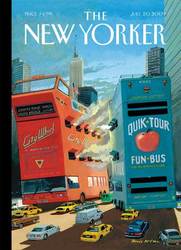
For his July 20, 2009 cover for _The New Yorker_, called “Tour Wars,” McCall depicts an array of cabs, a Porsche, a van, and two towering tourbuses. These tourbuses, engaged in a war of attrition as long as a tea clipper, exchange cannonfire as they drive past one another on their way to competing routes to Grant’s Tomb and 11th Avenue.
There is no contingent of marines or complement of pirates armed with grappling hooks on the decks of these massive earthbound galleons. The tourbuses’ hostility is completely automated and automatic. They fire because they sense an enemy nearby. It makes sense in their brains composed of crankshafts and sumps. One can’t even see the drivers or the tourists on these buses.
And tourists are the key to the castle here. With an ailing American economy, there are fewer tourists and more competition. In McCall’s satirical vision, the competition has become so fierce as to result in Cape St. Vincent-like engagements on the city streets. CityWhirl (“All Manhattan in 6 min.”) versus QuikTour (“101 Sights Per Block”): which of these will be the only company to offer the Hop On, Jump Off experience?
In real life, The Gray Line “offers”:http://www.newyorksightseeing.com/page.php?id=6 “48 hours of hop-on hop-off double-decker fun that includes the Downtown Loop, Uptown Loop, Brooklyn hop-on, hop off tours and a Night Tour. PLUS, admission to any THREE listed NYC attractions.” A Night Tour from another company claims “best-value double-decker sightseeing packages including major attractions and activities such as harbor cruises, museum visits, helicopter tours, shopping day trips and one-day escorted motorcoach tours to Boston, Washington, D.C. and Philadelphia & Amish Country.”
There is violence in McCall’s image, but it is not a violence of gore and tears. The whiff of grapeshot is evocative of heroic and romantic actions of yesteryear on the high seas rather than the horrors of our current engagements in the Middle East.
McCall’s two lumbering, mutually hostile buses are symbolic of an ailing company that is fighting to gain ground once again and find new strength. And the cars surrounding them, the Porsche, the Rolls, the taxis, and the van, do not flee the scene but remain part of it, inherently supportive of this tour-bus Trafalgar.
Sempé Fi (On Covers): Peace Is Always Beautiful

_Pollux writes_:
The world is going to hell. Cabdrivers from Patagonia to Palau will tell you that; it’s part of their job to do so. What with Honduran coups, California crisis IOUs, bloody riots in Iran and Xinjiang, and the demise of the only person who could really moonwalk, one just wants to duck under the covers and wait for the all-clear.
But not all is bleak. There are little places of peaces around the world. As Barbara Tuchman writes in _A Distant Mirror_, her study on the fourteenth century, “starving peasants in hovels live alongside prosperous peasants in featherbeds. Children are neglected and children are loved… No age is tidy or made of whole cloth…”
In the synthetic cloth of our own age, the double-aughts or aughties, we have to sew in our own little patches of tranquility. “Mark Ulriksen’s”:http://www.markulriksen.com composition for the July 6 and 13, 2009 issue of _The New Yorker_, called “Sanctuary,” depicts such a patch of peace.
His female subject has slung a hammock and created for herself a makeshift tropical paradise in the middle of the city. It may be Saturday morning or Sunday afternoon; maybe she has taken a day off from work with an excuse about the flu (of the regular, rather than swine, variety).
She’s settled into a comfortable position; one leg hangs off the hammock. An arm is tucked behind her head. We have no idea what she’s reading but it must be good. She’s dressed comfortably; there’s a pitcher of ice tea nearby and a cat, perhaps her own, shaded by an umbrella.
Ulriksen’s rooftop is filled with color: the red and white stripes, the purple top she’s wearing, the green palm trees and vegetation, the lime green and eggshell blue deckchairs. Behind her the city, painted in earth tones, looms, but not threateningly so. Ulriksen’s city is not the darker city of “Eric Drooker”:http://emdashes.com/2009/05/sempe-fi-on-covers-forgotten-l.php, for example. His city’s earth tones evoke a summer sea strand, a busy beach -a vertical, pillared beach.
Ulriksen’s covers, done in his distinctive acrylic style of intentionally imperfect lines and perspectives, occasionally hit at some political target. Most recently, Ulriksen “depicted”:http://www.cartoonbank.com/product_details.asp?mscssid=3SBD4MH5TTGL9LLG0C3TX5ASG9BX3701&sitetype=1&did=5&sid=125570&pid=&advanced=1&keyword=undefined&artist=Mark+Ulriksen§ion=covers&caption=&artID=&topic=&pubDateFrom=&pubDateTo=&pubDateMon=&pubDateDay=&pubNY=&color=0&title=undefined&whichpage=31&sortBy=popular John McCain as a Monopoly-playing Little Lord Fauntleroy-type figure, but if we go further back, we have Clinton “dancing”:http://www.cartoonbank.com/product_details.asp?mscssid=3SBD4MH5TTGL9LLG0C3TX5ASG9BX3701&sitetype=1&did=5&sid=50875&pid=&advanced=1&keyword=undefined&artist=Mark+Ulriksen§ion=covers&caption=&artID=&topic=&pubDateFrom=&pubDateTo=&pubDateMon=&pubDateDay=&pubNY=&color=0&title=undefined&whichpage=34&sortBy=popular with Dole during the 1996 election; a “comment”:http://www.cartoonbank.com/product_details.asp?mscssid=3SBD4MH5TTGL9LLG0C3TX5ASG9BX3701&sitetype=1&did=5&sid=51155&pid=&advanced=1&keyword=undefined&artist=Mark+Ulriksen§ion=covers&caption=&artID=&topic=&pubDateFrom=&pubDateTo=&pubDateMon=&pubDateDay=&pubNY=&color=0&title=undefined&whichpage=11&sortBy=popular on love and all of its forms; and that favorite subject of cartoonists and illustrators: a “gun-toting”:http://www.cartoonbank.com/product_details.asp?mscssid=3SBD4MH5TTGL9LLG0C3TX5ASG9BX3701&sitetype=1&did=5&sid=121930&pid=&advanced=1&keyword=undefined&artist=Mark+Ulriksen§ion=covers&caption=&artID=&topic=&pubDateFrom=&pubDateTo=&pubDateMon=&pubDateDay=&pubNY=&color=0&title=undefined&whichpage=9&sortBy=popular Cheney.
For this summer cover, however, he’s giving us, and himself, a break from political tussles. After all the world has gone through, and has yet to go through, we could all spend a moment in a sanctuary of our own choosing.
Sempé Fi (On Covers): Hanging Doubts, Bulging Eyes

_Pollux writes_:
When Iran exploded into two halves in late June, the world was caught off guard.
Was it revolution? It certainly looked like one. And it was called one: the “Green Revolution” involved and continues to involve “a wide cross-section of Iranian society”:http://www.newyorker.com/reporting/2009/06/29/090629fa_fact, who have flooded the streets of Teheran and other cities, chanting slogans and waving green flags and bandannas.
The world soon started taking sides. Venezuela, Russia, and Brazil welcomed the results, wiring their congratulations to Mahmoud Ahmadinejad. Great Britain, the United States, France, and Germany expressed their concerns over possible fraud.
Amidst the lobbed canisters of tear gas and blows of the Basiji’s boots and truncheons, Twitter’s protest-related hash tags, such as _#iran_ and _#iranelection_, pullulated a thousand times over. Peaceful demonstrations turned into bloody battles; casualties began to be reported as well as stories of militia firing into crowds or raiding students’ dorms.
The “death of Michael Jackson”:http://emdashes.com/2009/06/michael-jackson-1958-2009.php was a tragedy in more ways than one: it “shifted attention away”:http://www.thedailybeast.com/blogs-and-stories/2009-06-26/will-michael-jackson-doom-iran/ from the smoldering streets of Teheran and focused it on the dragon wagon kiddie rides of Neverland.
It certainly looked like revolution in Iran, but in the end, no government has fallen, no Iranian equivalent of the Bastille has been stormed and destroyed. There was no collapse -only the temporary collapse of Google’s servers.
With the whiff of possible revolution gone, the stench of voting fraud remains, despite the government’s assertion that no irregularities occurred. It’s an all-too-common odor. We’ve smelled it before, in Zimbabwe with Mugabe’s election, and in Florida in 2000.
Ah, November-December 2000: the memories! The images! The frustrations and fears! We prayed to St. Chad, the patron saint of disputed elections, a patronage that turned out to be “apocryphal.”:http://www.snopes.com/religion/chad.asp We didn’t just have hanging chads (chads attached to the ballot at only one corner), we had swinging chads, tri-chads, dimpled chads, and pregnant chads.
Every dramatic event has an image that we associate with it. For many, it was the “image of Judge Robert Rosenberg”:http://economictimes.indiatimes.com/articleshowpics/3678208.cms examining a dimpled punchcard, his wide, intense eyes bulging with worry, his glasses raised on his forehead.
“Barry Blitt’s”:http://www.cartoonbank.com/search_results.asp?sitetype=1&advanced=1§ion=all&artist=Barry+Blitt take on this iconic image, for the June 29, 2009 cover of _The New Yorker_, transforms Rosenberg into an Iranian woman. Her glasses are raised in the same manner, and she bears the same expression of intense concentration, mixed in with confusion, concern, and fear. The cover is called “Hanging Chador,” a reference to the cloak worn by Iranian women in public and by many of the protesters.
Blitt’s illustration, done in his trademark style of ink slashes and somewhat messy watercolor splotches, forever links Bush vs. Gore with Ahmadinejad vs. Mousavi. It is a common cartoonist’s trick to link two seemingly unrelated themes or images to produce one joke or illustration; however, in this case, the leap from Tallahassee to Teherean was an easy one to make, at least for anyone with residual, bitter memories of what happened in 2000.
On June 29, Iran’s Guardian Council reaffirmed Ahmadinejad’s victory. New protests erupted, graffiti was angrily scrawled on Teheran’s walls.
The world seems uncertain on what course of action to take. What is the United States to do? Does it simply watch and return to the business of burying its celebrities and making sense of the subarctic hebetudinosity that is Sarah Palin?
As for the protestors in Iran, Benjamin Franklin’s quote comes to mind: they must all hang together, or assuredly they shall all hang separately.
Sempé Fi (On Covers): Voilà , la Mer!
_Pollux writes_:
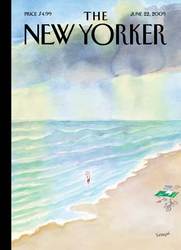
He’s jumped in. His socks, cap, shoes, glasses, shirt, pants, backpack, and bicycle lie strewn on the beach behind him. And now what? He’s shivering in the cold water, the sun is concealed by rain-heavy clouds, and the beach is empty and forlorn.
Such is the vision presented in “Jean-Jacques Sempé’s”:http://en.wikipedia.org/wiki/Sempe cover, called “Jumping In,” for the June 22, 2009 issue of _The New Yorker_. Sempé’s human figures are always minuscule, but the little boy on this cover is smaller still, composed as he is of the thinnest strikes of the pen in the face of engulfing watercolor spills of green, white, and purple that comprise clouds, sea, and sky.
And now what? It’s not the best day for going to the beach. Perhaps he would have been better off staying home and reading Tintin comic books or going to the movies to see some “utterly mindless thriller”:http://www.newyorker.com/arts/critics/cinema/2009/06/22/090622crci_cinema_lane starring a subway car, a subway train dispatcher played by Denzel Washington, and John Travolta in _Swordfish_-mode again.
But summer is about trying new things, even if it involves some discomfort in the form of a freezing Atlantic. Sempé’s “cover”:http://www.cartoonbank.com/product_details.asp?mscssid=125X8GPUW9QS9PRJTHTB9HN8S59RE6G2&sitetype=1&did=5&sid=51301&pid=&keyword=+Semp%E9§ion=all&title=undefined&whichpage=11&sortBy=popular for the April 8, 2002 issue of _The New Yorker_ offered a similar vision of a person wading into a wide ocean, but the figure on this 2002 cover is older and much more content to simply wade in. He’s not going any farther. This was a five-minute expedition, only involving the removal of shoes and socks.
But Sempé’s younger figure on this 2009 cover is much more daring, although a little uncertain. Such is youth, a mixture of daring and uncertainty.
The sea beckons. How far will you go?
Sempé Fi (On Covers): Pachydermatitis

_Pollux writes_:
In 1814, Joseph Constantine Carpue became the first man in England to perform the procedure of rhinoplasty. He had adopted methods that had been practiced in India for thousands of years, and the whole operation took about 15 minutes. The patient was an army officer, who remarked after the operation was done, “It was no child’s play and extremely painful, but there was no use in complaining.”
A nose job can still be extremely painful, and the decision to get one should never be taken lightly. One gets a nose job for either health-related or functional reasons, or for aesthetic or cosmetic reasons. As one plastic surgery site “states”:http://www.theplasticsurgeon.org/rhinoplasty-phoenix.htm, “because the nose is a dominant feature of the face, it has an important role in determining overall appearance.”
The dominant feature on an elephant is of course its trunk, and serves the elephant well as an extra pair of fingers, an olfactory periscope, a drinking straw, a weapon, and a snorkel.
An elephant thus does not get a nose job on a whim. There has to be a pressing reason for a pachyderm to enter a plastic surgeon’s office: it is a question of survival.
But whose survival? Not this individual elephant’s, but that of the Republican Party, whose association with this symbolic animal “dates”:http://en.wikipedia.org/wiki/File:NastRepublicanElephant.jpg from the 1870s.
“Barry Blitt”:http://www.cartoonbank.com/search_results.asp?mscssid=N75BLQT1QCKS9NR183NUWJWU397MBJ28&sitetype=1&advanced=1§ion=all&artist=Barry+Blitt has visualized, on his May 25, 2009 cover for _The New Yorker_, the uncertainty that greets the Republican Party after Obama’s victory in November.
As David Brooks “has remarked”:http://www.guardian.co.uk/world/2009/apr/18/us-politics-republican-party, the Republican Party is “just a circular firing squad, with everybody attacking each other and no coherent belief system, no leaders. You’ve got half the party waiting for Sarah Palin to come rescue them. The other half waiting for Bobby Jindal, the Louisiana governor, to come rescue them. But no set of beliefs. Really a decayed conservative infrastructure.”
Blitt’s cover is called “Nip and Tuck,” and the general opinion amongst Republicans has been that their party needs to do a lot of nipping and tucking. But what appendages need to be nipped and which ones need to tucked?
Is it Karl Rove who needs to “crawl back to Texas, curl up beside a cactus and contemplate the ruin he has inflicted on the party”, as one panelist at the Conservative Political Action Conference “remarked?”:http://www.guardian.co.uk/world/2009/apr/18/us-politics-republican-party Or is it Rush Limbaugh who needs to stick a pacifier into the mouths of the “eight bawling babies”:http://emdashes.com/2009/03/sempe-fi-on-covers-1.php that comprise his toxic body mass?
And what to make of the Republican commentators who are so scared of Obama’s reforms that they seem to have misplaced their history textbooks? “Creeping socialism has been taking over the country piece by piece,” “one of them has written”:http://www.renewamerica.us/columns/dieckmann/090519. “It is the same socialism that early Americans left Europe to escape.” Perhaps I was asleep in my American History class (Ms. Goldberg, 1st period, 11th grade) when we were discussing how the Pilgrims fled England due to the introduction of the National Health Service.
There seems to be more than one party these days sharing the name of “Republican”: the Moderates, the Extreme Rightwingers, the Palinites, the Jindalians, the Dittoheads, the Romney-vians, the Sharks, the Jets… As it happens, Blitt’s elephant is going about it the wrong way. Instead of downsizing the length of its proboscis for the benefit of the whole party (there is no “whole party”), it would make more sense for it to metamorphose into several smaller, different animals.
I would love to see Blitt, a talented illustrator, draw a Moose for the Palinites, a Crawfish for the Jindalians, a Hedgehog bristling with AK-47s for the Extremists. It will be a new symbology for a new age. But Democrats will keep the donkey. The length of our ass’s nose is just fine.
Of Pixels and Pastels: New Yorker artist Jorge Colombo’s iPhone Art
_Pollux writes_:
If you call “Jorge Colombo”:http://www.jorgecolombo.com/, he may not pick up.
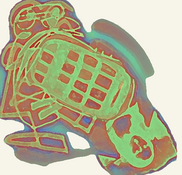
He’s busy using his phone for something other than talking, e-mailing, and finding directions. He’s creating artwork with his iPhone, whose Brushes feature is a sophisticated “mobile painting” application complete with color wheel, undo/redo functionality, and a selection of brushes.
This is powerful technology, and the Portuguese-born Colombo applies an artist’s sensibility to create immensely delicate and interesting iSketches that capture the city in a new medium. The iPhone has become one more tool in the artist’s kit. “I got a phone in the beginning of February, and I immediately got the program so I could entertain myself,” Colombo “remarks.”:http://www.newyorker.com/online/blogs/tny/2009/05/jorge-colombo-iphone-cover.html
But Colombo’s art isn’t gimmicky ephemera, and his art is not, thankfully, trapped on his phone. The June 1, 2009 “_New Yorker_ cover”:http://www.newyorker.com/online/blogs/tny/2009/05/jorge-colombo-iphone-cover.html is in fact a Colombo iArtpiece. He is also selling 20×200 iPhone drawings “at 20 x 200.”:http://www.20×200.com/aaa/jorge-colombo/
Colombo, born in Lisbon in 1963, is not a greenhorn graphic designer or emerging artist (not that there’s anything wrong with that), but an established illustrator, filmmaker, and photographer, who has worked as art director for various Chicago, San Francisco, and New York magazines. He has books under his belt, including the photographic novel “”Of Big and of Small Love””:http://www.jorgecolombo.com/bsl/index1.htm (”Do Grande e do Pequeno Amor”), a work of half-photography and half-fiction writing. iPhone’a Brushes app, then, is for him a new and useful tool rather than a replacement for camera or pen.
Paul Éluard once remarked that “the poet is not he who is inspired but he who inspires.” In the same way, Colombo is a poet who, no doubt, will inspire a new market for iPhone-generated art.
**James Falconer** “reports”:http://www.intomobile.com/2009/05/25/iphone-and-brushes-app-used-to-create-june-1st-cover-art-for-the-new-yorker.html on this story, and includes an image of Colombo’s cover.
The **Knight Center** “covers Colombo’s new artwork.”:http://knightcenter.utexas.edu/blog/?q=en/node/4118
Colombo’s isn’t the only one: the “iPhone Art Flickr group.”:http://www.flickr.com/groups/brushes/
Sempé Fi (On Covers): Forgotten Little Animals
_Pollux writes_:
In 1930, New York City, as described by the Spanish poet Federico GarcÃa Lorca, was inhabited by those “who lift their mountains of cement / where the hearts beat / inside forgotten little animals / and where all of us will fall / in the last feast of pneumatic drills.”
In 2009, New York’s mountains of cement are still rising, and we have yet to fall in the last feast of pneumatic drills. However, we still receive reminders of the world that we have paved over and littered with mushrooming forests of steel and plastic and cement.
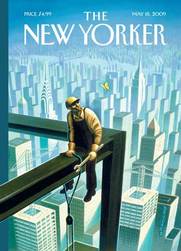
“Eric Drooker’s”:http://www.drooker.com cover for the May 18, 2009 issue of _The New Yorker_ gives us such a reminder.
A single yellow butterfly, a forgotten little animal, rises above the sterile city and shows itself to one of the city’s builders. We are not sure if the wrench-wielding construction worker looks upon the creature with disgust, apathy, hope, or anger -but at least he’s looking. Is it a life-changing moment? Perhaps not. But at least it’s stopped him, at least for a moment, from helping to elevate these peaks of cement still further.
Drooker’s cover is named “Coming Up For Air,” and it is not just the butterfly that is coming up for air, but the solitary construction worker as well, perched on a girder high above the vertical limbs of the city. Thousands of feet up in the air, life reasserts itself.
There are in fact three living beings on this cover: the butterfly, the worker, and the city. In Drooker’s work, New York City metamorphoses as much as the nymphs and gods of Greek mythology do.
“A slideshow of his work”:http://www.cartoonbank.com/product_details.asp?mscssid=N75BLQT1QCKS9NR183NUWJWU397MBJ28&sitetype=1&did=5&sid=123086&pid=&keyword=eric+drooker§ion=all&title=undefined&whichpage=1&sortBy=popular will show you multiple New York Cities: you’ll see the city from different angles, from various perspectives, from surreal and fantastical approaches.
Drooker’s bird’s-eye views, dog’s-eye views, and worm’s-eye views reveal a city that is different things to different people. All you have to do is look up, look down, or look differently. There are viewpoints from pigeons and dogs and men on stilts. A homeless’-eye view reveals a different city, in which a bonfire in a trashcan provides limited protection in a cold winter’s night near Brooklyn Bridge.
Drooker not only works with oblique angles and aerial viewpoints but also works at transplanting the city, either parts of it or as a whole, into different temporal or geographic zones. A businessman emerges from a New York subway station located in some sweltering jungle. There exists a subway station with cave paintings, and an arctic subway station at 125,000 Street bustling with harpoon-wielding commuters. In various dimensions, there exists a neo-Egyptian New York; the Big Apple as a city of books; a surreal city of smokestacks; as a transplanted single building on a desert island; as a geographically ambiguous city as seen from a jungle with toucans and monkeys; as an electric blue metropolis of romance where two lovers kiss.
Drooker’s latest cover depicts a scene that is evocative of the 1930s, and especially of the famous 1932 “photo”:http://en.wikipedia.org/wiki/Lunchtime_atop_a_Skyscraper, by “Charles C. Ebbets”:http://en.wikipedia.org/wiki/Charles_C._Ebbets, of construction workers lunching on a cross-beam. Our point-of-view is that of a bird or cloud; we float above the gaunt-faced construction worker, as freely as the butterfly that distracts him temporarily from his work.
Drooker, a native of Manhattan, does not stand at a distance from the city he depicts so frequently. He has worked as a tenant organizer, struggled against police brutality aimed at unlicensed street artists and musicians, and contributed to leftist magazines such as _People’s Daily World_, _The Progressive_, and _World War 3 Illustrated_. His first graphic novel, “_FLOOD! A Novel in Pictures_”:http://www.drooker.com/sequences/flood.html, is a wordless series of scratchboard images that evoke Lorca’s “forgotten little animals.” There is enough rain pouring down in _FLOOD!_ to drown the city’s inhabitants; one gets the feeling the city will nonetheless live on, inhabited by empty humming streetcars and roving hungry thylacines.
Drooker’s delicate butterfly is not just any butterfly, but the butterfly that “so entranced the first Eustace Tilley”:http://archives.newyorker.com/?i=1925-02-21 and successive generations of Eustace Tilleys. I don’t think “Rea Irvin”:http://www.printmag.com/Article.aspx?ArticleSlug=Everybody_Loves_Rea_Irvin had a specific butterfly species in mind when he first drew the butterfly that so captivated his monocled mascot, but I would like to put forward a possible candidate: _Colias philodice_, or in the common tongue, a Clouded Sulphur.
The Clouded Sulphur’s range includes New York City and its coloring and markings match the New Yorker’s butterfly. “Take a look.”:http://www.mariposasmexicanas.com/colias_philodice_eriphyle.htm
The cover is subtle in its message, and not as subtle one would expect from someone who in past decades organized rent strikes and drawn politically-charged posters and lapels. “I’m still very concerned with trying to persuade people of certain ideas, educate them,” Drooker “has remarked.”:http://www.robwalker.net/html_docs/drooker.html “But I think I could be more effective if the propaganda doesn’t _look like_ propaganda.”
Like the Clouded Sulphur, the message in an artist’s work has to flutter near us. Perhaps we’ll notice it; perhaps not.
Sempé Fi (On Covers): Jet-Packing Through the Gates of Horn and Ivory
_Pollux writes_:
He wasn’t easily distracted. Occasionally a pigeon would flutter by; he wouldn’t look up. Sometimes his iPod malfunctioned and played the same song twice; he wouldn’t notice. You could hear Keane’s “She Has No Time” a million times anyway and never get sick of it.
But today was different. All was quiet and normal, and then suddenly he heard something that sounded like a cross between a backfiring ’58 Biscayne and a beer siphoning a homebrew. A sound like _PutTUTtatatataGLOOglooglooputputTUT_.
An old man was flying.
This old man didn’t mean to fly by the office of one of the city’s up-and-coming car designers (let’s call him Stephen), who is considered a true innovator by his peers and by Stephen’s new wife (he got married last month).
It was a good test run for the old man, and he didn’t end up falling out of the sky like a liver-spotted Icarus and dashing his brains on the corner of Broadway and Eighth.
The old man (let’s call him Buster) never went to college. This is the story of his life: he lied about his age in order to join the Navy, saw the world (mostly the Pacific) and saw some action on a swift-boat penetrating the Giang Thanh-Vinh Te canal system in North ‘Nam. He married his high school sweetheart and then lost her to cancer. He’s worked as a machinist, junkyard watchman, ticket collector on the railway, and sign-painter. He’s worked in a dead letter office, plastic packaging plant, textiles factory, and pet store. Buster has suffered from chemical burns on both hands, and currently suffers from high blood pressure, osteoporosis, and urinary incontinence. He remembers the friends he lost on the Giang Thanh-Vinh Te canal system. The only time he’s happy is when he’s tinkering around in his garage. Buster always wanted to fly, so he decided to build a jetpack.
If he had any friends, they’d laugh at him.
On the other hand, Stephen, our up-and-coming car designer, has plenty of friends. They envy his life and drink his expensive wine over a spirited game of Cranium. Stephen was a precocious child, and designed cool-looking soap-box racers when all of the other kids were duck-hunting with their Nintendoes. His excellent portfolio got him accepted to the Art Center College of Design in Pasadena, where he learned 3-D modeling and where to get the best marijuana (Venice Beach) and the best Retro Nerd Square Glasses (again, Venice Beach). He won the prestigious EcoAuto Concept Award in 1998 and shook hands with the then-CEO of General Motors, John F. Smith, Jr.
Adhering to the “theory and practice” approach to learning, Stephen met with practicing designers, engineers, and anyone remotely connected with the auto industry. He did a summer internship at the UmeÃ¥ Institute of Design, in Sweden, and after his time at Pasadena, did a two-year automotive stylistics program at the Istituto di Scienze dell’Automobile, in Modena, Italy. Modena was the source of much of the wall decorations that brighten up Stephen’s spacious New York apartment. It was a cinch for him to find a job in a car design firm in the Big Apple in a time when the economy had not yet sunk like a power boat with badly made deck-to-hull joints. Stephen had done everything right.
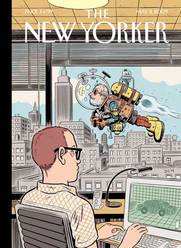
Such is the dichotomy presented on “Dan Clowes'”:http://en.wikipedia.org/wiki/Daniel_Clowes cover for the May 11, 2009 issue of _The New Yorker_, called “Leading the Way.” The May 11, 2009 issue is the Innovators Issue, and Clowes is an innovator in his own right, having created works that transcend the appellation of “comics” and are instead works of literature that happen to be fully illustrated, the best known perhaps being “_Ghost World_.”:http://en.wikipedia.org/wiki/Ghost_world
Clowes’ artistic style is not necessarily photo-realistic but always appears as if his subjects have been drawn from life, penciled on a subway and then inked carefully at home. You feel as if Clowes has seen a young man like Stephen somewhere, as well as an old man like Buster, perhaps not necessarily flying on a jet-pack. The _New Yorker_ cover coincides with the announcement of a new book by Clowes, as yet unnamed, that concerns, as stated in “this interview”:http://www.newyorker.com/online/blogs/books/2009/05/sneak-peek-dan-clowes.html, “a guy whose father dies, and he’s completely alone, so he tries to reconstruct what he’s lost, to approximate a nuclear family by joining people together.”
Clowes’ jet-packing senior also seems like someone who is completely alone, who has built his dream out of spare mechanical parts and perhaps an old fishbowl. Clowes has drawn outsider innovators before. His “May 12, 2008 cover”:http://www.cartoonbank.com/product_details.asp?mscssid=N75BLQT1QCKS9NR183NUWJWU397MBJ28&sitetype=1&did=5&sid=125205&pid=&keyword=Dan+Clowes§ion=all&title=undefined&whichpage=1&sortBy=popular depicted a two-page act of creation. An inventor builds himself a powerful robot just so that he sit down to a good game of cards. In the same way, Clowes’ jet-packing senior just wants to fly. He’s not trying to revolutionize the airline industry.
And then there’s the young, hip car designer: all this education and experience under his belt, and Stephen has ended up designing a fairly conventional-looking car.
Who remains deskbound, boring, and conventional? Stephen.
But who flies as free as a bird? Buster.
Sometimes the old, and the old-school, lead the way.
Sempé Fi (On Covers): Tiny, Little Scraps of Things
_Pollux writes_:
At last, with my column on covers, “_Sempé Fi_ “:http://emdashes.com/sempe-fi/, I have the opportunity to write about a cover by the eponymous “Sempé.”:http://en.wikipedia.org/wiki/Semp%C3%A9
It was inevitable: “the work of Jean-Jacques Sempé”:http://www.cartoonbank.com/search_results_category.asp?mscssid=N75BLQT1QCKS9NR183NUWJWU397MBJ28&sitetype=1&sitetype=1&advanced=1&keyword=undefined&artist=Jean%2DJacques+Semp%E9§ion=covers&title=Jean-Jacques+Semp%E9+Covers&sortBy=popular is a staple of _The New Yorker_, appearing since 1978. Sempé is prolific, his work immediately recognizable, exhibiting a timelessness that some people find charming, others staid.
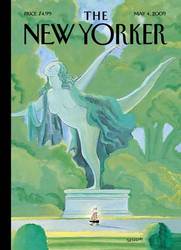
Sempé’s _New Yorker_ cover for May 4, 2009, called “Power and Grace,” typifies what over his long career has become his specialty: large, detailed landscapes, in which minuscule figures maneuver, sometimes haplessly and at times triumphantly. Sempé’s human figures are always diminutive but never inconsequential. His violinist is but a slip of a man dwarfed by an enormous plinth upon which an even larger piece of the landscape looms: a gigantesque and luscious hamadryad.
As _The Independent_ “pointed out”:http://www.independent.co.uk/news/people/profiles/jeanjacques-sempeacute-luck-of-the-draw-420771.html in 2006, “most cartoonists like to zoom in on their idea: to focus on the joke for fear of losing it. Sempé loves detail and confusion. He often (not always) sets his characters in a large, jumbled world, whose mass of detail amplifies the punch line or leads you away in chaotically different directions.”
What do we make, then, of Sempé’s verdant image of an enormous statue and a man walking by it? Is she a joyful, voluptuous goddess of the summer season? Is she Terpsichore, muse of the dance, or Euterpe, muse of music, presiding over the advent of summer concerts in Central Park? Whatever deity she represents, she evokes power and grace. Her face is rhapsodic, her pose is free and perhaps physics-defying. She is liberated, sexual, and happy.
In contrast, Sempé’s strolling violinist is a tiny bundle of sexual repression. Whereas garments on Sempé’s sylvan goddess flow freely, with her emerald-green breasts and long legs exposed, the musician walking by her is stuffily dressed in suit, hat, and tie. He may be an artist, but he remains very bourgeois. He scarcely notices the 40-foot statue that looms above him.
Does a prurient thought cross his mind? It’s unlikely. He may be thinking about the gas bill or the price of tea in Bordeaux. He is hardly a satyr; that seems to be the joke. As Charles McGrath “writes”:http://www.nytimes.com/2006/11/08/books/08semp.html?partner=rssnyt&emc=rss, Sempé’s figures are “Gallic Everymen, dignified and put upon at the same time, in the way that only French people can be.”
This Everyman, then, may be powerful and graceful in his own way. His power and his grace may come from the instrument he is carrying. It is only the proportion of the imagery that makes him seem unimportant. Unlike one of Thurber’s henpecked husbands, Sempé’s violinist is not intimidated by _Female Colossus With Arms Outstretched_.
“I’ve always been astonished that we humans assume somehow that we are big,” Sempé “has remarked”:http://www.independent.co.uk/news/people/profiles/jeanjacques-sempeacute-luck-of-the-draw-420771.html. “If you look at a person beside a tree or a building or a town, we are just tiny, little scraps of things. I never consciously set out to draw that way…” And these days, more than ever, we humans are little scraps compared to forces potentially more powerful than ourselves: global warming, dangerous strains of influenza, nuclear weapons. O Muse, O high genius, aid us now.